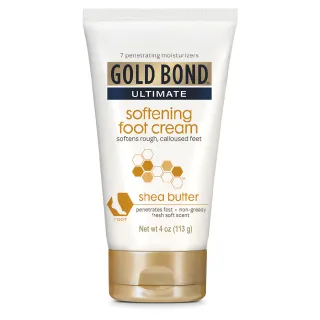
Gold Bond Ultimate Softening Foot Cream

Gold Bond Ultimate Softening Foot Cream

Efficacy100/100IrritancyHigh
Edit

Works for

1 of 1 advertised claim delivered

Moisturizing
21 ingredients credited for this claim
Strong support
What the product description says
“The formula also contains essential moisturizers and vitamins A, C, and E, along with shea butter, coconut oil, and cocoa butter to deliver nourishing hydration.”
Source: Walgreens

This product can help improve hydration of the skin with the two types of ingredients.

The first type is called “humectants”:
these ingredients help attract water. When humectants are on the surface of the skin, they “pull in” the moisture from the outside environment, or from within deeper layers of the skin. The following ingredients in this product do the job: glycerin, methyl gluceth-20.

This product also contains ingredients called “occlusives”. They help reduce the speed with which our skin loses moisture to the outside environment. These ingredients also help soften the upper layer of the skin, so it feels less tight and nicer to the touch. The following ingredients in this product do the job: dimethicone, dimethiconol.

The following ingredients in this product are especially good for supporting the skin barrier and helping with the hydration level: panthenol, petrolatum, urea

Hydrolyzed jojoba estersKey activeEffect: HighHelps soften the upper layer of the skin~0.3–0.6%
DimethiconeKey active· Emollient, OcclusiveEffect: HighA silicone that helps to reduce water loss from the surface of the skin. Can temporarily "fill in" lines and wrinkles, absorb oil, and create a nice product finish~2.4–3%
DimethiconolKey active· Emollient, OcclusiveEffect: HighA silicone that makes products more spreadable and keeps skin smooth. Helps to add gloss to skin and may visually fill in fine lines/wrinkles for short time~0.45–0.7%
GlycerinKey active· HumectantEffect: HighOne of the best moisturizing ingredients. Naturally present in skin. It attracts water to the upper layer of the skin working as a humectant~4–4.8%
Isopropyl myristateKey active· EmollientEffect: HighAn emollient that helps soften the skin. Could be comedogenic~0.15–0.25%
Jojoba estersKey active· EmollientEffect: HighAn emollient made of jojoba oil. Helps soften the skin and support its barrier function~1.4–1.7%
PanthenolHero· HumectantEffect: HighHelps attract water to the upper layer of the skin and can help improve skin barrier function~0.35–0.6%
PetrolatumHero· Emollient, OcclusiveEffect: HighOne of the most effective and the most studied occlusive ingredients that creates a protective layer on top of the skin preventing moisture loss~3.2–3.9%
UreaHero· HumectantEffect: HighNaturally present in skin (urea makes up about 7% of natural moisturizing factors in skin). Attracts water to the upper layer of the skin. Also has a positive effect on the skin barrier beyond the humectant action. Can enhance penetration of other ingredients. Is an exfoliating ingredient when used in high concentrations~8.7–10.6%
Cetearyl alcoholKey active· EmollientEffect: MediumA non-drying alcohol. Works as an emollient. Helps water and oil mix together and creates a nice product texture~0.75–1.1%
Cetyl alcoholKey active· EmollientEffect: MediumA non-drying alcohol that works to soften the skin and stabilize product formulations helping oil and water mix together~2–2.4%
Methyl gluceth-20Key active· HumectantEffect: MediumHelps attract water to the upper layer of the skin and soften it~0.4–0.6%
Silk amino acidsKey active· HumectantEffect: MediumMight help attract water to the upper layer of the skin~0.3–0.6%
Cetyl estersKey active· EmollientEffect: MediumHelps soften upper layer of the skin and can enhance penetration of other ingredients into the upper layer of the skin~1.1–1.4%
CyclopentasiloxaneKey active· EmollientEffect: MediumA silicone that helps improve the product texture and spreadability. Can absorb oil creating a short-term mattifying effect on the skin~1.7–2.1%
Butylene glycol· HumectantEffect: LowUsed to create a nice product texture and help delivery of other ingredients. Might be somewhat helpful in attracting water to the upper layer of the skin~0.4–0.6%
Propylene glycol· HumectantEffect: LowHelps oil and water mix together and can enhance the penetration of other ingredients into the skin. It can be irritating~0.6–0.9%
Glyceryl stearate· EmollientEffect: LowAn emollient that softens the skin and forms a protective layer on its surface. Helps water and oil mix together~0.5–0.8%
Butyrospermum parkii butter extractUnder-dosedEffect: HighA great moisturising ingredient that softens the skin and reduces water loss from its upper layer. It also can be helpful in protecting skin from free radicals~0.55–0.8%
Lactic acidUnder-dosedEffect: HighAn exfoliating and moisturizing alpha-hydroxy acid (AHA). Typically causes less irritation than other AHAs, for example, glycolic acid. At high concentrations (about 15%), lactic acid can help reduce lines and wrinkles. Recent studies show that lactic acid can support the "good" bacteria living on skin's surface (healthy skin microbiome)~0.8–1.2%
Aloe barbadensis leaf juiceEffect: Low, below effective doseTraditionally used to treat sunburns, dermatitis and inflammation, but evidence for its effectiveness is lacking. The extract can contain humectants that help attract water into the skin~0.5–0.75%
Evens skin tone
Not advertised by the brand · 3 ingredients credited for this claim
Moderate support

The following ingredient (ingredients) in this product might be helpful, but there is no evidence to confirm that it actually works: retinyl palmitate.

Retinyl palmitateKey activeEffect: MediumThree steps removed from the active form of vitamin A - retinoic acid. To have an effect in the skin, it first needs to be converted twice to become the retinoic acid. This means it is less potent than retinol, but could also be less irritating. Once converted to the retinoic acid in the skin, it helps against all signs of aging, improves skin cell turnover and helps fight blemishes and clogged pores. However, in many cosmetic formulations, it is used in a concentration that is too low to have the full effect~0.25–0.5%
Lactic acidUnder-dosedEffect: HighAn exfoliating and moisturizing alpha-hydroxy acid (AHA). Typically causes less irritation than other AHAs, for example, glycolic acid. At high concentrations (about 15%), lactic acid can help reduce lines and wrinkles. Recent studies show that lactic acid can support the "good" bacteria living on skin's surface (healthy skin microbiome)~0.8–1.2%
Magnesium ascorbyl phosphateEffect: Low, below effective doseA derivative of vitamin C that is more stable, but less bioavailable than the pure form of vitamin C. It does not penetrate the skin well, but has been shown to convert to pure vitamin C once in skin. It can be helpful in stimulating collagen production and lightening the skin tone, but the required concentration is likely to be very high~0.2–0.35%
Anti-aging
Not advertised by the brand · 4 ingredients credited for this claim
Moderate support

This product contains retinyl palmitate. This ingredient might be able to help reduce and prevent fine lines and wrinkles, improve skin elasticity and firmness, but there is not enough evidence that it actually works.

Retinyl palmitateKey activeEffect: MediumThree steps removed from the active form of vitamin A - retinoic acid. To have an effect in the skin, it first needs to be converted twice to become the retinoic acid. This means it is less potent than retinol, but could also be less irritating. Once converted to the retinoic acid in the skin, it helps against all signs of aging, improves skin cell turnover and helps fight blemishes and clogged pores. However, in many cosmetic formulations, it is used in a concentration that is too low to have the full effect~0.25–0.5%
Lactic acidUnder-dosedEffect: MediumAn exfoliating and moisturizing alpha-hydroxy acid (AHA). Typically causes less irritation than other AHAs, for example, glycolic acid. At high concentrations (about 15%), lactic acid can help reduce lines and wrinkles. Recent studies show that lactic acid can support the "good" bacteria living on skin's surface (healthy skin microbiome)~0.8–1.2%
Magnesium ascorbyl phosphateEffect: Low, below effective doseA derivative of vitamin C that is more stable, but less bioavailable than the pure form of vitamin C. It does not penetrate the skin well, but has been shown to convert to pure vitamin C once in skin. It can be helpful in stimulating collagen production and lightening the skin tone, but the required concentration is likely to be very high~0.2–0.35%
Aloe barbadensis leaf juiceEffect: Low, below effective doseTraditionally used to treat sunburns, dermatitis and inflammation, but evidence for its effectiveness is lacking. The extract can contain humectants that help attract water into the skin~0.5–0.75%

Can it cause trouble?

Irritancy
5 strong irritants: Parfum, Diazolidinyl urea + 3 more — patch-test recommended
High risk
We flagged 17 ingredients with irritancy potential. Severity depends on your sensitivity threshold; the table lists the worst offenders first.
IngredientFunctionIrritationEst. amount
Propylene glycolHelps oil and water mix together and can enhance the penetration of other ingredients into the skin. It can be irritatingHigh~0.6–0.9%est.
ParfumAn aromatic blend of unspecified and possibly irritating ingredientsHigh~0.4–0.6%est.
Diazolidinyl ureaA preservative. Works by releasing formaldehyde. Can be irritatingHigh~0.25–0.5%est.
Retinyl palmitateThree steps removed from the active form of vitamin A - retinoic acid. To have an effect in the skin, it first needs to be converted twice to become the retinoic acid. This means it is less potent than retinol, but could also be less irritating. Once converted to the retinoic acid in the skin, it helps against all signs of aging, improves skin cell turnover and helps fight blemishes and clogged pores. However, in many cosmetic formulations, it is used in a concentration that is too low to have the full effectHigh~0.25–0.5%est.
Lavandula angustifolia extractUsed for fragrance and contains volatile compounds that can irritate the skinHigh~0.15–0.3%est.
Chamomilla recutita flower extractPlant extract that can have healing and anti-inflammatory properties. It is a potential allergen and can be irritatingHigh~0.1–0.2%est.
Rosmarinus officinalis leaf extractCan be helpful in reducing inflammation in skin, including inflamed acne. It can be irritatingHigh~0.05–0.15%est.
Jojoba estersAn emollient made of jojoba oil. Helps soften the skin and support its barrier functionMedium~1.4–1.7%est.
Lactic acidAn exfoliating and moisturizing alpha-hydroxy acid (AHA). Typically causes less irritation than other AHAs, for example, glycolic acid. At high concentrations (about 15%), lactic acid can help reduce lines and wrinkles. Recent studies show that lactic acid can support the "good" bacteria living on skin's surface (healthy skin microbiome)Medium~0.8–1.2%est.
Behentrimonium methosulfateHelps oil and water mix togetherMedium~0.6–0.9%est.
Polysorbate 60Helps oil and water mix togetherMedium~0.6–0.9%est.
Potassium hydroxideUsed to adjust the pH level of productsMedium~0.6–0.85%est.
Aloe barbadensis leaf juiceTraditionally used to treat sunburns, dermatitis and inflammation, but evidence for its effectiveness is lacking. The extract can contain humectants that help attract water into the skinMedium~0.5–0.75%est.
Steareth-21Helps oil and water mix togetherMedium~0.55–0.8%est.
EdtaHelp to stabilize the product formulationMedium~0.35–0.6%est.
Tocopheryl acetateA more stable but less bio-available form of vitamin E compared to Tocopherol. Might help moisturize and protect the skin from free radicals, but mostly used in low concentrations to stabilize other ingredients.Medium~0.3–0.55%est.
Magnesium ascorbyl phosphateA derivative of vitamin C that is more stable, but less bioavailable than the pure form of vitamin C. It does not penetrate the skin well, but has been shown to convert to pure vitamin C once in skin. It can be helpful in stimulating collagen production and lightening the skin tone, but the required concentration is likely to be very highMedium~0.2–0.35%est.
Comedogenic
3 ingredients rated 2 or more on the 0–5 pore-clogging scale
3 flagged
These ingredients have a comedogenic rating of 2 or more on a 0–5 scale; the table shows each one's rating. In leave-on products they can clog pores in acne-prone skin.
IngredientFunctionRatingEst. amount
Butyrospermum parkii butter extractA great moisturising ingredient that softens the skin and reduces water loss from its upper layer. It also can be helpful in protecting skin from free radicals3/5~0.55–0.8%est.
Isopropyl myristateAn emollient that helps soften the skin. Could be comedogenic3/5~0.15–0.25%est.
Cetearyl alcoholA non-drying alcohol. Works as an emollient. Helps water and oil mix together and creates a nice product texture2/5~0.75–1.1%est.
Edit
Cheaper Alternatives
Similar formulations, better price
No cheaper similar product found.

User reviews

Would you recommend?
No community reviews yet.

Be the first — your take helps the next person decide.

Write a review · ~30s

Ingredients

Filter by role to see what each ingredient is doing.

Water~45–55%
Formula
Irritation risk
Low

Plain old water

More about Water
Urea~8.7–10.6%
Hero · Moisturizing
Irritation risk
Low
Works for
MoisturizingExfoliation

Naturally present in skin (urea makes up about 7% of natural moisturizing factors in skin). Attracts water to the upper layer of the skin. Also has a positive effect on the skin barrier beyond the humectant action. Can enhance penetration of other ingredients. Is an exfoliating ingredient when used in high concentrations

More about Urea
Glycerin~4–4.8%
Key active
Irritation risk
Low
Works for
Moisturizing

One of the best moisturizing ingredients. Naturally present in skin. It attracts water to the upper layer of the skin working as a humectant

More about Glycerin
Petrolatum~3.2–3.9%
Hero · Moisturizing
Irritation risk
Low
Works for
Moisturizing

One of the most effective and the most studied occlusive ingredients that creates a protective layer on top of the skin preventing moisture loss

More about Petrolatum
Dimethicone~2.4–3%
Key active
Irritation risk
Low
Works for
MoisturizingMattifying

A silicone that helps to reduce water loss from the surface of the skin. Can temporarily "fill in" lines and wrinkles, absorb oil, and create a nice product finish

More about Dimethicone
Cetyl alcohol~2–2.4%
Key active
Irritation risk
Low
Works for
CleansingMoisturizing

A non-drying alcohol that works to soften the skin and stabilize product formulations helping oil and water mix together

More about Cetyl alcohol
Cyclopentasiloxane~1.7–2.1%
Key active
Irritation risk
Low
Works for
MattifyingMoisturizing

A silicone that helps improve the product texture and spreadability. Can absorb oil creating a short-term mattifying effect on the skin

More about Cyclopentasiloxane
Distearyldimonium chloride~1.5–1.8%
Formula
Jojoba esters~1.4–1.7%
Key activeIrritant · medium
Irritation risk
Medium
Works for
Moisturizing

An emollient made of jojoba oil. Helps soften the skin and support its barrier function

More about Jojoba esters
Cetyl esters~1.1–1.4%
Key active
Irritation risk
Low
Works for
Moisturizing

Helps soften upper layer of the skin and can enhance penetration of other ingredients into the upper layer of the skin

More about Cetyl esters
Lactic acid~0.8–1.2%
Under-dosedIrritant · medium
Irritation risk
Medium
Works for
Evens skin toneMoisturizingExfoliationAnti-aging

An exfoliating and moisturizing alpha-hydroxy acid (AHA). Typically causes less irritation than other AHAs, for example, glycolic acid. At high concentrations (about 15%), lactic acid can help reduce lines and wrinkles. Recent studies show that lactic acid can support the "good" bacteria living on skin's surface (healthy skin microbiome)

More about Lactic acid
Stearyl alcohol~0.8–1.2%
Formula
Irritation risk
Low
Works for
Cleansing

An emollient that helps soften the skin

More about Stearyl alcohol
Cetearyl alcohol~0.75–1.1%
Key activeComedogenic 2/5
Irritation risk
Low
Comedogenicity
2/5
Works for
CleansingMoisturizing

A non-drying alcohol. Works as an emollient. Helps water and oil mix together and creates a nice product texture

More about Cetearyl alcohol
Propylene glycol~0.6–0.9%
Irritant · high
Irritation risk
High
Works for
Moisturizing

Helps oil and water mix together and can enhance the penetration of other ingredients into the skin. It can be irritating

More about Propylene glycol
Behentrimonium methosulfate~0.6–0.9%
Irritant · medium
Irritation risk
Medium
Works for
Cleansing

Helps oil and water mix together

More about Behentrimonium methosulfate
Polysorbate 60~0.6–0.9%
Irritant · medium
Irritation risk
Medium
Works for
Cleansing

Helps oil and water mix together

More about Polysorbate 60
Potassium hydroxide~0.6–0.85%
Irritant · medium
Irritation risk
Medium

Used to adjust the pH level of products

More about Potassium hydroxide
Stearamidopropyl pg-dimonium chloride phosphate~0.55–0.8%
Formula
Aloe barbadensis leaf juice~0.5–0.75%
Irritant · medium
Irritation risk
Medium
Works for
MoisturizingAnti-inflammatoryAntibacterialReduces rednessReduces irritationAnti-agingAnti-blemish

Traditionally used to treat sunburns, dermatitis and inflammation, but evidence for its effectiveness is lacking. The extract can contain humectants that help attract water into the skin

More about Aloe barbadensis leaf juice
Butyrospermum parkii butter extract~0.55–0.8%
Under-dosedComedogenic 3/5
Irritation risk
Low
Comedogenicity
3/5
Works for
Moisturizing

A great moisturising ingredient that softens the skin and reduces water loss from its upper layer. It also can be helpful in protecting skin from free radicals

More about Butyrospermum parkii butter extract
Glyceryl stearate~0.5–0.8%
Formula
Irritation risk
Low
Works for
CleansingMoisturizing

An emollient that softens the skin and forms a protective layer on its surface. Helps water and oil mix together

More about Glyceryl stearate
Steareth-21~0.55–0.8%
Irritant · medium
Irritation risk
Medium
Works for
Cleansing

Helps oil and water mix together

More about Steareth-21
Parfum~0.4–0.6%
Irritant · high
Irritation risk
High

An aromatic blend of unspecified and possibly irritating ingredients

More about Parfum
Diazolidinyl urea~0.25–0.5%
Irritant · high
Irritation risk
High

A preservative. Works by releasing formaldehyde. Can be irritating

More about Diazolidinyl urea
Dimethiconol~0.45–0.7%
Key active
Irritation risk
Low
Works for
Moisturizing

A silicone that makes products more spreadable and keeps skin smooth. Helps to add gloss to skin and may visually fill in fine lines/wrinkles for short time

More about Dimethiconol
Methyl gluceth-20~0.4–0.6%
Key active
Irritation risk
Low
Works for
Moisturizing

Helps attract water to the upper layer of the skin and soften it

More about Methyl gluceth-20
Butylene glycol~0.4–0.6%
Formula
Irritation risk
Low
Works for
Moisturizing

Used to create a nice product texture and help delivery of other ingredients. Might be somewhat helpful in attracting water to the upper layer of the skin

More about Butylene glycol
Methylparaben~0.15–0.3%
Formula
Irritation risk
Low

A preservative

More about Methylparaben
Edta~0.35–0.6%
Irritant · medium
Irritation risk
Medium

Help to stabilize the product formulation

More about Edta
Panthenol~0.35–0.6%
Hero · Moisturizing
Irritation risk
Low
Works for
Reduces rednessMoisturizingReduces irritation

Helps attract water to the upper layer of the skin and can help improve skin barrier function

More about Panthenol
Silk amino acids~0.3–0.6%
Key active
Irritation risk
Low
Works for
Moisturizing

Might help attract water to the upper layer of the skin

More about Silk amino acids
Hydrolyzed jojoba esters~0.3–0.6%
Key active
Irritation risk
Low
Works for
Moisturizing

Helps soften the upper layer of the skin

More about Hydrolyzed jojoba esters
Retinyl palmitate~0.25–0.5%
Key activeIrritant · high
Irritation risk
High
Works for
Anti-agingEvens skin toneAnti-blemishExfoliation

Three steps removed from the active form of vitamin A - retinoic acid. To have an effect in the skin, it first needs to be converted twice to become the retinoic acid. This means it is less potent than retinol, but could also be less irritating. Once converted to the retinoic acid in the skin, it helps against all signs of aging, improves skin cell turnover and helps fight blemishes and clogged pores. However, in many cosmetic formulations, it is used in a concentration that is too low to have the full effect

More about Retinyl palmitate
Tocopheryl acetate~0.3–0.55%
Irritant · medium
Irritation risk
Medium
Works for
Anti-oxidation

A more stable but less bio-available form of vitamin E compared to Tocopherol. Might help moisturize and protect the skin from free radicals, but mostly used in low concentrations to stabilize other ingredients.

More about Tocopheryl acetate
Propylparaben~0.2–0.35%
Formula
Irritation risk
Low

A preservative

More about Propylparaben
Magnesium ascorbyl phosphate~0.2–0.35%
Irritant · medium
Irritation risk
Medium
Works for
Evens skin toneAnti-agingAnti-oxidation

A derivative of vitamin C that is more stable, but less bioavailable than the pure form of vitamin C. It does not penetrate the skin well, but has been shown to convert to pure vitamin C once in skin. It can be helpful in stimulating collagen production and lightening the skin tone, but the required concentration is likely to be very high

More about Magnesium ascorbyl phosphate
Lavandula angustifolia extract~0.15–0.3%
Irritant · high
Irritation risk
High

Used for fragrance and contains volatile compounds that can irritate the skin

More about Lavandula angustifolia extract
Acacia farnesiana flower extract~0.1–0.25%
Formula
Chamomilla recutita flower extract~0.1–0.2%
Irritant · high
Irritation risk
High
Works for
Anti-inflammatory

Plant extract that can have healing and anti-inflammatory properties. It is a potential allergen and can be irritating

More about Chamomilla recutita flower extract
Rosmarinus officinalis leaf extract~0.05–0.15%
Irritant · high
Irritation risk
High
Works for
Anti-blemishAntibacterialAnti-oxidation

Can be helpful in reducing inflammation in skin, including inflamed acne. It can be irritating

More about Rosmarinus officinalis leaf extract
Isopropyl myristate~0.15–0.25%
Key activeComedogenic 3/5
Irritation risk
Low
Comedogenicity
3/5
Works for
Moisturizing

An emollient that helps soften the skin. Could be comedogenic

More about Isopropyl myristate
Ingredient list view

Water, Urea, Glycerin, Petrolatum, Dimethicone, Cetyl alcohol, Cyclopentasiloxane, Distearyldimonium chloride, Jojoba esters, Cetyl esters, Lactic acid, Stearyl alcohol, Cetearyl alcohol, Propylene glycol, Behentrimonium methosulfate, Polysorbate 60, Potassium hydroxide, Stearamidopropyl pg-dimonium chloride phosphate, Aloe barbadensis leaf juice, Butyrospermum parkii butter extract, Glyceryl stearate, Steareth-21, Parfum, Diazolidinyl urea, Dimethiconol, Methyl gluceth-20, Butylene glycol, Methylparaben, Edta, Panthenol, Silk amino acids, Hydrolyzed jojoba esters, Retinyl palmitate, Tocopheryl acetate, Propylparaben, Magnesium ascorbyl phosphate, Lavandula angustifolia extract, Acacia farnesiana flower extract, Chamomilla recutita flower extract, Rosmarinus officinalis leaf extract, Isopropyl myristate

Compare prices

Retailers ranked by price — lowest first.

Amazon USPrice as of 10/16/2026 00:23 GMT
$7.48
Buy
Walgreens
$8.99
Buy

Affiliate links · prices updated regularly · As an Amazon Associate, WIMJ earns from qualifying purchases.

Cheaper alternatives? See how this stacks up against similar formulas.
We compare ingredient profiles across our catalog — pick the closest match for your budget.
Open dupe finder

Product summary

Based on the ingredients included, "Gold Bond - Ultimate Softening Foot Cream" works well for moisturizing the skin. As we expect from a proper moisturizer, the formula includes a combo of effective humectants and emollients. These are the two different types of ingredients that are essential for improving the skin hydration and supporting a healthy skin barrier. Panthenol, urea, glycerin, methyl gluceth-20 and silk amino acids in this product (humectants) attract water molecules to the upper layer of the skin (the water comes from the outside air or from the deeper layers of the skin if the air is dry). Emollients in this formulation (petrolatum, isopropyl myristate, jojoba esters, dimethicone and dimethiconol) help to reduce the moisture loss from the skin. They also soften the skin surface and relieve the feeling of dryness and tightness.

Ingredient callouts

  • this moisturizer includes a form of retinoids (vitamin A) - retinyl palmitate 0.25% - 0.50%, but this type of vitamin A is not very effective. It could in theory help with fine lines and wrinkles, but the effect is most likely minimal.

Irritation risk

We assess the overall irritancy of this moisturizer to be high. For a detailed overview of all potential irritants: click here

You can see the detailed formula review with the breakdown of all actives in the product and the full ingredient list with estimated concentrations in the tables below.

Price

The product retails for 24.82CA$ in Canada, for 37.16A$ in Australia and from 6.12$ up to 8.99$ in the United States.

For a detailed price comparison: click here.

Sources cited in this review

Every concentration estimate and effectiveness label is anchored to one of these 18 studies and safety reviews.

  1. 1
    Topical urea in skincare: A reviewpubmed.ncbi.nlm.nih.gov
  2. 2
  3. 3
  4. 4
  5. 5
  6. 6
Gold Bond Ultimate Softening Foot Cream
Gold BondUltimate Softening Foot Cream

Affiliate links · As an Amazon Associate, WIMJ earns from qualifying purchases.

As an Amazon Associate, WIMJ earns from qualifying purchases.