
Works for
1 of 1 advertised claim delivered
MoisturizingCeramide ap, Ceramide np + 11 moreStrong evidence
“Priming Moisturizer Rich”
This product can help improve hydration of the skin with the two types of ingredients.
The first type is called “humectants”:
these ingredients help attract water.
When humectants are on the surface of the skin, they “pull in” the moisture from the outside environment, or from
within deeper layers of the skin. The following ingredients in this product do the job:
glycerin, sodium hyaluronate crosspolymer.
This product also contains ingredients called “occlusives”. They help reduce the speed with which our skin loses moisture to the outside environment. These ingredients also help soften the upper layer of the skin, so it feels less tight and nicer to the touch. The following ingredients in this product do the job: caprylic/capric triglyceride, squalane.
The following ingredients in this product are especially good for supporting the skin barrier and helping with the hydration level: ceramide ap, ceramide np
Can it cause trouble?
Irritancy15 flagged ingredientsLow risk
Comedogenic2 ingredients rated 2 or more on the 0–5 pore-clogging scale2 flagged

User reviews
Be the first — your take helps the next person decide.
Ingredients
Filter by role to see what each ingredient is doing.
Water~45–55%
Caprylic/capric triglyceride~6.5–8%
- Irritation risk
- Medium
A good mix of fatty acids that forms a protective layer on the skin. Improves the shelf life of products. Derived from coconut and glycerin
More about Caprylic/capric triglyceridePropanediol~4.3–5.2%
- Irritation risk
- Low
Acts as a solvent for other ingredients. Speeds up the absorption of other ingredients into the skin
More about PropanediolGlycerin~3.1–3.8%
- Irritation risk
- Low
One of the best moisturizing ingredients. Naturally present in skin. It attracts water to the upper layer of the skin working as a humectant
More about GlycerinSqualane~2.5–3%
- Irritation risk
- Low
An oil naturally present in skin. Works as an emollient to soften the skin and form a protective layer on its surface without a greasy feeling.
More about SqualaneOrbignya oleifera seed oil~2–2.4%
- Irritation risk
- Low
A plant oil that can help soften the upper layer of the skin. Might be helpful in calming down inflammation in skin
More about Orbignya oleifera seed oilCetearyl olivate~1.7–2%
Sorbitan olivate~1.4–1.7%
Pentaerythrityl tetraisostearate~1.2–1.5%
- Irritation risk
- Medium
Used to create a thicker product consistency
More about Pentaerythrityl tetraisostearatePseudozyma epicola/camellia japonica seed oil ferment extract filtrate~0.95–1.15%
Sodium hyaluronate crosspolymer~0.7–1.05%
- Irritation risk
- Medium
Attracts water into the upper layer of the skin
More about Sodium hyaluronate crosspolymerCeramide np~0.65–0.95%
- Irritation risk
- Low
A type of lipid similar to ceramides naturally present in skin. Helps to soften the upper layer of the skin and supports the skin barrier function to keep it hydrated. Can help to prevent inflammation in skin
More about Ceramide npCeramide ap~0.55–0.85%
- Irritation risk
- Low
A type of lipid similar to ceramides naturally present in skin. Helps to soften the upper layer of the skin and supports the skin barrier function to keep it hydrated. Can help to prevent inflammation in skin
More about Ceramide apBuddleja officinalis flower extract~0.65–1%
- Irritation risk
- High
A plant flower extract that might help calm down inflammation in skin and neutralize free radicals, but evidence of effectiveness in skin is lacking
More about Buddleja officinalis flower extractLithothamnion calcareum extract~0.45–0.65%
- Irritation risk
- Low
- Comedogenicity
- 3/5
A mineral-rich extract from red algae. Might be able to help attract water to the upper layer of the skin
More about Lithothamnion calcareum extractHydroxyethyl acrylate/sodium acryloyldimethyl taurate copolymer~0.45–0.7%
- Irritation risk
- Medium
A gelling agent that thickens the product consistency and leaves the skin with a velvety finish
More about Hydroxyethyl acrylate/sodium acryloyldimethyl taurate copolymerAmylopectin~0.45–0.65%
- Irritation risk
- Low
Acrylates/c10-30 alkyl acrylate crosspolymer~0.45–0.65%
- Irritation risk
- Medium
Maintains the texture of skincare products. Allows the product to spread evenly. Helps oil and water mix together
More about Acrylates/c10-30 alkyl acrylate crosspolymerSodium acrylate/sodium acryloyldimethyl taurate copolymer~0.3–0.6%
- Irritation risk
- Low
Used to create a thicker product consistency
More about Sodium acrylate/sodium acryloyldimethyl taurate copolymerCaprylyl/capryl glucoside~0.45–0.65%
- Irritation risk
- Medium
Helps oil and water mix together. Can be used as a cleansing agent
More about Caprylyl/capryl glucosideGlyceryl stearate~0.35–0.65%
- Irritation risk
- Low
An emollient that softens the skin and forms a protective layer on its surface. Helps water and oil mix together
More about Glyceryl stearateCaprylyl glycol~0.3–0.55%
- Irritation risk
- Medium
Helps preserve products and creates a nice product texture
More about Caprylyl glycolCetearyl alcohol~0.3–0.55%
- Irritation risk
- Low
- Comedogenicity
- 2/5
A non-drying alcohol. Works as an emollient. Helps water and oil mix together and creates a nice product texture
More about Cetearyl alcoholPentylene glycol~0.3–0.55%
- Irritation risk
- Medium
Used to preserve products, dissolve other ingredients and create a nice product texture
More about Pentylene glycolSorbitan isostearate~0.25–0.45%
- Irritation risk
- Low
Helps oil and water mix together
More about Sorbitan isostearateXanthan gum~0.25–0.45%
- Irritation risk
- Low
Used to create a thicker product consistency
More about Xanthan gum1,2-hexanediol~0.2–0.35%
Hydroxyacetophenone~0.2–0.4%
Polyisobutene~0.2–0.35%
Polysorbate 60~0.2–0.35%
Lactic acid~0.15–0.25%
- Irritation risk
- Medium
An exfoliating and moisturizing alpha-hydroxy acid (AHA). Typically causes less irritation than other AHAs, for example, glycolic acid. At high concentrations (about 15%), lactic acid can help reduce lines and wrinkles. Recent studies show that lactic acid can support the "good" bacteria living on skin's surface (healthy skin microbiome)
More about Lactic acidPotassium sorbate~0.1–0.25%
Sodium benzoate~0.1–0.2%
Potassium hydroxide~0.1–0.15%
Ingredient list view
Water, Caprylic/capric triglyceride, Propanediol, Glycerin, Squalane, Orbignya oleifera seed oil, Cetearyl olivate, Sorbitan olivate, Pentaerythrityl tetraisostearate, Pseudozyma epicola/camellia japonica seed oil ferment extract filtrate, Sodium hyaluronate crosspolymer, Ceramide np, Ceramide ap, Buddleja officinalis flower extract, Lithothamnion calcareum extract, Hydroxyethyl acrylate/sodium acryloyldimethyl taurate copolymer, Amylopectin, Acrylates/c10-30 alkyl acrylate crosspolymer, Sodium acrylate/sodium acryloyldimethyl taurate copolymer, Caprylyl/capryl glucoside, Glyceryl stearate, Caprylyl glycol, Cetearyl alcohol, Pentylene glycol, Sorbitan isostearate, Xanthan gum, 1,2-hexanediol, Hydroxyacetophenone, Polyisobutene, Polysorbate 60, Lactic acid, Potassium sorbate, Sodium benzoate, Potassium hydroxide
Compare prices
Retailers ranked by price — lowest first.

Affiliate links · prices updated regularly
Worth comparing, line by line.
Match % combines shared ingredients, the first five ingredients, shared actives and hero ingredients, irritancy (lower counts in the alternative's favour), texture and body area. Only products in the same routine step are compared.
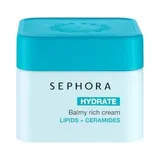
| GlossierPriming Moisturizer RichYOUR PRODUCT | SEPHORA COLLECTIONHYDRATE - Hydrating Balmy Rich Cream Moisturizer with Lipids + Ceramides | UriageXémose Emollient Face Cream | DR. JETSKE ULTEERepair Cream | |
|---|---|---|---|---|
| Match | — | 64% | 61% | 61% |
| Price | $35.00 | $19.25−$15.75 | $17.13−$17.87 | — |
| Shared key ingredients | — | 5 of 7 | 5 of 7 | 5 of 7 |
| Key difference | — | Phytosphingosine | Ceramide Eop | Ceramide Ns |
| Irritancy | Low | Low | Low | Low |
| Drying alcohol | — | — | — | — |
| View product | Shop | Shop | Shop |


Sources cited in this review
Every concentration estimate and effectiveness label is anchored to one of these 12 studies and safety reviews.
- 1
- 2
- 3
- 4
- 5
- 6

Affiliate links · As an Amazon Associate, WIMJ earns from qualifying purchases.