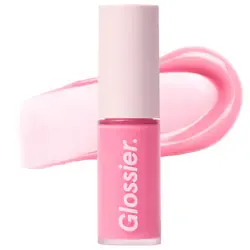
Glossier Lip Glaze Hydrating Cooling Sheer Lip Oil
Works for
MoisturizingHydrogenated poly(c6-14 olefin), Ricinus communis seed oil + 11 moreWorks
“What it is: A next-generation lip oil with a cooling, creamy, and hydrating formula with a sheer glaze of color—a refreshing scoop of gelato for your lips.”
This product can help soften the skin and reduce its moisture loss with emollients and occlusives: ricinus communis seed oil, simmondsia chinensis seed oil.
Keep in mind that this product does not contain effective ingredients to attract water to the upper layer of the skin. This is why an additional product with humectants like glycerin or hyaluronic acid can be helpful (apply it before this product for the best results).
Anti-oxidationSide benefit · Rubus idaeus seed oil, Butyrospermum parkii oil + 5 moreMay help
This product contains antioxidants (rubus idaeus seed oil) that can help neutralize free radicals in skin to lessen the damage it gets from the UV light (sun). There is some human evidence for this effect in skin, though it is smaller or less consistent than the evidence for the best antioxidants.
Can it cause trouble?
Irritancy1 strong irritant: MenthoxypropanediolMedium risk
Comedogenic1 ingredient rated 2 or more on the 0–5 pore-clogging scale1 flagged
User reviews
Be the first — your take helps the next person decide.
Ingredients
Filter by role to see what each ingredient is doing.
Hydrogenated polyisobutene~22–33%
- Irritation risk
- Low
Used to improve the product consistency and soften the upper layer of the skin
More about Hydrogenated polyisobuteneHydrogenated poly(c6-14 olefin)~4.9–7.3%
- Irritation risk
- Low
Helps soften the upper layer of the skin and create a nice product texture
More about Hydrogenated poly(c6-14 olefin)Ethylene/propylene/styrene copolymer~4.5–6.8%
- Irritation risk
- Low
Used to create a thicker product consistency
More about Ethylene/propylene/styrene copolymerOctyldodecanol~3.5–5.2%
- Irritation risk
- Low
An emollient that helps to soften the skin and create a pleasant product texture and stabilize the formulation
More about OctyldodecanolRicinus communis seed oil~2.9–4.3%
- Irritation risk
- Medium
A plant oil that can help soften the skin. It might be helpful in calming down inflammation, but solid research is lacking. Is often used in lip products to create the needed product consistency
More about Ricinus communis seed oilSqualane~2.1–3.2%
- Irritation risk
- Low
An oil naturally present in skin. Works as an emollient to soften the skin and form a protective layer on its surface without a greasy feeling.
More about SqualaneButyrospermum parkii oil~1.6–2.3%
- Irritation risk
- Low
- Comedogenicity
- 3/5
Rubus idaeus seed oil~1.3–1.9%
- Irritation risk
- Medium
A plant oil that might be able to help neutralize free radicals in skin
More about Rubus idaeus seed oilPrunus armeniaca kernel oil~1–1.5%
- Irritation risk
- Medium
An emollient that helps soften the skin
More about Prunus armeniaca kernel oilRosa canina fruit oil~0.8–1.25%
- Irritation risk
- Medium
A great emollient. Contains vitamin E (tocopherol) which may give it some anti-oxidant properties. Can contain volatile compounds and can be irritating
More about Rosa canina fruit oilPersea gratissima oil~0.5–1.2%
- Irritation risk
- Medium
An emollient that helps soften the skin and could be helpful in repairing its barrier function
More about Persea gratissima oilVitis vinifera seed oil~0.5–1.15%
- Irritation risk
- Medium
A great emollient that can also have anti-oxidant properties
More about Vitis vinifera seed oilSimmondsia chinensis seed oil~0.45–1.05%
- Irritation risk
- Medium
Softens the upper layer of skin and helps restore the healthy skin barrier. Has shown to help calm down inflammation in skin. It is a stable oil, meaning that it retains its properties even when exposed to air.
More about Simmondsia chinensis seed oilTocopherol~0.35–0.8%
- Irritation risk
- Low
Pure form of vitamin E. Can help moisturise and protect the skin from free radicals. Often used to help stabilise other ingredients or the formula itself
More about TocopherolTocopheryl acetate~0.3–0.7%
- Irritation risk
- Medium
A more stable but less bio-available form of vitamin E compared to Tocopherol. Might help moisturize and protect the skin from free radicals, but mostly used in low concentrations to stabilize other ingredients.
More about Tocopheryl acetateMenthoxypropanediol~0.15–0.65%
Pentaerythrityl tetra-di-t-butyl hydroxyhydrocinnamate~0.15–0.65%
- Irritation risk
- Low
Used to increase stability of product formulations
More about Pentaerythrityl tetra-di-t-butyl hydroxyhydrocinnamateButylene/ethylene/styrene copolymer~0.1–0.45%
- Irritation risk
- Low
Used to create a gel-like product texture
More about Butylene/ethylene/styrene copolymerSynthetic fluorphlogopite~0.1–0.45%
- Irritation risk
- Low
A mineral that is used as an optical filter (makes the skin looks nicer through light reflection) and to improve the texture of cosmetic products
More about Synthetic fluorphlogopiteTin oxide~0.15–0.7%
- Irritation risk
- Low
A colorant that can add a pearl-like appearance to the formulation
More about Tin oxideBenzoic acid~0.1–0.3%
Caprylyl glycol~0.1–0.45%
- Irritation risk
- Medium
Helps preserve products and creates a nice product texture
More about Caprylyl glycolTitanium dioxide~0.05–0.3%
- Irritation risk
- Low
Works as a UV filter when used in high concentrations. It is photostable and is effective mostly against the UVB light, with some protection in the UVA range. In small concentrations, used for its ability to improve the color of cosmetic products. Is usually well tolerated by the skin
More about Titanium dioxideIngredient list view
Hydrogenated polyisobutene, Hydrogenated poly(c6-14 olefin), Ethylene/propylene/styrene copolymer, Octyldodecanol, Ricinus communis seed oil, Squalane, Butyrospermum parkii oil, Rubus idaeus seed oil, Prunus armeniaca kernel oil, Rosa canina fruit oil, Persea gratissima oil, Vitis vinifera seed oil, Simmondsia chinensis seed oil, Tocopherol, Tocopheryl acetate, Menthoxypropanediol, Pentaerythrityl tetra-di-t-butyl hydroxyhydrocinnamate, Butylene/ethylene/styrene copolymer, Synthetic fluorphlogopite, Tin oxide, Benzoic acid, Caprylyl glycol, Titanium dioxide
Compare prices
Retailers ranked by price — lowest first.

Worth comparing, line by line.
Match % combines shared ingredients, the first five ingredients, shared actives and hero ingredients, irritancy (lower counts in the alternative's favour), texture and body area. Only products in the same routine step are compared.
| GlossierLip Glaze Hydrating Cooling Sheer Lip OilYOUR PRODUCT | Wunder2Wunderkiss Satin Lip Oil | evanhealyLip Balm - Whipped Shea Butter | Versed SkinSILK SLIP Conditioning Lip Oil | |
|---|---|---|---|---|
| Match | — | 33% | 33% | 33% |
| Price | $22.00 | — | $9.95−$12.05 | $11.81−$10.19 |
| Shared key ingredients | — | 4 of 10 | 3 of 10 | 2 of 10 |
| Key difference | — | Theobroma Cacao Seed Butter | Agran Oil | Butyrospermum Parkii Butter |
| Irritancy | Medium | Medium | Medium | Low |
| Drying alcohol | — | — | — | — |
| View product | Shop | Shop | Shop |



More alternatives: RÓEN Elixir Tinted Lip Oil Balm - StellaTower 28 Beauty ShineOn Milky Lip Jelly Gloss
Sources cited in this review
Every concentration estimate and effectiveness label is anchored to one of these 9 studies and safety reviews.
- 1
- 2
- 3
- 4
- 5Vitamin E in dermatologyncbi.nlm.nih.gov
- 6Vitamin E and Skin Healthlpi.oregonstate.edu

Affiliate links · As an Amazon Associate, WIMJ earns from qualifying purchases.