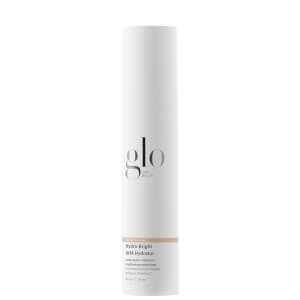
Glo Skin Beauty Hydra-Bright AHA Hydrator
Works for
3 of 4 advertised claims delivered
Moisturizing13 ingredients credited for this claimStrong support
“Delivering a next-level brightening boost, Hydra-Bright AHA Hydrator moisturizer is infused with vitamin C to restore radiance and shield from the damaging effects of blue light and pollution, while a mineral illuminating complex imparts instant glass-skin luminosity.”
This product can help improve hydration of the skin with the two types of ingredients.
The first type is called “humectants”:
these ingredients help attract water.
When humectants are on the surface of the skin, they “pull in” the moisture from the outside environment, or from
within deeper layers of the skin. The following ingredients in this product do the job:
dextran, glycerin.
This product also contains ingredients called “occlusives”. They help reduce the speed with which our skin loses moisture to the outside environment. These ingredients also help soften the upper layer of the skin, so it feels less tight and nicer to the touch. The following ingredients in this product do the job: butyrospermum parkii butter, caprylic/capric triglyceride.
The following ingredients in this product are especially good for supporting the skin barrier and helping with the hydration level: caprooyl tetrapeptide-3
Anti-aging5 ingredients credited for this claimModerate support
“Powered by 1% vegan lactic acid for gentle exfoliation and smoothing, the appearance of pores, fine lines and wrinkles is improved, while deeply conditioning squalane balances and restores skin’s elasticity and suppleness.”
This product contains caprooyl tetrapeptide-3. This ingredient might be able to help reduce and prevent fine lines and wrinkles, improve skin elasticity and firmness, but there is not enough evidence that it actually works.
Evens skin tone2 ingredients credited for this claimModerate support
“A new generation treatment moisturiser that features an elevated blend of vegan lactic acid, vitamin C, plus a mineral luminosity complex to impart instant radiance, while boosting brightness deep from within.”
The following ingredient (ingredients) in this product might be helpful, but there is no evidence to confirm that it actually works: 3-o-ethyl ascorbic acid.
Exfoliation1 ingredient credited for this claimWeak support
“Powered by 1% vegan lactic acid for gentle exfoliation and smoothing, the appearance of pores, fine lines and wrinkles is improved, while deeply conditioning squalane balances and restores skin’s elasticity and suppleness.”
This product does not contain effective exfoliating ingredients. It might be able to deliver physical exfoliation, that is scrub off some of the dead cells on the surface of the skin. We do not recommend physical exfoliation, because it is not uniform (some bits of skin can get exfoliated too much while others not at all). It can also traumatize the skin and aggrevate acne and other skin conditions.
Anti-oxidationNot advertised by the brand · 4 ingredients credited for this claimModerate support
This product contains antioxidants (3-o-ethyl ascorbic acid) that might be able to help neutralize free radicals in skin to lessen the damage it gets from the UV light (sun). There is not enough evidence to confirm their effectiveness in skin though.
Can it cause trouble?
Irritancy6 strong irritants: Alcohol denat., Santalum austrocaledonicum wood oil + 4 more — patch-test recommendedHigh risk
Comedogenic3 ingredients rated 2 or more on the 0–5 pore-clogging scale3 flagged
User reviews
Be the first — your take helps the next person decide.
Ingredients
Filter by role to see what each ingredient is doing.
Water~45–55%
Squalane~6.4–7.9%
- Irritation risk
- Low
An oil naturally present in skin. Works as an emollient to soften the skin and form a protective layer on its surface without a greasy feeling.
More about SqualaneCaprylic/capric triglyceride~4.9–6%
- Irritation risk
- Medium
A good mix of fatty acids that forms a protective layer on the skin. Improves the shelf life of products. Derived from coconut and glycerin
More about Caprylic/capric triglycerideButyrospermum parkii butter~3.4–4.1%
- Irritation risk
- Low
- Comedogenicity
- 3/5
A great moisturising ingredient that softens the skin and reduces water loss from its upper layer. It also can be helpful in protecting skin from free radicals
More about Butyrospermum parkii butterLauryl laurate~2.5–3%
- Irritation risk
- Medium
Helps soften the upper layer of the skin
More about Lauryl laurateGlycerin~2.1–2.6%
- Irritation risk
- Low
One of the best moisturizing ingredients. Naturally present in skin. It attracts water to the upper layer of the skin working as a humectant
More about GlycerinHydroxyethyl acrylate/sodium acryloyldimethyl taurate copolymer~1.8–2.1%
- Irritation risk
- Medium
A gelling agent that thickens the product consistency and leaves the skin with a velvety finish
More about Hydroxyethyl acrylate/sodium acryloyldimethyl taurate copolymerEthylhexyl palmitate~1.6–1.9%
- Irritation risk
- Low
- Comedogenicity
- 3/5
An emollient that helps soften the skin and create a nice product texture
More about Ethylhexyl palmitateCarnitine~1.9–2.3%
Polysorbate 20~1.1–1.3%
Sodium stearoyl glutamate~0.95–1.15%
- Irritation risk
- Medium
Helps oil and water mix together
More about Sodium stearoyl glutamateLactic acid~0.65–1%
- Irritation risk
- Medium
An exfoliating and moisturizing alpha-hydroxy acid (AHA). Typically causes less irritation than other AHAs, for example, glycolic acid. At high concentrations (about 15%), lactic acid can help reduce lines and wrinkles. Recent studies show that lactic acid can support the "good" bacteria living on skin's surface (healthy skin microbiome)
More about Lactic acidAlcohol denat.~0.65–0.95%
- Irritation risk
- High
Produces temporary toning effect. Can help dissolve other ingredients or preserve products
More about Alcohol denat.Phenoxyethanol~0.6–0.9%
- Irritation risk
- Low
A preservative. It helps prevent bacterial growth in cosmetic products
More about PhenoxyethanolCetearyl olivate~0.6–0.9%
Mica~0.6–0.95%
- Irritation risk
- Low
Creates an illusion of smoother and more radiant skin tone. Adds shimmer to the skin by reflecting light
More about MicaHydroxypropyl starch phosphate~0.6–0.9%
- Irritation risk
- Medium
Helps oil and water mix together and used to stabilize product formulations
More about Hydroxypropyl starch phosphateCetearyl alcohol~0.55–0.85%
- Irritation risk
- Low
- Comedogenicity
- 2/5
A non-drying alcohol. Works as an emollient. Helps water and oil mix together and creates a nice product texture
More about Cetearyl alcoholPolysorbate 60~0.5–0.8%
Sorbitan olivate~0.5–0.75%
3-o-ethyl ascorbic acid~0.45–0.65%
- Irritation risk
- High
A vitamin C derivative that is more stable but less potent than pure form of vitamin C. Can help neutralize free radicals and help reduce hyperpigmentation, but the required concentration is likely to be much higher than for the pure form of vitamin C, limiting the ingredient's effectiveness in products
More about 3-o-ethyl ascorbic acidSynthetic fluorphlogopite~0.45–0.7%
- Irritation risk
- Low
A mineral that is used as an optical filter (makes the skin looks nicer through light reflection) and to improve the texture of cosmetic products
More about Synthetic fluorphlogopitePotassium sorbate~0.3–0.6%
Sodium gluconate~0.4–0.6%
Xanthan gum~0.45–0.65%
- Irritation risk
- Low
Used to create a thicker product consistency
More about Xanthan gumEthylhexylglycerin~0.4–0.6%
Helianthus annuus seed oil~0.45–0.65%
- Irritation risk
- Low
A great emollient due to its high linoleic acid content. One of the most effective plant oils in helping skin hydration and repairing skin barrier function
More about Helianthus annuus seed oilSantalum austrocaledonicum wood oil~0.3–0.6%
- Irritation risk
- High
Used as a fragrance. Can be irritating
More about Santalum austrocaledonicum wood oilTeprenone~0.35–0.6%
- Irritation risk
- Low
Tocopherol~0.35–0.6%
- Irritation risk
- Low
Pure form of vitamin E. Can help moisturise and protect the skin from free radicals. Often used to help stabilise other ingredients or the formula itself
More about TocopherolLavandula angustifolia oil~0.3–0.6%
- Irritation risk
- High
An essential oil. Potential allergen and can be irritating. It has some anti-bacterial properties
More about Lavandula angustifolia oilHydrolyzed myrtus communis leaf extract~0.3–0.55%
- Irritation risk
- High
Polyglyceryl-4 caprate~0.3–0.55%
Vanilla planifolia fruit extract~0.25–0.45%
- Irritation risk
- High
A plant extract used as a fragrance. Can be irritating
More about Vanilla planifolia fruit extractSodium hydroxide~0.2–0.35%
Ormenis multicaulis oil~0.15–0.3%
- Irritation risk
- Low
Citrus aurantium dulcis peel oil~0.15–0.25%
- Irritation risk
- High
An essentil oil from orange peel. Potential allergen and can be irritating
More about Citrus aurantium dulcis peel oilDextran~0.1–0.2%
- Irritation risk
- Low
Helps attract water to the most upper layer of the skin. Derived from sugar
More about DextranCaprooyl tetrapeptide-3~0.15–0.25%
- Irritation risk
- Low
A type of peptide. Peptides are excellent moisturizers and might be able support collagen production reducing fine lines and wrinkles
More about Caprooyl tetrapeptide-3Ci 77891~0.1–0.15%
- Irritation risk
- Low
Ingredient list view
Water, Squalane, Caprylic/capric triglyceride, Butyrospermum parkii butter, Lauryl laurate, Glycerin, Hydroxyethyl acrylate/sodium acryloyldimethyl taurate copolymer, Ethylhexyl palmitate, Carnitine, Polysorbate 20, Sodium stearoyl glutamate, Lactic acid, Alcohol denat., Phenoxyethanol, Cetearyl olivate, Mica, Hydroxypropyl starch phosphate, Cetearyl alcohol, Polysorbate 60, Sorbitan olivate, 3-o-ethyl ascorbic acid, Synthetic fluorphlogopite, Potassium sorbate, Sodium gluconate, Xanthan gum, Ethylhexylglycerin, Helianthus annuus seed oil, Santalum austrocaledonicum wood oil, Teprenone, Tocopherol, Lavandula angustifolia oil, Hydrolyzed myrtus communis leaf extract, Polyglyceryl-4 caprate, Vanilla planifolia fruit extract, Sodium hydroxide, Ormenis multicaulis oil, Citrus aurantium dulcis peel oil, Dextran, Caprooyl tetrapeptide-3, Ci 77891
Compare prices
Retailers ranked by price — lowest first.

Product summary
"Glo Skin Beauty - Hydra-Bright AHA Hydrator" is effective for: Moisturizing
This moisturizer could be helpful for: Anti-aging, but its actives are not the most effective or are not well-studied.
Ingredient callouts
- This product contains acids (lactic acid 0.65% - 1.00%). Their concentration is low, and they will not have a strong exfoliating effect. Instead, they work to support the skin natural acid mantle and to attract water (as humectants). Lactic acid is particularly good in attracting water to the upper layer of the skin and improving the skin barrier.
- This moisturizer also contains Peptides (caprooyl tetrapeptide-3 0.15% - 0.30%). Peptides are a very big group of ingredients. They all consist of a different combination of aminoacids. Our skin produces Peptides naturally. Some of them work as natural antibiotics, promote wound-healing and production of collagen. The scientists are still studying how effective the topical application of Peptides is, but it is very likely that they are helpful. Peptides might be able to support skin barrier restoration and even have an anti-aging benefit. At the very least, they certainly help attract water to the skin and support the hydration in this way.
About the brand
According to Cruelty-Free Kitty "Glo Skin Beauty" is cruelty free and so is its parent company.
Price
The product retails for 54.00$ in the United States, for 40.78£ in the United Kingdom, for 215.00HK$ in Hong Kong and for 100.00NZ$ in New Zealand.
For a detailed price comparison: click here.
Sources cited in this review
Every concentration estimate and effectiveness label is anchored to one of these 12 studies and safety reviews.
- 1
- 2Epidermal and dermal effects of topical lactic acidncbi.nlm.nih.gov
- 3Dual Effects of Alpha-Hydroxy Acids on the Skinpdfs.semanticscholar.org
- 4
- 5
- 6

Affiliate links · As an Amazon Associate, WIMJ earns from qualifying purchases.