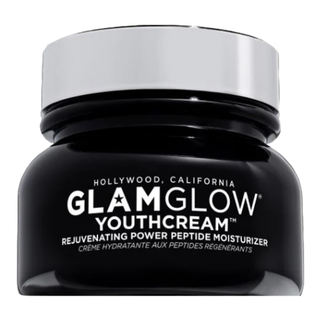
GLAMGLOW YOUTHCREAM™ Rejuvenating Power Peptide Moisturizer
Works for
2 of 2 advertised claims delivered
Moisturizing34 ingredients credited for this claimStrong support
“YOUTHCREAM™ Rejuvenating Power Peptide Moisturizer”
This product can help improve hydration of the skin with the two types of ingredients.
The first type is called “humectants”:
these ingredients help attract water.
When humectants are on the surface of the skin, they “pull in” the moisture from the outside environment, or from
within deeper layers of the skin. The following ingredients in this product do the job:
faex, glycerin.
This product also contains ingredients called “occlusives”. They help reduce the speed with which our skin loses moisture to the outside environment. These ingredients also help soften the upper layer of the skin, so it feels less tight and nicer to the touch. The following ingredients in this product do the job: dimethicone, phenyl trimethicone.
The following ingredients in this product are especially good for supporting the skin barrier and helping with the hydration level: acetyl hexapeptide-8, acetyl octapeptide-3, dipeptide diaminobutyroyl benzylamide diacetate
Anti-aging11 ingredients credited for this claimModerate support
“age resistors, this pillowy soft balm cream uses a potent triple peptide complex, hyaluronic acid boost and dual-tea infusion to reduce the look of fine lines and wrinkles, deliver plumping hydration and elevate skins natural glow.”
This product contains acetyl hexapeptide-8, acetyl octapeptide-3, adenosine phosphate, creatine, dipeptide diaminobutyroyl benzylamide diacetate. These ingredients might be able to help reduce and prevent fine lines and wrinkles, improve skin elasticity and firmness, but there is not enough evidence that it actually works.
ExfoliationNot advertised by the brand · 2 ingredients credited for this claimStrong support
This product can help exfoliate the skin. In other words, it helps break down the bonds between dead cells on the surface of the skin and speed up the skin turnover. Skin often appears softer and brighter after exfoliation, but overdoing it can result in disrupted skin barrier. The following ingredient is doing the exfoliating job in this product: hydroxyethyl urea.
Anti-oxidationNot advertised by the brand · 15 ingredients credited for this claimModerate support
This product contains antioxidants (creatine) that might be able to help neutralize free radicals in skin to lessen the damage it gets from the UV light (sun). There is not enough evidence to confirm their effectiveness in skin though.
Can it cause trouble?
Irritancy3 strong irritants: Parfum, Limonene + 1 more — patch-test recommendedHigh risk
Comedogenic3 ingredients rated 2 or more on the 0–5 pore-clogging scale3 flagged
User reviews
Be the first — your take helps the next person decide.
Ingredients
Filter by role to see what each ingredient is doing.
Water~45–55%
Butylene glycol~5.5–6.7%
- Irritation risk
- Low
Used to create a nice product texture and help delivery of other ingredients. Might be somewhat helpful in attracting water to the upper layer of the skin
More about Butylene glycolButyrospermum parkii oil~4.3–5.2%
- Irritation risk
- Low
- Comedogenicity
- 3/5
Cetearyl alcohol~2.4–3%
- Irritation risk
- Low
- Comedogenicity
- 2/5
A non-drying alcohol. Works as an emollient. Helps water and oil mix together and creates a nice product texture
More about Cetearyl alcoholPhenyl trimethicone~2.3–2.8%
- Irritation risk
- Low
A type of silicone that can decrease loss of moisture from the skin surface. It helps create a nice product texture
More about Phenyl trimethiconeHydrogenated polyisobutene~1.9–2.3%
- Irritation risk
- Low
Used to improve the product consistency and soften the upper layer of the skin
More about Hydrogenated polyisobuteneGlycerin~1.6–1.9%
- Irritation risk
- Low
One of the best moisturizing ingredients. Naturally present in skin. It attracts water to the upper layer of the skin working as a humectant
More about GlycerinSucrose~1.1–1.3%
- Irritation risk
- Low
Can help attract water to the upper layer of the skin. In crystal form, it can work as a gentle exfoliant, gentler than the salt scrub. Helps stabilize the emulsion
More about SucroseHdi/trimethylol hexyllactone crosspolymer~1–1.2%
- Irritation risk
- Low
Used to create a silky product texture and add volume to products
More about Hdi/trimethylol hexyllactone crosspolymerPeg-100 stearate~0.75–1.15%
- Irritation risk
- Low
Helps oil and water mix togehter and creates a nice product texture
More about Peg-100 stearateCetyl esters~0.55–0.85%
- Irritation risk
- Low
Helps soften upper layer of the skin and can enhance penetration of other ingredients into the upper layer of the skin
More about Cetyl estersIsostearyl neopentanoate~0.5–0.7%
- Irritation risk
- Medium
- Comedogenicity
- 2/5
Used to create a nice product texture and helps soften the upper layer of the skin. Could be comedogenic
More about Isostearyl neopentanoatePolyglyceryl-3 beeswax~0.4–0.6%
- Irritation risk
- Medium
Helps water and oil mix together. Could be an allergen (beeswax)
More about Polyglyceryl-3 beeswaxAcetyl hexapeptide-8~0.3–0.55%
- Irritation risk
- Low
A type of peptide. Peptides are excellent moisturizers and might be able support collagen production reducing fine lines and wrinkles
More about Acetyl hexapeptide-8Rubus idaeus leaf extract~0.25–0.5%
- Irritation risk
- Medium
A plant extract that might have some anti-oxidant properties but evidence of effectiveness in skin is lacking
More about Rubus idaeus leaf extractAcetyl octapeptide-3~0.25–0.5%
- Irritation risk
- Low
A type of peptide. Peptides are excellent moisturizers and might be able support collagen production reducing fine lines and wrinkles
More about Acetyl octapeptide-3Dipeptide diaminobutyroyl benzylamide diacetate~0.25–0.45%
- Irritation risk
- Low
A type of peptide. Peptides are excellent moisturizers and might be able support collagen production reducing fine lines and wrinkles
More about Dipeptide diaminobutyroyl benzylamide diacetateSodium hyaluronate~0.2–0.4%
- Irritation risk
- Low
One of the best moisturizing ingredients. Attracts water into the upper layer of the skin
More about Sodium hyaluronateCamellia sinensis leaf extract~0.2–0.4%
- Irritation risk
- Low
Can contain potent anti-oxidant compounds (abbreviated ECG, GCG, EGC, and EGCG) that might help protect the skin from free radicals. Can help calm down inflammation and has some anti-bacterial properties. Unfortunately, these antioxidants are unstable and lose their effectiveness very quickly in products. The concentration of the antioxidant compounds in the extract also tends to be low to be effective in topical formulation
More about Camellia sinensis leaf extractSigesbeckia orientalis extract~0.15–0.3%
- Irritation risk
- Medium
A plant extract that can contain an anti-inflammatory compound
More about Sigesbeckia orientalis extractPyrus malus fruit extract~0.15–0.3%
- Irritation risk
- Medium
Can have some moisturizing properties due to its sugar content
More about Pyrus malus fruit extractAcetyl glucosamine~0.15–0.25%
- Irritation risk
- Low
An effective moisturizing ingredient that also has been shown to be effective in evening out the skin tone and reducing hyperpigmentation. It can help somewhat reduce wrinkles in skin
More about Acetyl glucosamineSaccharomyces/xylinum/black tea ferment~0.15–0.25%
- Irritation risk
- Low
A fermented sweet black tea. There is no studies on particular benefits of this ingredient in skin. It can help attract water to the upper layer of the skin, and might have some anti-oxidant effect. It is used in skincare for mostly marketing purposes because of the popularity of kombucha drinks
More about Saccharomyces/xylinum/black tea fermentBiotin~0.15–0.3%
- Irritation risk
- Low
Might have some moisturising properties. Is not effective when applied topically beyond some moisturizing effect
More about BiotinYeast extract~0.15–0.3%
- Irritation risk
- Low
Helps attract water to the upper layer of the skin and might have some anti-oxidant and skin lightening properties. It can help calm down inflammation in skin
More about Yeast extractFaex~0.15–0.3%
- Irritation risk
- Low
Yeast extract. Helps to attract water to the upper layer of the skin
More about FaexYeast extract~0.15–0.3%
- Irritation risk
- Low
Helps attract water to the upper layer of the skin and might have some anti-oxidant and skin lightening properties. It can help calm down inflammation in skin
More about Yeast extractTocopheryl acetate~0.2–0.35%
- Irritation risk
- Medium
A more stable but less bio-available form of vitamin E compared to Tocopherol. Might help moisturize and protect the skin from free radicals, but mostly used in low concentrations to stabilize other ingredients.
More about Tocopheryl acetateCaffeine~0.15–0.3%
- Irritation risk
- Medium
Might be helpful in neutralizing free radicals. Can have a dehydration effect that might somewhat decrease the look of puffy eyes
More about CaffeineUrsolic acid~0.15–0.25%
- Irritation risk
- Low
Glycine soja protein~0.2–0.4%
- Irritation risk
- Low
A plant extract that helps to attract water to the upper layer of the skin and soften it. It might be helpful in neutralizing free radicals. It might be somewhat helpful for evening out the skin tone. It might be able to support elastin production but solid research is lacking
More about Glycine soja proteinSoy amino acids~0.15–0.3%
- Irritation risk
- Low
Help attract water to the upper layer of the skin
More about Soy amino acidsHydrolyzed soy protein~0.2–0.35%
- Irritation risk
- Low
Helps attract water to the upper layer of the skin. Might have some anti-aging, anti-oxidant, and skin lightening properties, but solid evidence is missing
More about Hydrolyzed soy proteinLinoleic acid~0.3–0.55%
- Irritation risk
- Low
An excellent emollient. Helps soften the skin, restore its barrier function, and can help to calm down inflammation. It can be helpful to prevent blemishes and clogged pores
More about Linoleic acidAdenosine phosphate~0.2–0.35%
- Irritation risk
- Low
Might help improve cell turnover and reduce inflammation in skin. One study shows that the ingredients might be able to stimulate collagen production in skin
More about Adenosine phosphateAcetyl carnitine hcl~0.2–0.35%
- Irritation risk
- Low
Might be helpful in decreasing sebum production making the skin less oily. Is claimed to be able to support ceramide production in skin that leads to better hydration, but evidence is lacking. Is able to attract water to the upper layer of the skin
More about Acetyl carnitine hclLecithin~0.2–0.4%
- Irritation risk
- Low
Used mostly for creating emulsions - helping oil and water mix together. Helps soften the upper layer of the skin
More about LecithinCetearyl glucoside~0.2–0.4%
- Irritation risk
- Medium
Helps water and oil in the product mix well together and improves product texture
More about Cetearyl glucosideCentaurium erythraea extract~0.2–0.35%
- Irritation risk
- Medium
A plant extract that can help calm down inflammation in skin
More about Centaurium erythraea extractDimethicone~0.25–0.45%
- Irritation risk
- Low
A silicone that helps to reduce water loss from the surface of the skin. Can temporarily "fill in" lines and wrinkles, absorb oil, and create a nice product finish
More about DimethiconeWhey protein~0.25–0.4%
- Irritation risk
- Low
A protein derived from milk. In skincare products, might help to soften the upper layer of the skin
More about Whey proteinMicrococcus lysate~0.2–0.35%
- Irritation risk
- Low
Consists of remains of dead bacteria cells. Is likely helpful in attracting water to the upper layer of the skin. Might be helpful in reducing inflammation and neutralizing free radicals in skin. It is claimed to be a "DNA repair enzyme"
More about Micrococcus lysateAminopropyl ascorbyl phosphate~0.2–0.35%
- Irritation risk
- Medium
A more stable but less potent derivative of vitamin C. It can help neautralize free radicals and even out the skin tone if used in high enough concentration (required levels are likely to be much higher than for pure vitamin C, and solid studies are lacking at the moment)
More about Aminopropyl ascorbyl phosphateTin oxide~0.3–0.6%
- Irritation risk
- Low
A colorant that can add a pearl-like appearance to the formulation
More about Tin oxideCalcium chloride~0.2–0.4%
- Irritation risk
- Medium
Helps create a thicker product consistency. Might be irritating
More about Calcium chlorideSilica~0.35–0.65%
Creatine~0.2–0.4%
- Irritation risk
- Low
Can support skin's ability to neutralize free radicals and produce collagen, though further research is needed to confirm effectiveness
More about CreatinePolybutene~0.25–0.45%
Polysilicone-11~0.25–0.5%
- Irritation risk
- Low
A silicone that forms a light film on the skin surface helping to bind water and temporarily absorb oils creating a matt and powdery feel
More about Polysilicone-11Methyl glucose sesquistearate~0.25–0.5%
- Irritation risk
- Medium
Helps water and oil mix together
More about Methyl glucose sesquistearateStearic acid~0.35–0.65%
- Irritation risk
- Low
Helps oil and water mix together and works as an emollient
More about Stearic acidCarbomer~0.25–0.45%
- Irritation risk
- Low
Helps create a thicker or gel-like product texture. It is not a surfactant but can be used in gentle cleansing formulations
More about CarbomerHydroxyethyl urea~0.25–0.45%
- Irritation risk
- Low
A derivative of urea, a compound that is naturally present in skin. Attracts water to the upper layer of the skin. Can enhance penetration of other ingredients
More about Hydroxyethyl ureaHydroxyethylcellulose~0.25–0.5%
- Irritation risk
- Low
Used to thicken product formulations and create gel-like textures
More about HydroxyethylcelluloseCaprylyl glycol~0.25–0.5%
- Irritation risk
- Medium
Helps preserve products and creates a nice product texture
More about Caprylyl glycol1,2-hexanediol~0.25–0.45%
Citric acid~0.25–0.45%
- Irritation risk
- Medium
Can work as an exfoliant but is typically used to adjust the product pH
More about Citric acidParfum~0.2–0.4%
- Irritation risk
- High
An aromatic blend of unspecified and possibly irritating ingredients
More about ParfumAminomethyl propanol~0.25–0.45%
Limonene~0.2–0.4%
- Irritation risk
- High
A common frangrance that can easily irritate skin, especially if exposed to air, light or heat
More about LimoneneMenthanediol~0.25–0.5%
- Irritation risk
- High
Disodium edta~0.2–0.4%
Sodium citrate~0.25–0.45%
- Irritation risk
- Medium
Helps to control the skin's pH level. Maintains the skin's natural film of amino-lactic acids and oils. Helps to preserve products
More about Sodium citrateErgothioneine~0.25–0.45%
- Irritation risk
- Low
Can help neutralize free radicals in skin. Preliminary studies show that it can be more effective than coenzyme Q10 but studies on effective concentration for topical applications are lacking
More about ErgothioneinePhenoxyethanol~0.25–0.45%
- Irritation risk
- Low
A preservative. It helps prevent bacterial growth in cosmetic products
More about PhenoxyethanolSodium dehydroacetate~0.2–0.4%
Sodium benzoate~0.2–0.35%
Potassium sorbate~0.15–0.3%
Mica~0.2–0.35%
- Irritation risk
- Low
Creates an illusion of smoother and more radiant skin tone. Adds shimmer to the skin by reflecting light
More about MicaTitanium dioxide~0.25–0.4%
- Irritation risk
- Low
Works as a UV filter when used in high concentrations. It is photostable and is effective mostly against the UVB light, with some protection in the UVA range. In small concentrations, used for its ability to improve the color of cosmetic products. Is usually well tolerated by the skin
More about Titanium dioxideCi 77891~0.15–0.25%
- Irritation risk
- Low
Datem~0.15–0.25%
Ingredient list view
Water, Butylene glycol, Butyrospermum parkii oil, Cetearyl alcohol, Phenyl trimethicone, Hydrogenated polyisobutene, Glycerin, Sucrose, Hdi/trimethylol hexyllactone crosspolymer, Peg-100 stearate, Cetyl esters, Isostearyl neopentanoate, Polyglyceryl-3 beeswax, Acetyl hexapeptide-8, Rubus idaeus leaf extract, Acetyl octapeptide-3, Dipeptide diaminobutyroyl benzylamide diacetate, Sodium hyaluronate, Camellia sinensis leaf extract, Sigesbeckia orientalis extract, Pyrus malus fruit extract, Acetyl glucosamine, Saccharomyces/xylinum/black tea ferment, Biotin, Yeast extract, Faex, Yeast extract, Tocopheryl acetate, Caffeine, Ursolic acid, Glycine soja protein, Soy amino acids, Hydrolyzed soy protein, Linoleic acid, Adenosine phosphate, Acetyl carnitine hcl, Lecithin, Cetearyl glucoside, Centaurium erythraea extract, Dimethicone, Whey protein, Micrococcus lysate, Aminopropyl ascorbyl phosphate, Tin oxide, Calcium chloride, Silica, Creatine, Polybutene, Polysilicone-11, Methyl glucose sesquistearate, Stearic acid, Carbomer, Hydroxyethyl urea, Hydroxyethylcellulose, Caprylyl glycol, 1,2-hexanediol, Citric acid, Parfum, Aminomethyl propanol, Limonene, Menthanediol, Disodium edta, Sodium citrate, Ergothioneine, Phenoxyethanol, Sodium dehydroacetate, Sodium benzoate, Potassium sorbate, Mica, Titanium dioxide, Ci 77891, Datem
Compare prices
Retailers ranked by price — lowest first.
Worth comparing, line by line.
Match % combines shared ingredients, the first five ingredients, shared actives and hero ingredients, irritancy (lower counts in the alternative's favour), texture and body area. Only products in the same routine step are compared.
| GLAMGLOWYOUTHCREAM™ Rejuvenating Power Peptide MoisturizerYOUR PRODUCT | CliniqueSmart Clinical MD Multi-Dimensional Age Transformer Duo Resculpt + Revolumize Moisturiser | |
|---|---|---|
| Match | — | 59% |
| Price | — | $161.29 |
| Shared key ingredients | — | 21 of 27 |
| Key difference | — | Lactic Acid |
| Irritancy | High | High |
| Drying alcohol | — | Contains drying alcohol |
| View product | Shop |


Product summary
"GLAMGLOW - YOUTHCREAM™ Rejuvenating Power Peptide Moisturizer" is a well-rounded moisturizing product. This moisturizer uses a good combo of humectants and emollients. These both types of ingredients are essentials for improving the skin hydration and keeping the skin barrier healthy. Humectants in this product (acetyl hexapeptide-8, acetyl octapeptide-3, faex, glycerin and hydroxyethyl urea) help to increase the water content in the upper layer of the skin. (These ingredients do so by "capturing" water molecules from the outside air or from within the deeper layers of the skin). Butyrospermum parkii oil, dimethicone, phenyl trimethicone, cetearyl alcohol and cetyl esters in this product help decrease the water evoporation from the skin, so that it stays hydrated for longer. These ingredients also soften the skin and take away the feeling of tightness and dryness.
Ingredient callouts
- This moisturizer also contains Peptides (dipeptide diaminobutyroyl benzylamide diacetate 0.25% - 0.45%, acetyl octapeptide-3 0.25% - 0.50% and acetyl hexapeptide-8 0.30% - 0.55%). Peptides are a very big group of ingredients. They all consist of a different combination of aminoacids. Our skin produces Peptides naturally. Some of them work as natural antibiotics, promote wound-healing and production of collagen. The scientists are still studying how effective the topical application of Peptides is, but it is very likely that they are helpful. Peptides might be able to support skin barrier restoration and even have an anti-aging benefit. At the very least, they certainly help attract water to the skin and support the hydration in this way.
Irritation risk
There are some common irritants in this product, including ingredients that do not have benefits for the skin. We assess the overall irritancy of this moisturizer to be high. For a detailed overview of all potential irritants: click here
You can see the detailed formula review with the breakdown of all actives in the product and the full ingredient list with estimated concentrations in the tables below.
Price
The product retails for 44.44$ in the United States.
For a detailed price comparison: click here.
Sources cited in this review
Every concentration estimate and effectiveness label is anchored to one of these 45 studies and safety reviews.
- 1
- 2
- 3
- 4
- 5
- 6

Affiliate links · As an Amazon Associate, WIMJ earns from qualifying purchases.