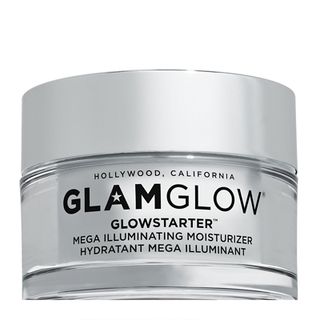
GLAMGLOW GLOWSTARTER Mega Illuminating Moisturizer Sun Glow
Works for
1 of 1 advertised claim delivered
Moisturizing21 ingredients credited for this claimStrong support
“GLOWSTARTER Mega Illuminating Moisturizer Sun Glow”
This product can help improve hydration of the skin with the two types of ingredients.
The first type is called “humectants”:
these ingredients help attract water.
When humectants are on the surface of the skin, they “pull in” the moisture from the outside environment, or from
within deeper layers of the skin. The following ingredients in this product do the job:
algae extract, glycerin.
This product also contains ingredients called “occlusives”. They help reduce the speed with which our skin loses moisture to the outside environment. These ingredients also help soften the upper layer of the skin, so it feels less tight and nicer to the touch. The following ingredients in this product do the job: dimethicone, simmondsia chinensis seed oil.
The following ingredients in this product are especially good for supporting the skin barrier and helping with the hydration level: ceramide ng
Can it cause trouble?
Irritancy4 strong irritants: Parfum, Limonene + 2 more — patch-test recommendedHigh risk
Comedogenic3 ingredients rated 2 or more on the 0–5 pore-clogging scale3 flagged

User reviews
Be the first — your take helps the next person decide.
Ingredients
Filter by role to see what each ingredient is doing.
Water~45–55%
Dimethicone~5.4–6.6%
- Irritation risk
- Low
A silicone that helps to reduce water loss from the surface of the skin. Can temporarily "fill in" lines and wrinkles, absorb oil, and create a nice product finish
More about DimethiconeButylene glycol~4.1–5%
- Irritation risk
- Low
Used to create a nice product texture and help delivery of other ingredients. Might be somewhat helpful in attracting water to the upper layer of the skin
More about Butylene glycolGlyceryl distearate~3.3–4%
- Irritation risk
- Low
Cetyl ricinoleate~2.5–3%
- Irritation risk
- Low
An emollient that helps soften the upper layer of the skin
More about Cetyl ricinoleateTrisiloxane~2–2.5%
Glyceryl stearate se~1.7–2.1%
- Irritation risk
- Low
- Comedogenicity
- 2/5
Used to stabilize the product formulations and works as an emollient
More about Glyceryl stearate seCholesterol~1.5–1.8%
- Irritation risk
- Low
An emollient that is naturally found in skin
More about CholesterolSteareth-10~1.2–1.5%
- Irritation risk
- Medium
- Comedogenicity
- 3/5
Helps oil and water mix together
More about Steareth-10Simmondsia chinensis seed oil~1–1.3%
- Irritation risk
- Medium
Softens the upper layer of skin and helps restore the healthy skin barrier. Has shown to help calm down inflammation in skin. It is a stable oil, meaning that it retains its properties even when exposed to air.
More about Simmondsia chinensis seed oilShea butter cetyl esters~0.7–1.05%
- Irritation risk
- Low
Cetyl alcohol~0.7–1.05%
- Irritation risk
- Low
A non-drying alcohol that works to soften the skin and stabilize product formulations helping oil and water mix together
More about Cetyl alcoholGlycerin~0.55–0.85%
- Irritation risk
- Low
One of the best moisturizing ingredients. Naturally present in skin. It attracts water to the upper layer of the skin working as a humectant
More about GlycerinTocopheryl acetate~0.5–0.75%
- Irritation risk
- Medium
A more stable but less bio-available form of vitamin E compared to Tocopherol. Might help moisturize and protect the skin from free radicals, but mostly used in low concentrations to stabilize other ingredients.
More about Tocopheryl acetateSodium hyaluronate~0.45–0.65%
- Irritation risk
- Low
One of the best moisturizing ingredients. Attracts water into the upper layer of the skin
More about Sodium hyaluronateAlgae extract~0.5–0.75%
- Irritation risk
- Low
- Comedogenicity
- 3/5
Plant extract that helps the skin to attract water and make it more smooth for touch. Also shows promise of anti-aging properties, but research is not extensive yet
More about Algae extractCamellia sinensis leaf extract~0.45–0.65%
- Irritation risk
- Low
Can contain potent anti-oxidant compounds (abbreviated ECG, GCG, EGC, and EGCG) that might help protect the skin from free radicals. Can help calm down inflammation and has some anti-bacterial properties. Unfortunately, these antioxidants are unstable and lose their effectiveness very quickly in products. The concentration of the antioxidant compounds in the extract also tends to be low to be effective in topical formulation
More about Camellia sinensis leaf extractCucumis sativus fruit extract~0.35–0.65%
- Irritation risk
- Medium
Might be somewhat helpful in reducing hyperpigmentation and neutralizing free radicals but its typical concentration in a product is too low for having an effect
More about Cucumis sativus fruit extractPyrus malus fruit extract~0.3–0.6%
- Irritation risk
- Medium
Can have some moisturizing properties due to its sugar content
More about Pyrus malus fruit extractSaccharomyces lysate extract~0.3–0.55%
- Irritation risk
- Low
Helps attract water to the upper layer of the skin. Can have some anti-inflammatory effect
More about Saccharomyces lysate extractScutellaria baicalensis root extract~0.25–0.5%
- Irritation risk
- High
A plant extract that might contain a compound baicalin that could be helpful in neutralizing free radicals and reducing inflammation in skin. The baicalin concentration in skincare products is often too low for an effective action. Can be used for its fragrant properties
More about Scutellaria baicalensis root extractCeramide ng~0.3–0.55%
- Irritation risk
- Low
A type of lipid similar to ceramides naturally present in skin. Helps to soften the upper layer of the skin and supports the skin barrier function to keep it hydrated. Can help to prevent inflammation in skin
More about Ceramide ngIsohexadecane~0.35–0.65%
- Irritation risk
- Low
Improves the texture of the product and helps soften the skin. Helps oil and water mix together and can be used as a cleansing agent
More about IsohexadecaneSynthetic fluorphlogopite~0.25–0.5%
- Irritation risk
- Low
A mineral that is used as an optical filter (makes the skin looks nicer through light reflection) and to improve the texture of cosmetic products
More about Synthetic fluorphlogopiteSucrose~0.2–0.4%
- Irritation risk
- Low
Can help attract water to the upper layer of the skin. In crystal form, it can work as a gentle exfoliant, gentler than the salt scrub. Helps stabilize the emulsion
More about SucrosePolysorbate 80~0.25–0.5%
Acrylamide/sodium acryloyldimethyltaurate copolymer~0.25–0.45%
- Irritation risk
- Low
Helps water and oil mix together and create gel-like textures
More about Acrylamide/sodium acryloyldimethyltaurate copolymerXanthan gum~0.25–0.5%
- Irritation risk
- Low
Used to create a thicker product consistency
More about Xanthan gumCaprylyl glycol~0.25–0.5%
- Irritation risk
- Medium
Helps preserve products and creates a nice product texture
More about Caprylyl glycolHexylene glycol~0.25–0.4%
- Irritation risk
- Medium
Helps create a more spreadable product texture
More about Hexylene glycolCitric acid~0.25–0.4%
- Irritation risk
- Medium
Can work as an exfoliant but is typically used to adjust the product pH
More about Citric acidLinoleic acid~0.3–0.6%
- Irritation risk
- Low
An excellent emollient. Helps soften the skin, restore its barrier function, and can help to calm down inflammation. It can be helpful to prevent blemishes and clogged pores
More about Linoleic acidPanthenol~0.2–0.4%
- Irritation risk
- Low
Helps attract water to the upper layer of the skin and can help improve skin barrier function
More about PanthenolParfum~0.2–0.35%
- Irritation risk
- High
An aromatic blend of unspecified and possibly irritating ingredients
More about ParfumLimonene~0.15–0.3%
- Irritation risk
- High
A common frangrance that can easily irritate skin, especially if exposed to air, light or heat
More about LimoneneCitral~0.15–0.3%
Linalool~0.15–0.25%
Disodium edta~0.15–0.25%
Magnesium ascorbyl phosphate~0.15–0.25%
- Irritation risk
- Medium
A derivative of vitamin C that is more stable, but less bioavailable than the pure form of vitamin C. It does not penetrate the skin well, but has been shown to convert to pure vitamin C once in skin. It can be helpful in stimulating collagen production and lightening the skin tone, but the required concentration is likely to be very high
More about Magnesium ascorbyl phosphateSodium citrate~0.05–0.15%
- Irritation risk
- Medium
Helps to control the skin's pH level. Maintains the skin's natural film of amino-lactic acids and oils. Helps to preserve products
More about Sodium citratePhenoxyethanol~0.15–0.3%
- Irritation risk
- Low
A preservative. It helps prevent bacterial growth in cosmetic products
More about PhenoxyethanolIngredient list view
Water, Dimethicone, Butylene glycol, Glyceryl distearate, Cetyl ricinoleate, Trisiloxane, Glyceryl stearate se, Cholesterol, Steareth-10, Simmondsia chinensis seed oil, Unknown, Shea butter cetyl esters, Cetyl alcohol, Glycerin, Tocopheryl acetate, Sodium hyaluronate, Algae extract, Camellia sinensis leaf extract, Cucumis sativus fruit extract, Pyrus malus fruit extract, Saccharomyces lysate extract, Scutellaria baicalensis root extract, Ceramide ng, Isohexadecane, Synthetic fluorphlogopite, Sucrose, Polysorbate 80, Acrylamide/sodium acryloyldimethyltaurate copolymer, Xanthan gum, Caprylyl glycol, Hexylene glycol, Citric acid, Linoleic acid, Panthenol, Parfum, Limonene, Citral, Linalool, Disodium edta, Magnesium ascorbyl phosphate, Sodium citrate, Phenoxyethanol
Compare prices
Retailers ranked by price — lowest first.
Worth comparing, line by line.
Match % combines shared ingredients, the first five ingredients, shared actives and hero ingredients, irritancy (lower counts in the alternative's favour), texture and body area. Only products in the same routine step are compared.
| GLAMGLOWGLOWSTARTER Mega Illuminating Moisturizer Sun GlowYOUR PRODUCT | MACMini MAC Strobe Cream | Crème de la MerThe Hydrating Illuminator | |
|---|---|---|---|
| Match | — | 64% | 54% |
| Price | $48.92 | $16.00−$32.92 | $79.32+$30.40 |
| Shared key ingredients | — | 11 of 12 | 9 of 12 |
| Key difference | — | Titanium Dioxide | Acetyl Hexapeptide-8 |
| Irritancy | High | Medium | High |
| Drying alcohol | — | — | Contains drying alcohol |
| View product | Shop | Shop |


Sources cited in this review
Every concentration estimate and effectiveness label is anchored to one of these 18 studies and safety reviews.
- 1
- 2Final Report on the Safety Assessment of Dimethicone Copolyoljournals.sagepub.com
- 3
- 4Hyaluronic acid: A key molecule in skin agingncbi.nlm.nih.gov
- 5
- 6Use of Probiotics for Dermal Applicationsresearchgate.net

Affiliate links · As an Amazon Associate, WIMJ earns from qualifying purchases.