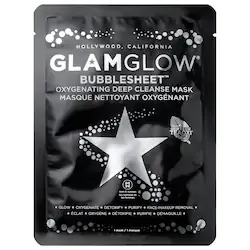
GLAMGLOW BUBBLESHEET Oxygenating Deep Cleanse Mask

GLAMGLOW BUBBLESHEET Oxygenating Deep Cleanse Mask

Efficacy100/100IrritancyHigh

Works for

Exfoliation
Hydroxyethyl urea, Retinyl palmitate + 1 more
Works well
What the product description says
“After using the mask, use the charcoal-infused fiber cloth as a washcloth for extra exfoliation for an added micro-circulation benefit.”
Source: Sephora

This product can help exfoliate the skin. In other words, it helps break down the bonds between dead cells on the surface of the skin and speed up the skin turnover. Skin often appears softer and brighter after exfoliation, but overdoing it can result in disrupted skin barrier. The following ingredient is doing the exfoliating job in this product: hydroxyethyl urea.

Hydroxyethyl ureaKey activeEffect: HighA derivative of urea, a compound that is naturally present in skin. Attracts water to the upper layer of the skin. Can enhance penetration of other ingredients~0.05–0.3%
Retinyl palmitateEffect: LowThree steps removed from the active form of vitamin A - retinoic acid. To have an effect in the skin, it first needs to be converted twice to become the retinoic acid. This means it is less potent than retinol, but could also be less irritating. Once converted to the retinoic acid in the skin, it helps against all signs of aging, improves skin cell turnover and helps fight blemishes and clogged pores. However, in many cosmetic formulations, it is used in a concentration that is too low to have the full effect~1.2–1.8%
AllantoinEffect: LowHelps calm down inflammation in skin and can help reduce itching. Helps to repair the skin barrier and keep skin hydrated~0.85–1.25%
Moisturizing
Side benefit · Ceramide np, Glycerin + 8 more
Works well

This product can help improve hydration of the skin with the two types of ingredients.

The first type is called “humectants”:
these ingredients help attract water. When humectants are on the surface of the skin, they “pull in” the moisture from the outside environment, or from within deeper layers of the skin. The following ingredients in this product do the job: allantoin, arginine.

This product also contains ingredients called “occlusives”. They help reduce the speed with which our skin loses moisture to the outside environment. These ingredients also help soften the upper layer of the skin, so it feels less tight and nicer to the touch. The following ingredients in this product do the job: arginine, helianthus annuus seed oil.

The following ingredients in this product are especially good for supporting the skin barrier and helping with the hydration level: ceramide np

Ceramide npHero· EmollientEffect: HighA type of lipid similar to ceramides naturally present in skin. Helps to soften the upper layer of the skin and supports the skin barrier function to keep it hydrated. Can help to prevent inflammation in skin~0.2–0.8%
GlycerinKey active· HumectantEffect: HighOne of the best moisturizing ingredients. Naturally present in skin. It attracts water to the upper layer of the skin working as a humectant~4.4–6.6%
AllantoinKey active· HumectantEffect: HighHelps calm down inflammation in skin and can help reduce itching. Helps to repair the skin barrier and keep skin hydrated~0.85–1.25%
ArginineKey active· Humectant, OcclusiveEffect: HighAn amino acid that is naturally present in skin and helps keep it hydrated. When used together with AHAs, it can reduce their irritating effect on the skin~0.55–1.3%
Helianthus annuus seed oilKey active· Emollient, OcclusiveEffect: HighA great emollient due to its high linoleic acid content. One of the most effective plant oils in helping skin hydration and repairing skin barrier function~0.4–0.9%
Saccharide isomerateKey active· HumectantEffect: HighHelps attract water to the upper layer of the skin~0.15–0.6%
Sodium pcaKey active· HumectantEffect: HighNaturally present in skin and helps to attract water to its upper layer~0.15–0.7%
Hydroxyethyl ureaKey active· HumectantEffect: HighA derivative of urea, a compound that is naturally present in skin. Attracts water to the upper layer of the skin. Can enhance penetration of other ingredients~0.05–0.3%
Camellia sinensis leaf extractEffect: LowCan contain potent anti-oxidant compounds (abbreviated ECG, GCG, EGC, and EGCG) that might help protect the skin from free radicals. Can help calm down inflammation and has some anti-bacterial properties. Unfortunately, these antioxidants are unstable and lose their effectiveness very quickly in products. The concentration of the antioxidant compounds in the extract also tends to be low to be effective in topical formulation~0.45–1%
Butylene glycol· HumectantEffect: LowUsed to create a nice product texture and help delivery of other ingredients. Might be somewhat helpful in attracting water to the upper layer of the skin~0.1–0.35%
Anti-aging
Side benefit · Retinyl palmitate, Camellia sinensis leaf extract + 1 more
May help

This product contains retinyl palmitate. This ingredient might be able to help reduce and prevent fine lines and wrinkles, improve skin elasticity and firmness, but there is not enough evidence that it actually works.

Retinyl palmitateKey activeEffect: MediumThree steps removed from the active form of vitamin A - retinoic acid. To have an effect in the skin, it first needs to be converted twice to become the retinoic acid. This means it is less potent than retinol, but could also be less irritating. Once converted to the retinoic acid in the skin, it helps against all signs of aging, improves skin cell turnover and helps fight blemishes and clogged pores. However, in many cosmetic formulations, it is used in a concentration that is too low to have the full effect~1.2–1.8%
Camellia sinensis leaf extractEffect: LowCan contain potent anti-oxidant compounds (abbreviated ECG, GCG, EGC, and EGCG) that might help protect the skin from free radicals. Can help calm down inflammation and has some anti-bacterial properties. Unfortunately, these antioxidants are unstable and lose their effectiveness very quickly in products. The concentration of the antioxidant compounds in the extract also tends to be low to be effective in topical formulation~0.45–1%
Ascorbyl glucosideUnder-dosedA vitamin C derivative that is more stable but less potent than pure form of vitamin C. Has a potential to boost collagen production, nutralise free radicals and reduce hyperpigmentation, but the required concentration is likely to be much higher than for the pure form of vitamin C, limiting the ingredient's effectiveness in products~0.3–0.75%
Anti-oxidation
Side benefit · Camellia sinensis leaf extract, Ascorbyl glucoside
May help

This product contains antioxidants (camellia sinensis leaf extract) that might be able to help neutralize free radicals in skin to lessen the damage it gets from the UV light (sun). There is not enough evidence to confirm their effectiveness in skin though.

Camellia sinensis leaf extractKey activeEffect: MediumCan contain potent anti-oxidant compounds (abbreviated ECG, GCG, EGC, and EGCG) that might help protect the skin from free radicals. Can help calm down inflammation and has some anti-bacterial properties. Unfortunately, these antioxidants are unstable and lose their effectiveness very quickly in products. The concentration of the antioxidant compounds in the extract also tends to be low to be effective in topical formulation~0.45–1%
Ascorbyl glucosideUnder-dosedA vitamin C derivative that is more stable but less potent than pure form of vitamin C. Has a potential to boost collagen production, nutralise free radicals and reduce hyperpigmentation, but the required concentration is likely to be much higher than for the pure form of vitamin C, limiting the ingredient's effectiveness in products~0.3–0.75%
Evens skin tone
Side benefit · Retinyl palmitate, Camellia sinensis leaf extract + 1 more
May help

This product might be able to help reduce hyperpigmentation and even out the skin tone because it contains hydroxyethyl urea. The effect, if any, is likely to be small. Keep in mind that you would need to apply any topical skincare targetted at hypigmentation consistently for a couple of months to get a result. No topical skincare product can help get rid of hyperpigmentation (including post-acne marks and age spots) instantly.

The following ingredient (ingredients) in this product might be helpful, but there is no evidence to confirm that it actually works: retinyl palmitate.

Retinyl palmitateKey activeEffect: MediumThree steps removed from the active form of vitamin A - retinoic acid. To have an effect in the skin, it first needs to be converted twice to become the retinoic acid. This means it is less potent than retinol, but could also be less irritating. Once converted to the retinoic acid in the skin, it helps against all signs of aging, improves skin cell turnover and helps fight blemishes and clogged pores. However, in many cosmetic formulations, it is used in a concentration that is too low to have the full effect~1.2–1.8%
Camellia sinensis leaf extractEffect: LowCan contain potent anti-oxidant compounds (abbreviated ECG, GCG, EGC, and EGCG) that might help protect the skin from free radicals. Can help calm down inflammation and has some anti-bacterial properties. Unfortunately, these antioxidants are unstable and lose their effectiveness very quickly in products. The concentration of the antioxidant compounds in the extract also tends to be low to be effective in topical formulation~0.45–1%
Ascorbyl glucosideUnder-dosedA vitamin C derivative that is more stable but less potent than pure form of vitamin C. Has a potential to boost collagen production, nutralise free radicals and reduce hyperpigmentation, but the required concentration is likely to be much higher than for the pure form of vitamin C, limiting the ingredient's effectiveness in products~0.3–0.75%

Can it cause trouble?

Irritancy
4 strong irritants: Retinyl palmitate, Citrus limon peel oil + 2 more — patch-test recommended
High risk
We flagged 15 ingredients with irritancy potential. Severity depends on your sensitivity threshold; the table lists the worst offenders first.
IngredientFunctionIrritationEst. amount
Cocamidopropyl betaineHelps water and oil mix together. Used as a cleansing ingredient. Could be an allergenHigh~2.7–4.1%est.
Retinyl palmitateThree steps removed from the active form of vitamin A - retinoic acid. To have an effect in the skin, it first needs to be converted twice to become the retinoic acid. This means it is less potent than retinol, but could also be less irritating. Once converted to the retinoic acid in the skin, it helps against all signs of aging, improves skin cell turnover and helps fight blemishes and clogged pores. However, in many cosmetic formulations, it is used in a concentration that is too low to have the full effectHigh~1.2–1.8%est.
Citrus limon peel oilA highly irritating fragranceHigh~0.05–0.15%est.
LimoneneA common frangrance that can easily irritate skin, especially if exposed to air, light or heatHigh~0.05–0.2%est.
CitralA fragrance with a lemon scent. A likely irritantHigh~0.05–0.2%est.
Acrylates copolymerUsed to stabilize product formulation, help create an even product layer over skin (for example, in sunscreen) and create a thicker product consistencyMedium~2.7–4.1%est.
Disodium cocoamphodiacetateHelps oil and water mix together and works as a cleansing agentMedium~1.7–2.6%est.
Lauryl glucosideHelps oil and water mix togetherMedium~1.5–2.2%est.
Ascorbyl glucosideA vitamin C derivative that is more stable but less potent than pure form of vitamin C. Has a potential to boost collagen production, nutralise free radicals and reduce hyperpigmentation, but the required concentration is likely to be much higher than for the pure form of vitamin C, limiting the ingredient's effectiveness in productsMedium~0.3–0.75%est.
EthylhexylglycerinA preservativeMedium~0.2–0.8%est.
Potassium cocoateHelps oil and water mix together and works as a cleansing agentMedium~0.1–0.5%est.
Hexylene glycolHelps create a more spreadable product textureMedium~0.1–0.35%est.
Citric acidCan work as an exfoliant but is typically used to adjust the product pHMedium~0.05–0.3%est.
Sodium citrateHelps to control the skin's pH level. Maintains the skin's natural film of amino-lactic acids and oils. Helps to preserve productsMedium~0.05–0.15%est.
Disodium edtaStabilizes the product formulationMedium~0.01–0.1%est.
Comedogenic
Clean of flagged comedogenic ingredients
None flagged

User reviews

Would you recommend?
No community reviews yet.

Be the first — your take helps the next person decide.

Ingredients

Filter by role to see what each ingredient is doing.

Water~40–60%
Formula
Irritation risk
Low

Plain old water

More about Water
Glycerin~4.4–6.6%
Key active
Irritation risk
Low
Works for
Moisturizing

One of the best moisturizing ingredients. Naturally present in skin. It attracts water to the upper layer of the skin working as a humectant

More about Glycerin
Methyl perfluorobutyl ether~3.6–5.3%
Formula
Acrylates copolymer~2.7–4.1%
Irritant · medium
Irritation risk
Medium

Used to stabilize product formulation, help create an even product layer over skin (for example, in sunscreen) and create a thicker product consistency

More about Acrylates copolymer
Cocamidopropyl betaine~2.7–4.1%
Irritant · high
Irritation risk
High
Works for
Cleansing

Helps water and oil mix together. Used as a cleansing ingredient. Could be an allergen

More about Cocamidopropyl betaine
Disodium cocoamphodiacetate~1.7–2.6%
Irritant · medium
Irritation risk
Medium
Works for
Cleansing

Helps oil and water mix together and works as a cleansing agent

More about Disodium cocoamphodiacetate
Lauryl glucoside~1.5–2.2%
Irritant · medium
Irritation risk
Medium
Works for
Cleansing

Helps oil and water mix together

More about Lauryl glucoside
Retinyl palmitate~1.2–1.8%
Key activeIrritant · high
Irritation risk
High
Works for
Anti-agingEvens skin toneAnti-blemishExfoliation

Three steps removed from the active form of vitamin A - retinoic acid. To have an effect in the skin, it first needs to be converted twice to become the retinoic acid. This means it is less potent than retinol, but could also be less irritating. Once converted to the retinoic acid in the skin, it helps against all signs of aging, improves skin cell turnover and helps fight blemishes and clogged pores. However, in many cosmetic formulations, it is used in a concentration that is too low to have the full effect

More about Retinyl palmitate
Allantoin~0.85–1.25%
Key active
Irritation risk
Low
Works for
Anti-inflammatoryMoisturizingReduces irritationReduces rednessAnti-blemishExfoliation

Helps calm down inflammation in skin and can help reduce itching. Helps to repair the skin barrier and keep skin hydrated

More about Allantoin
Arginine~0.55–1.3%
Key active
Irritation risk
Low
Works for
Moisturizing

An amino acid that is naturally present in skin and helps keep it hydrated. When used together with AHAs, it can reduce their irritating effect on the skin

More about Arginine
Camellia sinensis leaf extract~0.45–1%
Key active
Irritation risk
Low
Works for
AntibacterialAnti-oxidationAnti-agingMoisturizingEvens skin toneAnti-blemish

Can contain potent anti-oxidant compounds (abbreviated ECG, GCG, EGC, and EGCG) that might help protect the skin from free radicals. Can help calm down inflammation and has some anti-bacterial properties. Unfortunately, these antioxidants are unstable and lose their effectiveness very quickly in products. The concentration of the antioxidant compounds in the extract also tends to be low to be effective in topical formulation

More about Camellia sinensis leaf extract
Helianthus annuus seed oil~0.4–0.9%
Key active
Irritation risk
Low
Works for
Moisturizing

A great emollient due to its high linoleic acid content. One of the most effective plant oils in helping skin hydration and repairing skin barrier function

More about Helianthus annuus seed oil
Ascorbyl glucoside~0.3–0.75%
Under-dosedIrritant · medium
Irritation risk
Medium
Works for
Anti-agingAnti-oxidationEvens skin tone

A vitamin C derivative that is more stable but less potent than pure form of vitamin C. Has a potential to boost collagen production, nutralise free radicals and reduce hyperpigmentation, but the required concentration is likely to be much higher than for the pure form of vitamin C, limiting the ingredient's effectiveness in products

More about Ascorbyl glucoside
Ethylhexylglycerin~0.2–0.8%
Irritant · medium
Irritation risk
Medium

A preservative

More about Ethylhexylglycerin
Ceramide np~0.2–0.8%
Hero · Moisturizing
Irritation risk
Low
Works for
MoisturizingAnti-inflammatoryReduces irritation

A type of lipid similar to ceramides naturally present in skin. Helps to soften the upper layer of the skin and supports the skin barrier function to keep it hydrated. Can help to prevent inflammation in skin

More about Ceramide np
Sodium pca~0.15–0.7%
Key active
Irritation risk
Low
Works for
Moisturizing

Naturally present in skin and helps to attract water to its upper layer

More about Sodium pca
Sodium chloride~0.15–0.7%
Formula
Irritation risk
Low

Used to stabilize mixtures of oil and water, and create thicker, gel-like product textures

More about Sodium chloride
Saccharide isomerate~0.15–0.6%
Key active
Irritation risk
Low
Works for
Moisturizing

Helps attract water to the upper layer of the skin

More about Saccharide isomerate
Polyquaternium-10~0.15–0.6%
Formula
Irritation risk
Low

Helps soften the upper layer of the skin and create a nice product finish

More about Polyquaternium-10
Potassium cocoyl glycinate~0.15–0.5%
Formula
Irritation risk
Low
Works for
Cleansing
More about Potassium cocoyl glycinate
Potassium cocoate~0.1–0.5%
Irritant · medium
Irritation risk
Medium
Works for
Cleansing

Helps oil and water mix together and works as a cleansing agent

More about Potassium cocoate
Hexylene glycol~0.1–0.35%
Irritant · medium
Irritation risk
Medium
Works for
Cleansing

Helps create a more spreadable product texture

More about Hexylene glycol
Butylene glycol~0.1–0.35%
Formula
Irritation risk
Low
Works for
Moisturizing

Used to create a nice product texture and help delivery of other ingredients. Might be somewhat helpful in attracting water to the upper layer of the skin

More about Butylene glycol
Citric acid~0.05–0.3%
Irritant · medium
Irritation risk
Medium

Can work as an exfoliant but is typically used to adjust the product pH

More about Citric acid
Hydroxyethyl urea~0.05–0.3%
Key active
Irritation risk
Low
Works for
MoisturizingExfoliation

A derivative of urea, a compound that is naturally present in skin. Attracts water to the upper layer of the skin. Can enhance penetration of other ingredients

More about Hydroxyethyl urea
Citrus limon peel oil~0.05–0.15%
Irritant · high
Irritation risk
High

A highly irritating fragrance

More about Citrus limon peel oil
Limonene~0.05–0.2%
Irritant · high
Irritation risk
High

A common frangrance that can easily irritate skin, especially if exposed to air, light or heat

More about Limonene
Citral~0.05–0.2%
Irritant · high
Irritation risk
High

A fragrance with a lemon scent. A likely irritant

More about Citral
Sodium citrate~0.05–0.15%
Irritant · medium
Irritation risk
Medium

Helps to control the skin's pH level. Maintains the skin's natural film of amino-lactic acids and oils. Helps to preserve products

More about Sodium citrate
Disodium edta~0.01–0.1%
Irritant · medium
Irritation risk
Medium

Stabilizes the product formulation

More about Disodium edta
Phenoxyethanol~0.05–0.2%
Formula
Irritation risk
Low

A preservative. It helps prevent bacterial growth in cosmetic products

More about Phenoxyethanol
Ingredient list view

Water, Glycerin, Methyl perfluorobutyl ether, Acrylates copolymer, Cocamidopropyl betaine, Disodium cocoamphodiacetate, Lauryl glucoside, Retinyl palmitate, Allantoin, Arginine, Camellia sinensis leaf extract, Helianthus annuus seed oil, Ascorbyl glucoside, Ethylhexylglycerin, Ceramide np, Sodium pca, Sodium chloride, Saccharide isomerate, Polyquaternium-10, Potassium cocoyl glycinate, Potassium cocoate, Hexylene glycol, Butylene glycol, Citric acid, Hydroxyethyl urea, Citrus limon peel oil, Limonene, Citral, Sodium citrate, Disodium edta, Phenoxyethanol

Compare prices

Retailers ranked by price — lowest first.

Amazon US0.051 Kilograms
Price unavailable Out of stock
Check

Affiliate links · As an Amazon Associate, WIMJ earns from qualifying purchases.

Worth comparing, line by line.

Match % combines shared ingredients, the first five ingredients, shared actives and hero ingredients, irritancy (lower counts in the alternative's favour), texture and body area. Only products in the same routine step are compared.

Side-by-side comparison of this product against its closest alternatives
GLAMGLOWBUBBLESHEET Oxygenating Deep Cleanse MaskYOUR PRODUCTMEDIHEALD.N.A Hydrating Protein Sheet MaskPYUNKANG YULHighly Moisturizing Essence Mask PackAbibMild Acidic pH Sheet Mask Aqua Fit
Match—61%59%59%
Price——$1.34$22.67
Shared key ingredients—7 of 115 of 115 of 11
Key difference—Copper Tripeptide-1PanthenolAcetyl Dipeptide-1 Cetyl Ester
Irritancy High Medium Medium Medium
Drying alcohol——— Contains drying alcohol
View product Shop Shop Shop

More alternatives: VENN Skincare VENN Collagen Intensive Phyto-Retinol Renewal MaskRejuran Moisture Treatment Mask

Cheaper alternatives? Browse formulas in the same category.
We compare ingredient profiles across our catalog — pick the closest match for your budget.
Open dupe finder

Sources cited in this review

Every concentration estimate and effectiveness label is anchored to one of these 14 studies and safety reviews.

  1. 1
  2. 2
  3. 3
  4. 4
  5. 5
  6. 6
GLAMGLOW BUBBLESHEET Oxygenating Deep Cleanse Mask
GLAMGLOWBUBBLESHEET Oxygenating Deep Cleanse Mask

Affiliate links · As an Amazon Associate, WIMJ earns from qualifying purchases.

As an Amazon Associate, WIMJ earns from qualifying purchases.