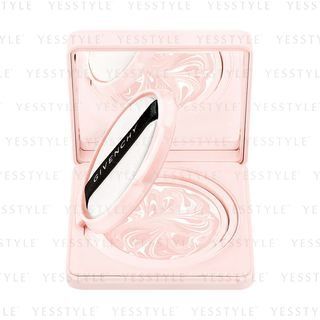
Givenchy Skin Perfecto Compact Cream SPF 15 PA+
Works for
1 of 2 advertised claims delivered
Sun protectionSPF 15 · 5 UV filters · Partial spectrumWeak protectionSPF under 30
This product does not offer good protection against UVA rays.
Moisturizing9 ingredients credited for this claimGood support
“The cool, comfortable texture of pink and white that melts like a marble fills the skin with moisture and complexion, keeping it fresh and lustrous.”
This product can help improve hydration of the skin with the two types of ingredients.
The first type is called “humectants”:
these ingredients help attract water.
When humectants are on the surface of the skin, they “pull in” the moisture from the outside environment, or from
within deeper layers of the skin. The following ingredients in this product do the job:
glycerin, butylene glycol.
This product also contains ingredients called “occlusives”. They help reduce the speed with which our skin loses moisture to the outside environment. These ingredients also help soften the upper layer of the skin, so it feels less tight and nicer to the touch. The following ingredients in this product do the job: caprylic/capric triglyceride, dimethicone.
Can it cause trouble?
Irritancy6 strong irritants: Parfum, Sorbitan sesquioleate + 4 more — patch-test recommendedHigh risk
Comedogenic1 ingredient rated 2 or more on the 0–5 pore-clogging scale1 flagged
User reviews
Be the first — your take helps the next person decide.
Ingredients
Filter by role to see what each ingredient is doing.
Water~45–55%
Ethylhexyl methoxycinnamate~5.6–6.9%
- Irritation risk
- High
Octinoxate. When used in higher concentrations, works as a sunscreen protecting the skin from UVB rays. When used in lower concentration, helps to preserve the product formulation. Is shown to be harmful to coral reefs - consider avoiding bathing in coral reef areas when wearing a product with this ingredient. It can be irritating
More about Ethylhexyl methoxycinnamateGlycerin~4.2–5.2%
- Irritation risk
- Low
One of the best moisturizing ingredients. Naturally present in skin. It attracts water to the upper layer of the skin working as a humectant
More about GlycerinCaprylic/capric triglyceride~3.3–4%
- Irritation risk
- Medium
A good mix of fatty acids that forms a protective layer on the skin. Improves the shelf life of products. Derived from coconut and glycerin
More about Caprylic/capric triglycerideDicaprylyl carbonate~2.4–3%
- Irritation risk
- Low
Helps products spread more easily and works as an emollient to soften skin
More about Dicaprylyl carbonateButylene glycol~2–2.4%
- Irritation risk
- Low
Used to create a nice product texture and help delivery of other ingredients. Might be somewhat helpful in attracting water to the upper layer of the skin
More about Butylene glycolCandelilla cera~1.8–2.2%
- Irritation risk
- Low
Euphorbia cerifera wax~1.8–2.2%
- Irritation risk
- Low
Phenyl trimethicone~1.3–1.6%
- Irritation risk
- Low
A type of silicone that can decrease loss of moisture from the skin surface. It helps create a nice product texture
More about Phenyl trimethiconeHomosalate~1.5–1.8%
- Irritation risk
- Medium
A weak sunscreen that offers some protection against the sun rays that cause sunburn (UVB), but does not offer meaningful protection against protect against the most aging sun rays (UVA). It loses its effectiveness quickly when exposed to sunlight. It is an organic, or so called "chemical" sunscreen. When used in low concentrations, helps to stabilize the product formulation
More about HomosalateZinc oxide~1.3–1.6%
- Irritation risk
- Low
A broad spectrum sunblock (protects from both UVA and UVB rays). Is suitable for most sensitive skins. In small concentrations, can be used as a colorant
More about Zinc oxideDimethicone~0.65–1%
- Irritation risk
- Low
A silicone that helps to reduce water loss from the surface of the skin. Can temporarily "fill in" lines and wrinkles, absorb oil, and create a nice product finish
More about DimethiconeEthylhexyl salicylate~0.75–1.15%
- Irritation risk
- Low
Octisalate. A UV filter. It offers some protection against the sun rays that cause sunburn (UVB), but does not protect against the most aging sun rays (UVA). It loses its effectiveness quickly when exposed to sunlight. It is an organic, or so called "chemical" sunscreen
More about Ethylhexyl salicylateTitanium dioxide~0.7–1%
- Irritation risk
- Low
Works as a UV filter when used in high concentrations. It is photostable and is effective mostly against the UVB light, with some protection in the UVA range. In small concentrations, used for its ability to improve the color of cosmetic products. Is usually well tolerated by the skin
More about Titanium dioxideMica~0.5–0.75%
- Irritation risk
- Low
Creates an illusion of smoother and more radiant skin tone. Adds shimmer to the skin by reflecting light
More about MicaOzokerite~0.5–0.7%
Ci 77891~0.5–0.7%
- Irritation risk
- Low
Titanium dioxide~0.5–0.75%
- Irritation risk
- Low
Works as a UV filter when used in high concentrations. It is photostable and is effective mostly against the UVB light, with some protection in the UVA range. In small concentrations, used for its ability to improve the color of cosmetic products. Is usually well tolerated by the skin
More about Titanium dioxideSynthetic fluorphlogopite~0.4–0.6%
- Irritation risk
- Low
A mineral that is used as an optical filter (makes the skin looks nicer through light reflection) and to improve the texture of cosmetic products
More about Synthetic fluorphlogopiteCetyl peg/ppg-10/1 dimethicone~0.3–0.6%
- Irritation risk
- Low
A type of silicone that helps water and oil mix together. Can help to soften upper layer of the skin
More about Cetyl peg/ppg-10/1 dimethiconePhenoxyethanol~0.3–0.55%
- Irritation risk
- Low
A preservative. It helps prevent bacterial growth in cosmetic products
More about PhenoxyethanolMyristyl myristate~0.3–0.55%
- Irritation risk
- Medium
- Comedogenicity
- 3/5
An emollient. Is not recommended for acne-prone skin as it can be comedogenic
More about Myristyl myristateParfum~0.25–0.45%
- Irritation risk
- High
An aromatic blend of unspecified and possibly irritating ingredients
More about ParfumSorbitan sesquioleate~0.3–0.55%
- Irritation risk
- High
Used to help oil and water mix together. Can be irritating
More about Sorbitan sesquioleateDimethicone/peg-10/15 crosspolymer~0.25–0.5%
C30-45 alkyl methicone~0.3–0.55%
- Irritation risk
- Low
Triethoxycaprylylsilane~0.25–0.5%
- Irritation risk
- Low
A type of silicone that helps oil and water mix well together. Helps to disperse other ingredients, e.g. pigments, evenly in a formulation
More about TriethoxycaprylylsilaneC30-45 olefin~0.25–0.5%
- Irritation risk
- Low
Ethylhexylglycerin~0.25–0.5%
Schinus terebinthifolia seed extract~0.25–0.45%
- Irritation risk
- Low
Hexadecene~0.25–0.5%
- Irritation risk
- Low
Ascorbyl glucoside~0.25–0.5%
- Irritation risk
- Medium
A vitamin C derivative that is more stable but less potent than pure form of vitamin C. Has a potential to boost collagen production, nutralise free radicals and reduce hyperpigmentation, but the required concentration is likely to be much higher than for the pure form of vitamin C, limiting the ingredient's effectiveness in products
More about Ascorbyl glucosideXanthan gum~0.25–0.5%
- Irritation risk
- Low
Used to create a thicker product consistency
More about Xanthan gumHydroxycitronellal~0.25–0.4%
- Irritation risk
- High
A fragrance. A likely allergen and can be irritating
More about HydroxycitronellalCi 77491~0.25–0.45%
- Irritation risk
- Low
A red colorant made of iron oxide. Typically is not irritating
More about Ci 77491Iron oxides~0.25–0.4%
- Irritation risk
- Low
An umbrella term for the following three colorants: CI 77491, CI 77492, CI 77499. They might be able to offer some protection against visible light, but the degree of the protection is not clear
More about Iron oxidesLimonene~0.2–0.35%
- Irritation risk
- High
A common frangrance that can easily irritate skin, especially if exposed to air, light or heat
More about LimoneneDipropylene glycol~0.2–0.35%
- Irritation risk
- Low
Helps to dissolve other ingredients in a formulation. Slows down the rate of product drying
More about Dipropylene glycolCitronellol~0.2–0.35%
Angelica keiskei extract~0.2–0.4%
- Irritation risk
- Low
Geranyl linalool~0.15–0.25%
- Irritation risk
- Low
Sodium citrate~0.15–0.3%
- Irritation risk
- Medium
Helps to control the skin's pH level. Maintains the skin's natural film of amino-lactic acids and oils. Helps to preserve products
More about Sodium citrateTocopherol~0.15–0.3%
- Irritation risk
- Low
Pure form of vitamin E. Can help moisturise and protect the skin from free radicals. Often used to help stabilise other ingredients or the formula itself
More about TocopherolCitral~0.1–0.15%
Pentaerythrityl tetra-di-t-butyl hydroxyhydrocinnamate~0.15–0.25%
- Irritation risk
- Low
Used to increase stability of product formulations
More about Pentaerythrityl tetra-di-t-butyl hydroxyhydrocinnamateIngredient list view
Water, Ethylhexyl methoxycinnamate, Glycerin, Caprylic/capric triglyceride, Dicaprylyl carbonate, Butylene glycol, Candelilla cera, Euphorbia cerifera wax, Phenyl trimethicone, Homosalate, Zinc oxide, Dimethicone, Ethylhexyl salicylate, Titanium dioxide, Mica, Ozokerite, Ci 77891, Titanium dioxide, Synthetic fluorphlogopite, Cetyl peg/ppg-10/1 dimethicone, Phenoxyethanol, Myristyl myristate, Parfum, Sorbitan sesquioleate, Dimethicone/peg-10/15 crosspolymer, C30-45 alkyl methicone, Triethoxycaprylylsilane, C30-45 olefin, Ethylhexylglycerin, Schinus terebinthifolia seed extract, Hexadecene, Ascorbyl glucoside, Xanthan gum, Hydroxycitronellal, Ci 77491, Iron oxides, Limonene, Dipropylene glycol, Citronellol, Angelica keiskei extract, Geranyl linalool, Sodium citrate, Tocopherol, Citral, Pentaerythrityl tetra-di-t-butyl hydroxyhydrocinnamate
Compare prices
Retailers ranked by price — lowest first.

Affiliate links · prices updated regularly
Product summary
"Givenchy - Skin Perfecto Compact Cream SPF 15 PA+" does not provide enough UVA protection. UVA rays do not cause sunburn, but still damage the skin, leading to early signs of aging and pigmentation issues.
Its formula is also hydrating, so you might not need an additional moistruizer during the day.
Sunscreen filters
This is a so-called "chemical" sunscreen. It means that it uses organic UV filters. They typically offer good sun protection and rarely leave a white cast, but they can be irritating for some people with sensitive skin. The UV filters in this sunscreen are: octinoxate 5.60% - 6.90%.
Irritation risk
There are quite a few common irritants in this product, including ingredients without particular skin benefits. We would not recommend it for sensitive skin. We assess the overall irritancy of this moisturizer to be high. For a detailed overview of all potential irritants: click here
You can see the detailed formula review with the breakdown of all actives in the product and the full ingredient list with estimated concentrations in the tables below.
Price
The product retails for 114.93$ in the United States.
For a detailed price comparison: click here.
Sources cited in this review
Every concentration estimate and effectiveness label is anchored to one of these 15 studies and safety reviews.
- 1
- 2
- 3A review of inorganic UV filters zinc oxide and titanium dioxideonlinelibrary.wiley.com
- 4
- 5
- 6

Affiliate links · As an Amazon Associate, WIMJ earns from qualifying purchases.