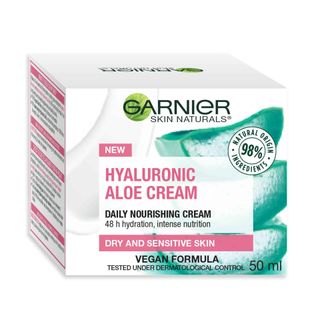
Garnier Hyaluronic Aloe Cream
Works for
1 of 1 advertised claim delivered
Moisturizing12 ingredients credited for this claimGood support
“Hyaluronic Aloe Cream”
This product can help improve hydration of the skin with the two types of ingredients.
The first type is called “humectants”:
these ingredients help attract water.
When humectants are on the surface of the skin, they “pull in” the moisture from the outside environment, or from
within deeper layers of the skin. The following ingredients in this product do the job:
glycerin, sodium hyaluronate.
This product also contains ingredients called “occlusives”. They help reduce the speed with which our skin loses moisture to the outside environment. These ingredients also help soften the upper layer of the skin, so it feels less tight and nicer to the touch. The following ingredients in this product do the job: butyrospermum parkii butter, caprylic/capric triglyceride.
Can it cause trouble?
Irritancy2 strong irritants: Alcohol denat., ParfumMedium risk
Comedogenic5 ingredients rated 2 or more on the 0–5 pore-clogging scale5 flagged


User reviews
Be the first — your take helps the next person decide.
Ingredients
Filter by role to see what each ingredient is doing.
Water~45–55%
Butyrospermum parkii butter~6.4–7.9%
- Irritation risk
- Low
- Comedogenicity
- 3/5
A great moisturising ingredient that softens the skin and reduces water loss from its upper layer. It also can be helpful in protecting skin from free radicals
More about Butyrospermum parkii butterGlycerin~4.2–5.2%
- Irritation risk
- Low
One of the best moisturizing ingredients. Naturally present in skin. It attracts water to the upper layer of the skin working as a humectant
More about GlycerinCaprylic/capric triglyceride~3.3–4.1%
- Irritation risk
- Medium
A good mix of fatty acids that forms a protective layer on the skin. Improves the shelf life of products. Derived from coconut and glycerin
More about Caprylic/capric triglycerideDicaprylyl ether~2.4–3%
- Irritation risk
- Low
Helps soften the upper layer of the skin while creating a non-greasy feel on the skin. Helps to dissolve other ingredients
More about Dicaprylyl etherAlcohol denat.~2–2.4%
- Irritation risk
- High
Produces temporary toning effect. Can help dissolve other ingredients or preserve products
More about Alcohol denat.Glyceryl stearate se~1.7–2.1%
- Irritation risk
- Low
- Comedogenicity
- 2/5
Used to stabilize the product formulations and works as an emollient
More about Glyceryl stearate sePolyglyceryl-3 methylglucose distearate~1.5–1.8%
- Irritation risk
- Medium
Helps water and oil mix together
More about Polyglyceryl-3 methylglucose distearateZea mays starch~1.2–1.4%
- Irritation risk
- Medium
- Comedogenicity
- 3/5
Used to thicken the product's consistency
More about Zea mays starchStearyl alcohol~1–1.3%
- Irritation risk
- Low
An emollient that helps soften the skin
More about Stearyl alcoholGlycine soja oil~0.7–1.05%
- Irritation risk
- Medium
- Comedogenicity
- 2/5
A good emollient that helps soften the skin and helps repair its barrier function. It can clog pores if used in high concentrations.
More about Glycine soja oilAloe barbadensis leaf juice powder~0.55–0.8%
- Irritation risk
- Medium
Traditionally used to treat sunburns, dermatitis and inflammation, but evidence for its effectiveness is lacking. The extract can contain humectants that help attract water into the skin
More about Aloe barbadensis leaf juice powderVitis vinifera fruit water~0.5–0.75%
- Irritation risk
- Low
Stearic acid~0.6–0.85%
- Irritation risk
- Low
Helps oil and water mix together and works as an emollient
More about Stearic acidCarbomer~0.45–0.65%
- Irritation risk
- Low
Helps create a thicker or gel-like product texture. It is not a surfactant but can be used in gentle cleansing formulations
More about CarbomerSodium hyaluronate~0.4–0.6%
- Irritation risk
- Low
One of the best moisturizing ingredients. Attracts water into the upper layer of the skin
More about Sodium hyaluronateSodium hydroxide~0.3–0.55%
Sodium phytate~0.25–0.5%
Myristic acid~0.3–0.55%
- Irritation risk
- Medium
- Comedogenicity
- 3/5
Helps oil and water mix together. Could be comedogenic
More about Myristic acidPalmitic acid~0.3–0.5%
- Irritation risk
- Low
An emollient that is naturally present in skin and helps soften it
More about Palmitic acidCaprylyl glycol~0.2–0.4%
- Irritation risk
- Medium
Helps preserve products and creates a nice product texture
More about Caprylyl glycolCitric acid~0.15–0.3%
- Irritation risk
- Medium
Can work as an exfoliant but is typically used to adjust the product pH
More about Citric acidXanthan gum~0.15–0.25%
- Irritation risk
- Low
Used to create a thicker product consistency
More about Xanthan gumTocopherol~0.15–0.25%
- Irritation risk
- Low
Pure form of vitamin E. Can help moisturise and protect the skin from free radicals. Often used to help stabilise other ingredients or the formula itself
More about TocopherolSalicylic acid~0.1–0.2%
- Irritation risk
- High
Used for skin exfoliation. It has an anti-inflammatory and anti-bacterial effect, helps to unclog pores, prevent blemishes and speed up healing of the existing ones. Sometimes referred to as a BHA (beta-hydroxy acid)
More about Salicylic acidParfum~0.05–0.1%
- Irritation risk
- High
An aromatic blend of unspecified and possibly irritating ingredients
More about ParfumIngredient list view
Water, Butyrospermum parkii butter, Glycerin, Caprylic/capric triglyceride, Dicaprylyl ether, Alcohol denat., Glyceryl stearate se, Polyglyceryl-3 methylglucose distearate, Zea mays starch, Stearyl alcohol, Glycine soja oil, Aloe barbadensis leaf juice powder, Vitis vinifera fruit water, Stearic acid, Carbomer, Sodium hyaluronate, Sodium hydroxide, Sodium phytate, Myristic acid, Palmitic acid, Caprylyl glycol, Citric acid, Xanthan gum, Tocopherol, Salicylic acid, Parfum
Compare prices
Retailers ranked by price — lowest first.

Worth comparing, line by line.
Match % combines shared ingredients, the first five ingredients, shared actives and hero ingredients, irritancy (lower counts in the alternative's favour), texture and body area. Only products in the same routine step are compared.
| GarnierHyaluronic Aloe CreamYOUR PRODUCT | BeautycounterCountermatch Recovery Sleeping Cream | VichyLiftActiv Supreme Anti-Wrinkle and Hydrating Face Cream for Dry Skin | Medipharma CosmeticsHaut in Balance Pigment/Age Spot Reducing Treatment Cream | |
|---|---|---|---|---|
| Match | — | 96% | 90% | 90% |
| Price | $13.18 | $62.00+$48.82 | $42.00+$28.82 | $27.50+$14.32 |
| Shared key ingredients | — | 5 of 6 | 4 of 6 | 4 of 6 |
| Key difference | — | Betaine | Meadowfoam Seed Oil | Lactic Acid |
| Irritancy | Medium | Low | Medium | Medium |
| Drying alcohol | Contains drying alcohol | — | Contains drying alcohol | Contains drying alcohol |
| View product | Shop | Shop | Shop |


Sources cited in this review
Every concentration estimate and effectiveness label is anchored to one of these 10 studies and safety reviews.
- 1
- 2Hyaluronic acid: A key molecule in skin agingncbi.nlm.nih.gov
- 3
- 4
- 5Vitamin E in dermatologyncbi.nlm.nih.gov
- 6Vitamin E and Skin Healthlpi.oregonstate.edu

Affiliate links · As an Amazon Associate, WIMJ earns from qualifying purchases.