Works for
1 of 1 advertised claim delivered
MoisturizingArginine, Glycerin + 11 moreGood evidence
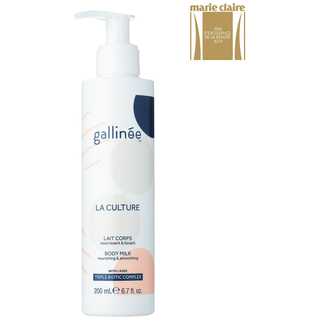
“Harnessing the nourishing benefits of a cream in a lightweight fluid texture, the Gallinée Probiotic Body Milk offers lasting soothing and moisturising benefits to dry-feeling skin.”
This product can help improve hydration of the skin with the two types of ingredients.
The first type is called “humectants”:
these ingredients help attract water.
When humectants are on the surface of the skin, they “pull in” the moisture from the outside environment, or from
within deeper layers of the skin. The following ingredients in this product do the job:
arginine, glycerin.
This product also contains ingredients called “occlusives”. They help reduce the speed with which our skin loses moisture to the outside environment. These ingredients also help soften the upper layer of the skin, so it feels less tight and nicer to the touch. The following ingredients in this product do the job: arginine, cetyl alcohol.
ExfoliationNot advertised by the brand · Lactic acidStrong evidence
This product can help exfoliate the skin. In other words, it helps break down the bonds between dead cells on the surface of the skin and speed up the skin turnover. Skin often appears softer and brighter after exfoliation, but overdoing it can result in disrupted skin barrier. The following ingredient is doing the exfoliating job in this product: lactic acid.
Evens skin toneNot advertised by the brand · Lactic acidStrong evidence
This product can help reduce hypepigmentation and even out the skin tone because it contains the following effective ingredients: lactic acid
Keep in mind that you would need to apply any topical skincare targetted at hypigmentation consistently for a couple of months to get a result. No topical skincare product can help get rid of hyperpigmentation (including post-acne marks and age spots) instantly.
Anti-agingNot advertised by the brand · Lactic acid, Aloe barbadensis leaf juiceModerate evidence
This product contains lactic acid. This ingredient might be able to help reduce and prevent fine lines and wrinkles, improve skin elasticity and firmness, but there is not enough evidence that it actually works.
Can it cause trouble?
Irritancy3 strong irritants: Parfum, Alcohol + 1 more — patch-test recommendedHigh risk
Comedogenic3 ingredients rated 2 or more on the 0–5 pore-clogging scale3 flagged


User reviews
Be the first — your take helps the next person decide.
Ingredients
Filter by role to see what each ingredient is doing.
Water~45–55%
Propanediol~5.5–6.7%
- Irritation risk
- Low
Acts as a solvent for other ingredients. Speeds up the absorption of other ingredients into the skin
More about PropanediolIsopropyl palmitate~4–4.9%
- Irritation risk
- Medium
- Comedogenicity
- 3/5
Helps soften the upper layer of the skin and create a thicker product consistency
More about Isopropyl palmitateAlpha-glucan oligosaccharide~3.6–4.4%
- Irritation risk
- Low
Helps attract water to the upper layer of the skin
More about Alpha-glucan oligosaccharideC14-22 alcohols~2.3–2.8%
- Irritation risk
- Low
A non-drying alcohol that helps stabilize product formulations
More about C14-22 alcoholsLactic acid~1.9–2.3%
- Irritation risk
- Medium
An exfoliating and moisturizing alpha-hydroxy acid (AHA). Typically causes less irritation than other AHAs, for example, glycolic acid. At high concentrations (about 15%), lactic acid can help reduce lines and wrinkles. Recent studies show that lactic acid can support the "good" bacteria living on skin's surface (healthy skin microbiome)
More about Lactic acidGlycerin~1.7–2.1%
- Irritation risk
- Low
One of the best moisturizing ingredients. Naturally present in skin. It attracts water to the upper layer of the skin working as a humectant
More about GlycerinAmmonium acryloyldimethyltaurate/vp copolymer~1.4–1.8%
- Irritation risk
- Low
Increases thickness of a product. Texture enhancer for oil-in-water emulsions
More about Ammonium acryloyldimethyltaurate/vp copolymerPrunus amygdalus dulcis seed~1.1–1.4%
- Irritation risk
- Low
Helps soften the upper layer of the skin
More about Prunus amygdalus dulcis seedCetyl alcohol~1–1.2%
- Irritation risk
- Low
A non-drying alcohol that works to soften the skin and stabilize product formulations helping oil and water mix together
More about Cetyl alcoholNylon-12~0.8–1.15%
Pentylene glycol~0.6–0.95%
- Irritation risk
- Medium
Used to preserve products, dissolve other ingredients and create a nice product texture
More about Pentylene glycolInulin~0.5–0.8%
- Irritation risk
- Low
Helps attract water to the upper layer of the skin. Is claimed to support the growth of "good" bacteria in skin (as a "prebiotic"), but the research is lacking
More about InulinPolymnia sonchifolia root juice~0.5–0.75%
- Irritation risk
- High
A plant extract that helps attract water to the upper layer of the skin and might have some anti-oxidant properties
More about Polymnia sonchifolia root juiceTocopheryl acetate~0.45–0.7%
- Irritation risk
- Medium
A more stable but less bio-available form of vitamin E compared to Tocopherol. Might help moisturize and protect the skin from free radicals, but mostly used in low concentrations to stabilize other ingredients.
More about Tocopheryl acetateMaltodextrin~0.45–0.7%
- Irritation risk
- Low
Used to stabilize the product formulation and can help absorb oil
More about MaltodextrinArginine~0.4–0.65%
- Irritation risk
- Low
An amino acid that is naturally present in skin and helps keep it hydrated. When used together with AHAs, it can reduce their irritating effect on the skin
More about ArginineAloe barbadensis leaf juice~0.35–0.65%
- Irritation risk
- Medium
Traditionally used to treat sunburns, dermatitis and inflammation, but evidence for its effectiveness is lacking. The extract can contain humectants that help attract water into the skin
More about Aloe barbadensis leaf juiceMenyanthes trifoliata leaf extract~0.3–0.6%
- Irritation risk
- Low
Aesculus hippocastanum seed extract~0.3–0.55%
- Irritation risk
- High
Plant extract. Might have some anti-oxidant properties. Can be irritating
More about Aesculus hippocastanum seed extractPalmaria palmata extract~0.25–0.5%
- Irritation risk
- Low
- Comedogenicity
- 3/5
Red algae extract that helps attract water to the upper layer of the skin
More about Palmaria palmata extractSodium acrylate/sodium acryloyldimethyl taurate copolymer~0.25–0.45%
- Irritation risk
- Low
Used to create a thicker product consistency
More about Sodium acrylate/sodium acryloyldimethyl taurate copolymerC12-20 alkyl glucoside~0.2–0.4%
- Irritation risk
- Medium
Helps water and oil mix together
More about C12-20 alkyl glucosideIsohexadecane~0.3–0.55%
- Irritation risk
- Low
Improves the texture of the product and helps soften the skin. Helps oil and water mix together and can be used as a cleansing agent
More about IsohexadecaneParfum~0.15–0.25%
- Irritation risk
- High
An aromatic blend of unspecified and possibly irritating ingredients
More about ParfumPolysorbate 80~0.2–0.35%
Sorbitan oleate~0.15–0.3%
- Irritation risk
- Medium
- Comedogenicity
- 2/5
Helps oil and water mix together
More about Sorbitan oleateAlcohol~0.1–0.25%
- Irritation risk
- High
Can be drying and contribute to skin irritation. Used in formulars to dissolve other ingredients, create a thinner product consistency or for its antibacterial properties
More about AlcoholEthylhexylglycerin~0.1–0.2%
Tetrasodium glutamate diacetate~0.05–0.15%
- Irritation risk
- Low
Helps stabilize the product formulation
More about Tetrasodium glutamate diacetateSodium hydroxide~0.05–0.1%
Limonene~0.05%
- Irritation risk
- High
A common frangrance that can easily irritate skin, especially if exposed to air, light or heat
More about LimoneneIngredient list view
Water, Propanediol, Isopropyl palmitate, Alpha-glucan oligosaccharide, C14-22 alcohols, Lactic acid, Glycerin, Ammonium acryloyldimethyltaurate/vp copolymer, Prunus amygdalus dulcis seed, Cetyl alcohol, Nylon-12, Pentylene glycol, Inulin, Polymnia sonchifolia root juice, Tocopheryl acetate, Maltodextrin, Arginine, Aloe barbadensis leaf juice, Menyanthes trifoliata leaf extract, Aesculus hippocastanum seed extract, Palmaria palmata extract, Sodium acrylate/sodium acryloyldimethyl taurate copolymer, C12-20 alkyl glucoside, Isohexadecane, Parfum, Polysorbate 80, Sorbitan oleate, Alcohol, Ethylhexylglycerin, Tetrasodium glutamate diacetate, Sodium hydroxide, Limonene
Compare prices
Retailers ranked by price — lowest first.
Affiliate links · prices updated regularly · As an Amazon Associate, WIMJ earns from qualifying purchases.
Worth comparing, line by line.
Match % combines shared ingredients, the first five ingredients, shared actives and hero ingredients, irritancy (lower counts in the alternative's favour), texture and body area. Only products in the same routine step are compared.
| GallinéeProbiotic Body MilkYOUR PRODUCT | By WishtrendVitamin A-mazing Bakuchiol Body Lotion | DCLC-Scape High Potency Body Lotion | |
|---|---|---|---|
| Match | — | 53% | 50% |
| Price | $27.99 | — | $40.00+$12.01 |
| Shared key ingredients | — | 2 of 7 | 2 of 7 |
| Key difference | — | Niacinamide | Tetrahexyldecyl Ascorbate |
| Irritancy | High | Medium | High |
| Drying alcohol | Contains drying alcohol | — | — |
| View product | Shop | Shop |

Sources cited in this review
Every concentration estimate and effectiveness label is anchored to one of these 9 studies and safety reviews.
- 1Final Report on the Safety Assessment of Isopropyl Isostearatejournals.sagepub.com
- 2Epidermal and dermal effects of topical lactic acidncbi.nlm.nih.gov
- 3Dual Effects of Alpha-Hydroxy Acids on the Skinpdfs.semanticscholar.org
- 4
- 5
- 6

Affiliate links · As an Amazon Associate, WIMJ earns from qualifying purchases.