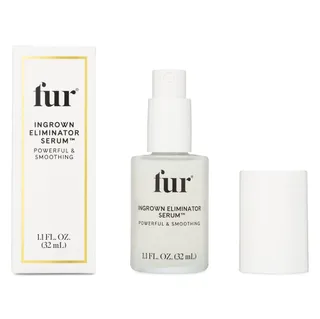
Works for
MoisturizingLactic acid, Galactoarabinan + 3 moreWorks
“The final touch is an infusion antimicrobial cold-pressed aloe juice that hydrates and restores suppleness to your skin.”
This product contains good ingredients to attract water to the upper layer of the skin. These ingredients are called "humectants": galactoarabinan, glycerin.
When humectants are on the surface of the skin, they “pull in” the moisture from the outside environment, or from within deeper layers of the skin. If the air is dry, humectants can speed up the moisture loss from the skin. This is why it is a good idea to use another product on top of this one to help "seal in" the moisture (look for ingredients like dimethicone, squalane, oils and butters).
ExfoliationSide benefit the brand mentions · Lactic acid, Salix alba bark extractWorks well
“Lactic acid breaks the bonds between dead skin cells to promote a brighter, more even tone, while antibacterial lavender oil soothes irritated skin and promotes healing.”
This product can help exfoliate the skin. In other words, it helps break down the bonds between dead cells on the surface of the skin and speed up the skin turnover. Skin often appears softer and brighter after exfoliation, but overdoing it can result in disrupted skin barrier. The following ingredient is doing the exfoliating job in this product: lactic acid.
Anti-agingSide benefit · Lactic acid, Aloe barbadensis leaf juiceMay help
This product contains lactic acid. This ingredient might be able to help reduce and prevent fine lines and wrinkles, improve skin elasticity and firmness, but there is not enough evidence that it actually works.
Can it cause trouble?
Irritancy6 strong irritants: Hamamelis virginiana extract, Lavandula angustifolia oil + 4 more — patch-test recommendedHigh risk
ComedogenicClean of flagged comedogenic ingredientsNone flagged


User reviews
Be the first — your take helps the next person decide.
Ingredients
Filter by role to see what each ingredient is doing.
Water~40–60%
Hamamelis virginiana extract~4.6–6.9%
- Irritation risk
- High
A plant extract that can help calm down inflammation in skin. Can, however, itself be irritating
More about Hamamelis virginiana extractSalix alba bark extract~3.5–5.2%
- Irritation risk
- High
A plant extract that can help neutralize free radicals in skin. It contains a compound salicin that can theoretically be converted into salicylic acid that, in turn, helps reduce inflammation in skin, but the evidence of effectiveness in skin is lacking and the extract is usually not used in a concentration that would enable an exfoliating effect
More about Salix alba bark extractAloe barbadensis leaf juice~2.7–4%
- Irritation risk
- Medium
Traditionally used to treat sunburns, dermatitis and inflammation, but evidence for its effectiveness is lacking. The extract can contain humectants that help attract water into the skin
More about Aloe barbadensis leaf juiceLactic acid~2–3%
- Irritation risk
- Medium
An exfoliating and moisturizing alpha-hydroxy acid (AHA). Typically causes less irritation than other AHAs, for example, glycolic acid. At high concentrations (about 15%), lactic acid can help reduce lines and wrinkles. Recent studies show that lactic acid can support the "good" bacteria living on skin's surface (healthy skin microbiome)
More about Lactic acidPhytic acid~1.7–2.5%
- Irritation risk
- Medium
An alpha-hydroxy acid (AHA), but is mostly used to stabilize product formulations in cosmetics
More about Phytic acidPolyglyceryl-6 caprylate~1.4–2.1%
- Irritation risk
- Medium
Helps oil and water mix together
More about Polyglyceryl-6 caprylatePolyglyceryl-3 cocoate~1.3–1.9%
- Irritation risk
- Medium
Helps oil and water mix together
More about Polyglyceryl-3 cocoatePolyglyceryl-4 caprate~1–1.45%
Polyglyceryl-6 ricinoleate~0.8–1.2%
- Irritation risk
- Medium
Helps oil and water mix together
More about Polyglyceryl-6 ricinoleateGalactoarabinan~0.5–1.15%
- Irritation risk
- Medium
Helps attract water to the upper layer of the skin
More about GalactoarabinanGlycerin~0.45–1%
- Irritation risk
- Low
One of the best moisturizing ingredients. Naturally present in skin. It attracts water to the upper layer of the skin working as a humectant
More about GlycerinPhenoxyethanol~0.35–0.8%
- Irritation risk
- Low
A preservative. It helps prevent bacterial growth in cosmetic products
More about PhenoxyethanolEthylhexylglycerin~0.3–0.7%
Saccharide isomerate~0.15–0.7%
- Irritation risk
- Low
Helps attract water to the upper layer of the skin
More about Saccharide isomerateCitric acid~0.15–0.55%
- Irritation risk
- Medium
Can work as an exfoliant but is typically used to adjust the product pH
More about Citric acidSodium citrate~0.15–0.5%
- Irritation risk
- Medium
Helps to control the skin's pH level. Maintains the skin's natural film of amino-lactic acids and oils. Helps to preserve products
More about Sodium citrateLavandula angustifolia oil~0.1–0.35%
- Irritation risk
- High
An essential oil. Potential allergen and can be irritating. It has some anti-bacterial properties
More about Lavandula angustifolia oilSalvia sclarea oil~0.05–0.3%
- Irritation risk
- High
Hydroxyethylcellulose~0.05–0.25%
- Irritation risk
- Low
Used to thicken product formulations and create gel-like textures
More about HydroxyethylcelluloseLinalool~0.05–0.15%
Limonene~0.05–0.1%
- Irritation risk
- High
A common frangrance that can easily irritate skin, especially if exposed to air, light or heat
More about LimoneneGeraniol~0.01–0.05%
Ingredient list view
Water, Hamamelis virginiana extract, Salix alba bark extract, Aloe barbadensis leaf juice, Lactic acid, Phytic acid, Polyglyceryl-6 caprylate, Polyglyceryl-3 cocoate, Polyglyceryl-4 caprate, Polyglyceryl-6 ricinoleate, Galactoarabinan, Glycerin, Phenoxyethanol, Ethylhexylglycerin, Saccharide isomerate, Citric acid, Sodium citrate, Lavandula angustifolia oil, Salvia sclarea oil, Hydroxyethylcellulose, Linalool, Limonene, Geraniol
Compare prices
Retailers ranked by price — lowest first.
Affiliate links · As an Amazon Associate, WIMJ earns from qualifying purchases.
Worth comparing, line by line.
Match % combines shared ingredients, the first five ingredients, shared actives and hero ingredients, irritancy (lower counts in the alternative's favour), texture and body area. Only products in the same routine step are compared.
| FurIngrown Eliminator SerumYOUR PRODUCT | RéViveSupérieur Body Nightly Renewing Serum | Renee RouleauSmoothing Body Serum | PRIORI SkincareLCA fx130 Eye Serum | |
|---|---|---|---|---|
| Match | — | 60% | 59% | 59% |
| Price | $37.00 | $154.60+$117.60 | — | — |
| Shared key ingredients | — | 2 of 5 | 2 of 5 | 2 of 5 |
| Key difference | — | Niacinamide | Glycolic Acid | Salicylic Acid |
| Irritancy | High | Medium | Low | Medium |
| Drying alcohol | — | — | — | — |
| View product | Shop | Shop | Shop |


More alternatives: Tula Instant De-Puff Eye Renewal SerumDR SEA Anti-Aging Eye Serum - Camu Camu and Q10
Sources cited in this review
Every concentration estimate and effectiveness label is anchored to one of these 11 studies and safety reviews.
- 1
- 2
- 3
- 4Efficacy and Safety of White Willow Bark (Salix alba) Extractonlinelibrary.wiley.com
- 5
- 6Epidermal and dermal effects of topical lactic acidncbi.nlm.nih.gov

Affiliate links · As an Amazon Associate, WIMJ earns from qualifying purchases.