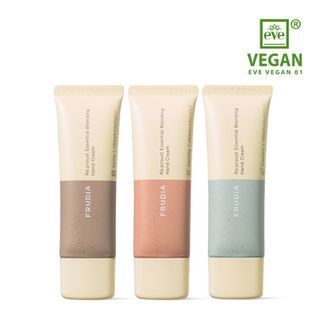
FRUDIA Re:proust Essential Blending Hand Cream - 3 Types
Works for
1 of 1 advertised claim delivered
MoisturizingGlycerin, Hippophae rhamnoides oil + 12 moreGood evidence
“Re proust Essential Blending Hand Cream , 3 Types”
This product can help improve hydration of the skin with the two types of ingredients.
The first type is called “humectants”:
these ingredients help attract water.
When humectants are on the surface of the skin, they “pull in” the moisture from the outside environment, or from
within deeper layers of the skin. The following ingredients in this product do the job:
glycerin, butylene glycol.
This product also contains ingredients called “occlusives”. They help reduce the speed with which our skin loses moisture to the outside environment. These ingredients also help soften the upper layer of the skin, so it feels less tight and nicer to the touch. The following ingredients in this product do the job: caprylic/capric triglyceride, dimethicone.
Can it cause trouble?
Irritancy10 strong irritants: Lavandula angustifolia oil, Citrus nobilis peel oil + 8 more — patch-test recommendedHigh risk
Comedogenic2 ingredients rated 2 or more on the 0–5 pore-clogging scale2 flagged
User reviews
Be the first — your take helps the next person decide.
Ingredients
Filter by role to see what each ingredient is doing.
Water~40–60%
Glycerin~4.3–6.5%
- Irritation risk
- Low
One of the best moisturizing ingredients. Naturally present in skin. It attracts water to the upper layer of the skin working as a humectant
More about GlycerinEthylhexyl palmitate~3.6–5.4%
- Irritation risk
- Low
- Comedogenicity
- 3/5
An emollient that helps soften the skin and create a nice product texture
More about Ethylhexyl palmitateCetyl alcohol~2.2–3.3%
- Irritation risk
- Low
A non-drying alcohol that works to soften the skin and stabilize product formulations helping oil and water mix together
More about Cetyl alcoholCaprylic/capric triglyceride~2.1–3.2%
- Irritation risk
- Medium
A good mix of fatty acids that forms a protective layer on the skin. Improves the shelf life of products. Derived from coconut and glycerin
More about Caprylic/capric triglyceridePolyglyceryl-10 laurate~1.7–2.5%
- Irritation risk
- Medium
Helps water and oil mix together
More about Polyglyceryl-10 laurateGlyceryl stearate~1.5–2.2%
- Irritation risk
- Low
An emollient that softens the skin and forms a protective layer on its surface. Helps water and oil mix together
More about Glyceryl stearateStearyl alcohol~1.3–2%
- Irritation risk
- Low
An emollient that helps soften the skin
More about Stearyl alcoholDimethicone~1.1–1.7%
- Irritation risk
- Low
A silicone that helps to reduce water loss from the surface of the skin. Can temporarily "fill in" lines and wrinkles, absorb oil, and create a nice product finish
More about DimethiconeCoptis japonica root extract~0.85–1.25%
- Irritation risk
- High
A plant extract that might have some anti-oxidant properties
More about Coptis japonica root extractGlyceryl caprylate~0.55–1.25%
- Irritation risk
- Low
An emollient that can also help water and oil mix together, as well as prevent bacteria growth in products
More about Glyceryl caprylateMyristyl alcohol~0.45–1.05%
- Irritation risk
- High
Helps to stabilize the product formulation while softening the upper layer of the skin. Can be irritating
More about Myristyl alcoholPalmitic acid~0.4–0.95%
- Irritation risk
- Low
An emollient that is naturally present in skin and helps soften it
More about Palmitic acidButylene glycol~0.35–0.8%
- Irritation risk
- Low
Used to create a nice product texture and help delivery of other ingredients. Might be somewhat helpful in attracting water to the upper layer of the skin
More about Butylene glycolStearic acid~0.4–0.95%
- Irritation risk
- Low
Helps oil and water mix together and works as an emollient
More about Stearic acidAcrylates/c10-30 alkyl acrylate crosspolymer~0.35–0.75%
- Irritation risk
- Medium
Maintains the texture of skincare products. Allows the product to spread evenly. Helps oil and water mix together
More about Acrylates/c10-30 alkyl acrylate crosspolymerTromethamine~0.2–0.8%
Lauryl alcohol~0.3–0.75%
Butyrospermum parkii butter~0.2–0.75%
- Irritation risk
- Low
- Comedogenicity
- 3/5
A great moisturising ingredient that softens the skin and reduces water loss from its upper layer. It also can be helpful in protecting skin from free radicals
More about Butyrospermum parkii butterMoringa oleifera seed oil~0.15–0.65%
- Irritation risk
- Medium
A plant oil that helps soften the upper layer of the skin. Is unlikely to be helpful in restoring skin barrier function due to the low content of linoleic acid
More about Moringa oleifera seed oilHippophae rhamnoides oil~0.15–0.65%
- Irritation risk
- High
A good emollient. Contains various ingredients including vitamins and fatty acids that could work in the skin to neutralize free radicals and minimize moisture loss - if enough of these compounds is able to penetrate the skin in an active form.
More about Hippophae rhamnoides oilDisodium edta~0.15–0.5%
Chlorphenesin~0.16–0.32%
1,2-hexanediol~0.1–0.45%
Cedrus atlantica wood oil~0.1–0.4%
- Irritation risk
- Low
Lavandula angustifolia oil~0.1–0.4%
- Irritation risk
- High
An essential oil. Potential allergen and can be irritating. It has some anti-bacterial properties
More about Lavandula angustifolia oilCitrus nobilis peel oil~0.1–0.4%
- Irritation risk
- High
A plant oil with high content of volatile compounds that, especially when exposed to air, can cause allergic reactions and irritate the skin
More about Citrus nobilis peel oilRosmarinus officinalis leaf oil~0.1–0.4%
- Irritation risk
- High
A plant oil with high content of volatile compounds that can irritate the skin. Can be used as a fragrance. Has anti-bacterial properties and might help neutralize free radicals on the surface of the skin
More about Rosmarinus officinalis leaf oilCitrus aurantium dulcis peel oil~0.1–0.4%
- Irritation risk
- High
An essentil oil from orange peel. Potential allergen and can be irritating
More about Citrus aurantium dulcis peel oilAnthemis nobilis flower oil~0.1–0.3%
- Irritation risk
- High
An essential oil that is used as a fragrance and can be irritating. It might have some anti-oxidant effect in skin
More about Anthemis nobilis flower oilCitrus aurantium bergamia fruit oil~0.05–0.3%
- Irritation risk
- High
A plant oil with a high content of volatile compounds that can irritate the skin and lead to allergic reactions. Can lead to photosensitivity
More about Citrus aurantium bergamia fruit oilPelargonium graveolens flower oil~0.1–0.35%
- Irritation risk
- High
An essential oil. Can be irritating. Can become an allergen with oxidation
More about Pelargonium graveolens flower oilSantalum album oil~0.05–0.3%
Limonene~0.05–0.2%
- Irritation risk
- High
A common frangrance that can easily irritate skin, especially if exposed to air, light or heat
More about LimoneneLinalool~0.05–0.15%
Citral~0.05–0.1%
Ingredient list view
Water, Glycerin, Ethylhexyl palmitate, Cetyl alcohol, Caprylic/capric triglyceride, Polyglyceryl-10 laurate, Glyceryl stearate, Stearyl alcohol, Dimethicone, Coptis japonica root extract, Glyceryl caprylate, Myristyl alcohol, Palmitic acid, Butylene glycol, Stearic acid, Acrylates/c10-30 alkyl acrylate crosspolymer, Tromethamine, Lauryl alcohol, Butyrospermum parkii butter, Moringa oleifera seed oil, Hippophae rhamnoides oil, Disodium edta, Chlorphenesin, 1,2-hexanediol, Cedrus atlantica wood oil, Lavandula angustifolia oil, Citrus nobilis peel oil, Rosmarinus officinalis leaf oil, Citrus aurantium dulcis peel oil, Anthemis nobilis flower oil, Citrus aurantium bergamia fruit oil, Pelargonium graveolens flower oil, Santalum album oil, Limonene, Linalool, Citral
Compare prices
Retailers ranked by price — lowest first.

Affiliate links · prices updated regularly
Sources cited in this review
Every concentration estimate and effectiveness label is anchored to one of these 23 studies and safety reviews.
- 1
- 2
- 3
- 4Final Report on the Safety Assessment of Dimethicone Copolyoljournals.sagepub.com
- 5Cosmetic allergy from myristyl alcoholncbi.nlm.nih.gov
- 6

Affiliate links · As an Amazon Associate, WIMJ earns from qualifying purchases.