Works for
1 of 1 advertised claim delivered
Moisturizing35 ingredients credited for this claimStrong support
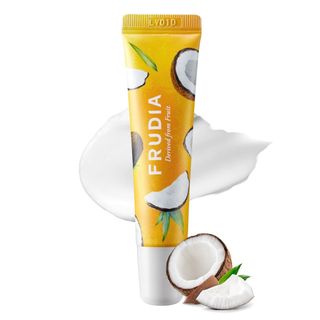
“Frudia Coconut Honey Salve Lip Cream is formulated with Coconut Extract and Shea Butter to moisturize and protect your lips from external aggressors.”
This product can help improve hydration of the skin with the two types of ingredients.
The first type is called “humectants”:
these ingredients help attract water.
When humectants are on the surface of the skin, they “pull in” the moisture from the outside environment, or from
within deeper layers of the skin. The following ingredients in this product do the job:
glycerin, trehalose.
This product also contains ingredients called “occlusives”. They help reduce the speed with which our skin loses moisture to the outside environment. These ingredients also help soften the upper layer of the skin, so it feels less tight and nicer to the touch. The following ingredients in this product do the job: beeswax, butyrospermum parkii butter.
The following ingredients in this product are especially good for supporting the skin barrier and helping with the hydration level: ceramide np, panthenol, phytosphingosine
Anti-oxidationNot advertised by the brand · 10 ingredients credited for this claimStrong support
This product contains antioxidants (asiaticoside) that can help neutralize free radicals in skin. By doing so, they can lessen the damage the skin gets from the UV light (sun).
The following ingredients - centella asiatica extract also can have an antioxidant effect, but there is less evidence to confirm their effectiveness in skin.
Anti-agingNot advertised by the brand · 5 ingredients credited for this claimStrong support
This product can help reduce and prevent fine lines and wrinkles, improve skin elasticity and firmness because it contains adenosine.
These ingredients in the product can also be helpful, even though there is less evidence for their effectiveness: asiaticoside, centella asiatica extract.
Keep in mind that it typically takes at least 6 weeks to notice any results because the changes that are needed to improve fine lines and elasticity happen in the deeper layers of the skin. No topical anti-aging product can “erase” wrinkles or fully reverse signs of aging.
Can it cause trouble?
Irritancy9 strong irritants: Sorbitan sesquioleate, Citrus limon peel oil + 7 more — patch-test recommendedHigh risk
Comedogenic2 ingredients rated 2 or more on the 0–5 pore-clogging scale2 flagged
User reviews
Be the first — your take helps the next person decide.
Ingredients
Filter by role to see what each ingredient is doing.
Cocos nucifera water~23–34%
- Irritation risk
- Low
Might help to attract water to the upper layer of the skin
More about Cocos nucifera waterGlycerin~3.7–5.6%
- Irritation risk
- Low
One of the best moisturizing ingredients. Naturally present in skin. It attracts water to the upper layer of the skin working as a humectant
More about GlycerinSorbitol~4.1–6.2%
- Irritation risk
- Low
Helps attract water to the upper layer of the skin and improves the product texture
More about SorbitolBeeswax~3.8–5.7%
- Irritation risk
- Low
Forms a protective barrier that holds water and keeps dry skin hydrated. Keeps an emulsion from separating into its oil and liquid components, and increases the thickness of a product. Can be an allergen
More about BeeswaxDiisostearyl malate~2.7–4.1%
- Irritation risk
- Medium
Helps to soften the upper layer of the skin
More about Diisostearyl malateCetyl ethylhexanoate~2–3%
- Irritation risk
- Medium
An emollient that helps soften the skin and creates a thicker product texture
More about Cetyl ethylhexanoateCaprylic/capric triglyceride~1.7–2.6%
- Irritation risk
- Medium
A good mix of fatty acids that forms a protective layer on the skin. Improves the shelf life of products. Derived from coconut and glycerin
More about Caprylic/capric triglycerideWater~1.3–1.9%
Butyrospermum parkii butter~1.3–1.9%
- Irritation risk
- Low
- Comedogenicity
- 3/5
A great moisturising ingredient that softens the skin and reduces water loss from its upper layer. It also can be helpful in protecting skin from free radicals
More about Butyrospermum parkii butterPanthenol~0.85–1.3%
- Irritation risk
- Low
Helps attract water to the upper layer of the skin and can help improve skin barrier function
More about PanthenolHydrogenated castor oil dimer dilinoleate~0.5–1.2%
- Irritation risk
- Low
1,2-hexanediol~0.4–1%
Polysorbate 60~0.45–1.05%
Methyl glucose sesquistearate~0.45–1.05%
- Irritation risk
- Medium
Helps water and oil mix together
More about Methyl glucose sesquistearateCetyl alcohol~0.45–1.05%
- Irritation risk
- Low
A non-drying alcohol that works to soften the skin and stabilize product formulations helping oil and water mix together
More about Cetyl alcoholGlyceryl stearate~0.45–1%
- Irritation risk
- Low
An emollient that softens the skin and forms a protective layer on its surface. Helps water and oil mix together
More about Glyceryl stearateButylene glycol~0.35–0.8%
- Irritation risk
- Low
Used to create a nice product texture and help delivery of other ingredients. Might be somewhat helpful in attracting water to the upper layer of the skin
More about Butylene glycolTrehalose~0.35–0.75%
- Irritation risk
- Low
A sugar that attracts water to the upper layer of the skin
More about TrehaloseSorbitan sesquioleate~0.3–0.75%
- Irritation risk
- High
Used to help oil and water mix together. Can be irritating
More about Sorbitan sesquioleateHydrogenated polyisobutene~0.35–0.8%
- Irritation risk
- Low
Used to improve the product consistency and soften the upper layer of the skin
More about Hydrogenated polyisobuteneGlyceryl caprylate~0.35–0.8%
- Irritation risk
- Low
An emollient that can also help water and oil mix together, as well as prevent bacteria growth in products
More about Glyceryl caprylateDimethicone~0.35–0.8%
- Irritation risk
- Low
A silicone that helps to reduce water loss from the surface of the skin. Can temporarily "fill in" lines and wrinkles, absorb oil, and create a nice product finish
More about DimethiconePeg-100 stearate~0.35–0.8%
- Irritation risk
- Low
Helps oil and water mix togehter and creates a nice product texture
More about Peg-100 stearateStearyl alcohol~0.35–0.75%
- Irritation risk
- Low
An emollient that helps soften the skin
More about Stearyl alcoholAmmonium acryloyldimethyltaurate/vp copolymer~0.2–0.7%
- Irritation risk
- Low
Increases thickness of a product. Texture enhancer for oil-in-water emulsions
More about Ammonium acryloyldimethyltaurate/vp copolymerSodium polyacrylate~0.35–0.85%
- Irritation risk
- Low
Used to create a gel-like product texture, as well as to stabilize emulsions
More about Sodium polyacrylateTocopheryl acetate~0.2–0.7%
- Irritation risk
- Medium
A more stable but less bio-available form of vitamin E compared to Tocopherol. Might help moisturize and protect the skin from free radicals, but mostly used in low concentrations to stabilize other ingredients.
More about Tocopheryl acetateAllantoin~0.15–0.6%
- Irritation risk
- Low
Helps calm down inflammation in skin and can help reduce itching. Helps to repair the skin barrier and keep skin hydrated
More about AllantoinEthylhexyl stearate~0.3–0.75%
- Irritation risk
- Low
Helps soften the upper layer of the skin
More about Ethylhexyl stearateMyristyl alcohol~0.3–0.75%
- Irritation risk
- High
Helps to stabilize the product formulation while softening the upper layer of the skin. Can be irritating
More about Myristyl alcoholAdenosine~0.15–0.7%
- Irritation risk
- Low
Might help improve cell turnover and reduce inflammation in skin. One study shows that the ingredients might be able to help reduce dynamic wrinkles (for example, in the corners of the eyes or on the forehead)
More about AdenosineLauryl alcohol~0.35–0.75%
Disodium edta~0.15–0.7%
Citrus limon peel oil~0.15–0.65%
Citrus aurantium dulcis peel oil~0.15–0.7%
- Irritation risk
- High
An essentil oil from orange peel. Potential allergen and can be irritating
More about Citrus aurantium dulcis peel oilTrideceth-6~0.2–0.7%
Punica granatum fruit extract~0.15–0.7%
- Irritation risk
- High
A fruit extract that is used to add a fragrance to the product. It might have some antioxidant properties
More about Punica granatum fruit extractAsiaticoside~0.15–0.6%
- Irritation risk
- Medium
An active compound of Centella Asiatica plant extract. In combination with other active compounds of Centella Asiatica extract (madecasosside, asiatic acid and madecassic acid), asiaticoside has been shown to be helpful in wound-healing, restoring skin barrier function and supporting collagen production in skin. It can, however, itself be irritating
More about AsiaticosideHoney extract~0.15–0.65%
- Irritation risk
- Medium
Helps attract water to the upper layer of the skin
More about Honey extractCitrus nobilis peel oil~0.15–0.65%
- Irritation risk
- High
A plant oil with high content of volatile compounds that, especially when exposed to air, can cause allergic reactions and irritate the skin
More about Citrus nobilis peel oilCitrus aurantium bergamia fruit oil~0.15–0.65%
- Irritation risk
- High
A plant oil with a high content of volatile compounds that can irritate the skin and lead to allergic reactions. Can lead to photosensitivity
More about Citrus aurantium bergamia fruit oilCitrus aurantifolia oil~0.2–0.75%
- Irritation risk
- High
Coco-caprylate/caprate~0.3–0.75%
- Irritation risk
- Low
Helps to soften the upper layer of the skin without creating a greasy texture
More about Coco-caprylate/caprateDextrin~0.15–0.65%
- Irritation risk
- Low
A sugar that is used to stabilize the product formulation. Can help attract water to the upper layer of the skin
More about DextrinMentha viridis leaf oil~0.15–0.7%
Vitis vinifera seed oil~0.3–0.75%
- Irritation risk
- Medium
A great emollient that can also have anti-oxidant properties
More about Vitis vinifera seed oilPrunus armeniaca kernel oil~0.3–0.75%
- Irritation risk
- Medium
An emollient that helps soften the skin
More about Prunus armeniaca kernel oilStearic acid~0.35–0.85%
- Irritation risk
- Low
Helps oil and water mix together and works as an emollient
More about Stearic acidGlyceryl citrate/lactate/linoleate/oleate~0.2–0.7%
Ceteareth-20~0.35–0.75%
- Irritation risk
- Medium
- Comedogenicity
- 2/5
Helps oil and water mix together. Has some emollient properties
More about Ceteareth-20Ceramide np~0.3–0.7%
- Irritation risk
- Low
A type of lipid similar to ceramides naturally present in skin. Helps to soften the upper layer of the skin and supports the skin barrier function to keep it hydrated. Can help to prevent inflammation in skin
More about Ceramide npCentella asiatica extract~0.2–0.75%
- Irritation risk
- Medium
A plant extract that has been shown to be able to reduce inflammation in skin, support restoration of skin barrier function, as well as support collagen production. Contains active compounds called centelloids: asiaticoside, madecasosside, asiatic acid and madecassic acid. Might be helpful in preventing stretch marks. It can be itself be irritating though.
More about Centella asiatica extractSolanum lycopersicum seed oil~0.2–0.8%
- Irritation risk
- Low
A good emollient that helps soften the upper layer of the skin and, due to the high linoleic acid content, can support the skin's barrier function
More about Solanum lycopersicum seed oilPunica granatum seed oil~0.3–0.7%
- Irritation risk
- Low
Helps soften the upper layer of the skin
More about Punica granatum seed oilPhytosphingosine~0.3–0.7%
- Irritation risk
- Low
A type of lipid that is naturally present in skin. It might help in repairing skin barrier function and has anti-bacterial effect
More about PhytosphingosineMangifera indica seed oil~0.3–0.7%
- Irritation risk
- Low
Citrus paradisi seed oil~0.15–0.55%
- Irritation risk
- High
Propolis extract~0.15–0.6%
- Irritation risk
- High
A complex substance produced by honey bees. Can have anti-bacterial and some anti-oxidant effect. Is an allergen and can be irritating
More about Propolis extractTocopherol~0.1–0.45%
- Irritation risk
- Low
Pure form of vitamin E. Can help moisturise and protect the skin from free radicals. Often used to help stabilise other ingredients or the formula itself
More about TocopherolRoyal jelly extract~0.1–0.45%
- Irritation risk
- Medium
A compound secreted by bees. Might be able to attract water to the top layer of the skin. Avoid if sensitive to honey and bee products
More about Royal jelly extractChlorphenesin~0.16–0.32%
Phenoxyethanol~0.1–0.4%
- Irritation risk
- Low
A preservative. It helps prevent bacterial growth in cosmetic products
More about PhenoxyethanolParfum~0.05–0.3%
- Irritation risk
- High
An aromatic blend of unspecified and possibly irritating ingredients
More about ParfumIngredient list view
Cocos nucifera water, Glycerin, Sorbitol, Beeswax, Diisostearyl malate, Cetyl ethylhexanoate, Caprylic/capric triglyceride, Water, Butyrospermum parkii butter, Panthenol, Hydrogenated castor oil dimer dilinoleate, 1,2-hexanediol, Polysorbate 60, Methyl glucose sesquistearate, Cetyl alcohol, Glyceryl stearate, Butylene glycol, Trehalose, Sorbitan sesquioleate, Hydrogenated polyisobutene, Glyceryl caprylate, Dimethicone, Peg-100 stearate, Stearyl alcohol, Ammonium acryloyldimethyltaurate/vp copolymer, Sodium polyacrylate, Tocopheryl acetate, Allantoin, Ethylhexyl stearate, Myristyl alcohol, Adenosine, Lauryl alcohol, Disodium edta, Citrus limon peel oil, Citrus aurantium dulcis peel oil, Trideceth-6, Punica granatum fruit extract, Asiaticoside, Honey extract, Citrus nobilis peel oil, Citrus aurantium bergamia fruit oil, Citrus aurantifolia oil, Coco-caprylate/caprate, Dextrin, Mentha viridis leaf oil, Vitis vinifera seed oil, Prunus armeniaca kernel oil, Stearic acid, Glyceryl citrate/lactate/linoleate/oleate, Ceteareth-20, Ceramide np, Centella asiatica extract, Solanum lycopersicum seed oil, Punica granatum seed oil, Phytosphingosine, Mangifera indica seed oil, Citrus paradisi seed oil, Propolis extract, Tocopherol, Royal jelly extract, Chlorphenesin, Phenoxyethanol, Parfum
Compare prices
Retailers ranked by price — lowest first.

Affiliate links · prices updated regularly
Product summary
Judging from the ingredient list, "FRUDIA - Buy Coconut Honey Salve Lip Cream in Australia - Online Korean Skincare" works well for improving skin hydration The formulation is based on a combination of good humectants and emollients. Both are needed to increase the skin hydration level. Humectants in this product (panthenol, glycerin, trehalose, honey extract and royal jelly extract) help to increase the water content in the upper layer of the skin. (These ingredients do so by "capturing" water molecules from the outside air or from within the deeper layers of the skin). Emollients in this formulation (ceramide np, phytosphingosine, solanum lycopersicum seed oil, vitis vinifera seed oil and beeswax) help to reduce the moisture loss from the skin. They also soften the skin surface and relieve the feeling of dryness and tightness.
Ingredient callouts
- Another benefit is that this moisturizer contain ceramides (phytosphingosine 0.30% - 0.70% and ceramide np 0.30% - 0.70%). Ceramides are an important part of our natural skin barrier. The Ceramides used in skincare are synthetic or come from plants. They help soften the skin and can help "fill the gaps" in the skin barrier, keeping the skin hydrated and resilient for longer.
- Adenosine 0.15% - 0.70%. It is a compound that in involved in many biological processes inside the skin cells. According one high-quality clinical trial, topical Adenosine in low concentrations can somewhat help improve "deep wrinkles" - the wrinkles that appear with age in places where our faces are most dynamic (for example, on the forehead or in the corners of the eyes).
- Actives derived from an extract of the Centella Asiatica plant (also known as Gotu Kola) - asiaticoside 0.15% - 0.60% The Centella Asiatica Actives, even in low concentration, can help reduce inflammation in skin, strengthen the skin barrier and reduce photodamage. They can also help to decrease scarring.
- Panthenol (pro-vitamin B5) at about 1.00% - 1.60% concentration. In this concentration, Panthenol works effectively to improve the skin barrier and reduce inflammation.
Irritation risk
There are quite a few common irritants in this product, including ingredients without particular skin benefits. We would not recommend it for sensitive skin. We assess the overall irritancy of this moisturizer to be high. For a detailed overview of all potential irritants: click here
You can see the detailed formula review with the breakdown of all actives in the product and the full ingredient list with estimated concentrations in the tables below.
Price
The product retails for 7.95A$ in Australia.
For a detailed price comparison: click here.
Sources cited in this review
Every concentration estimate and effectiveness label is anchored to one of these 34 studies and safety reviews.
- 1
- 2Skin moisturizing effects of panthenol-based formulationspdfs.semanticscholar.org
- 3
- 4
- 5
- 6

Affiliate links · As an Amazon Associate, WIMJ earns from qualifying purchases.