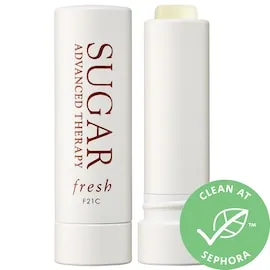
Fresh Sugar Advanced Therapy Treatment Lip Balm

Fresh Sugar Advanced Therapy Treatment Lip Balm

Efficacy37/100IrritancyHigh

Works for

Moisturizing
Cera alba, Simmondsia chinensis seed oil + 14 more
Works
What the product description says
“What it is: An intensive balm that moisturizes extra-dry lips for up to 24 hours and is clinically shown to improve the look of damaged lips.”
Source: Sephora

This product can help improve hydration of the skin with the two types of ingredients.

The first type is called “humectants”:
these ingredients help attract water. When humectants are on the surface of the skin, they “pull in” the moisture from the outside environment, or from within deeper layers of the skin. The following ingredients in this product do the job: sodium hyaluronate.

This product also contains ingredients called “occlusives”. They help reduce the speed with which our skin loses moisture to the outside environment. These ingredients also help soften the upper layer of the skin, so it feels less tight and nicer to the touch. The following ingredients in this product do the job: caprylic/capric triglyceride, cera alba.

Cera albaKey active· Emollient, OcclusiveEffect: HighForms a protective barrier that holds water and keeps dry skin hydrated. Keeps an emulsion from separating into its oil and liquid components, and increases the thickness of a product. Can be an allergen~22–33%
Simmondsia chinensis seed oilKey active· Emollient, OcclusiveEffect: HighSoftens the upper layer of skin and helps restore the healthy skin barrier. Has shown to help calm down inflammation in skin. It is a stable oil, meaning that it retains its properties even when exposed to air.~5.7–8.5%
C10-18 triglyceridesKey active· EmollientEffect: MediumHelps soften the skin and attract water to its upper layer. Helps create nice product texture~4.7–7.1%
Ricinus communis seed oilKey active· Emollient, OcclusiveEffect: HighA plant oil that can help soften the skin. It might be helpful in calming down inflammation, but solid research is lacking. Is often used in lip products to create the needed product consistency~3.9–5.9%
Vitis vinifera seed oilKey active· EmollientEffect: HighA great emollient that can also have anti-oxidant properties~2.2–3.3%
Crithmum maritimum extractKey activeEffect: MediumAn algae extract that might have anti-oxidant properties~1.4–2.1%
Prunus domestica seed oilKey activeEffect: MediumHelps soften the upper layer of the skin~1.2–1.8%
Limnanthes alba seed oilKey active· EmollientEffect: HighThis oil's cmposition is closest to rapeseed oil. It is a very stable oil and serves as an emoillient~1.1–1.6%
Ribes nigrum seed oilKey active· EmollientEffect: HighAn emollient. Can be helpful for restoring skin barrier function.~0.95–1.4%
Copernicia cerifera waxKey active· Emollient, OcclusiveEffect: HighHelps to soften the upper layer of the skin and create a nice product consistency~0.9–1.35%
Hydrogenated vegetable oilKey active· EmollientEffect: MediumAn oil from a mixture of different vegetables. Helps soften the upper layer of the skin~0.6–1.35%
Caprylic/capric triglycerideKey active· Emollient, OcclusiveEffect: HighA good mix of fatty acids that forms a protective layer on the skin. Improves the shelf life of products. Derived from coconut and glycerin~0.55–1.3%
Sodium hyaluronateKey active· HumectantEffect: HighOne of the best moisturizing ingredients. Attracts water into the upper layer of the skin~0.45–1.05%
TrioleinKey activeEffect: HighHelps soften the upper layer of the skin~0.45–1%
TocopherolEffect: Low, below effective dosePure form of vitamin E. Can help moisturise and protect the skin from free radicals. Often used to help stabilise other ingredients or the formula itself~0.5–1.15%
Ascorbyl tetraisopalmitateEffect: Low, below effective doseA vitamin C derivative. Studies show that is might be effective in reducing hyperpigmentation, but there are no studies confirming that it is effectively converted into the bioavailable form of Vitamin C in skin. It is not clear how this derivative compares in effectiveness to the topical application of bioavailable form of vitamin C (L-ascorbic acid)~0.35–0.8%
Anti-aging
Ascorbyl tetraisopalmitate ~0.35–0.8%, below the ~5% it needs
Under-dosed
What the product description says
“- Sea Fennel: helps to smooth the look of fine lines and wrinkles and define the lip area”
Source: Sephora

Effective ingredients missing or their concentration is too low.

Limnanthes alba seed oilEffect: LowThis oil's cmposition is closest to rapeseed oil. It is a very stable oil and serves as an emoillient~1.1–1.6%
TocopherolEffect: Low, below effective dosePure form of vitamin E. Can help moisturise and protect the skin from free radicals. Often used to help stabilise other ingredients or the formula itself~0.5–1.15%
Ascorbyl palmitateEffect: Low, below effective doseBeing a lipid soluble form of vitamin C, it is more stable and can penetrate the skin better than L-Ascorbic acid. It is effective in protecting the skin from free radicals, as well as evening the skin tone, but is less effective in stimulating collagen production compared to L-Ascorbic acid.~0.15–0.6%
Ascorbyl tetraisopalmitateUnder-dosedA vitamin C derivative. Studies show that is might be effective in reducing hyperpigmentation, but there are no studies confirming that it is effectively converted into the bioavailable form of Vitamin C in skin. It is not clear how this derivative compares in effectiveness to the topical application of bioavailable form of vitamin C (L-ascorbic acid)~0.35–0.8%

Can it cause trouble?

Irritancy
6 strong irritants: Parfum, Ethyl vanillin + 4 more — patch-test recommended
High risk
We flagged 18 ingredients with irritancy potential. Severity depends on your sensitivity threshold; the table lists the worst offenders first.
IngredientFunctionIrritationEst. amount
ParfumAn aromatic blend of unspecified and possibly irritating ingredientsHigh~1.6–2.4%est.
Ethyl vanillinUsed as a fragranceHigh~0.1–0.45%est.
LimoneneA common frangrance that can easily irritate skin, especially if exposed to air, light or heatHigh~0.1–0.45%est.
CitralA fragrance with a lemon scent. A likely irritantHigh~0.1–0.4%est.
Benzyl alcoholA preservative. Can be used to mask unpleasant smell. Can be irritatingHigh~0.1–0.35%est.
LinaloolA fragrance. Can be irritatingHigh~0.1–0.3%est.
GeraniolA fragrance. Can be irritatingHigh~0.05–0.3%est.
Cera albaForms a protective barrier that holds water and keeps dry skin hydrated. Keeps an emulsion from separating into its oil and liquid components, and increases the thickness of a product. Can be an allergenMedium~22–33%est.
Simmondsia chinensis seed oilSoftens the upper layer of skin and helps restore the healthy skin barrier. Has shown to help calm down inflammation in skin. It is a stable oil, meaning that it retains its properties even when exposed to air.Medium~5.7–8.5%est.
Ricinus communis seed oilA plant oil that can help soften the skin. It might be helpful in calming down inflammation, but solid research is lacking. Is often used in lip products to create the needed product consistencyMedium~3.9–5.9%est.
Hydrogenated olive oil decyl estersHelps stabilize the product formulationMedium~2.9–4.3%est.
Vitis vinifera seed oilA great emollient that can also have anti-oxidant propertiesMedium~2.2–3.3%est.
Prunus domestica seed oilHelps soften the upper layer of the skinMedium~1.2–1.8%est.
Ribes nigrum seed oilAn emollient. Can be helpful for restoring skin barrier function.Medium~0.95–1.4%est.
Tocopheryl acetateA more stable but less bio-available form of vitamin E compared to Tocopherol. Might help moisturize and protect the skin from free radicals, but mostly used in low concentrations to stabilize other ingredients.Medium~0.45–1.1%est.
Caprylic/capric triglycerideA good mix of fatty acids that forms a protective layer on the skin. Improves the shelf life of products. Derived from coconut and glycerinMedium~0.55–1.3%est.
Ascorbyl tetraisopalmitateA vitamin C derivative. Studies show that is might be effective in reducing hyperpigmentation, but there are no studies confirming that it is effectively converted into the bioavailable form of Vitamin C in skin. It is not clear how this derivative compares in effectiveness to the topical application of bioavailable form of vitamin C (L-ascorbic acid)Medium~0.35–0.8%est.
Ascorbyl palmitateBeing a lipid soluble form of vitamin C, it is more stable and can penetrate the skin better than L-Ascorbic acid. It is effective in protecting the skin from free radicals, as well as evening the skin tone, but is less effective in stimulating collagen production compared to L-Ascorbic acid.Medium~0.15–0.6%est.
Comedogenic
2 ingredients rated 2 or more on the 0–5 pore-clogging scale
2 flagged
These ingredients have a comedogenic rating of 2 or more on a 0–5 scale; the table shows each one's rating. In leave-on products they can clog pores in acne-prone skin.
IngredientFunctionRatingEst. amount
Crithmum maritimum extractAn algae extract that might have anti-oxidant properties3/5~1.4–2.1%est.
Hydrogenated vegetable oilAn oil from a mixture of different vegetables. Helps soften the upper layer of the skin2/5~0.6–1.35%est.

User reviews

Would you recommend?
No community reviews yet.

Be the first — your take helps the next person decide.

Ingredients

Filter by role to see what each ingredient is doing.

Cera alba~22–33%
Key activeIrritant · medium
Irritation risk
Medium
Works for
MoisturizingCleansing

Forms a protective barrier that holds water and keeps dry skin hydrated. Keeps an emulsion from separating into its oil and liquid components, and increases the thickness of a product. Can be an allergen

More about Cera alba
Simmondsia chinensis seed oil~5.7–8.5%
Key activeIrritant · medium
Irritation risk
Medium
Works for
Moisturizing

Softens the upper layer of skin and helps restore the healthy skin barrier. Has shown to help calm down inflammation in skin. It is a stable oil, meaning that it retains its properties even when exposed to air.

More about Simmondsia chinensis seed oil
C10-18 triglycerides~4.7–7.1%
Key active
Irritation risk
Low
Works for
Moisturizing

Helps soften the skin and attract water to its upper layer. Helps create nice product texture

More about C10-18 triglycerides
Ricinus communis seed oil~3.9–5.9%
Key activeIrritant · medium
Irritation risk
Medium
Works for
MoisturizingAnti-inflammatory

A plant oil that can help soften the skin. It might be helpful in calming down inflammation, but solid research is lacking. Is often used in lip products to create the needed product consistency

More about Ricinus communis seed oil
Hydrogenated olive oil decyl esters~2.9–4.3%
Irritant · medium
Irritation risk
Medium

Helps stabilize the product formulation

More about Hydrogenated olive oil decyl esters
Vitis vinifera seed oil~2.2–3.3%
Key activeIrritant · medium
Irritation risk
Medium
Works for
MoisturizingAnti-oxidation

A great emollient that can also have anti-oxidant properties

More about Vitis vinifera seed oil
Parfum~1.6–2.4%
Irritant · high
Irritation risk
High

An aromatic blend of unspecified and possibly irritating ingredients

More about Parfum
Crithmum maritimum extract~1.4–2.1%
Key activeComedogenic 3/5
Irritation risk
Low
Comedogenicity
3/5
Works for
MoisturizingAnti-oxidation

An algae extract that might have anti-oxidant properties

More about Crithmum maritimum extract
Prunus domestica seed oil~1.2–1.8%
Key activeIrritant · medium
Irritation risk
Medium
Works for
Moisturizing

Helps soften the upper layer of the skin

More about Prunus domestica seed oil
Limnanthes alba seed oil~1.1–1.6%
Key active
Irritation risk
Low
Works for
MoisturizingAnti-oxidationAnti-aging

This oil's cmposition is closest to rapeseed oil. It is a very stable oil and serves as an emoillient

More about Limnanthes alba seed oil
Ribes nigrum seed oil~0.95–1.4%
Key activeIrritant · medium
Irritation risk
Medium
Works for
MoisturizingAnti-oxidation

An emollient. Can be helpful for restoring skin barrier function.

More about Ribes nigrum seed oil
Copernicia cerifera wax~0.9–1.35%
Key active
Irritation risk
Low
Works for
Moisturizing

Helps to soften the upper layer of the skin and create a nice product consistency

More about Copernicia cerifera wax
Hydrogenated vegetable oil~0.6–1.35%
Key activeComedogenic 2/5
Irritation risk
Low
Comedogenicity
2/5
Works for
Moisturizing

An oil from a mixture of different vegetables. Helps soften the upper layer of the skin

More about Hydrogenated vegetable oil
Tocopherol~0.5–1.15%
Formula
Irritation risk
Low
Works for
Anti-oxidationAnti-inflammatoryMoisturizingAnti-aging

Pure form of vitamin E. Can help moisturise and protect the skin from free radicals. Often used to help stabilise other ingredients or the formula itself

More about Tocopherol
Tocopheryl acetate~0.45–1.1%
Irritant · medium
Irritation risk
Medium
Works for
Anti-oxidation

A more stable but less bio-available form of vitamin E compared to Tocopherol. Might help moisturize and protect the skin from free radicals, but mostly used in low concentrations to stabilize other ingredients.

More about Tocopheryl acetate
Caprylic/capric triglyceride~0.55–1.3%
Key activeIrritant · medium
Irritation risk
Medium
Works for
Moisturizing

A good mix of fatty acids that forms a protective layer on the skin. Improves the shelf life of products. Derived from coconut and glycerin

More about Caprylic/capric triglyceride
Sodium hyaluronate~0.45–1.05%
Key active
Irritation risk
Low
Works for
Moisturizing

One of the best moisturizing ingredients. Attracts water into the upper layer of the skin

More about Sodium hyaluronate
Triolein~0.45–1%
Key active
Irritation risk
Low
Works for
Moisturizing

Helps soften the upper layer of the skin

More about Triolein
Sucrose tetrastearate triacetate~0.45–1.1%
Formula
Irritation risk
Low
Works for
Cleansing
More about Sucrose tetrastearate triacetate
Ammonium glycyrrhizate~0.35–0.85%
Formula
Glyceryl dioleate~0.4–0.95%
Formula
Ascorbyl tetraisopalmitate~0.35–0.8%
Under-dosedIrritant · medium
Irritation risk
Medium
Works for
Anti-oxidationEvens skin toneAnti-agingMoisturizing

A vitamin C derivative. Studies show that is might be effective in reducing hyperpigmentation, but there are no studies confirming that it is effectively converted into the bioavailable form of Vitamin C in skin. It is not clear how this derivative compares in effectiveness to the topical application of bioavailable form of vitamin C (L-ascorbic acid)

More about Ascorbyl tetraisopalmitate
Ascorbyl palmitate~0.15–0.6%
Irritant · medium
Irritation risk
Medium
Works for
Anti-oxidationAnti-aging

Being a lipid soluble form of vitamin C, it is more stable and can penetrate the skin better than L-Ascorbic acid. It is effective in protecting the skin from free radicals, as well as evening the skin tone, but is less effective in stimulating collagen production compared to L-Ascorbic acid.

More about Ascorbyl palmitate
Ethyl vanillin~0.1–0.45%
Irritant · high
Irritation risk
High

Used as a fragrance

More about Ethyl vanillin
Limonene~0.1–0.45%
Irritant · high
Irritation risk
High

A common frangrance that can easily irritate skin, especially if exposed to air, light or heat

More about Limonene
Citral~0.1–0.4%
Irritant · high
Irritation risk
High

A fragrance with a lemon scent. A likely irritant

More about Citral
Benzyl alcohol~0.1–0.35%
Irritant · high
Irritation risk
High

A preservative. Can be used to mask unpleasant smell. Can be irritating

More about Benzyl alcohol
Linalool~0.1–0.3%
Irritant · high
Irritation risk
High

A fragrance. Can be irritating

More about Linalool
Geraniol~0.05–0.3%
Irritant · high
Irritation risk
High

A fragrance. Can be irritating

More about Geraniol
Ingredient list view

Cera alba, Simmondsia chinensis seed oil, C10-18 triglycerides, Ricinus communis seed oil, Hydrogenated olive oil decyl esters, Vitis vinifera seed oil, Parfum, Crithmum maritimum extract, Prunus domestica seed oil, Limnanthes alba seed oil, Ribes nigrum seed oil, Copernicia cerifera wax, Hydrogenated vegetable oil, Tocopherol, Tocopheryl acetate, Caprylic/capric triglyceride, Sodium hyaluronate, Triolein, Sucrose tetrastearate triacetate, Ammonium glycyrrhizate, Glyceryl dioleate, Ascorbyl tetraisopalmitate, Ascorbyl palmitate, Ethyl vanillin, Limonene, Citral, Benzyl alcohol, Linalool, Geraniol

Compare prices

Retailers ranked by price — lowest first.

Amazon US
Price unavailable Out of stock
Check

Affiliate links · As an Amazon Associate, WIMJ earns from qualifying purchases.

Worth comparing, line by line.

Match % combines shared ingredients, the first five ingredients, shared actives and hero ingredients, irritancy (lower counts in the alternative's favour), texture and body area. Only products in the same routine step are compared.

Side-by-side comparison of this product against its closest alternatives
FreshSugar Advanced Therapy Treatment Lip BalmYOUR PRODUCTSusanne KaufmannLip BalmKosasport Lipfuel BaselinePerricone MDCold Plasma Plus+ Lip Therapy
Match—40%38%38%
Price—$17.00$24.12$30.71
Shared key ingredients—6 of 117 of 114 of 11
Key difference——Bis-Diglyceryl Polyacyladipate-2Palmitoyl Tripeptide-1
Irritancy High Medium Medium Medium
Drying alcohol————
View product Shop Shop Shop

More alternatives: The Organic Pharmacy Volumising Balm Glossevolutionofsmooth Watermelon Frosé Stick and Sphere Lip Balm

Cheaper alternatives? See how this stacks up against similar formulas.
We compare ingredient profiles across our catalog — pick the closest match for your budget.
Open dupe finder

Sources cited in this review

Every concentration estimate and effectiveness label is anchored to one of these 13 studies and safety reviews.

  1. 1
  2. 2
  3. 3
  4. 4
  5. 5
    Vitamin E in dermatologyncbi.nlm.nih.gov
  6. 6
    Vitamin E and Skin Healthlpi.oregonstate.edu
Fresh Sugar Advanced Therapy Treatment Lip Balm
FreshSugar Advanced Therapy Treatment Lip Balm

Affiliate links · As an Amazon Associate, WIMJ earns from qualifying purchases.

As an Amazon Associate, WIMJ earns from qualifying purchases.