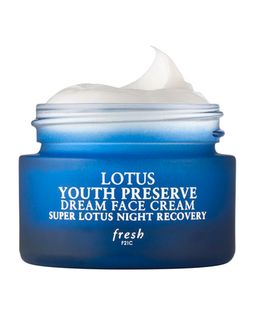
Fresh Lotus Youth Preserve Dream Face Cream
Works for
1 of 2 advertised claims delivered
Moisturizing17 ingredients credited for this claimGood support
“Lotus Youth Preserve Dream Face Cream”
This product can help improve hydration of the skin with the two types of ingredients.
The first type is called “humectants”:
these ingredients help attract water.
When humectants are on the surface of the skin, they “pull in” the moisture from the outside environment, or from
within deeper layers of the skin. The following ingredients in this product do the job:
diglycerin, glycerin.
This product also contains ingredients called “occlusives”. They help reduce the speed with which our skin loses moisture to the outside environment. These ingredients also help soften the upper layer of the skin, so it feels less tight and nicer to the touch. The following ingredients in this product do the job: butyrospermum parkii butter, caprylic/capric triglyceride.
Anti-aging4 ingredients credited for this claimLimited support
“Enriched with natural ingredients such as super lotus, peach leaf extract, shea butter, lemon peel oil, cucumber extract and anthemis nobilis flower extract, this nourishing cream helps to minimise the signs of ageing, including fine lines, wrinkles and blemishes.”
This product does not contain ingredients that are able to reduce fine lines and wrinkles or help with skin elasticity, but it can improve the look of the skin temporarily through moisturization. Well-moisturized skin might also be able to repair the sun damage better.This ingredient - butyrospermum parkii butter - could be helpful for preventing or repairing signs of aging in theory, but there is no evidence that it actually works.
Can it cause trouble?
Irritancy6 strong irritants: Citrus limon peel oil, Nelumbo nucifera flower extract + 4 more — patch-test recommendedHigh risk
Comedogenic3 ingredients rated 2 or more on the 0–5 pore-clogging scale3 flagged
User reviews
Be the first — your take helps the next person decide.
Ingredients
Filter by role to see what each ingredient is doing.
Water~45–55%
Glycerin~4.8–5.9%
- Irritation risk
- Low
One of the best moisturizing ingredients. Naturally present in skin. It attracts water to the upper layer of the skin working as a humectant
More about GlycerinIsononyl isononanoate~4.1–5%
- Irritation risk
- Low
Forms a protective film on the surface of the skin to prevent moisture loss. Gives a velvety feel to products while reducing tackiness
More about Isononyl isononanoateGlyceryl stearate~2.8–3.4%
- Irritation risk
- Low
An emollient that softens the skin and forms a protective layer on its surface. Helps water and oil mix together
More about Glyceryl stearateCaprylic/capric triglyceride~2.4–2.9%
- Irritation risk
- Medium
A good mix of fatty acids that forms a protective layer on the skin. Improves the shelf life of products. Derived from coconut and glycerin
More about Caprylic/capric triglycerideButylene glycol~1.9–2.3%
- Irritation risk
- Low
Used to create a nice product texture and help delivery of other ingredients. Might be somewhat helpful in attracting water to the upper layer of the skin
More about Butylene glycolPentylene glycol~1.7–2%
- Irritation risk
- Medium
Used to preserve products, dissolve other ingredients and create a nice product texture
More about Pentylene glycolC10-18 triglycerides~1.5–1.8%
- Irritation risk
- Low
Helps soften the skin and attract water to its upper layer. Helps create nice product texture
More about C10-18 triglyceridesDiglycerin~1.2–1.4%
- Irritation risk
- Low
Helps attract water to the upper layer of the skin
More about DiglycerinButyrospermum parkii butter~1–1.2%
- Irritation risk
- Low
- Comedogenicity
- 3/5
A great moisturising ingredient that softens the skin and reduces water loss from its upper layer. It also can be helpful in protecting skin from free radicals
More about Butyrospermum parkii butterPeg-100 stearate~0.75–1.15%
- Irritation risk
- Low
Helps oil and water mix togehter and creates a nice product texture
More about Peg-100 stearateMyristyl myristate~0.65–0.95%
- Irritation risk
- Medium
- Comedogenicity
- 3/5
An emollient. Is not recommended for acne-prone skin as it can be comedogenic
More about Myristyl myristateNelumbo nucifera extract~0.5–0.75%
- Irritation risk
- High
Might be somewhat helpful in protecting elastin in skin and evening skin tone, but good research is lacking. Contains fragrant components and can be irritating.
More about Nelumbo nucifera extractPrunus persica leaf extract~0.5–0.75%
- Irritation risk
- High
Might be helpful in supporting collagen and ellastin production but solid research is lacking. Could be irritating
More about Prunus persica leaf extractCitrus limon peel oil~0.4–0.6%
Cucumis sativus fruit extract~0.4–0.6%
- Irritation risk
- Medium
Might be somewhat helpful in reducing hyperpigmentation and neutralizing free radicals but its typical concentration in a product is too low for having an effect
More about Cucumis sativus fruit extractNelumbo nucifera flower extract~0.35–0.6%
Anthemis nobilis flower oil~0.3–0.55%
- Irritation risk
- High
An essential oil that is used as a fragrance and can be irritating. It might have some anti-oxidant effect in skin
More about Anthemis nobilis flower oilTocopheryl acetate~0.3–0.55%
- Irritation risk
- Medium
A more stable but less bio-available form of vitamin E compared to Tocopherol. Might help moisturize and protect the skin from free radicals, but mostly used in low concentrations to stabilize other ingredients.
More about Tocopheryl acetateTocopherol~0.3–0.5%
- Irritation risk
- Low
Pure form of vitamin E. Can help moisturise and protect the skin from free radicals. Often used to help stabilise other ingredients or the formula itself
More about TocopherolBehenyl alcohol~0.3–0.55%
- Irritation risk
- Low
Non-drying alcohol that helps water and oil mix together. Also serves as an emollient
More about Behenyl alcoholAmmonium acryloyldimethyltaurate/beheneth-25 methacrylate crosspolymer~0.25–0.45%
- Irritation risk
- Medium
Used to stabilize product formulations
More about Ammonium acryloyldimethyltaurate/beheneth-25 methacrylate crosspolymerCetearyl alcohol~0.25–0.45%
- Irritation risk
- Low
- Comedogenicity
- 2/5
A non-drying alcohol. Works as an emollient. Helps water and oil mix together and creates a nice product texture
More about Cetearyl alcoholCetyl palmitate~0.25–0.45%
- Irritation risk
- Low
An emollient that helps soften the skin and is used to improve product texture and stability
More about Cetyl palmitateCocoglycerides~0.25–0.45%
- Irritation risk
- High
Help soften the upper layer of the skin and make it easier for oil and water mix together. Recently, a rising number of allergic reactions to cocoglycerides and other coconut-derived surfactants has been reported. As there is a significant overlap between frequent irritants and allergens, we flag this ingredient for attention of those with very sensitive, reactive skin
More about CocoglyceridesAcrylates/c10-30 alkyl acrylate crosspolymer~0.25–0.45%
- Irritation risk
- Medium
Maintains the texture of skincare products. Allows the product to spread evenly. Helps oil and water mix together
More about Acrylates/c10-30 alkyl acrylate crosspolymerParfum~0.2–0.35%
- Irritation risk
- High
An aromatic blend of unspecified and possibly irritating ingredients
More about ParfumSodium hydroxide~0.2–0.4%
T-butyl alcohol~0.15–0.3%
- Irritation risk
- Medium
Used to dissolve other ingredients and to improve smell of products. It could be irritating
More about T-butyl alcoholSodium metabisulfite~0.1–0.2%
Bht~0.2–0.35%
Tetrasodium edta~0.2–0.35%
Ethylhexylglycerin~0.2–0.35%
Potassium sorbate~0.15–0.25%
Sodium benzoate~0.15–0.25%
Phenoxyethanol~0.15–0.25%
- Irritation risk
- Low
A preservative. It helps prevent bacterial growth in cosmetic products
More about PhenoxyethanolLimonene~0.1–0.2%
- Irritation risk
- High
A common frangrance that can easily irritate skin, especially if exposed to air, light or heat
More about LimoneneBenzyl salicylate~0.1–0.15%
Citral~0.05–0.1%
Ingredient list view
Water, Glycerin, Isononyl isononanoate, Glyceryl stearate, Caprylic/capric triglyceride, Butylene glycol, Pentylene glycol, C10-18 triglycerides, Diglycerin, Butyrospermum parkii butter, Peg-100 stearate, Myristyl myristate, Nelumbo nucifera extract, Prunus persica leaf extract, Citrus limon peel oil, Cucumis sativus fruit extract, Nelumbo nucifera flower extract, Anthemis nobilis flower oil, Tocopheryl acetate, Tocopherol, Behenyl alcohol, Ammonium acryloyldimethyltaurate/beheneth-25 methacrylate crosspolymer, Cetearyl alcohol, Cetyl palmitate, Cocoglycerides, Acrylates/c10-30 alkyl acrylate crosspolymer, Parfum, Sodium hydroxide, T-butyl alcohol, Sodium metabisulfite, Bht, Tetrasodium edta, Ethylhexylglycerin, Potassium sorbate, Sodium benzoate, Phenoxyethanol, Limonene, Benzyl salicylate, Citral
Compare prices
Retailers ranked by price — lowest first.

Sources cited in this review
Every concentration estimate and effectiveness label is anchored to one of these 8 studies and safety reviews.
- 1
- 2
- 3Safety Assessment of Anthemis nobilis– Derived Ingredients as Used in Cosmeticsjournals.sagepub.com
- 4Vitamin E in dermatologyncbi.nlm.nih.gov
- 5Vitamin E and Skin Healthlpi.oregonstate.edu
- 6

Affiliate links · As an Amazon Associate, WIMJ earns from qualifying purchases.