Works for:
based on ingredients and %- Moisturizing
- Anti-blemish
- Exfoliation
- Anti-oxidation
Can it cause trouble?
- Irritation risk: high
- Comedogenic risk ingredients: 0
Key actives


Anti-blemish
What does the product description say?
This clean formulation provides a protective layer between your makeup and your skin and is non-comedogenic, so it won't clog pores or cause breakouts.
Source: Firstaid Beauty
This product can help reduce breakouts and clogged pores because it contains the following ingredient: salicylic acid. This ingredient is used for treating acne and can have a noticeable effect.
The following ingredient (ingredients) in this product might be helpful, but there is no evidence to confirm that it actually works: linoleic acid
Used for skin exfoliation. It has an anti-inflammatory and anti-bacterial effect, helps to unclog pores, prevent blemishes and speed up healing of the existing ones. Sometimes referred to as a BHA (beta-hydroxy acid)
An excellent emollient. Helps soften the skin, restore its barrier function, and can help to calm down inflammation. It can be helpful to prevent blemishes and clogged pores
Might be helpful against blemishes, work as an anti-oxidant, reduce inflammation and improve skin's ability to hold on to moisture, but more research is needed to confirm its effectiveness when applied topically to human skin
Can contain potent anti-oxidant compounds (abbreviated ECG, GCG, EGC, and EGCG) that might help protect the skin from free radicals. Can help calm down inflammation and has some anti-bacterial properties. Unfortunately, these antioxidants are unstable and lose their effectiveness very quickly in products. The concentration of the antioxidant compounds in the extract also tends to be low to be effective in topical formulation
Exfoliation
This product can help exfoliate the skin. In other words, it helps break down the bonds between dead cells on the surface of the skin and speed up the skin turnover. Skin often appears softer and brighter after exfoliation, but overdoing it can result in disrupted skin barrier. The following ingredient is doing the exfoliating job in this product: salicylic acid.
Used for skin exfoliation. It has an anti-inflammatory and anti-bacterial effect, helps to unclog pores, prevent blemishes and speed up healing of the existing ones. Sometimes referred to as a BHA (beta-hydroxy acid)
Moisturizing
This product can help improve hydration of the skin with the two types of ingredients.
The first type is called “humectants”:
these ingredients help attract water.
When humectants are on the surface of the skin, they “pull in” the moisture from the outside environment, or from
within deeper layers of the skin. The following ingredients in this product do the job:
glycerin, sodium hyaluronate.
This product also contains ingredients called “occlusives”. They help reduce the speed with which our skin loses moisture to the outside environment. These ingredients also help soften the upper layer of the skin, so it feels less tight and nicer to the touch. The following ingredients in this product do the job: dimethicone, cetyl dimethicone.
The following ingredients in this product are especially good for supporting the skin barrier and helping with the hydration level: linoleic acid, panthenol
One of the best moisturizing ingredients. Naturally present in skin. It attracts water to the upper layer of the skin working as a humectant
One of the best moisturizing ingredients. Attracts water into the upper layer of the skin
A silicone that helps to reduce water loss from the surface of the skin. Can temporarily "fill in" lines and wrinkles, absorb oil, and create a nice product finish
An excellent emollient. Helps soften the skin, restore its barrier function, and can help to calm down inflammation. It can be helpful to prevent blemishes and clogged pores
A type of silicone. Helps soften the upper layer of the skin and creates a nice, light product texture
Helps attract water to the upper layer of the skin and can help improve skin barrier function
Used to create a thicker product texture. Helps soften the upper layer of the skin and might be able to prevent moisture loss from its surface
Helps soften the upper layer of the skin and create a nice product consistency
A fruit extract that might have some antioxidant properties and might help attract water to the skin, but evidence of effectiveness is lacking
A fruit extract that might help to attract water to the upper layer of the skin, but there is no evidence for any other benefits to the skin
Used to create a nice product texture and help delivery of other ingredients. Might be somewhat helpful in attracting water to the upper layer of the skin
Helps preserve products and creates a nice product texture
Helps to restore skin barrier function, soften the upper layer of the skin and calm down inflammation
A good mix of fatty acids that forms a protective layer on the skin. Improves the shelf life of products. Derived from coconut and glycerin
Can have some moisturizing properties due to its sugar content
Might be helpful against blemishes, work as an anti-oxidant, reduce inflammation and improve skin's ability to hold on to moisture, but more research is needed to confirm its effectiveness when applied topically to human skin
Might be somewhat helpful in reducing hyperpigmentation and neutralizing free radicals but its typical concentration in a product is too low for having an effect
Can contain potent anti-oxidant compounds (abbreviated ECG, GCG, EGC, and EGCG) that might help protect the skin from free radicals. Can help calm down inflammation and has some anti-bacterial properties. Unfortunately, these antioxidants are unstable and lose their effectiveness very quickly in products. The concentration of the antioxidant compounds in the extract also tends to be low to be effective in topical formulation
Anti-oxidation
This product contains antioxidants (ficus carica fruit extract) that might be able to help neutralize free radicals in skin to lessen the damage it gets from the UV light (sun). There is not enough evidence to confirm their effectiveness in skin though.
A plant extract that can help neutralize free radicals. The concentrations typically used in cosmetics are too small to have an effect
A plant extract that can help lighten the skin and calm down inflammation. Might be helpful in neutralizing free radicals
A fruit extract that might have some anti-oxidant properties
A plant extract that might have some anti-oxidant properties but evidence of effectiveness in skin is lacking
Can contain potent anti-oxidant compounds (abbreviated ECG, GCG, EGC, and EGCG) that might help protect the skin from free radicals. Can help calm down inflammation and has some anti-bacterial properties. Unfortunately, these antioxidants are unstable and lose their effectiveness very quickly in products. The concentration of the antioxidant compounds in the extract also tends to be low to be effective in topical formulation
Might be helpful against blemishes, work as an anti-oxidant, reduce inflammation and improve skin's ability to hold on to moisture, but more research is needed to confirm its effectiveness when applied topically to human skin
Helps to restore skin barrier function, soften the upper layer of the skin and calm down inflammation
Might be somewhat helpful in reducing hyperpigmentation and neutralizing free radicals but its typical concentration in a product is too low for having an effect
Can have some moisturizing properties due to its sugar content
A more stable but less bio-available form of vitamin E compared to Tocopherol. Might help moisturize and protect the skin from free radicals, but mostly used in low concentrations to stabilize other ingredients.
A derivative of vitamin C that is more stable, but less bioavailable than the pure form of vitamin C. It does not penetrate the skin well, but has been shown to convert to pure vitamin C once in skin. It can be helpful in stimulating collagen production and lightening the skin tone, but the required concentration is likely to be very high
How honest is this product?
| Promise | Can it deliver? |
|---|---|
| Moisturizing | |
| Anti-blemish |
Total Promises Fulfilled score: 100/100.
We receive a small commission for purchases made through these links at no cost for you. Thank you for your support! Learn more
Potential irritants
Comedogenic ingredients
No comedogenic ingredients detected
User reviews (0)
Averages from community submissions.
No reviews yet for this product.
Be the first to share your experience!
Tried this product?
Help capture what the ingredient list can't—texture, finish, pilling, scent, and more. Answer what you can, skip the rest.
Takes ~30 seconds.
Reviews are shown in aggregate. No personal details.
| Product | Similarity | Price | Irritancy |
|---|---|---|---|
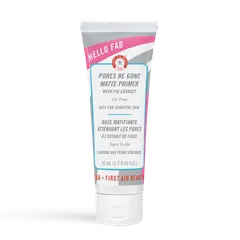
 First Aid Beauty Hello FAB Pores Be Gone Matte Primer With Fig Extract | Current | $30.00 | |
The Crème Shop Universal Blend Color Correcting Primer - Infused with Cica Serum | 68% | - | |
e.l.f. Cosmetics Acne Fighting Putty Primer | 67% | $12.00 | |
 NARS Pore & Shine Control Primer | 64% | $36.00 | |
 REVOLUTION SKINCARE Conceal & Fix Mattifying Primer | 64% | ≈ $7.40 |
Key Actives
Can contain potent anti-oxidant compounds (abbreviated ECG, GCG, EGC, and EGCG) that might help protect the skin from free radicals. Can help calm down inflammation and has some anti-bacterial properties. Unfortunately, these antioxidants are unstable and lose their effectiveness very quickly in products. The concentration of the antioxidant compounds in the extract also tends to be low to be effective in topical formulation
Used for skin exfoliation. It has an anti-inflammatory and anti-bacterial effect, helps to unclog pores, prevent blemishes and speed up healing of the existing ones. Sometimes referred to as a BHA (beta-hydroxy acid)
Used for skin exfoliation. It has an anti-inflammatory and anti-bacterial effect, helps to unclog pores, prevent blemishes and speed up healing of the existing ones. Sometimes referred to as a BHA (beta-hydroxy acid)
Might be helpful against blemishes, work as an anti-oxidant, reduce inflammation and improve skin's ability to hold on to moisture, but more research is needed to confirm its effectiveness when applied topically to human skin
Helps to restore skin barrier function, soften the upper layer of the skin and calm down inflammation
Helps attract water to the upper layer of the skin and can help improve skin barrier function
An excellent emollient. Helps soften the skin, restore its barrier function, and can help to calm down inflammation. It can be helpful to prevent blemishes and clogged pores
A silicone that helps to reduce water loss from the surface of the skin. Can temporarily "fill in" lines and wrinkles, absorb oil, and create a nice product finish
One of the best moisturizing ingredients. Naturally present in skin. It attracts water to the upper layer of the skin working as a humectant
A type of silicone. Helps soften the upper layer of the skin and creates a nice, light product texture
A good mix of fatty acids that forms a protective layer on the skin. Improves the shelf life of products. Derived from coconut and glycerin
One of the best moisturizing ingredients. Attracts water into the upper layer of the skin
A plant extract that can help neutralize free radicals. The concentrations typically used in cosmetics are too small to have an effect
Works as a UV filter when used in high concentrations. It is photostable and is effective mostly against the UVB light, with some protection in the UVA range. In small concentrations, used for its ability to improve the color of cosmetic products. Is usually well tolerated by the skin
Potential irritants
Used for skin exfoliation. It has an anti-inflammatory and anti-bacterial effect, helps to unclog pores, prevent blemishes and speed up healing of the existing ones. Sometimes referred to as a BHA (beta-hydroxy acid)
A plant extract used as a fragrance. Can be irritating
An aromatic irritating plant extract that can cause photosensitivity in skin
Could have anti-inflammatory effect on skin, but can be irritating as well. Can be added to products for its smell
A common frangrance that can easily irritate skin, especially if exposed to air, light or heat
A good mix of fatty acids that forms a protective layer on the skin. Improves the shelf life of products. Derived from coconut and glycerin
Helps soften the upper layer of the skin and create a nice product consistency
A fruit extract that might have some antioxidant properties and might help attract water to the skin, but evidence of effectiveness is lacking
Can have some moisturizing properties due to its sugar content
A plant extract that might have some anti-oxidant properties but evidence of effectiveness in skin is lacking
A fruit extract that might have some anti-oxidant properties
A fruit extract that might help to attract water to the upper layer of the skin, but there is no evidence for any other benefits to the skin
Might be somewhat helpful in reducing hyperpigmentation and neutralizing free radicals but its typical concentration in a product is too low for having an effect
Helps preserve products and creates a nice product texture
A more stable but less bio-available form of vitamin E compared to Tocopherol. Might help moisturize and protect the skin from free radicals, but mostly used in low concentrations to stabilize other ingredients.
A plant extract that might help calm down inflammation in skin but evidence of effectiveness is lacking
A plant extract that can help lighten the skin and calm down inflammation. Might be helpful in neutralizing free radicals
A plant extract that can help neutralize free radicals. The concentrations typically used in cosmetics are too small to have an effect
A derivative of vitamin C that is more stable, but less bioavailable than the pure form of vitamin C. It does not penetrate the skin well, but has been shown to convert to pure vitamin C once in skin. It can be helpful in stimulating collagen production and lightening the skin tone, but the required concentration is likely to be very high
Used to stabilize the formula of product formulation. Might be helpful in neutralizing free radicals in skin
Comedogenic ingredients
We couldn't find any comedogenic ingredients in this product
All ingredients
Used for skin exfoliation. It has an anti-inflammatory and anti-bacterial effect, helps to unclog pores, prevent blemishes and speed up healing of the existing ones. Sometimes referred to as a BHA (beta-hydroxy acid)
A silicone that helps to reduce water loss from the surface of the skin. Can temporarily "fill in" lines and wrinkles, absorb oil, and create a nice product finish
Used to create a thicker product texture. Helps soften the upper layer of the skin and might be able to prevent moisture loss from its surface
One of the best moisturizing ingredients. Naturally present in skin. It attracts water to the upper layer of the skin working as a humectant
Used to create a nice product texture and help delivery of other ingredients. Might be somewhat helpful in attracting water to the upper layer of the skin
Used to stabilize product formulations and create a nice product texture
A type of silicone. Helps soften the upper layer of the skin and creates a nice, light product texture
A good mix of fatty acids that forms a protective layer on the skin. Improves the shelf life of products. Derived from coconut and glycerin
Helps soften the upper layer of the skin and create a nice product consistency
A preservative. It helps prevent bacterial growth in cosmetic products
A fruit extract that might have some antioxidant properties and might help attract water to the skin, but evidence of effectiveness is lacking
Can have some moisturizing properties due to its sugar content
A plant extract that might have some anti-oxidant properties but evidence of effectiveness in skin is lacking
A fruit extract that might have some anti-oxidant properties
A fruit extract that might help to attract water to the upper layer of the skin, but there is no evidence for any other benefits to the skin
A plant extract used as a fragrance. Can be irritating
An aromatic irritating plant extract that can cause photosensitivity in skin
Might be somewhat helpful in reducing hyperpigmentation and neutralizing free radicals but its typical concentration in a product is too low for having an effect
Helps to restore skin barrier function, soften the upper layer of the skin and calm down inflammation
Helps create a thicker or gel-like product texture. It is not a surfactant but can be used in gentle cleansing formulations
Helps preserve products and creates a nice product texture
A more stable but less bio-available form of vitamin E compared to Tocopherol. Might help moisturize and protect the skin from free radicals, but mostly used in low concentrations to stabilize other ingredients.
Helps attract water to the upper layer of the skin and can help improve skin barrier function
A plant extract that might help calm down inflammation in skin but evidence of effectiveness is lacking
One of the best moisturizing ingredients. Attracts water into the upper layer of the skin
An excellent emollient. Helps soften the skin, restore its barrier function, and can help to calm down inflammation. It can be helpful to prevent blemishes and clogged pores
Used for skin exfoliation. It has an anti-inflammatory and anti-bacterial effect, helps to unclog pores, prevent blemishes and speed up healing of the existing ones. Sometimes referred to as a BHA (beta-hydroxy acid)
Could have anti-inflammatory effect on skin, but can be irritating as well. Can be added to products for its smell
A plant extract that can help lighten the skin and calm down inflammation. Might be helpful in neutralizing free radicals
Can contain potent anti-oxidant compounds (abbreviated ECG, GCG, EGC, and EGCG) that might help protect the skin from free radicals. Can help calm down inflammation and has some anti-bacterial properties. Unfortunately, these antioxidants are unstable and lose their effectiveness very quickly in products. The concentration of the antioxidant compounds in the extract also tends to be low to be effective in topical formulation
A plant extract that can help neutralize free radicals. The concentrations typically used in cosmetics are too small to have an effect
A derivative of vitamin C that is more stable, but less bioavailable than the pure form of vitamin C. It does not penetrate the skin well, but has been shown to convert to pure vitamin C once in skin. It can be helpful in stimulating collagen production and lightening the skin tone, but the required concentration is likely to be very high
Used to stabilize the formula of product formulation. Might be helpful in neutralizing free radicals in skin
Might be helpful against blemishes, work as an anti-oxidant, reduce inflammation and improve skin's ability to hold on to moisture, but more research is needed to confirm its effectiveness when applied topically to human skin
A common frangrance that can easily irritate skin, especially if exposed to air, light or heat
Works as a UV filter when used in high concentrations. It is photostable and is effective mostly against the UVB light, with some protection in the UVA range. In small concentrations, used for its ability to improve the color of cosmetic products. Is usually well tolerated by the skin
An umbrella term for the following three colorants: CI 77491, CI 77492, CI 77499. They might be able to offer some protection against visible light, but the degree of the protection is not clear
Ingredient list view
Salicylic acid, Water, Dimethicone, Trisiloxane, Dimethicone crosspolymer, Glycerin, Butylene glycol, Polyglyceryl-4 isostearate, Dimethicone/vinyl dimethicone crosspolymer, Cetyl dimethicone, Bis-(glyceryl/lauryl) glyceryl lauryl dimethicone, Caprylic/capric triglyceride, Silica, Hexyl laurate, Phenoxyethanol, Santalum album wood extract, Citrus limon peel extract, Prunus armeniaca fruit extract, Pyrus malus fruit extract, Elettaria cardamomum seed extract, Rubus idaeus leaf extract, Cucumis melo fruit extract, Citrus aurantium dulcis peel extract, Rose extract, Ananas sativus fruit extract, Vanilla planifolia fruit extract, Citrus grandis peel extract, Cucumis sativus fruit extract, Cananga odorata flower extract, Colloidal oatmeal, Carbomer, Peg-60 almond glycerides, Caprylyl glycol, Tocopheryl acetate, Panthenol, Serenoa serrulata fruit extract, Sodium hyaluronate, Sodium dehydroacetate, Linoleic acid, Salicylic acid, Chrysanthemum parthenium extract, Glycyrrhiza glabra root extract, Camellia sinensis leaf extract, Ficus carica fruit extract, Magnesium ascorbyl phosphate, Nordihydroguaiaretic acid, Oleanolic acid, Hydroxycitronellal, Limonene, Titanium dioxide, Ci 77891, Iron oxides
- Salicylic acid as a peeling agent: a comprehensive review
- Beta Hydroxy Acids
- A review of toxicity from topical salicylic acid preparations
- Glycolic Acid Peels Versus Salicylic–Mandelic Acid Peels in Active Acne Vulgaris and Post‐Acne Scarring and Hyperpigmentation: A Comparative Study
- Dimethicone as a protective ingredient in topical medications
- Final Report on the Safety Assessment of Dimethicone Copolyol
- Glycerol and the skin: holistic approach to its origin and functions
- Antioxidant and anti-inflammatory properties of a Cucumis melo LC. extract rich in superoxide dismutase activity
- ANTIOXIDANT ACTIVITY OF FRUIT EXTRACTS USED IN COSMETIC PRODUCTS
- Safety Assessment of Citrus Peel-Derived Ingredients as Used in Cosmetics
- Photosensitivity in children: An approach to diagnosis and management
- Mechanism of action and clinical benefits of colloidal oatmeal for dermatologic practice
- Skin moisturizing effects of panthenol-based formulations
- Safety Assessment of Panthenol, Pantothenic Acid, and Derivatives as Used in Cosmetics
- Saw palmetto extract: A dermatologist's perspective
- Hyaluronic acid: A key molecule in skin aging
- Hyaluronan (Hyaluronic Acid): a natural moisturizer for skin care
- 4 Final Report on the Safety Assessment of Sodium Dehydroacetate and Dehydroacetic Acid
- The Permeability Barrier in Essential Fatty Acid Deficiency: Evidence for a Direct Role for Linoleic Acid in Barrier Function
- Digital image analysis of the effect of topically applied linoleic acid on acne microcomedones.
- Stability, transdermal penetration, and cutaneous effects of ascorbic acid and its derivatives
- Topical L-ascorbic acid: percutaneous absorption studies
- Nordihydroguaiaretic acid, an inhibitor of lipoxygenase, also inhibits cytochrome P-450-mediated monooxygenase activity in rat epidermal and hepatic microsomes.
- Antimutagenic and antitumorigenic activities of nordihydroguaiaretic acid
- Estrogenic activity of an antioxidant, nordihydroguaiaretic acid (NDGA)
- Molecular mechanisms and clinical applications of nordihydroguaiaretic acid (NDGA) and its derivatives: An update
- Effectiveness of the formulation that containing oleanolic acid 3% on inhibition of 5-α reductase activity on skin of patients with acne
- The effect of ursolic and oleanolic acids on human skin fibroblast cells