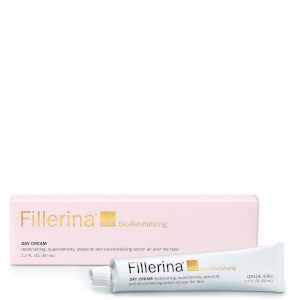
Fillerina 932 Bio-Revitalizing Day Cream - Grade 4
Works for
1 of 1 advertised claim delivered
Moisturizing47 ingredients credited for this claimStrong support
“932 Bio-Revitalizing Day Cream .”
This product can help improve hydration of the skin with the two types of ingredients.
The first type is called “humectants”:
these ingredients help attract water.
When humectants are on the surface of the skin, they “pull in” the moisture from the outside environment, or from
within deeper layers of the skin. The following ingredients in this product do the job:
alanine, arginine.
This product also contains ingredients called “occlusives”. They help reduce the speed with which our skin loses moisture to the outside environment. These ingredients also help soften the upper layer of the skin, so it feels less tight and nicer to the touch. The following ingredients in this product do the job: arginine, cocos nucifera oil.
The following ingredients in this product are especially good for supporting the skin barrier and helping with the hydration level: acetyl hexapeptide-30, acetyl hexapeptide-37, palmitoyl heptapeptide-18, palmitoyl hexapeptide-52, palmitoyl tripeptide-38, sh-oligopeptide-1, sh-polypeptide-1
Anti-agingNot advertised by the brand · 14 ingredients credited for this claimModerate support
This product contains acetyl hexapeptide-30, acetyl hexapeptide-37, aspartic acid, palmitoyl heptapeptide-18, palmitoyl hexapeptide-52, palmitoyl tripeptide-38, serine, sh-oligopeptide-1, sh-polypeptide-1, threonine. These ingredients might be able to help reduce and prevent fine lines and wrinkles, improve skin elasticity and firmness, but there is not enough evidence that it actually works.
Can it cause trouble?
Irritancy10 strong irritants: Parfum, Limonene + 8 more — patch-test recommendedHigh risk
Comedogenic5 ingredients rated 2 or more on the 0–5 pore-clogging scale5 flagged
User reviews
Be the first — your take helps the next person decide.
Ingredients
Filter by role to see what each ingredient is doing.
Water~45–55%
Cetearyl isononanoate~4.1–5%
- Irritation risk
- Low
An emollient that softens the skin and helps prevent moisture loss.
More about Cetearyl isononanoatePropylene glycol~4.1–5%
- Irritation risk
- High
Helps oil and water mix together and can enhance the penetration of other ingredients into the skin. It can be irritating
More about Propylene glycolEthylhexyl methoxycinnamate~3.5–4.3%
- Irritation risk
- High
Octinoxate. When used in higher concentrations, works as a sunscreen protecting the skin from UVB rays. When used in lower concentration, helps to preserve the product formulation. Is shown to be harmful to coral reefs - consider avoiding bathing in coral reef areas when wearing a product with this ingredient. It can be irritating
More about Ethylhexyl methoxycinnamateEthylhexyl salicylate~3.1–3.8%
- Irritation risk
- Low
Octisalate. A UV filter. It offers some protection against the sun rays that cause sunburn (UVB), but does not protect against the most aging sun rays (UVA). It loses its effectiveness quickly when exposed to sunlight. It is an organic, or so called "chemical" sunscreen
More about Ethylhexyl salicylateGlyceryl stearate se~1.9–2.3%
- Irritation risk
- Low
- Comedogenicity
- 2/5
Used to stabilize the product formulations and works as an emollient
More about Glyceryl stearate seGlyceryl stearate~1.6–2%
- Irritation risk
- Low
An emollient that softens the skin and forms a protective layer on its surface. Helps water and oil mix together
More about Glyceryl stearateEthylhexyl cocoate~1.4–1.7%
- Irritation risk
- Low
Helps soften the upper layer of the skin
More about Ethylhexyl cocoateCeteareth-20~1.2–1.5%
- Irritation risk
- Medium
- Comedogenicity
- 2/5
Helps oil and water mix together. Has some emollient properties
More about Ceteareth-20Isodecyl oleate~0.95–1.15%
- Irritation risk
- Low
- Comedogenicity
- 2/5
Hdi/trimethylol hexyllactone crosspolymer~0.65–0.95%
- Irritation risk
- Low
Used to create a silky product texture and add volume to products
More about Hdi/trimethylol hexyllactone crosspolymerMethylene bis-benzotriazolyl tetramethylbutylphenol~0.7–1.05%
- Irritation risk
- Medium
Tinosorb M. A UV filter. Is effective against both UVA and UVB rays. It also provides some protection against visible light. It is photostable and can also be used to improve photostability of other sunscreen ingredients. Its physical properties help to create lightweight sunscreen formulations. It can leave a slight white cast. Unfortunately, it is not approved by the FDA (US) yet
More about Methylene bis-benzotriazolyl tetramethylbutylphenolCetyl alcohol~0.55–0.85%
- Irritation risk
- Low
A non-drying alcohol that works to soften the skin and stabilize product formulations helping oil and water mix together
More about Cetyl alcoholGlycerin~0.45–0.7%
- Irritation risk
- Low
One of the best moisturizing ingredients. Naturally present in skin. It attracts water to the upper layer of the skin working as a humectant
More about GlycerinAluminum starch octenylsuccinate~0.35–0.65%
- Irritation risk
- Medium
Used to thicken the product's consistency
More about Aluminum starch octenylsuccinateHydrolyzed glycosaminoglycans~0.35–0.6%
- Irritation risk
- Low
Long sugars that help attract water to the upper layer of the skin
More about Hydrolyzed glycosaminoglycansXylitol~0.3–0.6%
- Irritation risk
- Low
Helps attract water to the upper layer of the skin and repair the skin barrier function
More about XylitolCocos nucifera oil~0.3–0.55%
- Irritation risk
- Low
- Comedogenicity
- 3/5
An emollient. Found to be as effective as a moisturizer for dry skin as mineral oil. Could be comedogenic
More about Cocos nucifera oilPhenoxyethanol~0.3–0.55%
- Irritation risk
- Low
A preservative. It helps prevent bacterial growth in cosmetic products
More about PhenoxyethanolEthylhexylglycerin~0.25–0.5%
Caprylyl glycol~0.25–0.5%
- Irritation risk
- Medium
Helps preserve products and creates a nice product texture
More about Caprylyl glycolDecyl glucoside~0.3–0.6%
- Irritation risk
- High
Helps oil and water mix together. Can be irritating
More about Decyl glucosideSodium hyaluronate~0.2–0.4%
- Irritation risk
- Low
One of the best moisturizing ingredients. Attracts water into the upper layer of the skin
More about Sodium hyaluronateCarbomer~0.2–0.4%
- Irritation risk
- Low
Helps create a thicker or gel-like product texture. It is not a surfactant but can be used in gentle cleansing formulations
More about CarbomerTocopheryl acetate~0.2–0.4%
- Irritation risk
- Medium
A more stable but less bio-available form of vitamin E compared to Tocopherol. Might help moisturize and protect the skin from free radicals, but mostly used in low concentrations to stabilize other ingredients.
More about Tocopheryl acetatePentylene glycol~0.25–0.5%
- Irritation risk
- Medium
Used to preserve products, dissolve other ingredients and create a nice product texture
More about Pentylene glycolParfum~0.2–0.35%
- Irritation risk
- High
An aromatic blend of unspecified and possibly irritating ingredients
More about ParfumPseudoalteromonas ferment extract filtrate~0.2–0.35%
- Irritation risk
- Low
Sodium pca~0.2–0.4%
- Irritation risk
- Low
Naturally present in skin and helps to attract water to its upper layer
More about Sodium pcaHydrolyzed collagen~0.25–0.45%
- Irritation risk
- Low
A typically plant-derived compound that is supposed mimic human collagen. Cannot penetrate the skin barrier so is not particularly useful in skincare products beyond attracting water to the upper layer of the skin
More about Hydrolyzed collagenSilica~0.3–0.6%
Limonene~0.2–0.35%
- Irritation risk
- High
A common frangrance that can easily irritate skin, especially if exposed to air, light or heat
More about LimoneneSodium lactate~0.2–0.4%
- Irritation risk
- Medium
Helps attract water to the upper layer of the skin. Is often used to adjust the pH level of the product
More about Sodium lactateArginine~0.2–0.35%
- Irritation risk
- Low
An amino acid that is naturally present in skin and helps keep it hydrated. When used together with AHAs, it can reduce their irritating effect on the skin
More about ArginineButylene glycol~0.2–0.4%
- Irritation risk
- Low
Used to create a nice product texture and help delivery of other ingredients. Might be somewhat helpful in attracting water to the upper layer of the skin
More about Butylene glycolLinalool~0.2–0.35%
Bht~0.2–0.4%
Hexylene glycol~0.2–0.4%
- Irritation risk
- Medium
Helps create a more spreadable product texture
More about Hexylene glycolAspartic acid~0.2–0.4%
- Irritation risk
- Low
An amino-acid that helps increase skin hydration and might help to slightly improve skin firmness, potentially reducing lines and wrinkles
More about Aspartic acidBha~0.2–0.4%
Pca~0.2–0.4%
- Irritation risk
- Low
Naturally present in skin and helps to attract water to its upper layer
More about PcaHexyl cinnamal~0.2–0.35%
Sodium hyaluronate crosspolymer~0.2–0.4%
- Irritation risk
- Medium
Attracts water into the upper layer of the skin
More about Sodium hyaluronate crosspolymerXanthan gum~0.2–0.4%
- Irritation risk
- Low
Used to create a thicker product consistency
More about Xanthan gumDecylene glycol~0.2–0.4%
- Irritation risk
- Low
Used to creat a nice product texture and support penetration of other ingredients
More about Decylene glycolSorbitol~0.2–0.4%
- Irritation risk
- Low
Helps attract water to the upper layer of the skin and improves the product texture
More about SorbitolLecithin~0.25–0.45%
- Irritation risk
- Low
Used mostly for creating emulsions - helping oil and water mix together. Helps soften the upper layer of the skin
More about LecithinHydrolyzed dna~0.2–0.4%
- Irritation risk
- Low
Hydrolyzed rna~0.2–0.4%
- Irritation risk
- Low
Butylphenyl methylpropional~0.2–0.35%
- Irritation risk
- High
A fragrance. Can trigger allergic reactions and be irritating
More about Butylphenyl methylpropionalSodium chondroitin sulfate~0.2–0.35%
- Irritation risk
- Low
Is naturally present in skin. Helps to attract water to its upper layer
More about Sodium chondroitin sulfateHydrolyzed hyaluronic acid~0.2–0.4%
- Irritation risk
- Low
One of the best moisturizing ingredients. Attracts water into the upper layer of the skin. A version of it is naturally present in skin
More about Hydrolyzed hyaluronic acidHydrolyzed sodium hyaluronate~0.2–0.4%
- Irritation risk
- Low
Attracts water into the upper layer of the skin
More about Hydrolyzed sodium hyaluronateHyaluronic acid~0.2–0.4%
- Irritation risk
- Low
One of the best moisturizing ingredients. Attracts water into the upper layer of the skin. Naturally present in skin. Typically has large molecule size unless advertised otherwise on the product label. Helps support skin's barrier function and may help to reduce inflammation
More about Hyaluronic acidGlycine~0.2–0.4%
- Irritation risk
- Low
Helps to attract water to the upper layer of the skin and can help restore the skin barrier function
More about GlycineGeraniol~0.2–0.35%
Citronellol~0.2–0.35%
Alanine~0.2–0.4%
- Irritation risk
- Low
An amino-acid that helps to attract water to the upper layer of the skin and might help to lighten the skin, but solid evidence is lacking
More about AlanineHydroxypropyl cyclodextrin~0.25–0.45%
- Irritation risk
- Medium
Used to stabilize product formulations and help soften the upper layer of the skin
More about Hydroxypropyl cyclodextrinAcetyl cysteine~0.2–0.35%
- Irritation risk
- Low
Glutamic acid~0.2–0.4%
- Irritation risk
- Low
An amino-acid that helps attract water to the upper layer of the skin
More about Glutamic acidGlutamine~0.25–0.45%
- Irritation risk
- Low
Leucine~0.25–0.45%
- Irritation risk
- Low
Lysine hcl~0.25–0.45%
Methionine~0.25–0.45%
- Irritation risk
- Low
Tyrosine~0.25–0.45%
Serine~0.25–0.45%
- Irritation risk
- Low
An amino-acid that helps to attract water to the upper layer of the skin. In combination with other amino-acids, might help to reduce fine lines and wrinkles
More about SerineValine~0.25–0.45%
- Irritation risk
- Low
Sodium benzoate~0.25–0.5%
Sodium hydroxide~0.25–0.5%
Taurine~0.25–0.5%
- Irritation risk
- Medium
Could be helpful in reducing inflammation in skin, evening out the skin tone and neutralizing free radicals, but more research is needed to confirm its effectiveness
More about TaurineCoumarin~0.25–0.45%
Citral~0.25–0.45%
Glyceryl caprylate~0.3–0.6%
- Irritation risk
- Low
An emollient that can also help water and oil mix together, as well as prevent bacteria growth in products
More about Glyceryl caprylateSodium chloride~0.3–0.55%
- Irritation risk
- Low
Used to stabilize mixtures of oil and water, and create thicker, gel-like product textures
More about Sodium chlorideSoluble collagen~0.25–0.5%
- Irritation risk
- Low
A typically plant-derived compound that is supposed mimic human collagen. Cannot penetrate the skin barrier so is not particularly useful in skincare products beyond attracting water to the upper layer of the skin
More about Soluble collagenTryptophan~0.25–0.5%
- Irritation risk
- Low
Isoleucine~0.25–0.45%
- Irritation risk
- Low
An amino acid that can help attract water to the upper layer of the skin and support skin's barrier function
More about IsoleucineProline~0.25–0.5%
Threonine~0.25–0.5%
- Irritation risk
- Low
An amino-acid that helps to attract water to the upper layer of the skin. In combination with other amino-acids, might help to reduce fine lines and wrinkles
More about ThreonineGlyceryl linoleate~0.3–0.6%
- Irritation risk
- Medium
Helps oil and water mix together
More about Glyceryl linoleateGlyceryl linolenate~0.3–0.55%
- Irritation risk
- Low
Helps soften the upper layer of the skin
More about Glyceryl linolenateRetinyl palmitate~0.25–0.45%
- Irritation risk
- High
Three steps removed from the active form of vitamin A - retinoic acid. To have an effect in the skin, it first needs to be converted twice to become the retinoic acid. This means it is less potent than retinol, but could also be less irritating. Once converted to the retinoic acid in the skin, it helps against all signs of aging, improves skin cell turnover and helps fight blemishes and clogged pores. However, in many cosmetic formulations, it is used in a concentration that is too low to have the full effect
More about Retinyl palmitateSodium ascorbyl phosphate~0.25–0.5%
- Irritation risk
- Medium
A stable derivative of vitamin C. It is oil-soluble which means it is more likely to penetrate the skin compared to the pure form of vitamin C (which is water-soluble), but it is less bio-available and is way less effective in stimulating collagen and reducing wrinkles compared to the pure form of vitamin C (L-ascorbic acid) and its other derivatives (for example, magnesium ascorbyl phosphate). At the same time, this vitamin C derivative has been shown in studies to be effective in reducing acne, blemishes and clogged pores. It is less irritating then the pure form of vitamin C
More about Sodium ascorbyl phosphateHydrolyzed elastin~0.3–0.55%
- Irritation risk
- Low
Histidine~0.25–0.45%
Leuconostoc/radish root ferment filtrate~0.25–0.5%
- Irritation risk
- Medium
A preservative that comes from radishes fermented by a bacteria. New research suggests that the preservation properties in the ingredient come from an ammonium salt that is not present naturally in radish root but used in its cultivation. Is problematic because the exact amount of the preservative agents is difficult to determine
More about Leuconostoc/radish root ferment filtratePhenylalanine~0.25–0.5%
- Irritation risk
- Low
Biotin/folic acid/cyanocobalamin/niacinamide/pantothenic acid/pyridoxine/riboflavin/thiamine/yeast polypeptides~0.25–0.45%
Acetyl hexapeptide-30~0.25–0.45%
- Irritation risk
- Low
A type of peptide. Peptides are excellent moisturizers and might be able support collagen production reducing fine lines and wrinkles
More about Acetyl hexapeptide-30Calcium chloride~0.25–0.5%
- Irritation risk
- Medium
Helps create a thicker product consistency. Might be irritating
More about Calcium chlorideCupric chloride~0.25–0.45%
- Irritation risk
- Low
Ferric chloride~0.25–0.5%
- Irritation risk
- Low
Sh-oligopeptide-1~0.25–0.45%
- Irritation risk
- Low
A type of peptide. Peptides are excellent moisturizers and might be able support collagen production reducing fine lines and wrinkles
More about Sh-oligopeptide-1Magnesium chloride~0.25–0.5%
Manganese chloride~0.25–0.45%
- Irritation risk
- Low
Zinc chloride~0.25–0.45%
- Irritation risk
- Low
Sh-polypeptide-5~0.25–0.5%
- Irritation risk
- Low
Phenylpropanol~0.25–0.5%
- Irritation risk
- High
Helps mask the smell of other ingredients and helps preserve the product formulation
More about PhenylpropanolPalmitoyl hexapeptide-52~0.25–0.5%
- Irritation risk
- Low
A type of peptide. Peptides are excellent moisturizers and might be able support collagen production reducing fine lines and wrinkles
More about Palmitoyl hexapeptide-52Sh-polypeptide-1~0.25–0.45%
- Irritation risk
- Low
A type of peptide. Peptides are excellent moisturizers and might be able support collagen production reducing fine lines and wrinkles
More about Sh-polypeptide-1Palmitoyl tripeptide-38~0.25–0.45%
- Irritation risk
- Low
A type of peptide. Peptides are excellent moisturizers and might be able support collagen production reducing fine lines and wrinkles
More about Palmitoyl tripeptide-38Ascorbyl palmitate~0.25–0.45%
- Irritation risk
- Medium
Being a lipid soluble form of vitamin C, it is more stable and can penetrate the skin better than L-Ascorbic acid. It is effective in protecting the skin from free radicals, as well as evening the skin tone, but is less effective in stimulating collagen production compared to L-Ascorbic acid.
More about Ascorbyl palmitatePalmitoyl heptapeptide-18~0.25–0.4%
Acetyl hexapeptide-37~0.2–0.4%
- Irritation risk
- Low
A type of peptide. Peptides are excellent moisturizers and might be able support collagen production reducing fine lines and wrinkles
More about Acetyl hexapeptide-37Citric acid~0.2–0.35%
- Irritation risk
- Medium
Can work as an exfoliant but is typically used to adjust the product pH
More about Citric acidDisodium edta~0.15–0.3%
Polyvinyl alcohol~0.2–0.35%
Sorbic acid~0.15–0.3%
Glycine soja oil~0.2–0.35%
- Irritation risk
- Medium
- Comedogenicity
- 2/5
A good emollient that helps soften the skin and helps repair its barrier function. It can clog pores if used in high concentrations.
More about Glycine soja oilSodium oleate~0.45–0.7%
- Irritation risk
- Medium
Helps oil and water mix together and create a thicker product consistency
More about Sodium oleateHydrogenated lecithin~0.1–0.2%
- Irritation risk
- Low
Helps to retain moisture by creating a protective barrier on the skin. Rich in fatty acids. Improves product texture and helps with the penetration of other ingredients.
More about Hydrogenated lecithinIngredient list view
Water, Cetearyl isononanoate, Propylene glycol, Ethylhexyl methoxycinnamate, Ethylhexyl salicylate, Glyceryl stearate se, Glyceryl stearate, Ethylhexyl cocoate, Ceteareth-20, Isodecyl oleate, Hdi/trimethylol hexyllactone crosspolymer, Methylene bis-benzotriazolyl tetramethylbutylphenol, Cetyl alcohol, Glycerin, Aluminum starch octenylsuccinate, Hydrolyzed glycosaminoglycans, Xylitol, Cocos nucifera oil, Phenoxyethanol, Ethylhexylglycerin, Caprylyl glycol, Decyl glucoside, Sodium hyaluronate, Carbomer, Tocopheryl acetate, Pentylene glycol, Parfum, Pseudoalteromonas ferment extract filtrate, Sodium pca, Hydrolyzed collagen, Silica, Limonene, Sodium lactate, Arginine, Butylene glycol, Linalool, Bht, Hexylene glycol, Aspartic acid, Bha, Pca, Hexyl cinnamal, Sodium hyaluronate crosspolymer, Xanthan gum, Decylene glycol, Sorbitol, Lecithin, Hydrolyzed dna, Hydrolyzed rna, Butylphenyl methylpropional, Sodium chondroitin sulfate, Hydrolyzed hyaluronic acid, Hydrolyzed sodium hyaluronate, Hyaluronic acid, Glycine, Geraniol, Citronellol, Alanine, Hydroxypropyl cyclodextrin, Acetyl cysteine, Glutamic acid, Glutamine, Leucine, Lysine hcl, Methionine, Tyrosine, Serine, Valine, Sodium benzoate, Sodium hydroxide, Taurine, Coumarin, Citral, Glyceryl caprylate, Sodium chloride, Soluble collagen, Tryptophan, Isoleucine, Proline, Threonine, Glyceryl linoleate, Glyceryl linolenate, Retinyl palmitate, Sodium ascorbyl phosphate, Hydrolyzed elastin, Histidine, Leuconostoc/radish root ferment filtrate, Phenylalanine, Biotin/folic acid/cyanocobalamin/niacinamide/pantothenic acid/pyridoxine/riboflavin/thiamine/yeast polypeptides, Acetyl hexapeptide-30, Calcium chloride, Cupric chloride, Ferric chloride, Sh-oligopeptide-1, Magnesium chloride, Manganese chloride, Zinc chloride, Sh-polypeptide-5, Phenylpropanol, Palmitoyl hexapeptide-52, Sh-polypeptide-1, Palmitoyl tripeptide-38, Ascorbyl palmitate, Palmitoyl heptapeptide-18, Acetyl hexapeptide-37, Citric acid, Disodium edta, Polyvinyl alcohol, Sorbic acid, Glycine soja oil, Sodium oleate, Hydrogenated lecithin
Compare prices
Retailers ranked by price — lowest first.

Affiliate links · prices updated regularly
Product summary
Based on the ingredients included, "Fillerina - 932 Bio-Revitalizing Day Cream - Grade 4" works well for moisturizing the skin. To work well, any moisturizer needs to include a combination of water-binding and emollient ingredients. Fillerina - 932 Bio-Revitalizing Day Cream - Grade 4 ticks this box. Humectants in this product (alanine, arginine, aspartic acid, glutamic acid and glycerin) help to increase the water content in the upper layer of the skin. (These ingredients do so by "capturing" water molecules from the outside air or from within the deeper layers of the skin). Glycine soja oil, hydrolyzed collagen, arginine, cocos nucifera oil and cetyl alcohol in this product help decrease the water evoporation from the skin, so that it stays hydrated for longer. These ingredients also soften the skin and take away the feeling of tightness and dryness.
Ingredient callouts
- this moisturizer includes a form of Retinoids (vitamin A) - retinyl palmitate 0.25% - 0.45%, but this type of vitamin A is not very effective. It could in theory help with fine lines and wrinkles, but the effect is most likely minimal.
- This moisturizer also contains Peptides (palmitoyl hexapeptide-52 0.25% - 0.50%, palmitoyl heptapeptide-18 0.25% - 0.40%, palmitoyl tripeptide-38 0.25% - 0.45%, acetyl hexapeptide-37 0.20% - 0.40%, sh-polypeptide-1 0.25% - 0.45%, sh-oligopeptide-1 0.25% - 0.45% and acetyl hexapeptide-30 0.25% - 0.45%). Peptides are a very big group of ingredients. They all consist of a different combination of aminoacids. Our skin produces Peptides naturally. Some of them work as natural antibiotics, promote wound-healing and production of collagen. The scientists are still studying how effective the topical application of Peptides is, but it is very likely that they are helpful. Peptides might be able to support skin barrier restoration and even have an anti-aging benefit. At the very least, they certainly help attract water to the skin and support the hydration in this way.
Irritation risk
There are quite a few common irritants in this product, including ingredients without particular skin benefits. We would not recommend it for sensitive skin. We assess the overall irritancy of this moisturizer to be high. For a detailed overview of all potential irritants: click here
You can see the detailed formula review with the breakdown of all actives in the product and the full ingredient list with estimated concentrations in the tables below.
Price
The product retails for 90.00CA$ in Canada.
For a detailed price comparison: click here.
Sources cited in this review
Every concentration estimate and effectiveness label is anchored to one of these 30 studies and safety reviews.
- 1Surfactants and experimental irritant contact dermatitisncbi.nlm.nih.gov
- 2Propylene Glycolpubmed.ncbi.nlm.nih.gov
- 3Skin-sensitizing and irritant properties of propylene glycolonlinelibrary.wiley.com
- 4
- 5
- 6

Affiliate links · As an Amazon Associate, WIMJ earns from qualifying purchases.