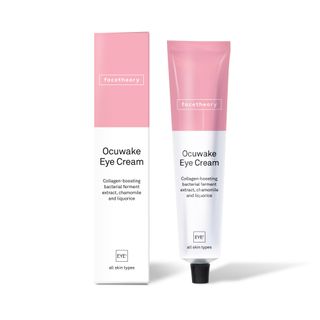
Facetheory Ocuwake Eye Cream EYE1 with Chamomile, Vitamin C, Liquorice, Meiview and Hexylresorcinol
Works for
2 of 2 advertised claims delivered
Anti-aging4 ingredients credited for this claimModerate support
“Ocuwake Eye Cream EYE1 with Chamomile, Vitamin C, Liquorice, Meiview and Hexylresorcinol”
This product contains ferulic acid. This ingredient might be able to help reduce and prevent fine lines and wrinkles, improve skin elasticity and firmness, but there is not enough evidence that it actually works.
Evens skin tone4 ingredients credited for this claimModerate support
“Stabilised vitamin C brightens dark circles, liquorice targets hyperpigmentation and CO2-extracted chamomile soothes delicate skin.”
The following ingredient (ingredients) in this product might be helpful, but there is no evidence to confirm that it actually works: ferulic acid, glycyrrhiza glabra root extract, hexylresorcinol.
Anti-oxidationNot advertised by the brand · 6 ingredients credited for this claimStrong support
This product contains antioxidants (ferulic acid, tocopherol) that can help neutralize free radicals in skin. By doing so, they can lessen the damage the skin gets from the UV light (sun).
The following ingredients - hexylresorcinol also can have an antioxidant effect, but there is less evidence to confirm their effectiveness in skin.
MoisturizingNot advertised by the brand · 14 ingredients credited for this claimStrong support
This product can help improve hydration of the skin with the two types of ingredients.
The first type is called “humectants”:
these ingredients help attract water.
When humectants are on the surface of the skin, they “pull in” the moisture from the outside environment, or from
within deeper layers of the skin. The following ingredients in this product do the job:
glycerin.
This product also contains ingredients called “occlusives”. They help reduce the speed with which our skin loses moisture to the outside environment. These ingredients also help soften the upper layer of the skin, so it feels less tight and nicer to the touch. The following ingredients in this product do the job: argania spinosa kernel oil, oryza sativa bran oil.
The following ingredients in this product are especially good for supporting the skin barrier and helping with the hydration level: urea
Can it cause trouble?
Irritancy1 strong irritant: Sodium anisateMedium risk
ComedogenicClean of flagged comedogenic ingredientsNone flagged
User reviews
Ingredients
Filter by role to see what each ingredient is doing.
Water~45–55%
Coco-caprylate~5.3–6.5%
- Irritation risk
- Medium
An emollient that softens skin and creates a nice product texture
More about Coco-caprylateUrea~4.1–5%
- Irritation risk
- Low
Naturally present in skin (urea makes up about 7% of natural moisturizing factors in skin). Attracts water to the upper layer of the skin. Also has a positive effect on the skin barrier beyond the humectant action. Can enhance penetration of other ingredients. Is an exfoliating ingredient when used in high concentrations
More about UreaGlyceryl stearate~3.3–4%
- Irritation risk
- Low
An emollient that softens the skin and forms a protective layer on its surface. Helps water and oil mix together
More about Glyceryl stearateBacillus ferment~2.8–3.4%
- Irritation risk
- Low
A product of bacterial fermentation. Can help attract water to the upper layer of the skin
More about Bacillus fermentCetyl alcohol~2.3–2.8%
- Irritation risk
- Low
A non-drying alcohol that works to soften the skin and stabilize product formulations helping oil and water mix together
More about Cetyl alcoholArgania spinosa kernel oil~1.9–2.4%
- Irritation risk
- Medium
An emollient that helps soften the upper layer of the skin. Might have some weak anti-oxidant properties
More about Argania spinosa kernel oilTocopherol~1.5–1.9%
- Irritation risk
- Low
Pure form of vitamin E. Can help moisturise and protect the skin from free radicals. Often used to help stabilise other ingredients or the formula itself
More about TocopherolPolyglyceryl-6 stearate~1.4–1.7%
- Irritation risk
- Low
Helps soften the upper layer of the skin
More about Polyglyceryl-6 stearateStearic acid~1.2–1.4%
- Irritation risk
- Low
Helps oil and water mix together and works as an emollient
More about Stearic acidSimmondsia chinensis seed oil~0.95–1.15%
- Irritation risk
- Medium
Softens the upper layer of skin and helps restore the healthy skin barrier. Has shown to help calm down inflammation in skin. It is a stable oil, meaning that it retains its properties even when exposed to air.
More about Simmondsia chinensis seed oilOryza sativa bran oil~0.7–1.05%
- Irritation risk
- Low
Helps soften the upper layer of the skin and might have some anti-oxidant properties
More about Oryza sativa bran oilHexylresorcinol~0.55–0.85%
- Irritation risk
- Medium
Might be helpful in reducing hyperpigmentation and neutralizing free radicals in skin
More about HexylresorcinolGlycerin~0.55–0.85%
- Irritation risk
- Low
One of the best moisturizing ingredients. Naturally present in skin. It attracts water to the upper layer of the skin working as a humectant
More about GlycerinSodium anisate~0.5–0.75%
Sodium levulinate~0.45–0.65%
Sodium ascorbyl phosphate~0.45–0.65%
- Irritation risk
- Medium
A stable derivative of vitamin C. It is oil-soluble which means it is more likely to penetrate the skin compared to the pure form of vitamin C (which is water-soluble), but it is less bio-available and is way less effective in stimulating collagen and reducing wrinkles compared to the pure form of vitamin C (L-ascorbic acid) and its other derivatives (for example, magnesium ascorbyl phosphate). At the same time, this vitamin C derivative has been shown in studies to be effective in reducing acne, blemishes and clogged pores. It is less irritating then the pure form of vitamin C
More about Sodium ascorbyl phosphateLactic acid~0.35–0.6%
- Irritation risk
- Medium
An exfoliating and moisturizing alpha-hydroxy acid (AHA). Typically causes less irritation than other AHAs, for example, glycolic acid. At high concentrations (about 15%), lactic acid can help reduce lines and wrinkles. Recent studies show that lactic acid can support the "good" bacteria living on skin's surface (healthy skin microbiome)
More about Lactic acidGlyceryl caprylate~0.3–0.55%
- Irritation risk
- Low
An emollient that can also help water and oil mix together, as well as prevent bacteria growth in products
More about Glyceryl caprylateGellan gum~0.25–0.45%
Ferulic acid~0.2–0.35%
- Irritation risk
- Low
A potent anti-oxidant that has been shown to be effective in neutralizing free radicals in skin. There seem to have a synergetic effect of ferulic acid, vitamin E and C, meaning that when the ingredients are used together, they enhance each other's ability protect the skin against free radicals. Ferulic acid also helps to stabilize other ingredients - including vitamins C and E. It can help to even out the skin tone. Ferulic acid is approved for use as a sunscreen ingredient in Japan in concentrations up to 10%
More about Ferulic acidGlycyrrhiza glabra root extract~0.2–0.35%
- Irritation risk
- Medium
A plant extract that can help lighten the skin and calm down inflammation. Might be helpful in neutralizing free radicals
More about Glycyrrhiza glabra root extractSodium phytate~0.15–0.25%
Chamomilla recutita flower extract~0.1–0.2%
- Irritation risk
- High
Plant extract that can have healing and anti-inflammatory properties. It is a potential allergen and can be irritating
More about Chamomilla recutita flower extractXanthan gum~0.1–0.2%
- Irritation risk
- Low
Used to create a thicker product consistency
More about Xanthan gumCitric acid~0.05–0.1%
- Irritation risk
- Medium
Can work as an exfoliant but is typically used to adjust the product pH
More about Citric acidPotassium sorbate~0.1–0.15%
Ingredient list view
Water, Coco-caprylate, Urea, Glyceryl stearate, Bacillus ferment, Cetyl alcohol, Argania spinosa kernel oil, Tocopherol, Polyglyceryl-6 stearate, Stearic acid, Simmondsia chinensis seed oil, Oryza sativa bran oil, Hexylresorcinol, Glycerin, Sodium anisate, Sodium levulinate, Sodium ascorbyl phosphate, Lactic acid, Glyceryl caprylate, Unknown, Gellan gum, Ferulic acid, Glycyrrhiza glabra root extract, Sodium phytate, Chamomilla recutita flower extract, Xanthan gum, Citric acid, Potassium sorbate
Compare prices
Retailers ranked by price — lowest first.

Affiliate links · prices updated regularly
Product summary
Judging from the ingredient list, "Facetheory - Ocuwake Eye Cream EYE1 with Chamomile, Vitamin C, Liquorice, Meiview and Hexylresorcinol" works well for improving skin hydration This moisturizer uses a good combo of humectants and emollients. These both types of ingredients are essentials for improving the skin hydration and keeping the skin barrier healthy. Humectants in this product (urea and glycerin) help to increase the water content in the upper layer of the skin. (These ingredients do so by "capturing" water molecules from the outside air or from within the deeper layers of the skin). Emollients in this formulation (argania spinosa kernel oil, oryza sativa bran oil, cetyl alcohol, coco-caprylate and polyglyceryl-6 stearate) help to reduce the moisture loss from the skin. They also soften the skin surface and relieve the feeling of dryness and tightness.
This product contains ingredients that could be beneficial, but their concentrations are too low in this formulation: sodium ascorbyl phosphate and lactic acidIrritation risk
This formulation includes some common irritants, including ingredients that do not provide a benefit for the skin. We assess the overall irritancy of this moisturizer to be medium. For a detailed overview of all potential irritants: click here
You can see the detailed formula review with the breakdown of all actives in the product and the full ingredient list with estimated concentrations in the tables below.
Price
The product retails for 14.87£ in the United Kingdom.
For a detailed price comparison: click here.
Sources cited in this review
Every concentration estimate and effectiveness label is anchored to one of these 18 studies and safety reviews.
- 1Topical urea in skincare: A reviewpubmed.ncbi.nlm.nih.gov
- 2
- 3Vitamin E in dermatologyncbi.nlm.nih.gov
- 4Vitamin E and Skin Healthlpi.oregonstate.edu
- 5
- 6

Affiliate links · As an Amazon Associate, WIMJ earns from qualifying purchases.