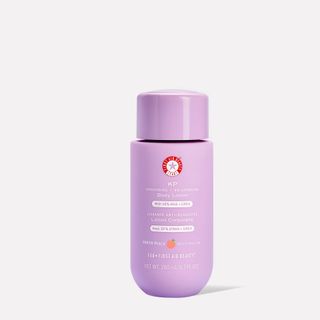
fab KP Smoothing + Brightening Body Lotion Fresh Peach
Works for
1 of 2 advertised claims delivered
Moisturizing20 ingredients credited for this claimStrong support
“With Urea, Colloidal Oatmeal, Ceramides, + juicy peach scent , the hydrating formula reveals skin that is healthier-looking, supple and silky smooth Vegan, Gluten-Free, Paraben-Free, Oil-Free, Sulfate-Free”
This product can help improve hydration of the skin with the two types of ingredients.
The first type is called “humectants”:
these ingredients help attract water.
When humectants are on the surface of the skin, they “pull in” the moisture from the outside environment, or from
within deeper layers of the skin. The following ingredients in this product do the job:
glycerin, sodium pca.
This product also contains ingredients called “occlusives”. They help reduce the speed with which our skin loses moisture to the outside environment. These ingredients also help soften the upper layer of the skin, so it feels less tight and nicer to the touch. The following ingredients in this product do the job: dimethicone, c12-15 alkyl benzoate.
The following ingredients in this product are especially good for supporting the skin barrier and helping with the hydration level: ceramide np, lanolin, paraffinum liquidum, petrolatum, urea
Exfoliation3 ingredients credited for this claimLimited support
“Contains 10% Lactic Acid (AHA) to resurface the top layer of skin, helping to reduce the appearance of hard, rough bumps associated with Keratosis Pilaris.”
This product might help exfoliate the skin with urea, but This ingredient is not the most effective.
Evens skin toneNot advertised by the brand · 2 ingredients credited for this claimStrong support
This product can help reduce hypepigmentation and even out the skin tone because it contains the following effective ingredients: hydroquinone.
Keep in mind that you would need to apply any topical skincare targetted at hypigmentation consistently for a couple of months to get a result. No topical skincare product can help get rid of hyperpigmentation (including post-acne marks and age spots) instantly.
Can it cause trouble?
Irritancy7 strong irritants: Alcohol, Parfum + 5 more — patch-test recommendedHigh risk
Comedogenic3 ingredients rated 2 or more on the 0–5 pore-clogging scale3 flagged
User reviews
Be the first — your take helps the next person decide.
Ingredients
Filter by role to see what each ingredient is doing.
Alcohol~24–35%
- Irritation risk
- High
Can be drying and contribute to skin irritation. Used in formulars to dissolve other ingredients, create a thinner product consistency or for its antibacterial properties
More about AlcoholParfum~3.6–5.4%
- Irritation risk
- High
An aromatic blend of unspecified and possibly irritating ingredients
More about ParfumLanolin~3.3–5%
- Irritation risk
- Low
Sebum of wool-bearing animals (most commonly sheep). Helps soften the upper layer of the skin and reduce the skin water loss. In rare cases could be an allergen. Not suitable for vegans
More about LanolinParaffinum liquidum~3.7–5.5%
- Irritation risk
- Low
Mineral oil. One of the most effective and well studied occlusive and emollient moisturizing ingredients. Helps reduce moisture loss in skin and repair skin barrier function
More about Paraffinum liquidumPetrolatum~2.9–4.3%
- Irritation risk
- Low
One of the most effective and the most studied occlusive ingredients that creates a protective layer on top of the skin preventing moisture loss
More about PetrolatumPropylene glycol~1.8–2.6%
- Irritation risk
- High
Helps oil and water mix together and can enhance the penetration of other ingredients into the skin. It can be irritating
More about Propylene glycolTalc~1.5–2.3%
Formaldehyde~0.5–1.2%
- Irritation risk
- Low
Benzophenone-3~1.3–1.9%
- Irritation risk
- High
Same as oxybenzone. Protects in the UVB and short UVA range. In small concentrations, used to stabilize product formulation. Can be irritating. Is shown to be harmful to coral reefs - consider avoiding bathing in coral reef areas when wearing a product with this ingredient. It can penetrate the skin and get absorbed into bloodstream faster than other popular filters available in the US. The study that produced this finding did not address any potential health effects of the absorption
More about Benzophenone-3Coal tar~0.8–1.25%
- Irritation risk
- Low
- Comedogenicity
- 3/5
Hydroquinone~0.5–1.15%
- Irritation risk
- High
A potent anti-pigmentation active. It can have serious side-effects though and ideally is used under supervision of a doctor. It should not be used over a long period of time (over a year).
More about HydroquinoneCarbon~0.4–1%
- Irritation risk
- Low
Alcohol~0.4–0.9%
- Irritation risk
- High
Can be drying and contribute to skin irritation. Used in formulars to dissolve other ingredients, create a thinner product consistency or for its antibacterial properties
More about AlcoholWater~0.35–0.85%
Lactic acid~0.35–0.75%
- Irritation risk
- Medium
An exfoliating and moisturizing alpha-hydroxy acid (AHA). Typically causes less irritation than other AHAs, for example, glycolic acid. At high concentrations (about 15%), lactic acid can help reduce lines and wrinkles. Recent studies show that lactic acid can support the "good" bacteria living on skin's surface (healthy skin microbiome)
More about Lactic acidC12-15 alkyl benzoate~0.4–0.9%
- Irritation risk
- Low
Enhances the product texture and makes it more spreadable. Helps reduce water loss from the outer layer of skin. Extands the shelf life by preventing bacteria growth
More about C12-15 alkyl benzoatePropanediol~0.35–0.8%
- Irritation risk
- Low
Acts as a solvent for other ingredients. Speeds up the absorption of other ingredients into the skin
More about PropanediolCaprylic/capric triglyceride~0.35–0.85%
- Irritation risk
- Medium
A good mix of fatty acids that forms a protective layer on the skin. Improves the shelf life of products. Derived from coconut and glycerin
More about Caprylic/capric triglycerideSilica~0.4–0.9%
Sodium hydroxide~0.15–0.7%
Palmitic acid~0.3–0.75%
- Irritation risk
- Low
An emollient that is naturally present in skin and helps soften it
More about Palmitic acidDimethicone~0.3–0.75%
- Irritation risk
- Low
A silicone that helps to reduce water loss from the surface of the skin. Can temporarily "fill in" lines and wrinkles, absorb oil, and create a nice product finish
More about DimethiconeStearic acid~0.35–0.8%
- Irritation risk
- Low
Helps oil and water mix together and works as an emollient
More about Stearic acidGlyceryl stearate~0.2–0.8%
- Irritation risk
- Low
An emollient that softens the skin and forms a protective layer on its surface. Helps water and oil mix together
More about Glyceryl stearateGlyceryl stearate se~0.15–0.65%
- Irritation risk
- Low
- Comedogenicity
- 2/5
Used to stabilize the product formulations and works as an emollient
More about Glyceryl stearate seGlycerin~0.15–0.7%
- Irritation risk
- Low
One of the best moisturizing ingredients. Naturally present in skin. It attracts water to the upper layer of the skin working as a humectant
More about GlycerinUrea~0.15–0.6%
- Irritation risk
- Low
Naturally present in skin (urea makes up about 7% of natural moisturizing factors in skin). Attracts water to the upper layer of the skin. Also has a positive effect on the skin barrier beyond the humectant action. Can enhance penetration of other ingredients. Is an exfoliating ingredient when used in high concentrations
More about UreaCeramide np~0.2–0.75%
- Irritation risk
- Low
A type of lipid similar to ceramides naturally present in skin. Helps to soften the upper layer of the skin and supports the skin barrier function to keep it hydrated. Can help to prevent inflammation in skin
More about Ceramide npPrunus persica fruit extract~0.2–0.8%
- Irritation risk
- High
A fruit extact. Might have some anti-oxidant properties
More about Prunus persica fruit extractColloidal oatmeal~0.3–0.7%
- Irritation risk
- Low
Helps to restore skin barrier function, soften the upper layer of the skin and calm down inflammation
More about Colloidal oatmealAllantoin~0.15–0.55%
- Irritation risk
- Low
Helps calm down inflammation in skin and can help reduce itching. Helps to repair the skin barrier and keep skin hydrated
More about AllantoinRibes nigrum bud extract~0.15–0.55%
- Irritation risk
- Low
Triacetin~0.2–0.75%
Sodium pca~0.15–0.55%
- Irritation risk
- Low
Naturally present in skin and helps to attract water to its upper layer
More about Sodium pcaCetearyl alcohol~0.35–0.8%
- Irritation risk
- Low
- Comedogenicity
- 2/5
A non-drying alcohol. Works as an emollient. Helps water and oil mix together and creates a nice product texture
More about Cetearyl alcoholCitrus aurantium dulcis peel oil~0.2–0.7%
- Irritation risk
- High
An essentil oil from orange peel. Potential allergen and can be irritating
More about Citrus aurantium dulcis peel oilSodium phytate~0.15–0.65%
Ethyl hydroxypyrone~0.15–0.55%
- Irritation risk
- Low
Butylene glycol~0.15–0.55%
- Irritation risk
- Low
Used to create a nice product texture and help delivery of other ingredients. Might be somewhat helpful in attracting water to the upper layer of the skin
More about Butylene glycolXanthan gum~0.15–0.55%
- Irritation risk
- Low
Used to create a thicker product consistency
More about Xanthan gumGamma-undecalactone~0.1–0.45%
- Irritation risk
- Low
Phenoxyethanol~0.1–0.4%
- Irritation risk
- Low
A preservative. It helps prevent bacterial growth in cosmetic products
More about PhenoxyethanolPotassium sorbate~0.1–0.45%
Sodium benzoate~0.1–0.4%
Limonene~0.1–0.3%
- Irritation risk
- High
A common frangrance that can easily irritate skin, especially if exposed to air, light or heat
More about LimoneneLinalool~0.1–0.3%
Ingredient list view
Alcohol, Parfum, Lanolin, Paraffinum liquidum, Petrolatum, Propylene glycol, Talc, Formaldehyde, Benzophenone-3, Coal tar, Hydroquinone, Carbon, Alcohol, Water, Lactic acid, C12-15 alkyl benzoate, Propanediol, Caprylic/capric triglyceride, Silica, Sodium hydroxide, Palmitic acid, Dimethicone, Stearic acid, Glyceryl stearate, Glyceryl stearate se, Glycerin, Urea, Ceramide np, Prunus persica fruit extract, Colloidal oatmeal, Allantoin, Ribes nigrum bud extract, Triacetin, Sodium pca, Cetearyl alcohol, Citrus aurantium dulcis peel oil, Sodium phytate, Ethyl hydroxypyrone, Butylene glycol, Xanthan gum, Gamma-undecalactone, Phenoxyethanol, Potassium sorbate, Sodium benzoate, Limonene, Linalool
Compare prices
Retailers ranked by price — lowest first.

Affiliate links · prices updated regularly
Product summary
"fab - KP Smoothing + Brightening Body Lotion Fresh Peach" is effective for: Moisturizing and Evens skin tone
Ingredient callouts
- As a plus, this moisturizer also contains Ceramides (ceramide np 0.20% - 0.75%). Ceramides are a type of lipids that our skin produces itself. They are a building block of the skin's barrier. Ceramides used in skincare are synthetic or extracted from plants. They work well for softening the skin surface and "patch holes" in the skin's barrier.
Price
The product retails for 36.00$ in the United States.
For a detailed price comparison: click here.
Sources cited in this review
Every concentration estimate and effectiveness label is anchored to one of these 19 studies and safety reviews.
- 1
- 2A review on the extensive skin benefits of mineral oilncbi.nlm.nih.gov
- 3Surfactants and experimental irritant contact dermatitisncbi.nlm.nih.gov
- 4Propylene Glycolpubmed.ncbi.nlm.nih.gov
- 5Skin-sensitizing and irritant properties of propylene glycolonlinelibrary.wiley.com
- 6

Affiliate links · As an Amazon Associate, WIMJ earns from qualifying purchases.