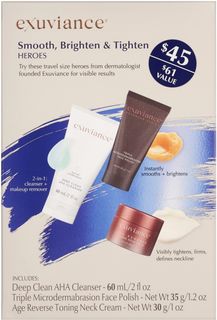
Exuviance Smooth, Brighten & Tighten Heroes
Works for
3 of 4 advertised claims delivered
Exfoliation5 ingredients credited for this claimStrong support
“2 oz) This triple action formula features a unique blend of 3 exfoliators .”
This product can help exfoliate the skin. In other words, it helps break down the bonds between dead cells on the surface of the skin and speed up the skin turnover. Skin often appears softer and brighter after exfoliation, but overdoing it can result in disrupted skin barrier. The following ingredient is doing the exfoliating job in this product: gluconolactone, glycolic acid, lactobionic acid.
Evens skin tone4 ingredients credited for this claimStrong support
“Skin will appear brighter, clarified with reduced appearance of pores and more even skin tone.”
This product can help reduce hypepigmentation and even out the skin tone because it contains the following effective ingredients: acetyl glucosamine, gluconolactone, glycolic acid, lactobionic acid
Keep in mind that you would need to apply any topical skincare targetted at hypigmentation consistently for a couple of months to get a result. No topical skincare product can help get rid of hyperpigmentation (including post-acne marks and age spots) instantly.
Anti-aging5 ingredients credited for this claimStrong support
“Age Reverse Toning Neck Cream.”
This product can help reduce and prevent fine lines and wrinkles, improve skin elasticity and firmness because it contains acetyl glucosamine, gluconolactone, glycolic acid, lactobionic acid.
Keep in mind that it typically takes at least 6 weeks to notice any results because the changes that are needed to improve fine lines and elasticity happen in the deeper layers of the skin. No topical anti-aging product can “erase” wrinkles or fully reverse signs of aging.
Anti-blemish3 ingredients credited for this claimLimited support
“to help dissolve impurities that contribute to congested pores and polish dull skin to a gorgeous silky softness and glow.”
This product contains ingredients (gluconolactone, glycolic acid, lactobionic acid) that could help reduce blemishes and clogged pores in theory, but there is not enough evidence that they actually work.
MoisturizingNot advertised by the brand · 25 ingredients credited for this claimStrong support
This product can help improve hydration of the skin with the two types of ingredients.
The first type is called “humectants”:
these ingredients help attract water.
When humectants are on the surface of the skin, they “pull in” the moisture from the outside environment, or from
within deeper layers of the skin. The following ingredients in this product do the job:
arginine, glycerin.
This product also contains ingredients called “occlusives”. They help reduce the speed with which our skin loses moisture to the outside environment. These ingredients also help soften the upper layer of the skin, so it feels less tight and nicer to the touch. The following ingredients in this product do the job: arginine, dimethicone.
The following ingredients in this product are especially good for supporting the skin barrier and helping with the hydration level: acetyl glucosamine, lactobionic acid
Anti-oxidationNot advertised by the brand · 4 ingredients credited for this claimStrong support
This product contains antioxidants (lactobionic acid) that can help neutralize free radicals in skin. By doing so, they can lessen the damage the skin gets from the UV light (sun).
The following ingredients - gluconolactone also can have an antioxidant effect, but there is less evidence to confirm their effectiveness in skin.
Can it cause trouble?
Irritancy2 strong irritants: Benzophenone-4, Parfum — patch-test recommendedHigh risk
Comedogenic6 ingredients rated 2 or more on the 0–5 pore-clogging scale6 flagged
User reviews
Be the first — your take helps the next person decide.
Ingredients
Filter by role to see what each ingredient is doing.
Water~45–55%
Sodium laureth sulfate~11–13%
- Irritation risk
- High
- Comedogenicity
- 2/5
Works as a foaming cleansing agent
More about Sodium laureth sulfateCocamidopropyl betaine~6.5–7.9%
- Irritation risk
- High
Helps water and oil mix together. Used as a cleansing ingredient. Could be an allergen
More about Cocamidopropyl betainePeg-7 glyceryl cocoate~3.4–4.2%
- Irritation risk
- Medium
Helps oils and water mix together and works as a cleansing agent
More about Peg-7 glyceryl cocoateTea-lauryl sulfate~2.7–3.3%
Propylene glycol~2–2.5%
- Irritation risk
- High
Helps oil and water mix together and can enhance the penetration of other ingredients into the skin. It can be irritating
More about Propylene glycolGlycolic acid~1.7–2.1%
- Irritation risk
- High
An alpha-hydroxy acid (AHA) that helps to remove the dead skin cells on the surface of the skin reveling a more even, smoother complexation. It is also able to stimulate collagen production with long-term use. Could help to reduce pore congestion. It can be irritating to the skin. Apply sunscreen daily if using products with glycolic acid
More about Glycolic acidGluconolactone~1.5–1.8%
- Irritation risk
- Medium
A polyhydroxy acid (PHA) that helps shed the dead cells from the skin surface revealing smoother skin. Is believed to be genter than AHAs. It helps attract water to the upper layer of the skin and can stimulate production of skin's own hyaluronic acid resulting in improved hydration levels. It has been shown to be helpful against acne and clogged pores if used consistently (e.g over a period of 12 weeks) in high enough concentration. It can help reduce fine lines and wrinkles and improve skin tone with long-term application. Can help neutralize free radicals
More about GluconolactonePolyquaternium-10~1.3–1.6%
- Irritation risk
- Low
Helps soften the upper layer of the skin and create a nice product finish
More about Polyquaternium-10Benzophenone-4~1.4–1.8%
- Irritation risk
- High
Sulisobenzone. A UV filter. Is typically used to improve the product stability under exposure to UV light. It is effective against both UVA and UVB rays. It can be used is larger concentrations as a sun protection ingredient for the skin, but can be irritating
More about Benzophenone-4Caprylyl glycol~0.75–1.15%
- Irritation risk
- Medium
Helps preserve products and creates a nice product texture
More about Caprylyl glycolPhenoxyethanol~0.6–0.95%
- Irritation risk
- Low
A preservative. It helps prevent bacterial growth in cosmetic products
More about PhenoxyethanolChlorphenesin~0.16–0.32%
Parfum~0.5–0.75%
- Irritation risk
- High
An aromatic blend of unspecified and possibly irritating ingredients
More about ParfumCi 42090~0.5–0.75%
Ci 19140~0.5–0.75%
Cream~0.5–0.75%
- Irritation risk
- Low
Water~0.45–0.7%
Acetyl glucosamine~0.4–0.6%
- Irritation risk
- Low
An effective moisturizing ingredient that also has been shown to be effective in evening out the skin tone and reducing hyperpigmentation. It can help somewhat reduce wrinkles in skin
More about Acetyl glucosamineCyclopentasiloxane~0.45–0.65%
- Irritation risk
- Low
A silicone that helps improve the product texture and spreadability. Can absorb oil creating a short-term mattifying effect on the skin
More about CyclopentasiloxaneTriethyl citrate~0.3–0.6%
Cetearyl alcohol~0.45–0.65%
- Irritation risk
- Low
- Comedogenicity
- 2/5
A non-drying alcohol. Works as an emollient. Helps water and oil mix together and creates a nice product texture
More about Cetearyl alcoholC12-15 alkyl benzoate~0.35–0.6%
- Irritation risk
- Low
Enhances the product texture and makes it more spreadable. Helps reduce water loss from the outer layer of skin. Extands the shelf life by preventing bacteria growth
More about C12-15 alkyl benzoateButyrospermum parkii butter~0.4–0.6%
- Irritation risk
- Low
- Comedogenicity
- 3/5
A great moisturising ingredient that softens the skin and reduces water loss from its upper layer. It also can be helpful in protecting skin from free radicals
More about Butyrospermum parkii butterGlyceryl stearate~0.4–0.6%
- Irritation risk
- Low
An emollient that softens the skin and forms a protective layer on its surface. Helps water and oil mix together
More about Glyceryl stearateCyclohexasiloxane~0.35–0.65%
- Irritation risk
- Low
A silicone that serves as an emollient. Helps create a nice non-greasy feels
More about CyclohexasiloxaneGlycerin~0.35–0.65%
- Irritation risk
- Low
One of the best moisturizing ingredients. Naturally present in skin. It attracts water to the upper layer of the skin working as a humectant
More about GlycerinIsocetyl stearoyl stearate~0.35–0.6%
- Irritation risk
- Low
Helps soften the upper layer of the skin
More about Isocetyl stearoyl stearateDimethicone~0.4–0.65%
- Irritation risk
- Low
A silicone that helps to reduce water loss from the surface of the skin. Can temporarily "fill in" lines and wrinkles, absorb oil, and create a nice product finish
More about DimethiconeEthoxydiglycol~0.3–0.55%
Peg-100 stearate~0.45–0.65%
- Irritation risk
- Low
Helps oil and water mix togehter and creates a nice product texture
More about Peg-100 stearatePolymethylsilsesquioxane~0.35–0.6%
- Irritation risk
- Low
A silicone that improves product texture and helps dissolve other ingredients. Can form a non-greasy film on the skin to prevent moisture loss
More about PolymethylsilsesquioxaneNylon-12~0.35–0.65%
Isostearic acid~0.45–0.65%
- Irritation risk
- Low
Used to create a nice product texture
More about Isostearic acidTocopheryl acetate~0.35–0.6%
- Irritation risk
- Medium
A more stable but less bio-available form of vitamin E compared to Tocopherol. Might help moisturize and protect the skin from free radicals, but mostly used in low concentrations to stabilize other ingredients.
More about Tocopheryl acetatePalmitoyl glycine~0.4–0.65%
- Irritation risk
- Low
Malus domestica fruit cell culture extract~0.3–0.55%
- Irritation risk
- Low
Hydrogenated palm kernel glycerides~0.35–0.6%
- Irritation risk
- Low
Help soften the upper layer of the skin
More about Hydrogenated palm kernel glyceridesHydrogenated palm glycerides~0.4–0.6%
- Irritation risk
- Low
An emollient that softens the skin
More about Hydrogenated palm glyceridesDimethiconol~0.4–0.6%
- Irritation risk
- Low
A silicone that makes products more spreadable and keeps skin smooth. Helps to add gloss to skin and may visually fill in fine lines/wrinkles for short time
More about DimethiconolIsopropyl myristate~0.35–0.65%
- Irritation risk
- Low
- Comedogenicity
- 3/5
An emollient that helps soften the skin. Could be comedogenic
More about Isopropyl myristateCaprylyl glycol~0.35–0.65%
- Irritation risk
- Medium
Helps preserve products and creates a nice product texture
More about Caprylyl glycolLecithin~0.35–0.65%
- Irritation risk
- Low
Used mostly for creating emulsions - helping oil and water mix together. Helps soften the upper layer of the skin
More about LecithinPeg-40 stearate~0.35–0.6%
Ceteareth-20~0.45–0.65%
- Irritation risk
- Medium
- Comedogenicity
- 2/5
Helps oil and water mix together. Has some emollient properties
More about Ceteareth-20Carbomer~0.3–0.6%
- Irritation risk
- Low
Helps create a thicker or gel-like product texture. It is not a surfactant but can be used in gentle cleansing formulations
More about CarbomerXanthan gum~0.3–0.6%
- Irritation risk
- Low
Used to create a thicker product consistency
More about Xanthan gumPentaerythrityl tetra-di-t-butyl hydroxyhydrocinnamate~0.35–0.6%
- Irritation risk
- Low
Used to increase stability of product formulations
More about Pentaerythrityl tetra-di-t-butyl hydroxyhydrocinnamateSodium bisulfite~0.1–0.2%
Disodium edta~0.3–0.6%
Ammonium hydroxide~0.3–0.6%
Chlorphenesin~0.16–0.32%
Phenoxyethanol~0.3–0.6%
- Irritation risk
- Low
A preservative. It helps prevent bacterial growth in cosmetic products
More about PhenoxyethanolEthylene brassylate~0.3–0.55%
Methyldihydrojasmonate~0.3–0.6%
Isobutyl methyl tetrahydropyranol~0.3–0.6%
Methyl decenol~0.3–0.5%
- Irritation risk
- High
Used to mask the smell of other ingredients in the formulation
More about Methyl decenolCaramel~0.3–0.6%
- Irritation risk
- Low
Ci 19140~0.3–0.6%
Water~0.3–0.6%
Glycolic acid~0.3–0.6%
- Irritation risk
- High
An alpha-hydroxy acid (AHA) that helps to remove the dead skin cells on the surface of the skin reveling a more even, smoother complexation. It is also able to stimulate collagen production with long-term use. Could help to reduce pore congestion. It can be irritating to the skin. Apply sunscreen daily if using products with glycolic acid
More about Glycolic acidAlumina~0.5–0.75%
- Irritation risk
- Low
The same compound that is used safely in dental implants and bone cements. In cosmetics, it is used to improve the consistency of products
More about AluminaGlycerin~0.35–0.65%
- Irritation risk
- Low
One of the best moisturizing ingredients. Naturally present in skin. It attracts water to the upper layer of the skin working as a humectant
More about GlycerinHydrogenated polydecene~0.3–0.6%
- Irritation risk
- Low
Helps to soften the upper layer of the skin and create a nice product texture
More about Hydrogenated polydeceneIsononyl isononanoate~0.35–0.65%
- Irritation risk
- Low
Forms a protective film on the surface of the skin to prevent moisture loss. Gives a velvety feel to products while reducing tackiness
More about Isononyl isononanoateC12-15 alkyl benzoate~0.35–0.6%
- Irritation risk
- Low
Enhances the product texture and makes it more spreadable. Helps reduce water loss from the outer layer of skin. Extands the shelf life by preventing bacteria growth
More about C12-15 alkyl benzoateGlyceryl stearate~0.4–0.6%
- Irritation risk
- Low
An emollient that softens the skin and forms a protective layer on its surface. Helps water and oil mix together
More about Glyceryl stearateAmmonium hydroxide~0.3–0.6%
Arginine~0.3–0.55%
- Irritation risk
- Low
An amino acid that is naturally present in skin and helps keep it hydrated. When used together with AHAs, it can reduce their irritating effect on the skin
More about ArginineButylene glycol~0.3–0.6%
- Irritation risk
- Low
Used to create a nice product texture and help delivery of other ingredients. Might be somewhat helpful in attracting water to the upper layer of the skin
More about Butylene glycolStearyl alcohol~0.4–0.6%
- Irritation risk
- Low
An emollient that helps soften the skin
More about Stearyl alcoholPolyacrylate-1 crosspolymer~0.35–0.65%
- Irritation risk
- Low
Peg-100 stearate~0.45–0.65%
- Irritation risk
- Low
Helps oil and water mix togehter and creates a nice product texture
More about Peg-100 stearateLactobionic acid~0.3–0.6%
- Irritation risk
- Medium
A polyhydroxy acid (PHA) that helps shed dead cells from the surface of the skin revealing a smoother, more even skin. PHAs tend to be gentler on the skin compared to AHAs (for example, glycolic acid). It also has hydrating properties and helps attract water to the upper layer of the skin. It can help calm down inflammation in skin and support restoration of the barrier function. It has an anti-oxidant effect as well. It can help reduce fine line, wrinkles and improve skin elasticity
More about Lactobionic acidPapain~0.3–0.55%
- Irritation risk
- High
An enzyme extracted from papaya fruit. Can have an exfoliating effect on the skin. Can be irritating
More about PapainCetyl alcohol~0.4–0.6%
- Irritation risk
- Low
A non-drying alcohol that works to soften the skin and stabilize product formulations helping oil and water mix together
More about Cetyl alcoholHydroxypropyl starch phosphate~0.35–0.6%
- Irritation risk
- Medium
Helps oil and water mix together and used to stabilize product formulations
More about Hydroxypropyl starch phosphatePeg-75 stearate~0.3–0.55%
Dehydroxanthan gum~0.3–0.6%
- Irritation risk
- Low
Helps create thicker product formulations and stabilize emulsions
More about Dehydroxanthan gumCeteth-20~0.45–0.7%
Steareth-20~0.4–0.65%
Carbomer~0.25–0.5%
- Irritation risk
- Low
Helps create a thicker or gel-like product texture. It is not a surfactant but can be used in gentle cleansing formulations
More about CarbomerCaprylyl glycol~0.3–0.5%
- Irritation risk
- Medium
Helps preserve products and creates a nice product texture
More about Caprylyl glycolAlgin~0.2–0.4%
- Irritation risk
- Low
- Comedogenicity
- 3/5
Used to thicken product formulation. Can help attract water to the upper layer of the skin
More about AlginPhenoxyethanol~0.2–0.35%
- Irritation risk
- Low
A preservative. It helps prevent bacterial growth in cosmetic products
More about PhenoxyethanolChlorphenesin~0.16–0.32%
Parfum~0.15–0.3%
- Irritation risk
- High
An aromatic blend of unspecified and possibly irritating ingredients
More about ParfumCi 19140~0.15–0.25%
Ci 14700~0.15–0.25%
Ingredient list view
Water, Sodium laureth sulfate, Cocamidopropyl betaine, Peg-7 glyceryl cocoate, Tea-lauryl sulfate, Propylene glycol, Glycolic acid, Gluconolactone, Polyquaternium-10, Benzophenone-4, Caprylyl glycol, Phenoxyethanol, Chlorphenesin, Parfum, Ci 42090, Ci 19140, Cream, Water, Acetyl glucosamine, Cyclopentasiloxane, Triethyl citrate, Cetearyl alcohol, C12-15 alkyl benzoate, Butyrospermum parkii butter, Glyceryl stearate, Cyclohexasiloxane, Glycerin, Isocetyl stearoyl stearate, Dimethicone, Ethoxydiglycol, Peg-100 stearate, Polymethylsilsesquioxane, Nylon-12, Isostearic acid, Tocopheryl acetate, Palmitoyl glycine, Malus domestica fruit cell culture extract, Hydrogenated palm kernel glycerides, Hydrogenated palm glycerides, Dimethiconol, Isopropyl myristate, Caprylyl glycol, Lecithin, Peg-40 stearate, Ceteareth-20, Carbomer, Xanthan gum, Pentaerythrityl tetra-di-t-butyl hydroxyhydrocinnamate, Sodium bisulfite, Disodium edta, Ammonium hydroxide, Chlorphenesin, Phenoxyethanol, Ethylene brassylate, Methyldihydrojasmonate, Isobutyl methyl tetrahydropyranol, Methyl decenol, Caramel, Ci 19140, Water, Glycolic acid, Alumina, Glycerin, Hydrogenated polydecene, Isononyl isononanoate, C12-15 alkyl benzoate, Glyceryl stearate, Ammonium hydroxide, Arginine, Butylene glycol, Stearyl alcohol, Polyacrylate-1 crosspolymer, Peg-100 stearate, Lactobionic acid, Papain, Cetyl alcohol, Hydroxypropyl starch phosphate, Peg-75 stearate, Dehydroxanthan gum, Ceteth-20, Steareth-20, Carbomer, Caprylyl glycol, Algin, Phenoxyethanol, Chlorphenesin, Parfum, Ci 19140, Ci 14700
Compare prices
Retailers ranked by price — lowest first.
Affiliate links · prices updated regularly · As an Amazon Associate, WIMJ earns from qualifying purchases.
Product summary
Judging from the ingredient list, "Exuviance - Smooth, Brighten & Tighten Heroes" works well for improving skin hydration The formulation is based on a combination of good humectants and emollients. Both are needed to increase the skin hydration level. Acetyl glucosamine, arginine, glycerin, butylene glycol and caprylyl glycol in this product (humectants) attract water molecules to the upper layer of the skin (the water comes from the outside air or from the deeper layers of the skin if the air is dry). Emollients in this formulation (isopropyl myristate, arginine, dimethicone, dimethiconol and c12-15 alkyl benzoate) help to reduce the moisture loss from the skin. They also soften the skin surface and relieve the feeling of dryness and tightness.
Irritation risk
There are quite a few common irritants in this product, including ingredients without particular skin benefits. We would not recommend it for sensitive skin. We assess the overall irritancy of this moisturizer to be high. For a detailed overview of all potential irritants: click here
You can see the detailed formula review with the breakdown of all actives in the product and the full ingredient list with estimated concentrations in the tables below.
Price
The product retails for 49.00$ in the United States.
For a detailed price comparison: click here.
Sources cited in this review
Every concentration estimate and effectiveness label is anchored to one of these 36 studies and safety reviews.
- 1Surfactants and experimental irritant contact dermatitisncbi.nlm.nih.gov
- 2Propylene Glycolpubmed.ncbi.nlm.nih.gov
- 3Skin-sensitizing and irritant properties of propylene glycolonlinelibrary.wiley.com
- 4
- 5Glycolic acid peel therapy – a current reviewncbi.nlm.nih.gov
- 6

Affiliate links · As an Amazon Associate, WIMJ earns from qualifying purchases.