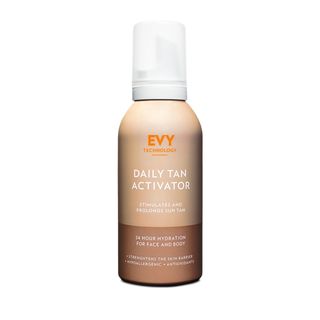
EVY Sunscreen EVY Daily Tan Activator
Works for
1 of 1 advertised claim delivered
Moisturizing11 ingredients credited for this claimGood support
“Strengthens skin’s protective barrier and prevents dehydration whilst encouraging melanin production for a deeper natural tan.”
This product can help improve hydration of the skin with the two types of ingredients.
The first type is called “humectants”:
these ingredients help attract water.
When humectants are on the surface of the skin, they “pull in” the moisture from the outside environment, or from
within deeper layers of the skin. The following ingredients in this product do the job:
glycerin, hydrolyzed collagen.
This product also contains ingredients called “occlusives”. They help reduce the speed with which our skin loses moisture to the outside environment. These ingredients also help soften the upper layer of the skin, so it feels less tight and nicer to the touch. The following ingredients in this product do the job: dimethicone, hydrolyzed collagen.
Can it cause trouble?
Irritancy13 flagged ingredientsLow risk
ComedogenicClean of flagged comedogenic ingredientsNone flagged
User reviews
Be the first — your take helps the next person decide.
Ingredients
Filter by role to see what each ingredient is doing.
Water~45–55%
Butane~6.4–7.8%
- Irritation risk
- Low
Propylene glycol~4.2–5.1%
- Irritation risk
- High
Helps oil and water mix together and can enhance the penetration of other ingredients into the skin. It can be irritating
More about Propylene glycolOctocrylene~3.6–4.4%
- Irritation risk
- Medium
A weak sunscreen that protects against the sun rays that cause sunburn (UVB) and is somewhat effective against the UVA rays. It is quite stable and can help stabilize other, more vulnerable, sunscreen ingredients like Avobenzone. It is an organic, or so called "chemical" sunscreen
More about OctocryleneEthylhexyl isononanoate~2.4–2.9%
- Irritation risk
- Low
Helps soften the upper layer of the skin and improve the product consistency
More about Ethylhexyl isononanoateStearic acid~2–2.5%
- Irritation risk
- Low
Helps oil and water mix together and works as an emollient
More about Stearic acidDiethylamino hydroxybenzoyl hexyl benzoate~2.1–2.5%
- Irritation risk
- Medium
Uvinul A Plus. A new generation broad spectrum sunscreen that offers an effective protection especially in the UVA range. It is stable in formulations. Unfortunately, is not approved by the FDA (US) yet
More about Diethylamino hydroxybenzoyl hexyl benzoatePalmitic acid~1.4–1.7%
- Irritation risk
- Low
An emollient that is naturally present in skin and helps soften it
More about Palmitic acidIsobutane~1.1–1.4%
- Irritation risk
- High
Butyl methoxydibenzoylmethane~1.4–1.7%
- Irritation risk
- Medium
Avobenzone. An organic, or so-called "chemical" UV filter. Protects against both UVA and UVB rays. Needs to be combined with other filters in a formulation to be stable.
More about Butyl methoxydibenzoylmethaneVp/hexadecene copolymer~0.7–1.05%
- Irritation risk
- Low
Creates a nice product texture and can support water-resistance of sunscreens
More about Vp/hexadecene copolymerDipropylene glycol~0.5–0.75%
- Irritation risk
- Low
Helps to dissolve other ingredients in a formulation. Slows down the rate of product drying
More about Dipropylene glycolPvp~0.5–0.75%
- Irritation risk
- Medium
Helps evenly disperse other ingredients in a formulation and create an even layer on the surface of the skin
More about PvpPolysorbate 20~0.45–0.7%
Ethylhexyl triazone~0.6–0.85%
- Irritation risk
- Medium
Uvinul T. A UV filter. Effective against UVB rays. It is photostable. Can increase water resistance properties of the sunscreen. Unfortunately, not approved by the FDA (US) yet
More about Ethylhexyl triazoneTriethanolamine~0.45–0.65%
- Irritation risk
- Medium
Used to adjust pH of the product and can help improve the product's smell
More about TriethanolamineBis-ethylhexyloxyphenol methoxyphenyl triazine~0.55–0.85%
- Irritation risk
- Medium
Tinosorb S. One of the most effective broad spectrum sunscreen ingredients. Protects from both UVA and UVB rays. It is photostable. Unfortunately, not approved by FDA (US) yet.
More about Bis-ethylhexyloxyphenol methoxyphenyl triazineSodium hyaluronate~0.35–0.6%
- Irritation risk
- Low
One of the best moisturizing ingredients. Attracts water into the upper layer of the skin
More about Sodium hyaluronateSodium palmitoyl proline~0.3–0.55%
- Irritation risk
- Low
Caprylic/capric triglyceride~0.35–0.6%
- Irritation risk
- Medium
A good mix of fatty acids that forms a protective layer on the skin. Improves the shelf life of products. Derived from coconut and glycerin
More about Caprylic/capric triglycerideDimethicone~0.3–0.6%
- Irritation risk
- Low
A silicone that helps to reduce water loss from the surface of the skin. Can temporarily "fill in" lines and wrinkles, absorb oil, and create a nice product finish
More about DimethiconeNymphaea alba flower extract~0.25–0.45%
- Irritation risk
- Low
Hydrolyzed silk~0.2–0.4%
- Irritation risk
- Medium
Can help attract water to the upper layer of the skin
More about Hydrolyzed silkGlycerin~0.25–0.45%
- Irritation risk
- Low
One of the best moisturizing ingredients. Naturally present in skin. It attracts water to the upper layer of the skin working as a humectant
More about GlycerinAllantoin~0.2–0.35%
- Irritation risk
- Low
Helps calm down inflammation in skin and can help reduce itching. Helps to repair the skin barrier and keep skin hydrated
More about AllantoinPropane~0.2–0.35%
- Irritation risk
- Low
Tocopheryl acetate~0.15–0.3%
- Irritation risk
- Medium
A more stable but less bio-available form of vitamin E compared to Tocopherol. Might help moisturize and protect the skin from free radicals, but mostly used in low concentrations to stabilize other ingredients.
More about Tocopheryl acetateHydrolyzed collagen~0.2–0.35%
- Irritation risk
- Low
A typically plant-derived compound that is supposed mimic human collagen. Cannot penetrate the skin barrier so is not particularly useful in skincare products beyond attracting water to the upper layer of the skin
More about Hydrolyzed collagenSodium ascorbyl phosphate~0.1–0.2%
- Irritation risk
- Medium
A stable derivative of vitamin C. It is oil-soluble which means it is more likely to penetrate the skin compared to the pure form of vitamin C (which is water-soluble), but it is less bio-available and is way less effective in stimulating collagen and reducing wrinkles compared to the pure form of vitamin C (L-ascorbic acid) and its other derivatives (for example, magnesium ascorbyl phosphate). At the same time, this vitamin C derivative has been shown in studies to be effective in reducing acne, blemishes and clogged pores. It is less irritating then the pure form of vitamin C
More about Sodium ascorbyl phosphateButylene glycol~0.1–0.15%
- Irritation risk
- Low
Used to create a nice product texture and help delivery of other ingredients. Might be somewhat helpful in attracting water to the upper layer of the skin
More about Butylene glycolTetrasodium glutamate diacetate~0.05–0.1%
- Irritation risk
- Low
Helps stabilize the product formulation
More about Tetrasodium glutamate diacetateIngredient list view
Water, Butane, Propylene glycol, Octocrylene, Ethylhexyl isononanoate, Stearic acid, Diethylamino hydroxybenzoyl hexyl benzoate, Palmitic acid, Isobutane, Butyl methoxydibenzoylmethane, Vp/hexadecene copolymer, Dipropylene glycol, Pvp, Polysorbate 20, Ethylhexyl triazone, Triethanolamine, Bis-ethylhexyloxyphenol methoxyphenyl triazine, Sodium hyaluronate, Sodium palmitoyl proline, Caprylic/capric triglyceride, Dimethicone, Nymphaea alba flower extract, Hydrolyzed silk, Glycerin, Allantoin, Propane, Tocopheryl acetate, Hydrolyzed collagen, Sodium ascorbyl phosphate, Butylene glycol, Tetrasodium glutamate diacetate
Compare prices
Retailers ranked by price — lowest first.

Affiliate links · prices updated regularly
Sources cited in this review
Every concentration estimate and effectiveness label is anchored to one of these 18 studies and safety reviews.
- 1Surfactants and experimental irritant contact dermatitisncbi.nlm.nih.gov
- 2Propylene Glycolpubmed.ncbi.nlm.nih.gov
- 3Skin-sensitizing and irritant properties of propylene glycolonlinelibrary.wiley.com
- 4
- 5Hyaluronic acid: A key molecule in skin agingncbi.nlm.nih.gov
- 6

Affiliate links · As an Amazon Associate, WIMJ earns from qualifying purchases.