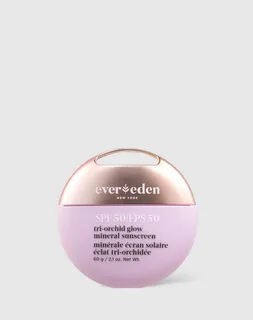
Evereden Tri-Orchid Glow Mineral Sunscreen SPF50
Works for
Sun protectionSPF 50 · 2 UV filtersBroad spectrum
This product offers a good level of protection against both UVB and UVA rays.
It is a mineral sunscreen. In other words, it contains non-organic UV filters. It will probably not sting your eyes but might leave a white cast.
This product can be considered "reef safe" because it does not contain the UV filters (oxybenzone and octinoxate) that can be harmful to coral reefs when present in the water in high concentrations.
Evens skin toneSide benefit · No ingredient credited for this claimWorks well
This product offers broad spectrum sun protection. It means that it can prevent hyperpigmentation and help keep the skin tone even (sun damage is the main factor causing age spots, darkening of post-acne marks and other discolorations).
Anti-agingSide benefit · No ingredient credited for this claimWorks well
This product can help prevent early signs of skin aging because it offers a good level of broad spectrum sun protection. Sun damage is the main cause of premature skin aging, and protecting your skin from the sun is the best anti-aging strategy.
MoisturizingSide benefit the brand mentions · Undecane, Caprylic/capric triglyceride + 17 moreWorks
“(3) Safflower Oleotech™ delivers all-day hydration with time-release technology that infuses skin with vitamin E, for long-lasting comfort.”
This product can help improve hydration of the skin with the two types of ingredients.
The first type is called “humectants”:
these ingredients help attract water.
When humectants are on the surface of the skin, they “pull in” the moisture from the outside environment, or from
within deeper layers of the skin. The following ingredients in this product do the job:
glycerin, caprylyl glycol.
This product also contains ingredients called “occlusives”. They help reduce the speed with which our skin loses moisture to the outside environment. These ingredients also help soften the upper layer of the skin, so it feels less tight and nicer to the touch. The following ingredients in this product do the job: caprylic/capric triglyceride, cocos nucifera oil.
Can it cause trouble?
Irritancy3 strong irritants: Rosa rubiginosa seed oil, Vanilla planifolia fruit extract + 1 more — patch-test recommendedHigh risk
Comedogenic1 ingredient rated 2 or more on the 0–5 pore-clogging scale1 flagged
User reviews
Be the first — your take helps the next person decide.
Ingredients
Filter by role to see what each ingredient is doing.
Zinc oxide~44–54%
- Irritation risk
- Low
A broad spectrum sunblock (protects from both UVA and UVB rays). Is suitable for most sensitive skins. In small concentrations, can be used as a colorant
More about Zinc oxideTitanium dioxide~7.2–8.8%
- Irritation risk
- Low
Works as a UV filter when used in high concentrations. It is photostable and is effective mostly against the UVB light, with some protection in the UVA range. In small concentrations, used for its ability to improve the color of cosmetic products. Is usually well tolerated by the skin
More about Titanium dioxideWater~4.2–5.1%
Water~3.3–4%
Cetyl ethylhexanoate~2.8–3.4%
- Irritation risk
- Medium
An emollient that helps soften the skin and creates a thicker product texture
More about Cetyl ethylhexanoateUndecane~2.3–2.8%
- Irritation risk
- Medium
Helps create a non-greasy finish on the skin
More about UndecaneCaprylic/capric triglyceride~2–2.4%
- Irritation risk
- Medium
A good mix of fatty acids that forms a protective layer on the skin. Improves the shelf life of products. Derived from coconut and glycerin
More about Caprylic/capric triglycerideDicaprylyl ether~1.6–2%
- Irritation risk
- Low
Helps soften the upper layer of the skin while creating a non-greasy feel on the skin. Helps to dissolve other ingredients
More about Dicaprylyl etherC13-15 alkane~1.3–1.6%
Tridecane~1–1.2%
Argania spinosa kernel oil~1–1.2%
- Irritation risk
- Medium
An emollient that helps soften the upper layer of the skin. Might have some weak anti-oxidant properties
More about Argania spinosa kernel oilTocopheryl acetate~0.8–1.2%
- Irritation risk
- Medium
A more stable but less bio-available form of vitamin E compared to Tocopherol. Might help moisturize and protect the skin from free radicals, but mostly used in low concentrations to stabilize other ingredients.
More about Tocopheryl acetatePropanediol~0.9–1.1%
- Irritation risk
- Low
Acts as a solvent for other ingredients. Speeds up the absorption of other ingredients into the skin
More about Propanediol1,2-hexanediol~0.7–1.05%
Polyglyceryl-6 polyricinoleate~0.75–1.1%
- Irritation risk
- Medium
Helps oil and water mix together
More about Polyglyceryl-6 polyricinoleatePolyhydroxystearic acid~0.75–1.1%
- Irritation risk
- Medium
Used to create a thicker product consistency and stabilize the formulation
More about Polyhydroxystearic acidSilica~0.95–1.15%
Carthamus tinctorius oleosomes~0.65–1%
- Irritation risk
- Low
Helps soften the upper layer of the skin
More about Carthamus tinctorius oleosomesTrioctyldodecyl citrate~0.65–0.95%
- Irritation risk
- Low
Stearyl citrate~0.6–0.9%
- Irritation risk
- Low
Stearic acid~0.65–1%
- Irritation risk
- Low
Helps oil and water mix together and works as an emollient
More about Stearic acidAluminum hydroxide~0.65–0.95%
- Irritation risk
- Low
Is used to add opaque (non-transparent) appearance to formulations. Can be used to coat other ingredients for even dispersion. This is a different ingredient compared to the ones used in antipersperants (aluminium chloride and aluminium chlorohydrate)
More about Aluminum hydroxideSodium chloride~0.55–0.85%
- Irritation risk
- Low
Used to stabilize mixtures of oil and water, and create thicker, gel-like product textures
More about Sodium chlorideCucumis sativus fruit extract~0.55–0.8%
- Irritation risk
- Medium
Might be somewhat helpful in reducing hyperpigmentation and neutralizing free radicals but its typical concentration in a product is too low for having an effect
More about Cucumis sativus fruit extractBenzyl alcohol~0.5–0.8%
- Irritation risk
- High
A preservative. Can be used to mask unpleasant smell. Can be irritating
More about Benzyl alcoholDextrin palmitate~0.55–0.85%
- Irritation risk
- Medium
Helps water and oil mix together
More about Dextrin palmitateMagnolia officinalis bark extract~0.55–0.8%
- Irritation risk
- Low
Bisabolol~0.5–0.75%
- Irritation risk
- Low
An active component of chamomile plant that historically has been used to calm down irritated skin. A recent study shows that bisabolol indeed can have some anti-inflammatory effect on skin, even though conclusive data is lacking. Bisabolol has a sweet floral scent and can be added to products for its aromatic properties
More about BisabololVitis vinifera seed oil~0.6–0.85%
- Irritation risk
- Medium
A great emollient that can also have anti-oxidant properties
More about Vitis vinifera seed oilPersea gratissima oil~0.6–0.9%
- Irritation risk
- Medium
An emollient that helps soften the skin and could be helpful in repairing its barrier function
More about Persea gratissima oilCocos nucifera oil~0.5–0.75%
- Irritation risk
- Low
- Comedogenicity
- 3/5
An emollient. Found to be as effective as a moisturizer for dry skin as mineral oil. Could be comedogenic
More about Cocos nucifera oilRosa rubiginosa seed oil~0.6–0.85%
- Irritation risk
- High
Plant oil that due to the high content of linoleic acid can support skin's barrier function and reduce moisture loss
More about Rosa rubiginosa seed oilHelianthus annuus seed oil unsaponifiables~0.6–0.85%
- Irritation risk
- Low
A great emollient due to its high linoleic acid content. One of the most effective plant oils in helping skin hydration and repairing skin barrier function
More about Helianthus annuus seed oil unsaponifiablesHelianthus annuus seed oil~0.55–0.85%
- Irritation risk
- Low
A great emollient due to its high linoleic acid content. One of the most effective plant oils in helping skin hydration and repairing skin barrier function
More about Helianthus annuus seed oilXanthan gum~0.6–0.9%
- Irritation risk
- Low
Used to create a thicker product consistency
More about Xanthan gumPongamia pinnata seed extract~0.55–0.8%
- Irritation risk
- Low
Cymbidium grandiflorum flower extract~0.55–0.8%
- Irritation risk
- Low
Calanthe discolor extract~0.55–0.8%
- Irritation risk
- Low
Vanilla planifolia fruit extract~0.55–0.8%
- Irritation risk
- High
A plant extract used as a fragrance. Can be irritating
More about Vanilla planifolia fruit extractGlycerin~0.6–0.85%
- Irritation risk
- Low
One of the best moisturizing ingredients. Naturally present in skin. It attracts water to the upper layer of the skin working as a humectant
More about GlycerinBixa orellana seed extract~0.55–0.8%
- Irritation risk
- Low
Kalanchoe pinnata leaf extract~0.55–0.8%
- Irritation risk
- High
Is claimed to improve skin's ability to produce its natural moisturizers, but solid research is lacking
More about Kalanchoe pinnata leaf extractPentylene glycol~0.6–0.9%
- Irritation risk
- Medium
Used to preserve products, dissolve other ingredients and create a nice product texture
More about Pentylene glycolSodium phytate~0.5–0.8%
Lipase~0.5–0.75%
- Irritation risk
- High
An enzyme that breaks down and helps remove oil (sebum or other oils). It could damage the skin barrier in the same way that surfactants do
More about LipaseProtease~0.4–0.6%
- Irritation risk
- Low
Phenylpropanol~0.3–0.55%
- Irritation risk
- High
Helps mask the smell of other ingredients and helps preserve the product formulation
More about PhenylpropanolCaprylyl glycol~0.3–0.6%
- Irritation risk
- Medium
Helps preserve products and creates a nice product texture
More about Caprylyl glycolLevulinic acid~0.15–0.3%
Glyceryl caprylate~0.15–0.3%
- Irritation risk
- Low
An emollient that can also help water and oil mix together, as well as prevent bacteria growth in products
More about Glyceryl caprylateIngredient list view
Zinc oxide, Titanium dioxide, Water, Water, Cetyl ethylhexanoate, Undecane, Caprylic/capric triglyceride, Dicaprylyl ether, C13-15 alkane, Tridecane, Argania spinosa kernel oil, Tocopheryl acetate, Propanediol, 1,2-hexanediol, Polyglyceryl-6 polyricinoleate, Polyhydroxystearic acid, Silica, Carthamus tinctorius oleosomes, Trioctyldodecyl citrate, Stearyl citrate, Stearic acid, Aluminum hydroxide, Sodium chloride, Cucumis sativus fruit extract, Benzyl alcohol, Dextrin palmitate, Magnolia officinalis bark extract, Bisabolol, Vitis vinifera seed oil, Persea gratissima oil, Cocos nucifera oil, Rosa rubiginosa seed oil, Helianthus annuus seed oil unsaponifiables, Helianthus annuus seed oil, Xanthan gum, Pongamia pinnata seed extract, Cymbidium grandiflorum flower extract, Calanthe discolor extract, Vanilla planifolia fruit extract, Glycerin, Bixa orellana seed extract, Kalanchoe pinnata leaf extract, Pentylene glycol, Sodium phytate, Lipase, Protease, Phenylpropanol, Caprylyl glycol, Levulinic acid, Glyceryl caprylate
Worth comparing, line by line.
Match % combines shared ingredients, the first five ingredients, shared actives and hero ingredients, irritancy (lower counts in the alternative's favour), texture and body area. Only products in the same routine step are compared.
| EveredenTri-Orchid Glow Mineral Sunscreen SPF50YOUR PRODUCT | JASON Natural ProductsSunbrellas Chemical Free Sun Block SPF30+ EA 1/by Jason Natural Products | BabyganicsKids Sunscreen Lotion, SPF 50+ | WeledaUV Glow Fluid | |
|---|---|---|---|---|
| Match | — | 41% | 41% | 40% |
| Price | — | — | $9.78 | $16.03 |
| Shared key ingredients | — | 6 of 12 | 6 of 12 | 6 of 12 |
| Key difference | — | Butyrospermum Parkii Butter | Butyrospermum Parkii Butter | Haematococcus Pluvialis Extract |
| Irritancy | High | Medium | Low | Low |
| SPF | SPF 50 | SPF 30 | SPF 50 | SPF 30 |
| Drying alcohol | — | — | — | — |
| View product | Shop | Shop | Shop |


More alternatives: Ik Skin Perfection Mineral SPF 50Patyka Sun Face Cream SPF30 Organic
Sources cited in this review
Every concentration estimate and effectiveness label is anchored to one of these 15 studies and safety reviews.
- 1A review of inorganic UV filters zinc oxide and titanium dioxideonlinelibrary.wiley.com
- 2
- 3
- 4
- 5
- 6
