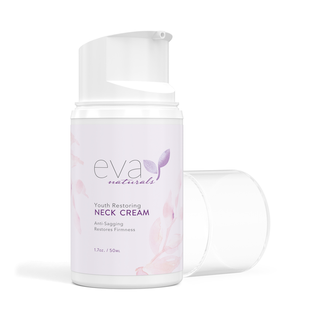
Eva Naturals Neck Firming & Tightening Cream
Works for
2 of 2 advertised claims delivered
Anti-agingGlycolic acid, Acetyl hexapeptide-1 + 10 moreStrong evidence
“Our Tightening Cream was expertly formulated with CoQ10 and Avocado to deeply penetrate the skin and strengthen cells for improved elasticity and a lifted appearance.”
This product can help reduce and prevent fine lines and wrinkles, improve skin elasticity and firmness because it contains glycolic acid.
These ingredients in the product can also be helpful, even though there is less evidence for their effectiveness: acetyl hexapeptide-1, dipeptide diaminobutyroyl benzylamide diacetate.
Keep in mind that it typically takes at least 6 weeks to notice any results because the changes that are needed to improve fine lines and elasticity happen in the deeper layers of the skin. No topical anti-aging product can “erase” wrinkles or fully reverse signs of aging.
MoisturizingAcetyl hexapeptide-1, Dipeptide diaminobutyroyl benzylamide diacetate + 41 moreStrong evidence
“Neck Firming & Tightening Cream”
This product can help improve hydration of the skin with the two types of ingredients.
The first type is called “humectants”:
these ingredients help attract water.
When humectants are on the surface of the skin, they “pull in” the moisture from the outside environment, or from
within deeper layers of the skin. The following ingredients in this product do the job:
glycerin, hyaluronic acid.
This product also contains ingredients called “occlusives”. They help reduce the speed with which our skin loses moisture to the outside environment. These ingredients also help soften the upper layer of the skin, so it feels less tight and nicer to the touch. The following ingredients in this product do the job: beeswax, cocos nucifera oil.
The following ingredients in this product are especially good for supporting the skin barrier and helping with the hydration level: acetyl hexapeptide-1, dipeptide diaminobutyroyl benzylamide diacetate
ExfoliationNot advertised by the brand · Glycolic acid, Lactic acidStrong evidence
This product can help exfoliate the skin. In other words, it helps break down the bonds between dead cells on the surface of the skin and speed up the skin turnover. Skin often appears softer and brighter after exfoliation, but overdoing it can result in disrupted skin barrier. The following ingredient is doing the exfoliating job in this product: glycolic acid.
Anti-oxidationNot advertised by the brand · Ubiquinone, Camellia sinensis extract + 19 moreStrong evidence
This product contains antioxidants (ubiquinone) that can help neutralize free radicals in skin. By doing so, they can lessen the damage the skin gets from the UV light (sun).
The following ingredients - camellia sinensis extract also can have an antioxidant effect, but there is less evidence to confirm their effectiveness in skin.
Evens skin toneNot advertised by the brand · Glycolic acid, Glycyrrhiza glabra root extract + 3 moreStrong evidence
This product can help reduce hypepigmentation and even out the skin tone because it contains the following effective ingredients: glycolic acid
The following ingredient (ingredients) in this product might be helpful, but there is no evidence to confirm that it actually can help even out the skin tone: glycyrrhiza glabra root extract.
Keep in mind that you would need to apply any topical skincare targetted at hypigmentation consistently for a couple of months to get a result. No topical skincare product can help get rid of hyperpigmentation (including post-acne marks and age spots) instantly.
Can it cause trouble?
Irritancy10 strong irritants: Citrus aurantium dulcis fruit extract, Citrus aurantium dulcis peel oil + 8 more — patch-test recommendedHigh risk
Comedogenic6 ingredients rated 2 or more on the 0–5 pore-clogging scale6 flagged
User reviews
Be the first — your take helps the next person decide.
Ingredients
Filter by role to see what each ingredient is doing.
Water~45–55%
Aloe barbadensis leaf juice~6.3–7.7%
- Irritation risk
- Medium
Traditionally used to treat sunburns, dermatitis and inflammation, but evidence for its effectiveness is lacking. The extract can contain humectants that help attract water into the skin
More about Aloe barbadensis leaf juiceAloe barbadensis extract~4.1–5%
- Irritation risk
- Medium
Traditionally used to treat sunburns, dermatitis and inflammation, but evidence for its effectiveness is lacking. The extract can contain humectants that help attract water into the skin
More about Aloe barbadensis extractGlycerin~3–3.6%
- Irritation risk
- Low
One of the best moisturizing ingredients. Naturally present in skin. It attracts water to the upper layer of the skin working as a humectant
More about GlycerinGlyceryl stearate~2.2–2.7%
- Irritation risk
- Low
An emollient that softens the skin and forms a protective layer on its surface. Helps water and oil mix together
More about Glyceryl stearateHelianthus annuus seed oil~1.9–2.3%
- Irritation risk
- Low
A great emollient due to its high linoleic acid content. One of the most effective plant oils in helping skin hydration and repairing skin barrier function
More about Helianthus annuus seed oilHelianthus annuus extract~1.5–1.9%
- Irritation risk
- Low
Helps soften the upper layer of the skin
More about Helianthus annuus extractCetyl alcohol~1.3–1.6%
- Irritation risk
- Low
A non-drying alcohol that works to soften the skin and stabilize product formulations helping oil and water mix together
More about Cetyl alcoholEthylhexyl palmitate~1–1.3%
- Irritation risk
- Low
- Comedogenicity
- 3/5
An emollient that helps soften the skin and create a nice product texture
More about Ethylhexyl palmitateIsopropyl palmitate~0.7–1.05%
- Irritation risk
- Medium
- Comedogenicity
- 3/5
Helps soften the upper layer of the skin and create a thicker product consistency
More about Isopropyl palmitateLactic acid~0.5–0.75%
- Irritation risk
- Medium
An exfoliating and moisturizing alpha-hydroxy acid (AHA). Typically causes less irritation than other AHAs, for example, glycolic acid. At high concentrations (about 15%), lactic acid can help reduce lines and wrinkles. Recent studies show that lactic acid can support the "good" bacteria living on skin's surface (healthy skin microbiome)
More about Lactic acidSqualane~0.5–0.75%
- Irritation risk
- Low
An oil naturally present in skin. Works as an emollient to soften the skin and form a protective layer on its surface without a greasy feeling.
More about SqualaneCocos nucifera oil~0.3–0.6%
- Irritation risk
- Low
- Comedogenicity
- 3/5
An emollient. Found to be as effective as a moisturizer for dry skin as mineral oil. Could be comedogenic
More about Cocos nucifera oilTheobroma cacao seed butter~0.3–0.6%
- Irritation risk
- Low
- Comedogenicity
- 3/5
Helps soften the upper layer of the skin and can be helpful in restoring the skin barrier function. Might have some anti-oxidant effect
More about Theobroma cacao seed butterTheobroma cacao extract~0.25–0.5%
- Irritation risk
- Low
- Comedogenicity
- 3/5
Beeswax~0.3–0.6%
- Irritation risk
- Low
Forms a protective barrier that holds water and keeps dry skin hydrated. Keeps an emulsion from separating into its oil and liquid components, and increases the thickness of a product. Can be an allergen
More about BeeswaxSimmondsia chinensis seed oil~0.3–0.55%
- Irritation risk
- Medium
Softens the upper layer of skin and helps restore the healthy skin barrier. Has shown to help calm down inflammation in skin. It is a stable oil, meaning that it retains its properties even when exposed to air.
More about Simmondsia chinensis seed oilOenothera biennis oil~0.25–0.5%
- Irritation risk
- Medium
Helps soften the upper layer of the skin and can support skin barrier function
More about Oenothera biennis oilOenothera biennis extract~0.25–0.45%
- Irritation risk
- Low
Camellia oleifera seed oil~0.2–0.4%
- Irritation risk
- Medium
An emollient that does not leave a greasy finish
More about Camellia oleifera seed oilPersea gratissima oil~0.2–0.4%
- Irritation risk
- Medium
An emollient that helps soften the skin and could be helpful in repairing its barrier function
More about Persea gratissima oilCalophyllum inophyllum seed oil~0.15–0.3%
- Irritation risk
- Low
Rosa canina fruit oil~0.15–0.3%
- Irritation risk
- Medium
A great emollient. Contains vitamin E (tocopherol) which may give it some anti-oxidant properties. Can contain volatile compounds and can be irritating
More about Rosa canina fruit oilRosa canina seed~0.2–0.35%
Vitis vinifera seed oil~0.15–0.3%
- Irritation risk
- Medium
A great emollient that can also have anti-oxidant properties
More about Vitis vinifera seed oilVitis vinifera seed~0.1–0.25%
- Irritation risk
- Low
Macadamia ternifolia seed oil~0.15–0.3%
- Irritation risk
- Medium
Plant oil from nuts that helps soften the upper layer of the skin. Contains a high concentration of oleic acid that can weaken skin's barrier function and increase water-loss while enhancing penetration of other ingredients
More about Macadamia ternifolia seed oilBorago officinalis seed oil~0.15–0.3%
- Irritation risk
- Low
A plant oil that is effective in reducing irritation in skin, restore the barrier function and support its hydration
More about Borago officinalis seed oilLinum usitatissimum seed oil~0.1–0.2%
Sodium ascorbyl phosphate~0.15–0.25%
- Irritation risk
- Medium
A stable derivative of vitamin C. It is oil-soluble which means it is more likely to penetrate the skin compared to the pure form of vitamin C (which is water-soluble), but it is less bio-available and is way less effective in stimulating collagen and reducing wrinkles compared to the pure form of vitamin C (L-ascorbic acid) and its other derivatives (for example, magnesium ascorbyl phosphate). At the same time, this vitamin C derivative has been shown in studies to be effective in reducing acne, blemishes and clogged pores. It is less irritating then the pure form of vitamin C
More about Sodium ascorbyl phosphatePanthenol~0.15–0.25%
- Irritation risk
- Low
Helps attract water to the upper layer of the skin and can help improve skin barrier function
More about PanthenolTocopheryl acetate~0.15–0.3%
- Irritation risk
- Medium
A more stable but less bio-available form of vitamin E compared to Tocopherol. Might help moisturize and protect the skin from free radicals, but mostly used in low concentrations to stabilize other ingredients.
More about Tocopheryl acetateTocopherol~0.15–0.25%
- Irritation risk
- Low
Pure form of vitamin E. Can help moisturise and protect the skin from free radicals. Often used to help stabilise other ingredients or the formula itself
More about TocopherolDimethyl sulfone~0.15–0.25%
Glycolic acid~0.15–0.25%
- Irritation risk
- High
An alpha-hydroxy acid (AHA) that helps to remove the dead skin cells on the surface of the skin reveling a more even, smoother complexation. It is also able to stimulate collagen production with long-term use. Could help to reduce pore congestion. It can be irritating to the skin. Apply sunscreen daily if using products with glycolic acid
More about Glycolic acidCaesalpinia spinosa gum~0.2–0.35%
Hyaluronic acid~0.15–0.25%
- Irritation risk
- Low
One of the best moisturizing ingredients. Attracts water into the upper layer of the skin. Naturally present in skin. Typically has large molecule size unless advertised otherwise on the product label. Helps support skin's barrier function and may help to reduce inflammation
More about Hyaluronic acidAcetyl hexapeptide-1~0.1–0.25%
- Irritation risk
- Low
A type of peptide. Peptides are excellent moisturizers and might be able support collagen production reducing fine lines and wrinkles
More about Acetyl hexapeptide-1Ascorbic acid~0.15–0.25%
- Irritation risk
- High
The most well-researched antioxidant that works in skin. Helps neutralize free radicals supporting collagen production, helping to even out the skin tone and preventing early signs of aging
More about Ascorbic acidUbiquinone~0.15–0.25%
- Irritation risk
- Low
Coenzyme Q10. It helps neutralize free radicals in skin, improves skin hydration and might be helpful agains fine lines and wrinkles. It can be an allergen
More about UbiquinoneRoyal jelly extract~0.15–0.25%
- Irritation risk
- Medium
A compound secreted by bees. Might be able to attract water to the top layer of the skin. Avoid if sensitive to honey and bee products
More about Royal jelly extractCamellia sinensis leaf extract~0.15–0.3%
- Irritation risk
- Low
Can contain potent anti-oxidant compounds (abbreviated ECG, GCG, EGC, and EGCG) that might help protect the skin from free radicals. Can help calm down inflammation and has some anti-bacterial properties. Unfortunately, these antioxidants are unstable and lose their effectiveness very quickly in products. The concentration of the antioxidant compounds in the extract also tends to be low to be effective in topical formulation
More about Camellia sinensis leaf extractCamellia sinensis extract~0.1–0.2%
- Irritation risk
- Low
Tea extract. Might be helpful in neutralizing free radicals in skin
More about Camellia sinensis extractPropolis extract~0.15–0.25%
- Irritation risk
- High
A complex substance produced by honey bees. Can have anti-bacterial and some anti-oxidant effect. Is an allergen and can be irritating
More about Propolis extractVerbascum thapsus extract~0.1–0.25%
- Irritation risk
- Low
Cucumis sativus extract~0.1–0.25%
- Irritation risk
- Medium
Euphrasia officinalis extract~0.1–0.2%
- Irritation risk
- Low
Indigofera tinctoria leaf extract~0.1–0.25%
- Irritation risk
- Low
Mahonia aquifolium root extract~0.15–0.25%
- Irritation risk
- Low
Vitis vinifera~0.15–0.3%
- Irritation risk
- Low
A plant extract that contains resveratrol and other anti-oxidant compounds that can help neutralize free radicals, reduce inflammation in skin and even out its tone. Can be also used to stabilize the product formulation
More about Vitis viniferaCitrus aurantium dulcis fruit extract~0.15–0.3%
- Irritation risk
- High
A plant extract that is used as a fragrance. Can be irritating and lead to photosensitivity
More about Citrus aurantium dulcis fruit extractCitrus aurantium dulcis peel oil~0.15–0.3%
- Irritation risk
- High
An essentil oil from orange peel. Potential allergen and can be irritating
More about Citrus aurantium dulcis peel oilCitrus limon peel extract~0.15–0.25%
Citrus limon peel oil~0.15–0.25%
Lonicera caprifolium flower extract~0.15–0.25%
- Irritation risk
- High
A plant extract that might help neutralize free radicals in skin. Can contain volalite oils and be irritating
More about Lonicera caprifolium flower extractLonicera japonica flower extract~0.15–0.3%
- Irritation risk
- High
A plant extract that might help neutralize free radicals in skin. Can contain volalite oils and be irritating
More about Lonicera japonica flower extractPyrus malus fruit extract~0.15–0.3%
- Irritation risk
- Medium
Can have some moisturizing properties due to its sugar content
More about Pyrus malus fruit extractMalus domestica fruit cell culture extract~0.15–0.3%
- Irritation risk
- Low
Saccharum officinarum extract~0.15–0.3%
- Irritation risk
- Low
Sugar extract that helps attract water to the upper layer of the skin
More about Saccharum officinarum extractSucrose~0.15–0.3%
- Irritation risk
- Low
Can help attract water to the upper layer of the skin. In crystal form, it can work as a gentle exfoliant, gentler than the salt scrub. Helps stabilize the emulsion
More about SucroseCentella asiatica extract~0.25–0.45%
- Irritation risk
- Medium
A plant extract that has been shown to be able to reduce inflammation in skin, support restoration of skin barrier function, as well as support collagen production. Contains active compounds called centelloids: asiaticoside, madecasosside, asiatic acid and madecassic acid. Might be helpful in preventing stretch marks. It can be itself be irritating though.
More about Centella asiatica extractEquisetum arvense extract~0.2–0.35%
- Irritation risk
- High
A plant extract that might have anti-oxidant properties. Can be irritating
More about Equisetum arvense extractGeranium maculatum extract~0.2–0.35%
- Irritation risk
- High
Contains an essential oil. Can be irritating
More about Geranium maculatum extractTaraxacum officinale extract~0.2–0.35%
- Irritation risk
- High
A plant extract that might have anti-oxidant and anti-inflammatory properties, but evidence of effectiveness in skin is lacking. Can be an allergen
More about Taraxacum officinale extractGlycyrrhiza glabra root extract~0.15–0.3%
- Irritation risk
- Medium
A plant extract that can help lighten the skin and calm down inflammation. Might be helpful in neutralizing free radicals
More about Glycyrrhiza glabra root extractArnica montana flower extract~0.15–0.3%
- Irritation risk
- High
A plant extract that can be irritating. It can have some anti-bacterial properties, but there are no evidence of a beneficial effect for skin
More about Arnica montana flower extractCalendula officinalis extract~0.2–0.4%
- Irritation risk
- High
A plant extract that might help neutralize free radicals in skin
More about Calendula officinalis extractChamomilla recutita extract~0.2–0.4%
- Irritation risk
- High
Plant extract that can have healing and anti-inflammatory properties. It is a potential allergen and can be irritating
More about Chamomilla recutita extractLavandula angustifolia extract~0.2–0.4%
- Irritation risk
- High
Used for fragrance and contains volatile compounds that can irritate the skin
More about Lavandula angustifolia extractHelichrysum angustifolium flower oil~0.2–0.4%
- Irritation risk
- Low
Cymbopogon martini oil~0.2–0.4%
- Irritation risk
- High
Aromatic plant oil used in cosmetics as a fragrance. A likely irritant
More about Cymbopogon martini oilCucumis sativus fruit water~0.2–0.4%
Cucumis sativus extract~0.2–0.4%
- Irritation risk
- Medium
Potassium stearate~0.45–0.7%
Cetearyl alcohol~0.25–0.5%
- Irritation risk
- Low
- Comedogenicity
- 2/5
A non-drying alcohol. Works as an emollient. Helps water and oil mix together and creates a nice product texture
More about Cetearyl alcoholStearyl alcohol~0.25–0.5%
- Irritation risk
- Low
An emollient that helps soften the skin
More about Stearyl alcoholCetearyl glucoside~0.25–0.45%
- Irritation risk
- Medium
Helps water and oil in the product mix well together and improves product texture
More about Cetearyl glucosideXanthan gum~0.25–0.45%
- Irritation risk
- Low
Used to create a thicker product consistency
More about Xanthan gumSodium carbomer~0.25–0.45%
Tetrasodium glutamate diacetate~0.2–0.4%
- Irritation risk
- Low
Helps stabilize the product formulation
More about Tetrasodium glutamate diacetateAlcohol~0.25–0.45%
- Irritation risk
- High
Can be drying and contribute to skin irritation. Used in formulars to dissolve other ingredients, create a thinner product consistency or for its antibacterial properties
More about AlcoholButylene glycol~0.25–0.45%
- Irritation risk
- Low
Used to create a nice product texture and help delivery of other ingredients. Might be somewhat helpful in attracting water to the upper layer of the skin
More about Butylene glycolDipeptide diaminobutyroyl benzylamide diacetate~0.25–0.4%
- Irritation risk
- Low
A type of peptide. Peptides are excellent moisturizers and might be able support collagen production reducing fine lines and wrinkles
More about Dipeptide diaminobutyroyl benzylamide diacetateLecithin~0.3–0.5%
- Irritation risk
- Low
Used mostly for creating emulsions - helping oil and water mix together. Helps soften the upper layer of the skin
More about LecithinLysolecithin~0.25–0.4%
- Irritation risk
- Low
Lecithin derivative. It helps oil and water mix together and can enhance penetration of other ingredients. It helps soften the upper layer of the skin
More about LysolecithinPhytic acid~0.2–0.4%
- Irritation risk
- Medium
An alpha-hydroxy acid (AHA), but is mostly used to stabilize product formulations in cosmetics
More about Phytic acidPullulan~0.2–0.35%
- Irritation risk
- High
Creates a thin drying film on the skin resulting in a short-term tightening effect
More about PullulanSclerotium gum~0.15–0.3%
- Irritation risk
- Low
Used to create gel-like formulas and stabilize emulsions
More about Sclerotium gumPhenoxyethanol~0.15–0.3%
- Irritation risk
- Low
A preservative. It helps prevent bacterial growth in cosmetic products
More about PhenoxyethanolEthylhexylglycerin~0.1–0.2%
Ingredient list view
Water, Aloe barbadensis leaf juice, Aloe barbadensis extract, Glycerin, Glyceryl stearate, Helianthus annuus seed oil, Helianthus annuus extract, Cetyl alcohol, Ethylhexyl palmitate, Isopropyl palmitate, Lactic acid, Squalane, Cocos nucifera oil, Theobroma cacao seed butter, Theobroma cacao extract, Beeswax, Simmondsia chinensis seed oil, Oenothera biennis oil, Oenothera biennis extract, Camellia oleifera seed oil, Persea gratissima oil, Calophyllum inophyllum seed oil, Rosa canina fruit oil, Rosa canina seed, Vitis vinifera seed oil, Vitis vinifera seed, Macadamia ternifolia seed oil, Borago officinalis seed oil, Linum usitatissimum seed oil, Sodium ascorbyl phosphate, Panthenol, Tocopheryl acetate, Tocopherol, Dimethyl sulfone, Glycolic acid, Caesalpinia spinosa gum, Hyaluronic acid, Acetyl hexapeptide-1, Ascorbic acid, Ubiquinone, Royal jelly extract, Camellia sinensis leaf extract, Camellia sinensis extract, Propolis extract, Verbascum thapsus extract, Cucumis sativus extract, Euphrasia officinalis extract, Indigofera tinctoria leaf extract, Mahonia aquifolium root extract, Vitis vinifera, Citrus aurantium dulcis fruit extract, Citrus aurantium dulcis peel oil, Citrus limon peel extract, Citrus limon peel oil, Lonicera caprifolium flower extract, Lonicera japonica flower extract, Pyrus malus fruit extract, Malus domestica fruit cell culture extract, Saccharum officinarum extract, Sucrose, Unknown, Centella asiatica extract, Equisetum arvense extract, Geranium maculatum extract, Taraxacum officinale extract, Glycyrrhiza glabra root extract, Arnica montana flower extract, Calendula officinalis extract, Chamomilla recutita extract, Lavandula angustifolia extract, Helichrysum angustifolium flower oil, Unknown, Cymbopogon martini oil, Cucumis sativus fruit water, Cucumis sativus extract, Unknown, Potassium stearate, Cetearyl alcohol, Stearyl alcohol, Cetearyl glucoside, Xanthan gum, Sodium carbomer, Tetrasodium glutamate diacetate, Alcohol, Butylene glycol, Dipeptide diaminobutyroyl benzylamide diacetate, Lecithin, Lysolecithin, Phytic acid, Pullulan, Sclerotium gum, Phenoxyethanol, Ethylhexylglycerin
Compare prices
Retailers ranked by price — lowest first.

Product summary
Based on the ingredient list, "Eva Naturals - Neck Firming & Tightening Cream" can work well for skin moisturization. As we expect from a proper moisturizer, the formula includes a combo of effective humectants and emollients. These are the two different types of ingredients that are essential for improving the skin hydration and supporting a healthy skin barrier. Humectants in this product (glycerin, hyaluronic acid, sucrose, royal jelly extract and aloe barbadensis extract) help to increase the water content in the upper layer of the skin. (These ingredients do so by "capturing" water molecules from the outside air or from within the deeper layers of the skin). Emollients in this formulation (borago officinalis seed oil, helianthus annuus extract, oenothera biennis oil, theobroma cacao seed butter and vitis vinifera seed oil) help to reduce the moisture loss from the skin. They also soften the skin surface and relieve the feeling of dryness and tightness.
Ingredient callouts
- This product also contains vitamin C (Ascorbic Acid). It can be an effective active for anti-aging and evening out the skin tone, but in this moisturizer it is used for stabilizing other ingredients in the formulation. In this concentration (0.15% - 0.25%) it cannot have a noticeable benefit for the skin.
- This moistruizer also contains peptides (dipeptide diaminobutyroyl benzylamide diacetate 0.25% - 0.40% and acetyl hexapeptide-1 0.10% - 0.25%). Peptides is a very big group of ingredients. They all consist of a different combination of amino-acids. Our skin produces peptides naturally. Some of them work as natural anti-biotics, promote wound-healing and production of collagen. The scientists are still studying how effective the topical application of peptides is, but it is very likely that peptides in skincare are helpful. They might be able to support skin barrier restoration and even have an anti-aging benefit. At the very least, they certainly help attract water to the skin and support the hydration in this way.
Irritation risk
This moisturizer contains a bunch of common irritants, including ingredients that do not provide any known benefit for the skin. It might not be the best choice if your skin is sensitive. We assess the overall irritancy of this moisturizer to be high. For a detailed overview of all potential irritants: click here
You can see the detailed formula review with the breakdown of all actives in the product and the full ingredient list with estimated concentrations in the tables below.
Price
The product retails from 12.99$ up to 16.99$ in the United States.
For a detailed price comparison: click here.
Sources cited in this review
Every concentration estimate and effectiveness label is anchored to one of these 53 studies and safety reviews.
- 1
- 2
- 3
- 4Effect of topically applied lipids on surfactant-irritated skinonlinelibrary.wiley.com
- 5
- 6Final Report on the Safety Assessment of Isopropyl Isostearatejournals.sagepub.com

Affiliate links · As an Amazon Associate, WIMJ earns from qualifying purchases.