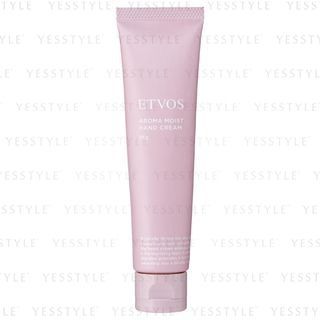
etvos Aroma Moist Hand Cream Orange & Lavender
Works for
1 of 1 advertised claim delivered
Moisturizing33 ingredients credited for this claimStrong support
“A luxurious combination of moisturizing ingredients to keep the skin moisturized.”
This product can help improve hydration of the skin with the two types of ingredients.
The first type is called “humectants”:
these ingredients help attract water.
When humectants are on the surface of the skin, they “pull in” the moisture from the outside environment, or from
within deeper layers of the skin. The following ingredients in this product do the job:
alanine, arginine.
This product also contains ingredients called “occlusives”. They help reduce the speed with which our skin loses moisture to the outside environment. These ingredients also help soften the upper layer of the skin, so it feels less tight and nicer to the touch. The following ingredients in this product do the job: arginine, butyrospermum parkii butter.
The following ingredients in this product are especially good for supporting the skin barrier and helping with the hydration level: ceramide ap, ceramide eop, ceramide ng, ceramide np, phytosphingosine
Anti-agingNot advertised by the brand · 5 ingredients credited for this claimModerate support
This product contains serine, threonine. These ingredients might be able to help reduce and prevent fine lines and wrinkles, improve skin elasticity and firmness, but there is not enough evidence that it actually works.
Evens skin toneNot advertised by the brand · 4 ingredients credited for this claimModerate support
The following ingredient (ingredients) in this product might be helpful, but there is no evidence to confirm that it actually works: alanine, stearyl glycyrrhetinate.
Can it cause trouble?
Irritancy4 strong irritants: Citrus aurantium dulcis oil, Lavandula angustifolia oil + 2 more — patch-test recommendedHigh risk
Comedogenic1 ingredient rated 2 or more on the 0–5 pore-clogging scale1 flagged
User reviews
Be the first — your take helps the next person decide.
Ingredients
Filter by role to see what each ingredient is doing.
Water~45–55%
Butylene glycol~5.8–7.1%
- Irritation risk
- Low
Used to create a nice product texture and help delivery of other ingredients. Might be somewhat helpful in attracting water to the upper layer of the skin
More about Butylene glycolButyrospermum parkii butter~4.4–5.4%
- Irritation risk
- Low
- Comedogenicity
- 3/5
A great moisturising ingredient that softens the skin and reduces water loss from its upper layer. It also can be helpful in protecting skin from free radicals
More about Butyrospermum parkii butterCaprylic/capric triglyceride~3.2–3.9%
- Irritation risk
- Medium
A good mix of fatty acids that forms a protective layer on the skin. Improves the shelf life of products. Derived from coconut and glycerin
More about Caprylic/capric triglycerideEuphorbia cerifera cera~2.4–3%
- Irritation risk
- Medium
Helps soften the upper layer of the skin and thickens the product's texture
More about Euphorbia cerifera ceraPolyglyceryl-10 stearate~1.8–2.2%
- Irritation risk
- Medium
Helps water and oil mix together and softens the upper layer of the skin
More about Polyglyceryl-10 stearateSorbitan sesquistearate~1.5–1.9%
Glycerin~1.4–1.7%
- Irritation risk
- Low
One of the best moisturizing ingredients. Naturally present in skin. It attracts water to the upper layer of the skin working as a humectant
More about GlycerinVegetable oil~1.1–1.4%
- Irritation risk
- Low
An oil from a mixture of different vegetables. Helps soften the upper layer of the skin
More about Vegetable oilCeramide eop~0.8–1.15%
- Irritation risk
- Low
A type of lipid similar to ceramides naturally present in skin. Helps to soften the upper layer of the skin and supports the skin barrier function to keep it hydrated. Can help to prevent inflammation in skin
More about Ceramide eopCeramide ng~0.6–0.9%
- Irritation risk
- Low
A type of lipid similar to ceramides naturally present in skin. Helps to soften the upper layer of the skin and supports the skin barrier function to keep it hydrated. Can help to prevent inflammation in skin
More about Ceramide ngCeramide np~0.55–0.8%
- Irritation risk
- Low
A type of lipid similar to ceramides naturally present in skin. Helps to soften the upper layer of the skin and supports the skin barrier function to keep it hydrated. Can help to prevent inflammation in skin
More about Ceramide npCeramide ap~0.45–0.65%
- Irritation risk
- Low
A type of lipid similar to ceramides naturally present in skin. Helps to soften the upper layer of the skin and supports the skin barrier function to keep it hydrated. Can help to prevent inflammation in skin
More about Ceramide apPhytosphingosine~0.45–0.7%
- Irritation risk
- Low
A type of lipid that is naturally present in skin. It might help in repairing skin barrier function and has anti-bacterial effect
More about PhytosphingosineCholesterol~0.4–0.65%
- Irritation risk
- Low
An emollient that is naturally found in skin
More about CholesterolStearyl glycyrrhetinate~0.3–0.6%
- Irritation risk
- Medium
A fatty acid derived from licorice. Works as an emollient and can help calm down inflammation
More about Stearyl glycyrrhetinateTremella fuciformis polysaccharide~0.35–0.65%
- Irritation risk
- Low
Sodium hyaluronate~0.3–0.55%
- Irritation risk
- Low
One of the best moisturizing ingredients. Attracts water into the upper layer of the skin
More about Sodium hyaluronatePanthenol~0.25–0.5%
- Irritation risk
- Low
Helps attract water to the upper layer of the skin and can help improve skin barrier function
More about PanthenolAscorbyl tetraisopalmitate~0.25–0.5%
- Irritation risk
- Medium
A vitamin C derivative. Studies show that is might be effective in reducing hyperpigmentation, but there are no studies confirming that it is effectively converted into the bioavailable form of Vitamin C in skin. It is not clear how this derivative compares in effectiveness to the topical application of bioavailable form of vitamin C (L-ascorbic acid)
More about Ascorbyl tetraisopalmitateTocopherol~0.25–0.45%
- Irritation risk
- Low
Pure form of vitamin E. Can help moisturise and protect the skin from free radicals. Often used to help stabilise other ingredients or the formula itself
More about TocopherolChamomilla recutita flower extract~0.2–0.4%
- Irritation risk
- High
Plant extract that can have healing and anti-inflammatory properties. It is a potential allergen and can be irritating
More about Chamomilla recutita flower extractPhytosteryl isostearate~0.2–0.4%
- Irritation risk
- Low
Squalane~0.25–0.5%
- Irritation risk
- Low
An oil naturally present in skin. Works as an emollient to soften the skin and form a protective layer on its surface without a greasy feeling.
More about SqualaneHelianthus annuus seed oil~0.25–0.45%
- Irritation risk
- Low
A great emollient due to its high linoleic acid content. One of the most effective plant oils in helping skin hydration and repairing skin barrier function
More about Helianthus annuus seed oilArginine~0.2–0.4%
- Irritation risk
- Low
An amino acid that is naturally present in skin and helps keep it hydrated. When used together with AHAs, it can reduce their irritating effect on the skin
More about ArginineTaurine~0.2–0.4%
- Irritation risk
- Medium
Could be helpful in reducing inflammation in skin, evening out the skin tone and neutralizing free radicals, but more research is needed to confirm its effectiveness
More about TaurineLysine hcl~0.2–0.4%
Glutamic acid~0.2–0.4%
- Irritation risk
- Low
An amino-acid that helps attract water to the upper layer of the skin
More about Glutamic acidGlycine~0.2–0.4%
- Irritation risk
- Low
Helps to attract water to the upper layer of the skin and can help restore the skin barrier function
More about GlycineLeucine~0.25–0.45%
- Irritation risk
- Low
Histidine hcl~0.25–0.45%
- Irritation risk
- Low
A salt of an amino-acid that helps attract water to the upper layer of the skin. Might be helpful in restoring the skin barrier function
More about Histidine hclSerine~0.25–0.45%
- Irritation risk
- Low
An amino-acid that helps to attract water to the upper layer of the skin. In combination with other amino-acids, might help to reduce fine lines and wrinkles
More about SerineValine~0.25–0.45%
- Irritation risk
- Low
Sodium aspartate~0.25–0.45%
- Irritation risk
- Low
Threonine~0.25–0.45%
- Irritation risk
- Low
An amino-acid that helps to attract water to the upper layer of the skin. In combination with other amino-acids, might help to reduce fine lines and wrinkles
More about ThreonineAlanine~0.25–0.45%
- Irritation risk
- Low
An amino-acid that helps to attract water to the upper layer of the skin and might help to lighten the skin, but solid evidence is lacking
More about AlanineIsoleucine~0.25–0.45%
- Irritation risk
- Low
An amino acid that can help attract water to the upper layer of the skin and support skin's barrier function
More about IsoleucinePhenylalanine~0.25–0.45%
- Irritation risk
- Low
Proline~0.25–0.5%
Tyrosine~0.25–0.45%
Disodium inosinate~0.25–0.5%
- Irritation risk
- Low
Disodium guanylate~0.25–0.5%
- Irritation risk
- Low
Allantoin~0.2–0.4%
- Irritation risk
- Low
Helps calm down inflammation in skin and can help reduce itching. Helps to repair the skin barrier and keep skin hydrated
More about AllantoinSclerotium gum~0.25–0.45%
- Irritation risk
- Low
Used to create gel-like formulas and stabilize emulsions
More about Sclerotium gumXanthan gum~0.25–0.5%
- Irritation risk
- Low
Used to create a thicker product consistency
More about Xanthan gumBehenyl alcohol~0.3–0.55%
- Irritation risk
- Low
Non-drying alcohol that helps water and oil mix together. Also serves as an emollient
More about Behenyl alcoholCarbomer~0.25–0.45%
- Irritation risk
- Low
Helps create a thicker or gel-like product texture. It is not a surfactant but can be used in gentle cleansing formulations
More about CarbomerAcrylates/c10-30 alkyl acrylate crosspolymer~0.25–0.5%
- Irritation risk
- Medium
Maintains the texture of skincare products. Allows the product to spread evenly. Helps oil and water mix together
More about Acrylates/c10-30 alkyl acrylate crosspolymerSodium lauroyl lactylate~0.25–0.5%
- Irritation risk
- Medium
Helps water and oil mix together
More about Sodium lauroyl lactylateSodium stearoyl lactylate~0.25–0.45%
- Irritation risk
- Medium
Helps oil and water mix together
More about Sodium stearoyl lactylatePolyglyceryl-10 pentastearate~0.25–0.4%
- Irritation risk
- Low
Ethylhexylglycerin~0.2–0.35%
Phenoxyethanol~0.15–0.3%
- Irritation risk
- Low
A preservative. It helps prevent bacterial growth in cosmetic products
More about PhenoxyethanolCitrus aurantium dulcis oil~0.15–0.3%
- Irritation risk
- High
Used as a fragrance. It can be irritating and cause photosensitivity
More about Citrus aurantium dulcis oilCedrus atlantica bark oil~0.15–0.25%
- Irritation risk
- Low
Lavandula angustifolia oil~0.15–0.25%
- Irritation risk
- High
An essential oil. Potential allergen and can be irritating. It has some anti-bacterial properties
More about Lavandula angustifolia oilCitrus nobilis peel oil~0.1–0.15%
- Irritation risk
- High
A plant oil with high content of volatile compounds that, especially when exposed to air, can cause allergic reactions and irritate the skin
More about Citrus nobilis peel oilRosmarinus officinalis leaf oil~0.1–0.2%
- Irritation risk
- High
A plant oil with high content of volatile compounds that can irritate the skin. Can be used as a fragrance. Has anti-bacterial properties and might help neutralize free radicals on the surface of the skin
More about Rosmarinus officinalis leaf oilIngredient list view
Water, Butylene glycol, Butyrospermum parkii butter, Caprylic/capric triglyceride, Euphorbia cerifera cera, Polyglyceryl-10 stearate, Sorbitan sesquistearate, Glycerin, Vegetable oil, Ceramide eop, Ceramide ng, Ceramide np, Ceramide ap, Phytosphingosine, Cholesterol, Stearyl glycyrrhetinate, Tremella fuciformis polysaccharide, Sodium hyaluronate, Panthenol, Ascorbyl tetraisopalmitate, Tocopherol, Chamomilla recutita flower extract, Phytosteryl isostearate, Squalane, Helianthus annuus seed oil, Arginine, Taurine, Lysine hcl, Glutamic acid, Glycine, Leucine, Histidine hcl, Serine, Valine, Sodium aspartate, Threonine, Alanine, Isoleucine, Phenylalanine, Proline, Tyrosine, Disodium inosinate, Disodium guanylate, Allantoin, Sclerotium gum, Xanthan gum, Behenyl alcohol, Carbomer, Acrylates/c10-30 alkyl acrylate crosspolymer, Sodium lauroyl lactylate, Sodium stearoyl lactylate, Polyglyceryl-10 pentastearate, Ethylhexylglycerin, Phenoxyethanol, Citrus aurantium dulcis oil, Cedrus atlantica bark oil, Lavandula angustifolia oil, Citrus nobilis peel oil, Rosmarinus officinalis leaf oil
Compare prices
Retailers ranked by price — lowest first.

Affiliate links · prices updated regularly
Worth comparing, line by line.
Match % combines shared ingredients, the first five ingredients, shared actives and hero ingredients, irritancy (lower counts in the alternative's favour), texture and body area. Only products in the same routine step are compared.
| etvosAroma Moist Hand Cream Orange & LavenderYOUR PRODUCT | treecellDelight Eleven Hand Cream | SkintegraCica-Cera | SkincottonDay Hand Cream | |
|---|---|---|---|---|
| Match | — | 55% | 54% | 53% |
| Price | — | $14.00 | — | $22.70 |
| Shared key ingredients | — | 9 of 27 | 11 of 27 | 14 of 27 |
| Key difference | — | Ceramide As | Madecassoside | Niacinamide |
| Irritancy | High | Medium | Medium | Medium |
| Drying alcohol | — | — | — | — |
| View product | Shop | Shop | Shop |


Sources cited in this review
Every concentration estimate and effectiveness label is anchored to one of these 38 studies and safety reviews.
- 1
- 2
- 3
- 4
- 5
- 6

Affiliate links · As an Amazon Associate, WIMJ earns from qualifying purchases.