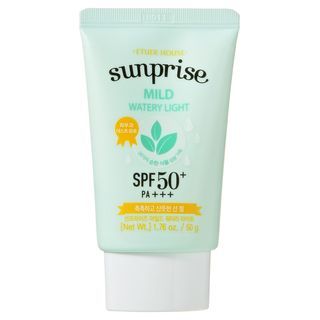
Etude House Sunprise Mild Watery Light SPF50+ PA+++
Works for
2 of 2 advertised claims delivered
Sun protectionSPF 50 · 5 UV filtersBroad spectrum
This product offers a good level of protection against both UVB and UVA rays.
This sunscreen uses organic (so-called "chemical") sunscreen filters. Organic, or "chemical" filters usually provide reliable sun protection and rarely leave a white cast. Sunscreens with organic filters can sting eyes.
Anti-agingHyaluronic acid, Aloe barbadensis leaf juice + 1 moreStrong evidence
“Chemical sunscreen fitted with SPF 50+ PA++++ protects skin against the sun's rays.”
This product can help prevent early signs of skin aging because it offers a good level of broad spectrum sun protection. Sun damage is the main cause of premature skin aging, and protecting your skin from the sun is the best anti-aging strategy.
Evens skin toneNot advertised by the brand · No ingredient credited for this claimStrong evidence
This product offers broad spectrum sun protection. It means that it can prevent hyperpigmentation and help keep the skin tone even (sun damage is the main factor causing age spots, darkening of post-acne marks and other discolorations).
MoisturizingNot advertised by the brand · Helianthus annuus seed oil, Echium plantagineum seed oil + 12 moreGood evidence
This product can help improve hydration of the skin with the two types of ingredients.
The first type is called “humectants”:
these ingredients help attract water.
When humectants are on the surface of the skin, they “pull in” the moisture from the outside environment, or from
within deeper layers of the skin. The following ingredients in this product do the job:
hyaluronic acid, butylene glycol.
This product also contains ingredients called “occlusives”. They help reduce the speed with which our skin loses moisture to the outside environment. These ingredients also help soften the upper layer of the skin, so it feels less tight and nicer to the touch. The following ingredients in this product do the job: helianthus annuus seed oil, helianthus annuus seed oil unsaponifiables.
Can it cause trouble?
Irritancy6 strong irritants: Citrus aurantium bergamia fruit oil, Citrus limon peel oil + 4 more — patch-test recommendedHigh risk
Comedogenic1 ingredient rated 2 or more on the 0–5 pore-clogging scale1 flagged
User reviews
Ingredients
Filter by role to see what each ingredient is doing.
Water~45–55%
Ethylhexyl methoxycinnamate~5.4–6.6%
- Irritation risk
- High
Octinoxate. When used in higher concentrations, works as a sunscreen protecting the skin from UVB rays. When used in lower concentration, helps to preserve the product formulation. Is shown to be harmful to coral reefs - consider avoiding bathing in coral reef areas when wearing a product with this ingredient. It can be irritating
More about Ethylhexyl methoxycinnamateHomosalate~4.8–5.9%
- Irritation risk
- Medium
A weak sunscreen that offers some protection against the sun rays that cause sunburn (UVB), but does not offer meaningful protection against protect against the most aging sun rays (UVA). It loses its effectiveness quickly when exposed to sunlight. It is an organic, or so called "chemical" sunscreen. When used in low concentrations, helps to stabilize the product formulation
More about HomosalateEthylhexyl salicylate~3.7–4.5%
- Irritation risk
- Low
Octisalate. A UV filter. It offers some protection against the sun rays that cause sunburn (UVB), but does not protect against the most aging sun rays (UVA). It loses its effectiveness quickly when exposed to sunlight. It is an organic, or so called "chemical" sunscreen
More about Ethylhexyl salicylateDiethylamino hydroxybenzoyl hexyl benzoate~3.2–3.9%
- Irritation risk
- Medium
Uvinul A Plus. A new generation broad spectrum sunscreen that offers an effective protection especially in the UVA range. It is stable in formulations. Unfortunately, is not approved by the FDA (US) yet
More about Diethylamino hydroxybenzoyl hexyl benzoateAlcohol~2–2.4%
- Irritation risk
- High
Can be drying and contribute to skin irritation. Used in formulars to dissolve other ingredients, create a thinner product consistency or for its antibacterial properties
More about AlcoholButylene glycol~1.7–2.1%
- Irritation risk
- Low
Used to create a nice product texture and help delivery of other ingredients. Might be somewhat helpful in attracting water to the upper layer of the skin
More about Butylene glycolDicaprylyl carbonate~1.5–1.8%
- Irritation risk
- Low
Helps products spread more easily and works as an emollient to soften skin
More about Dicaprylyl carbonateCyclopentasiloxane~1.2–1.5%
- Irritation risk
- Low
A silicone that helps improve the product texture and spreadability. Can absorb oil creating a short-term mattifying effect on the skin
More about CyclopentasiloxaneOctocrylene~1.5–1.8%
- Irritation risk
- Medium
A weak sunscreen that protects against the sun rays that cause sunburn (UVB) and is somewhat effective against the UVA rays. It is quite stable and can help stabilize other, more vulnerable, sunscreen ingredients like Avobenzone. It is an organic, or so called "chemical" sunscreen
More about OctocryleneC20-22 alkyl phosphate~0.7–1.1%
C20-22 alcohols~0.6–0.9%
- Irritation risk
- Low
Silica~0.9–1.1%
1,2-hexanediol~0.5–0.7%
Cetyl alcohol~0.55–0.8%
- Irritation risk
- Low
A non-drying alcohol that works to soften the skin and stabilize product formulations helping oil and water mix together
More about Cetyl alcoholViscum album leaf extract~0.45–0.65%
- Irritation risk
- Medium
A plant extract that has anti-inflammatory and anti-bacterial properties and might help neutralize free radicals in skin, but solid research is lacking
More about Viscum album leaf extractPortulaca oleracea extract~0.45–0.65%
- Irritation risk
- Medium
A plant extract that has some anti-oxidant activity, but solid research is lacking. Can help attract water to the upper layer of the skin
More about Portulaca oleracea extractCentella asiatica extract~0.45–0.7%
- Irritation risk
- Medium
A plant extract that has been shown to be able to reduce inflammation in skin, support restoration of skin barrier function, as well as support collagen production. Contains active compounds called centelloids: asiaticoside, madecasosside, asiatic acid and madecassic acid. Might be helpful in preventing stretch marks. It can be itself be irritating though.
More about Centella asiatica extractGlyceryl stearate~0.45–0.65%
- Irritation risk
- Low
An emollient that softens the skin and forms a protective layer on its surface. Helps water and oil mix together
More about Glyceryl stearateMethyl methacrylate crosspolymer~0.35–0.65%
- Irritation risk
- Low
Helps thicken the product consistency
More about Methyl methacrylate crosspolymerTromethamine~0.3–0.55%
Dimethicone/vinyl dimethicone crosspolymer~0.3–0.55%
- Irritation risk
- Low
Used to stabilize product formulations and create a nice product texture
More about Dimethicone/vinyl dimethicone crosspolymerPhenoxyethanol~0.3–0.55%
- Irritation risk
- Low
A preservative. It helps prevent bacterial growth in cosmetic products
More about PhenoxyethanolOctyldodecanol~0.3–0.55%
- Irritation risk
- Low
An emollient that helps to soften the skin and create a pleasant product texture and stabilize the formulation
More about OctyldodecanolPolyacrylate crosspolymer-6~0.3–0.55%
- Irritation risk
- Low
Opuntia ficus-indica extract~0.25–0.5%
- Irritation risk
- Low
Aloe barbadensis leaf juice~0.25–0.5%
- Irritation risk
- Medium
Traditionally used to treat sunburns, dermatitis and inflammation, but evidence for its effectiveness is lacking. The extract can contain humectants that help attract water into the skin
More about Aloe barbadensis leaf juiceGlycine soja lipids~0.25–0.5%
- Irritation risk
- Low
Microcrystalline cellulose~0.3–0.6%
Xanthan gum~0.3–0.55%
- Irritation risk
- Low
Used to create a thicker product consistency
More about Xanthan gumSodium acrylate/sodium acryloyldimethyl taurate copolymer~0.25–0.5%
- Irritation risk
- Low
Used to create a thicker product consistency
More about Sodium acrylate/sodium acryloyldimethyl taurate copolymerPolyisobutene~0.3–0.55%
Carex humillis root extract~0.25–0.5%
- Irritation risk
- Low
Citrus aurantium bergamia fruit oil~0.25–0.45%
- Irritation risk
- High
A plant oil with a high content of volatile compounds that can irritate the skin and lead to allergic reactions. Can lead to photosensitivity
More about Citrus aurantium bergamia fruit oilCitrus limon peel oil~0.25–0.45%
Eucalyptus globulus leaf oil~0.25–0.45%
- Irritation risk
- High
An essential oil that can be very irritating. Has some anti-bacterial properties
More about Eucalyptus globulus leaf oilPinus sylvestris leaf oil~0.3–0.55%
- Irritation risk
- High
An essential oil from pine tree. Can be irritating
More about Pinus sylvestris leaf oilCitrus aurantifolia oil~0.3–0.5%
- Irritation risk
- High
Citrus aurantium dulcis peel oil~0.25–0.5%
- Irritation risk
- High
An essentil oil from orange peel. Potential allergen and can be irritating
More about Citrus aurantium dulcis peel oilEchium plantagineum seed oil~0.25–0.5%
- Irritation risk
- Medium
A plant oil that because of its high content of alpha-linolenic acid help support skin barrier function and moisturize the skin
More about Echium plantagineum seed oilEuterpe oleracea fruit extract~0.25–0.5%
- Irritation risk
- Medium
A plant extract that can have some anti-oxidant effect in skin
More about Euterpe oleracea fruit extractMalpighia emarginata fruit extract~0.25–0.5%
- Irritation risk
- Low
Terminalia ferdinandiana fruit extract~0.25–0.5%
- Irritation risk
- Medium
A plant extract that might have some anti-oxidant effect in skin, but evidence is lacking
More about Terminalia ferdinandiana fruit extractCellulose gum~0.25–0.5%
- Irritation risk
- Low
Used to create thicker product consistency and stabilize emulsions
More about Cellulose gumAdansonia digitata seed oil~0.3–0.55%
- Irritation risk
- Medium
Helps soften the upper layer of the skin
More about Adansonia digitata seed oilHyaluronic acid~0.25–0.45%
- Irritation risk
- Low
One of the best moisturizing ingredients. Attracts water into the upper layer of the skin. Naturally present in skin. Typically has large molecule size unless advertised otherwise on the product label. Helps support skin's barrier function and may help to reduce inflammation
More about Hyaluronic acidSorbitan oleate~0.25–0.45%
- Irritation risk
- Medium
- Comedogenicity
- 2/5
Helps oil and water mix together
More about Sorbitan oleateCaprylyl/capryl glucoside~0.3–0.55%
- Irritation risk
- Medium
Helps oil and water mix together. Can be used as a cleansing agent
More about Caprylyl/capryl glucosideHelianthus annuus seed oil~0.2–0.4%
- Irritation risk
- Low
A great emollient due to its high linoleic acid content. One of the most effective plant oils in helping skin hydration and repairing skin barrier function
More about Helianthus annuus seed oilCardiospermum halicacabum flower/leaf/vine extract~0.2–0.35%
- Irritation risk
- High
A plant extract that might have some anti-inflammatory and anti-oxidant properties but evidence is missing
More about Cardiospermum halicacabum flower/leaf/vine extractHelianthus annuus seed oil unsaponifiables~0.2–0.4%
- Irritation risk
- Low
A great emollient due to its high linoleic acid content. One of the most effective plant oils in helping skin hydration and repairing skin barrier function
More about Helianthus annuus seed oil unsaponifiablesIsoceteth-10~0.15–0.25%
Isoceteth-25~0.1–0.25%
Ingredient list view
Water, Ethylhexyl methoxycinnamate, Homosalate, Ethylhexyl salicylate, Diethylamino hydroxybenzoyl hexyl benzoate, Alcohol, Butylene glycol, Dicaprylyl carbonate, Cyclopentasiloxane, Octocrylene, C20-22 alkyl phosphate, C20-22 alcohols, Silica, 1,2-hexanediol, Cetyl alcohol, Viscum album leaf extract, Portulaca oleracea extract, Centella asiatica extract, Glyceryl stearate, Methyl methacrylate crosspolymer, Tromethamine, Dimethicone/vinyl dimethicone crosspolymer, Phenoxyethanol, Octyldodecanol, Polyacrylate crosspolymer-6, Opuntia ficus-indica extract, Aloe barbadensis leaf juice, Glycine soja lipids, Microcrystalline cellulose, Xanthan gum, Sodium acrylate/sodium acryloyldimethyl taurate copolymer, Polyisobutene, Carex humillis root extract, Citrus aurantium bergamia fruit oil, Citrus limon peel oil, Eucalyptus globulus leaf oil, Pinus sylvestris leaf oil, Citrus aurantifolia oil, Citrus aurantium dulcis peel oil, Echium plantagineum seed oil, Euterpe oleracea fruit extract, Malpighia emarginata fruit extract, Terminalia ferdinandiana fruit extract, Cellulose gum, Adansonia digitata seed oil, Hyaluronic acid, Sorbitan oleate, Caprylyl/capryl glucoside, Helianthus annuus seed oil, Cardiospermum halicacabum flower/leaf/vine extract, Helianthus annuus seed oil unsaponifiables, Isoceteth-10, Isoceteth-25
Compare prices
Retailers ranked by price — lowest first.

Affiliate links · prices updated regularly
Product summary
We believe that "Etude House - Sunprise Mild Watery Light SPF50+ PA+++" can provide reliable sun protection based on the ingredients listed. We love that it can protect from both UVA and UVB rays (not all sunscreens with SPF ratings give UVA protection. UVA rays do not cause sunburn, but still damage our skin and lead to early aging).
This product should also be hydrating enough to use without an additional moisturizer during the day. Like all broad-spectrum sunscreens, this product has an anti-aging benefit.
Sunscreen filters
This sunscreen uses so-called "chemical", or organic UV filters (organic simply means that their molecules contain atoms of carbon). These filters typically give good sun protection and rarely leave a white cast, but they can be irritating for sensitive skin. These are the sun protection ingredients in this sunscreen: uvinul a plus 3.20% - 3.90%, octinoxate 5.40% - 6.60%, octisalate 3.70% - 4.50%, homosalate 4.80% - 5.90% and octocrylene 1.50% - 1.80%.
Irritation risk
This product contains a bunch of common irritants, including ingredients that do not provide any known benefit for the skin. It might not be the best choice if your skin is sensitive. We assess the overall irritancy of this sunscreen to be high. For a detailed overview of all potential irritants: click here
You can see the detailed formula review with the breakdown of all actives in the product and the full ingredient list with estimated concentrations in the tables below.
What our users say
Based on 1 review 0% recommend this product- As for the white cast, it did not leave a noticeable white residue for the reviewer.
- When it comes to using this sunscreen under makeup, the user found that it pills under a foundation.
- As for using this sunscreen in the eye area, the reviewer reported that it does not sting eyes.
About the brand
According to Cruelty-Free Kitty "Etude House" is cruelty free, but its parent company is not.
Price
The product retails for 1999.99KSH in Kenya and for 9.83$ in the United States.
For a detailed price comparison: click here.
Sources cited in this review
Every concentration estimate and effectiveness label is anchored to one of these 28 studies and safety reviews.
- 1
- 2
- 3Triterpenes from natural sources for parenteral and topical applicationthieme-connect.com
- 4Portulaca oleracea (purslane)mdedge.com
- 5
- 6Centella asiatica in cosmetologyncbi.nlm.nih.gov

Affiliate links · As an Amazon Associate, WIMJ earns from qualifying purchases.