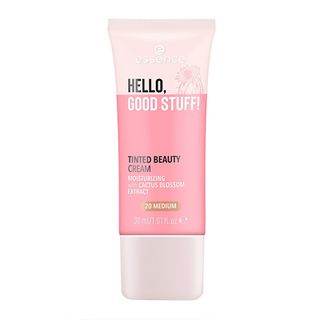
Essence Hello, Good Stuff! Tinted Beauty Cream
Works for
1 of 1 advertised claim delivered
Moisturizing10 ingredients credited for this claimGood support
“The softly tinted, nourishing day cream with natural cactus blossom extract, hyaluronic acid and glycerin provides moisture for 24 hours, makes slight skin irregularities disappear and is easy to blend.”
This product can help improve hydration of the skin with the two types of ingredients.
The first type is called “humectants”:
these ingredients help attract water.
When humectants are on the surface of the skin, they “pull in” the moisture from the outside environment, or from
within deeper layers of the skin. The following ingredients in this product do the job:
glycerin, sodium hyaluronate.
This product also contains ingredients called “occlusives”. They help reduce the speed with which our skin loses moisture to the outside environment. These ingredients also help soften the upper layer of the skin, so it feels less tight and nicer to the touch. The following ingredients in this product do the job: caprylic/capric triglyceride, coco-caprylate/caprate.
Anti-oxidationNot advertised by the brand · 1 ingredient credited for this claimModerate support
This product contains antioxidants (cereus grandiflorus flower extract) that might be able to help neutralize free radicals in skin to lessen the damage it gets from the UV light (sun). There is not enough evidence to confirm their effectiveness in skin though.
Can it cause trouble?
Irritancy1 strong irritant: ParfumMedium risk
ComedogenicClean of flagged comedogenic ingredientsNone flagged
User reviews
Be the first — your take helps the next person decide.
Ingredients
Filter by role to see what each ingredient is doing.
Water~45–55%
Caprylic/capric triglyceride~6.5–8%
- Irritation risk
- Medium
A good mix of fatty acids that forms a protective layer on the skin. Improves the shelf life of products. Derived from coconut and glycerin
More about Caprylic/capric triglycerideC13-15 alkane~5.2–6.4%
Coco-caprylate/caprate~3.2–3.9%
- Irritation risk
- Low
Helps to soften the upper layer of the skin without creating a greasy texture
More about Coco-caprylate/capratePolyglyceryl-4 diisostearate/polyhydroxystearate/sebacate~2.3–2.8%
- Irritation risk
- Medium
Helps water and oil mix together
More about Polyglyceryl-4 diisostearate/polyhydroxystearate/sebacateGlycerin~2–2.4%
- Irritation risk
- Low
One of the best moisturizing ingredients. Naturally present in skin. It attracts water to the upper layer of the skin working as a humectant
More about GlycerinSilica~1.9–2.3%
Propanediol~1.5–1.8%
- Irritation risk
- Low
Acts as a solvent for other ingredients. Speeds up the absorption of other ingredients into the skin
More about PropanediolTriethylhexanoin~1.2–1.5%
- Irritation risk
- Medium
Helps soften the upper layer of the skin
More about TriethylhexanoinKaolin~1.3–1.6%
- Irritation risk
- Low
A type of clay that consists mainly of aluminum silicate. Helps absorb oil and creates a thicker product consistency. Can be used to add a white color
More about KaolinStearalkonium hectorite~0.75–1.15%
Sea salt~0.65–1%
- Irritation risk
- Medium
Used to thicken the product formulation and might help to add minerals to the surface of the skin. It is used in scrubs as a physical exfoliant. Can increase sensitivity to other ingredients if left on the skin or used in high concentration
More about Sea saltCereus grandiflorus flower extract~0.6–0.9%
- Irritation risk
- Medium
A cactus extract that can help neutralize free radicals because it contains a chemical compound called betacyanins and flavonolglycosides. Can help make the surface of the skin dryer helping make pores look smaller for a very short period of time. The concentrations usually used in cosmetics are too small to have any effect
More about Cereus grandiflorus flower extractSodium hyaluronate~0.6–0.9%
- Irritation risk
- Low
One of the best moisturizing ingredients. Attracts water into the upper layer of the skin
More about Sodium hyaluronateHydrolyzed caesalpinia spinosa gum~0.6–0.85%
- Irritation risk
- Medium
Helps softent the upper layer of the skin and create a thicker product consistency
More about Hydrolyzed caesalpinia spinosa gumLeuconostoc/radish root ferment filtrate~0.55–0.85%
- Irritation risk
- Medium
A preservative that comes from radishes fermented by a bacteria. New research suggests that the preservation properties in the ingredient come from an ammonium salt that is not present naturally in radish root but used in its cultivation. Is problematic because the exact amount of the preservative agents is difficult to determine
More about Leuconostoc/radish root ferment filtrateCaesalpinia spinosa gum~0.6–0.85%
Butylene glycol~0.5–0.75%
- Irritation risk
- Low
Used to create a nice product texture and help delivery of other ingredients. Might be somewhat helpful in attracting water to the upper layer of the skin
More about Butylene glycolPropylene carbonate~0.5–0.75%
- Irritation risk
- Low
Is used to dissolve other ingredients and create nice product texture
More about Propylene carbonateCaprylyl glycol~0.5–0.7%
- Irritation risk
- Medium
Helps preserve products and creates a nice product texture
More about Caprylyl glycolCaprylhydroxamic acid~0.45–0.65%
Triethoxycaprylylsilane~0.4–0.65%
- Irritation risk
- Low
A type of silicone that helps oil and water mix well together. Helps to disperse other ingredients, e.g. pigments, evenly in a formulation
More about TriethoxycaprylylsilaneAlumina~0.55–0.8%
- Irritation risk
- Low
The same compound that is used safely in dental implants and bone cements. In cosmetics, it is used to improve the consistency of products
More about AluminaPhenoxyethanol~0.4–0.65%
- Irritation risk
- Low
A preservative. It helps prevent bacterial growth in cosmetic products
More about PhenoxyethanolPotassium sorbate~0.3–0.6%
Parfum~0.35–0.6%
- Irritation risk
- High
An aromatic blend of unspecified and possibly irritating ingredients
More about ParfumCi 77491~0.4–0.6%
- Irritation risk
- Low
A red colorant made of iron oxide. Typically is not irritating
More about Ci 77491Ci 77492~0.4–0.6%
Ci 77499~0.4–0.6%
Titanium dioxide~0.5–0.75%
- Irritation risk
- Low
Works as a UV filter when used in high concentrations. It is photostable and is effective mostly against the UVB light, with some protection in the UVA range. In small concentrations, used for its ability to improve the color of cosmetic products. Is usually well tolerated by the skin
More about Titanium dioxideWater~0.4–0.6%
Caprylic/capric triglyceride~0.45–0.7%
- Irritation risk
- Medium
A good mix of fatty acids that forms a protective layer on the skin. Improves the shelf life of products. Derived from coconut and glycerin
More about Caprylic/capric triglycerideC13-15 alkane~0.4–0.6%
Coco-caprylate/caprate~0.45–0.65%
- Irritation risk
- Low
Helps to soften the upper layer of the skin without creating a greasy texture
More about Coco-caprylate/capratePolyglyceryl-4 diisostearate/polyhydroxystearate/sebacate~0.45–0.65%
- Irritation risk
- Medium
Helps water and oil mix together
More about Polyglyceryl-4 diisostearate/polyhydroxystearate/sebacateGlycerin~0.45–0.65%
- Irritation risk
- Low
One of the best moisturizing ingredients. Naturally present in skin. It attracts water to the upper layer of the skin working as a humectant
More about GlycerinSilica~0.55–0.8%
Propanediol~0.45–0.65%
- Irritation risk
- Low
Acts as a solvent for other ingredients. Speeds up the absorption of other ingredients into the skin
More about PropanediolTriethylhexanoin~0.3–0.6%
- Irritation risk
- Medium
Helps soften the upper layer of the skin
More about TriethylhexanoinKaolin~0.55–0.8%
- Irritation risk
- Low
A type of clay that consists mainly of aluminum silicate. Helps absorb oil and creates a thicker product consistency. Can be used to add a white color
More about KaolinStearalkonium hectorite~0.4–0.6%
Sea salt~0.35–0.65%
- Irritation risk
- Medium
Used to thicken the product formulation and might help to add minerals to the surface of the skin. It is used in scrubs as a physical exfoliant. Can increase sensitivity to other ingredients if left on the skin or used in high concentration
More about Sea saltCereus grandiflorus flower extract~0.35–0.65%
- Irritation risk
- Medium
A cactus extract that can help neutralize free radicals because it contains a chemical compound called betacyanins and flavonolglycosides. Can help make the surface of the skin dryer helping make pores look smaller for a very short period of time. The concentrations usually used in cosmetics are too small to have any effect
More about Cereus grandiflorus flower extractSodium hyaluronate~0.4–0.6%
- Irritation risk
- Low
One of the best moisturizing ingredients. Attracts water into the upper layer of the skin
More about Sodium hyaluronateHydrolyzed caesalpinia spinosa gum~0.4–0.6%
- Irritation risk
- Medium
Helps softent the upper layer of the skin and create a thicker product consistency
More about Hydrolyzed caesalpinia spinosa gumLeuconostoc/radish root ferment filtrate~0.35–0.6%
- Irritation risk
- Medium
A preservative that comes from radishes fermented by a bacteria. New research suggests that the preservation properties in the ingredient come from an ammonium salt that is not present naturally in radish root but used in its cultivation. Is problematic because the exact amount of the preservative agents is difficult to determine
More about Leuconostoc/radish root ferment filtrateCaesalpinia spinosa gum~0.4–0.6%
Butylene glycol~0.3–0.6%
- Irritation risk
- Low
Used to create a nice product texture and help delivery of other ingredients. Might be somewhat helpful in attracting water to the upper layer of the skin
More about Butylene glycolPropylene carbonate~0.35–0.65%
- Irritation risk
- Low
Is used to dissolve other ingredients and create nice product texture
More about Propylene carbonateCaprylyl glycol~0.35–0.6%
- Irritation risk
- Medium
Helps preserve products and creates a nice product texture
More about Caprylyl glycolCaprylhydroxamic acid~0.3–0.55%
Triethoxycaprylylsilane~0.3–0.55%
- Irritation risk
- Low
A type of silicone that helps oil and water mix well together. Helps to disperse other ingredients, e.g. pigments, evenly in a formulation
More about TriethoxycaprylylsilaneAlumina~0.45–0.7%
- Irritation risk
- Low
The same compound that is used safely in dental implants and bone cements. In cosmetics, it is used to improve the consistency of products
More about AluminaPhenoxyethanol~0.25–0.5%
- Irritation risk
- Low
A preservative. It helps prevent bacterial growth in cosmetic products
More about PhenoxyethanolPotassium sorbate~0.25–0.45%
Parfum~0.2–0.35%
- Irritation risk
- High
An aromatic blend of unspecified and possibly irritating ingredients
More about ParfumCi 77491~0.15–0.3%
- Irritation risk
- Low
A red colorant made of iron oxide. Typically is not irritating
More about Ci 77491Ci 77492~0.15–0.25%
Ci 77499~0.15–0.3%
Titanium dioxide~0.2–0.35%
- Irritation risk
- Low
Works as a UV filter when used in high concentrations. It is photostable and is effective mostly against the UVB light, with some protection in the UVA range. In small concentrations, used for its ability to improve the color of cosmetic products. Is usually well tolerated by the skin
More about Titanium dioxideIngredient list view
Water, Caprylic/capric triglyceride, C13-15 alkane, Coco-caprylate/caprate, Polyglyceryl-4 diisostearate/polyhydroxystearate/sebacate, Glycerin, Silica, Propanediol, Triethylhexanoin, Kaolin, Stearalkonium hectorite, Sea salt, Cereus grandiflorus flower extract, Sodium hyaluronate, Hydrolyzed caesalpinia spinosa gum, Leuconostoc/radish root ferment filtrate, Caesalpinia spinosa gum, Butylene glycol, Propylene carbonate, Caprylyl glycol, Caprylhydroxamic acid, Triethoxycaprylylsilane, Alumina, Phenoxyethanol, Potassium sorbate, Parfum, Ci 77491, Ci 77492, Ci 77499, Titanium dioxide, Water, Caprylic/capric triglyceride, C13-15 alkane, Coco-caprylate/caprate, Polyglyceryl-4 diisostearate/polyhydroxystearate/sebacate, Glycerin, Silica, Propanediol, Triethylhexanoin, Kaolin, Stearalkonium hectorite, Sea salt, Cereus grandiflorus flower extract, Sodium hyaluronate, Hydrolyzed caesalpinia spinosa gum, Leuconostoc/radish root ferment filtrate, Caesalpinia spinosa gum, Butylene glycol, Propylene carbonate, Caprylyl glycol, Caprylhydroxamic acid, Triethoxycaprylylsilane, Alumina, Phenoxyethanol, Potassium sorbate, Parfum, Ci 77491, Ci 77492, Ci 77499, Titanium dioxide
Compare prices
Retailers ranked by price — lowest first.
Affiliate links · prices updated regularly · As an Amazon Associate, WIMJ earns from qualifying purchases.
Sources cited in this review
Every concentration estimate and effectiveness label is anchored to one of these 7 studies and safety reviews.
- 1Safety Assessment of Alkyl Esters as Used in Cosmeticscir-safety.org
- 2
- 3
- 4Hyaluronic acid: A key molecule in skin agingncbi.nlm.nih.gov
- 5
- 6

Affiliate links · As an Amazon Associate, WIMJ earns from qualifying purchases.