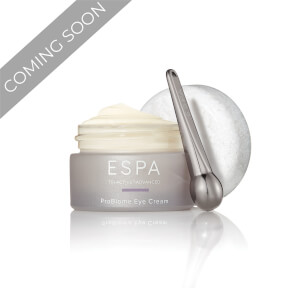
ESPA Tri-Active Resilience ProBiome Eye Cream
Works for
1 of 2 advertised claims delivered
Moisturizing31 ingredients credited for this claimGood support
“Introducing ESPA's Tri-Active Resilience Pro Biome Eye Treatment, an antioxidant-rich and clinically-proven protecting eye cream laced with potent actives to brighten and smooth skin around the eye area.Infused with anti-inflammatory tuberose which whilst hydrates and stimulates skin, peony to sooth and smooth and neroli which replenishes for beautifully soft, supple skin alongside natural bio retinol, bidens pilosa, this Tri-Active Resilience Pro Biome Eye Treatment from ESPA nurtures and supports skin while you slumber for tangible results come morning.”
This product can help improve hydration of the skin with the two types of ingredients.
The first type is called “humectants”:
these ingredients help attract water.
When humectants are on the surface of the skin, they “pull in” the moisture from the outside environment, or from
within deeper layers of the skin. The following ingredients in this product do the job:
anhydroxylitol, glycerin.
This product also contains ingredients called “occlusives”. They help reduce the speed with which our skin loses moisture to the outside environment. These ingredients also help soften the upper layer of the skin, so it feels less tight and nicer to the touch. The following ingredients in this product do the job: helianthus annuus seed oil, squalene.
Anti-aging5 ingredients credited for this claimLimited support
“Introducing ESPA's Tri-Active Resilience Pro Biome Eye Treatment, an antioxidant-rich and clinically-proven protecting eye cream laced with potent actives to brighten and smooth skin around the eye area.Infused with anti-inflammatory tuberose which whilst hydrates and stimulates skin, peony to sooth and smooth and neroli which replenishes for beautifully soft, supple skin alongside natural bio retinol, bidens pilosa, this Tri-Active Resilience Pro Biome Eye Treatment from ESPA nurtures and supports skin while you slumber for tangible results come morning.”
This product does not contain ingredients that are able to reduce fine lines and wrinkles or help with skin elasticity, but it can improve the look of the skin temporarily through moisturization. Well-moisturized skin might also be able to repair the sun damage better.
This ingredient bifida ferment lysate might be able to help neutralize free radicals in skin and help it fight off some of the sun damage.
Anti-oxidationNot advertised by the brand · 9 ingredients credited for this claimModerate support
This product contains antioxidants (bifida ferment lysate, squalene) that might be able to help neutralize free radicals in skin to lessen the damage it gets from the UV light (sun). There is not enough evidence to confirm their effectiveness in skin though.
Can it cause trouble?
Irritancy10 strong irritants: Polianthes tuberosa callus extract, Citrus aurantium amara flower oil + 8 more — patch-test recommendedHigh risk
Comedogenic8 ingredients rated 2 or more on the 0–5 pore-clogging scale8 flagged
User reviews
Be the first — your take helps the next person decide.
Ingredients
Filter by role to see what each ingredient is doing.
Water~45–55%
Coconut alkanes~6–7.3%
- Irritation risk
- Medium
- Comedogenicity
- 2/5
An emollient that helps soften the skin
More about Coconut alkanesBifida ferment lysate~4.4–5.4%
- Irritation risk
- Low
Consists of remains of dead yeast bacteria cells. Helps to hydrate the skin and reduce irritation. Might has some anti-oxidant effect
More about Bifida ferment lysateHelianthus annuus seed oil unsaponifiables~3.2–3.9%
- Irritation risk
- Low
A great emollient due to its high linoleic acid content. One of the most effective plant oils in helping skin hydration and repairing skin barrier function
More about Helianthus annuus seed oil unsaponifiablesPropanediol~2.4–2.9%
- Irritation risk
- Low
Acts as a solvent for other ingredients. Speeds up the absorption of other ingredients into the skin
More about PropanediolMaris aqua~1.9–2.4%
Sea water~1.7–2%
- Irritation risk
- Low
Dissolves other ingredients. It does not have additional skin benefits compared to plain water
More about Sea waterPolyglyceryl-6 distearate~1.4–1.7%
- Irritation risk
- Medium
Helps oil and water mix together while softening the upper layer of the skin
More about Polyglyceryl-6 distearateGlycerin~1.2–1.5%
- Irritation risk
- Low
One of the best moisturizing ingredients. Naturally present in skin. It attracts water to the upper layer of the skin working as a humectant
More about GlycerinHelianthus annuus seed oil~0.95–1.15%
- Irritation risk
- Low
A great emollient due to its high linoleic acid content. One of the most effective plant oils in helping skin hydration and repairing skin barrier function
More about Helianthus annuus seed oilPolyglyceryl-2 stearate~0.65–0.95%
- Irritation risk
- Medium
Helps water and oil mix together
More about Polyglyceryl-2 stearateCetyl stearate~0.55–0.85%
- Irritation risk
- Low
Xylitylglucoside~0.45–0.7%
- Irritation risk
- Low
Helps attract water to the upper layer of the skin and repair the skin barrier function
More about XylitylglucosideCoco-caprylate/caprate~0.45–0.65%
- Irritation risk
- Low
Helps to soften the upper layer of the skin without creating a greasy texture
More about Coco-caprylate/caprateGlyceryl stearate~0.45–0.65%
- Irritation risk
- Low
An emollient that softens the skin and forms a protective layer on its surface. Helps water and oil mix together
More about Glyceryl stearateAnhydroxylitol~0.35–0.6%
- Irritation risk
- Low
Helps attract water to the upper layer of the skin and repair the skin barrir function
More about AnhydroxylitolPhenoxyethanol~0.35–0.6%
- Irritation risk
- Low
A preservative. It helps prevent bacterial growth in cosmetic products
More about PhenoxyethanolCetyl alcohol~0.35–0.6%
- Irritation risk
- Low
A non-drying alcohol that works to soften the skin and stabilize product formulations helping oil and water mix together
More about Cetyl alcoholStearyl alcohol~0.3–0.55%
- Irritation risk
- Low
An emollient that helps soften the skin
More about Stearyl alcoholGossypium herbaceum seed oil~0.25–0.45%
- Irritation risk
- Low
- Comedogenicity
- 3/5
Cottonseed oil. It is used as an emollient and occlusive in products. It is rich palmitic, oleic acid, and linoleic fatty acids.
More about Gossypium herbaceum seed oilBentonite~0.25–0.45%
Elaeis guineensis oil~0.25–0.45%
- Irritation risk
- Low
Helps soften the upper layer of the skin
More about Elaeis guineensis oilIsostearyl isostearate~0.2–0.4%
- Irritation risk
- Medium
- Comedogenicity
- 3/5
Helps soften the upper layer of the skin and improve the product texture. It can be comedogenic
More about Isostearyl isostearatePotassium cetyl phosphate~0.25–0.5%
- Irritation risk
- Medium
Helps oil and water mix together
More about Potassium cetyl phosphateJojoba esters~0.25–0.5%
- Irritation risk
- Medium
An emollient made of jojoba oil. Helps soften the skin and support its barrier function
More about Jojoba estersBidens pilosa extract~0.2–0.4%
- Irritation risk
- Low
Linum usitatissimum seed oil~0.2–0.35%
Sclerotium gum~0.2–0.4%
- Irritation risk
- Low
Used to create gel-like formulas and stabilize emulsions
More about Sclerotium gumSodium hyaluronate~0.25–0.45%
- Irritation risk
- Low
One of the best moisturizing ingredients. Attracts water into the upper layer of the skin
More about Sodium hyaluronateXylitol~0.2–0.4%
- Irritation risk
- Low
Helps attract water to the upper layer of the skin and repair the skin barrier function
More about XylitolPolyglyceryl-3 beeswax~0.25–0.5%
- Irritation risk
- Medium
Helps water and oil mix together. Could be an allergen (beeswax)
More about Polyglyceryl-3 beeswaxPolianthes tuberosa callus extract~0.25–0.5%
- Irritation risk
- High
Citrus aurantium amara flower oil~0.25–0.45%
- Irritation risk
- High
Used as a fragrance. Can be irritating
More about Citrus aurantium amara flower oilBenzoic acid~0.25–0.5%
Olive oil decyl esters~0.25–0.45%
- Irritation risk
- Low
Dehydroacetic acid~0.25–0.45%
Glucose~0.25–0.45%
- Irritation risk
- Low
Helps attract water to the upper layer of the skin. Could be helpful in restoring the skin barrier function
More about GlucoseLinalool~0.2–0.4%
Citric acid~0.25–0.45%
- Irritation risk
- Medium
Can work as an exfoliant but is typically used to adjust the product pH
More about Citric acidHydrated silica~0.4–0.6%
Rosmarinus officinalis leaf extract~0.2–0.4%
- Irritation risk
- High
Can be helpful in reducing inflammation in skin, including inflamed acne. It can be irritating
More about Rosmarinus officinalis leaf extractEthylhexylglycerin~0.25–0.45%
Plankton extract~0.25–0.45%
- Irritation risk
- Medium
- Comedogenicity
- 3/5
Can help attract water to the upper layer of the skin
More about Plankton extractPaeonia lactiflora root extract~0.25–0.45%
- Irritation risk
- Medium
A plant extract that might help neutralize free radicals and reduce hyperpigmentation, but the research on its effectiveness in skin is lacking
More about Paeonia lactiflora root extractLimonene~0.2–0.4%
- Irritation risk
- High
A common frangrance that can easily irritate skin, especially if exposed to air, light or heat
More about LimoneneTrehalose~0.25–0.45%
- Irritation risk
- Low
A sugar that attracts water to the upper layer of the skin
More about TrehaloseStearic acid~0.5–0.75%
- Irritation risk
- Low
Helps oil and water mix together and works as an emollient
More about Stearic acidLaminaria digitata extract~0.25–0.45%
- Irritation risk
- Low
- Comedogenicity
- 3/5
Seaweed extract that helps the skin to attract water and make it more smooth for touch. Also shows promise of anti-aging properties, but good research is lacking at the moment
More about Laminaria digitata extractLactic acid~0.25–0.45%
- Irritation risk
- Medium
An exfoliating and moisturizing alpha-hydroxy acid (AHA). Typically causes less irritation than other AHAs, for example, glycolic acid. At high concentrations (about 15%), lactic acid can help reduce lines and wrinkles. Recent studies show that lactic acid can support the "good" bacteria living on skin's surface (healthy skin microbiome)
More about Lactic acidHydrolyzed rhodophyceae extract~0.25–0.45%
- Irritation risk
- Low
- Comedogenicity
- 3/5
Geraniol~0.2–0.4%
Squalene~0.3–0.55%
- Irritation risk
- Low
- Comedogenicity
- 2/5
An oil that is naturally part of skin sebum that helps to soften its upper layer, reduce water loss and neutralize free radicals. It might be comedogenic. Avoid applying large concentrations (or pure oil) before sun exposure as oxidized squalene can clog pores and lead to skin irritation. Today squalene is mostly derived from vegetable oils or synthetized by yeast
More about SqualeneChlorella vulgaris extract~0.25–0.45%
- Irritation risk
- Medium
- Comedogenicity
- 3/5
A plant extract that can help to attract water to the upper layer of the skin and might have some anti-oxidant and anti-inflammatory properties
More about Chlorella vulgaris extractFarnesol~0.2–0.4%
Tocopherol~0.25–0.45%
- Irritation risk
- Low
Pure form of vitamin E. Can help moisturise and protect the skin from free radicals. Often used to help stabilise other ingredients or the formula itself
More about TocopherolSorbitol~0.25–0.45%
- Irritation risk
- Low
Helps attract water to the upper layer of the skin and improves the product texture
More about SorbitolLecithin~0.3–0.5%
- Irritation risk
- Low
Used mostly for creating emulsions - helping oil and water mix together. Helps soften the upper layer of the skin
More about LecithinPotassium sorbate~0.25–0.45%
Sodium benzoate~0.25–0.45%
Citronellol~0.2–0.4%
Saccharide isomerate~0.25–0.45%
- Irritation risk
- Low
Helps attract water to the upper layer of the skin
More about Saccharide isomerateParfum~0.2–0.4%
- Irritation risk
- High
An aromatic blend of unspecified and possibly irritating ingredients
More about ParfumTocopheryl acetate~0.25–0.45%
- Irritation risk
- Medium
A more stable but less bio-available form of vitamin E compared to Tocopherol. Might help moisturize and protect the skin from free radicals, but mostly used in low concentrations to stabilize other ingredients.
More about Tocopheryl acetateMaris sal~0.2–0.4%
- Irritation risk
- Medium
Used to thicken the product formulation and might help to add minerals to the surface of the skin. It is used in scrubs as a physical exfoliant. Can increase sensitivity to other ingredients if left on the skin or used in high concentration
More about Maris salSea salt~0.2–0.4%
- Irritation risk
- Medium
Used to thicken the product formulation and might help to add minerals to the surface of the skin. It is used in scrubs as a physical exfoliant. Can increase sensitivity to other ingredients if left on the skin or used in high concentration
More about Sea saltGlyceryl linoleate~0.25–0.5%
- Irritation risk
- Medium
Helps oil and water mix together
More about Glyceryl linoleateGlyceryl linolenate~0.25–0.45%
- Irritation risk
- Low
Helps soften the upper layer of the skin
More about Glyceryl linolenateSodium ascorbyl phosphate~0.2–0.35%
- Irritation risk
- Medium
A stable derivative of vitamin C. It is oil-soluble which means it is more likely to penetrate the skin compared to the pure form of vitamin C (which is water-soluble), but it is less bio-available and is way less effective in stimulating collagen and reducing wrinkles compared to the pure form of vitamin C (L-ascorbic acid) and its other derivatives (for example, magnesium ascorbyl phosphate). At the same time, this vitamin C derivative has been shown in studies to be effective in reducing acne, blemishes and clogged pores. It is less irritating then the pure form of vitamin C
More about Sodium ascorbyl phosphateXanthan gum~0.2–0.35%
- Irritation risk
- Low
Used to create a thicker product consistency
More about Xanthan gumCaprylyl glycol~0.2–0.35%
- Irritation risk
- Medium
Helps preserve products and creates a nice product texture
More about Caprylyl glycolRetinyl palmitate~0.15–0.25%
- Irritation risk
- High
Three steps removed from the active form of vitamin A - retinoic acid. To have an effect in the skin, it first needs to be converted twice to become the retinoic acid. This means it is less potent than retinol, but could also be less irritating. Once converted to the retinoic acid in the skin, it helps against all signs of aging, improves skin cell turnover and helps fight blemishes and clogged pores. However, in many cosmetic formulations, it is used in a concentration that is too low to have the full effect
More about Retinyl palmitateDisodium edta~0.15–0.25%
Glyceryl caprylate~0.15–0.25%
- Irritation risk
- Low
An emollient that can also help water and oil mix together, as well as prevent bacteria growth in products
More about Glyceryl caprylateParfum~0.05–0.15%
- Irritation risk
- High
An aromatic blend of unspecified and possibly irritating ingredients
More about ParfumIngredient list view
Water, Coconut alkanes, Bifida ferment lysate, Helianthus annuus seed oil unsaponifiables, Propanediol, Maris aqua, Sea water, Polyglyceryl-6 distearate, Glycerin, Helianthus annuus seed oil, Polyglyceryl-2 stearate, Cetyl stearate, Xylitylglucoside, Coco-caprylate/caprate, Glyceryl stearate, Anhydroxylitol, Phenoxyethanol, Cetyl alcohol, Stearyl alcohol, Gossypium herbaceum seed oil, Bentonite, Elaeis guineensis oil, Isostearyl isostearate, Potassium cetyl phosphate, Jojoba esters, Bidens pilosa extract, Linum usitatissimum seed oil, Sclerotium gum, Sodium hyaluronate, Xylitol, Polyglyceryl-3 beeswax, Polianthes tuberosa callus extract, Citrus aurantium amara flower oil, Benzoic acid, Olive oil decyl esters, Dehydroacetic acid, Glucose, Linalool, Citric acid, Hydrated silica, Rosmarinus officinalis leaf extract, Ethylhexylglycerin, Plankton extract, Paeonia lactiflora root extract, Limonene, Trehalose, Stearic acid, Laminaria digitata extract, Lactic acid, Hydrolyzed rhodophyceae extract, Geraniol, Squalene, Chlorella vulgaris extract, Farnesol, Tocopherol, Sorbitol, Lecithin, Potassium sorbate, Sodium benzoate, Citronellol, Saccharide isomerate, Parfum, Tocopheryl acetate, Maris sal, Sea salt, Glyceryl linoleate, Glyceryl linolenate, Sodium ascorbyl phosphate, Xanthan gum, Caprylyl glycol, Retinyl palmitate, Disodium edta, Glyceryl caprylate, Parfum
Compare prices
Retailers ranked by price — lowest first.

Affiliate links · prices updated regularly
Sources cited in this review
Every concentration estimate and effectiveness label is anchored to one of these 35 studies and safety reviews.
- 1Bifidobacterium longumlysate, a new ingredient forreactive skinonlinelibrary.wiley.com
- 2Use of Probiotics for Dermal Applicationsresearchgate.net
- 3
- 4
- 5
- 6Effect of topically applied lipids on surfactant-irritated skinonlinelibrary.wiley.com

Affiliate links · As an Amazon Associate, WIMJ earns from qualifying purchases.