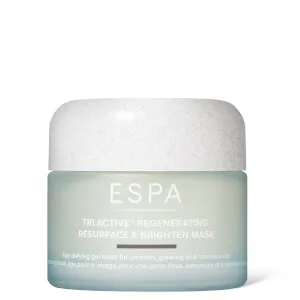
ESPA Regenerating Resurface & Brightening Mask

ESPA Regenerating Resurface & Brightening Mask

Efficacy91/100IrritancyHigh

Works for

Exfoliation
Gluconolactone, Salix alba bark extract
Works well
What the product description says
“ESPA’s Tri-Active™ Regenerating Resurface & Brighten Mask promotes the skin’s cellular renewal process by offering gentle yet effective exfoliation that eradicates dull cells.”
Source: Espa

This product can help exfoliate the skin. In other words, it helps break down the bonds between dead cells on the surface of the skin and speed up the skin turnover. Skin often appears softer and brighter after exfoliation, but overdoing it can result in disrupted skin barrier. The following ingredient is doing the exfoliating job in this product: gluconolactone.

GluconolactoneKey activeEffect: HighA polyhydroxy acid (PHA) that helps shed the dead cells from the skin surface revealing smoother skin. Is believed to be genter than AHAs. It helps attract water to the upper layer of the skin and can stimulate production of skin's own hyaluronic acid resulting in improved hydration levels. It has been shown to be helpful against acne and clogged pores if used consistently (e.g over a period of 12 weeks) in high enough concentration. It can help reduce fine lines and wrinkles and improve skin tone with long-term application. Can help neutralize free radicals~3.1–3.8%
Salix alba bark extractEffect: LowA plant extract that can help neutralize free radicals in skin. It contains a compound salicin that can theoretically be converted into salicylic acid that, in turn, helps reduce inflammation in skin, but the evidence of effectiveness in skin is lacking and the extract is usually not used in a concentration that would enable an exfoliating effect~0.5–0.75%
Anti-aging
Gluconolactone, Ascorbyl glucoside
Works well
What the product description says
“Wrinkles, lines, pores, and imperfections appear reduced, and a radiant, glowing complexion is restored.”
Source: Espa

This product can help reduce and prevent fine lines and wrinkles, improve skin elasticity and firmness because it contains gluconolactone.

These ingredients in the product can also be helpful, even though there is less evidence for their effectiveness: ascorbyl glucoside.

Keep in mind that it typically takes at least 6 weeks to notice any results because the changes that are needed to improve fine lines and elasticity happen in the deeper layers of the skin. No topical anti-aging product can “erase” wrinkles or fully reverse signs of aging.

GluconolactoneKey activeEffect: HighA polyhydroxy acid (PHA) that helps shed the dead cells from the skin surface revealing smoother skin. Is believed to be genter than AHAs. It helps attract water to the upper layer of the skin and can stimulate production of skin's own hyaluronic acid resulting in improved hydration levels. It has been shown to be helpful against acne and clogged pores if used consistently (e.g over a period of 12 weeks) in high enough concentration. It can help reduce fine lines and wrinkles and improve skin tone with long-term application. Can help neutralize free radicals~3.1–3.8%
Ascorbyl glucosideKey activeEffect: MediumA vitamin C derivative that is more stable but less potent than pure form of vitamin C. Has a potential to boost collagen production, nutralise free radicals and reduce hyperpigmentation, but the required concentration is likely to be much higher than for the pure form of vitamin C, limiting the ingredient's effectiveness in products~0.95–1.15%
Moisturizing
Glycerin, Gluconolactone + 5 more
Works
What the product description says
“Skin appears brightened and plumped with this resurfacing formula that brings you visibly smooth, hydrated skin.”
Source: Espa

This product contains good ingredients to attract water to the upper layer of the skin. These ingredients are called "humectants": glycerin, hydrolyzed hyaluronic acid.

When humectants are on the surface of the skin, they “pull in” the moisture from the outside environment, or from within deeper layers of the skin. If the air is dry, humectants can speed up the moisture loss from the skin. This is why it is a good idea to use another product on top of this one to help "seal in" the moisture (look for ingredients like dimethicone, squalane, oils and butters).

GlycerinKey active· HumectantEffect: HighOne of the best moisturizing ingredients. Naturally present in skin. It attracts water to the upper layer of the skin working as a humectant~4.2–5.1%
GluconolactoneKey activeEffect: HighA polyhydroxy acid (PHA) that helps shed the dead cells from the skin surface revealing smoother skin. Is believed to be genter than AHAs. It helps attract water to the upper layer of the skin and can stimulate production of skin's own hyaluronic acid resulting in improved hydration levels. It has been shown to be helpful against acne and clogged pores if used consistently (e.g over a period of 12 weeks) in high enough concentration. It can help reduce fine lines and wrinkles and improve skin tone with long-term application. Can help neutralize free radicals~3.1–3.8%
HoneyKey active· HumectantEffect: MediumHelps attract water to the skin and might have some anti-bacterial properties. Can be an allergen~0.45–0.7%
Saccharum officinarum extractKey activeEffect: HighSugar extract that helps attract water to the upper layer of the skin~0.4–0.65%
Hydrolyzed hyaluronic acidKey active· HumectantEffect: HighOne of the best moisturizing ingredients. Attracts water into the upper layer of the skin. A version of it is naturally present in skin~0.3–0.6%
Hydrolyzed alginKey active· HumectantEffect: MediumDerived from brown algae. Helps attract water to the upper layer of the skin~0.25–0.4%
Chlorella vulgaris extractKey activeEffect: MediumA plant extract that can help to attract water to the upper layer of the skin and might have some anti-oxidant and anti-inflammatory properties~0.05–0.1%
Evens skin tone
Side benefit · Gluconolactone, Ascorbyl glucoside
Works well

This product can help reduce hypepigmentation and even out the skin tone because it contains the following effective ingredients: gluconolactone

The following ingredient (ingredients) in this product might be helpful, but there is no evidence to confirm that it actually can help even out the skin tone: ascorbyl glucoside.

Keep in mind that you would need to apply any topical skincare targetted at hypigmentation consistently for a couple of months to get a result. No topical skincare product can help get rid of hyperpigmentation (including post-acne marks and age spots) instantly.

GluconolactoneKey activeEffect: HighA polyhydroxy acid (PHA) that helps shed the dead cells from the skin surface revealing smoother skin. Is believed to be genter than AHAs. It helps attract water to the upper layer of the skin and can stimulate production of skin's own hyaluronic acid resulting in improved hydration levels. It has been shown to be helpful against acne and clogged pores if used consistently (e.g over a period of 12 weeks) in high enough concentration. It can help reduce fine lines and wrinkles and improve skin tone with long-term application. Can help neutralize free radicals~3.1–3.8%
Ascorbyl glucosideKey activeEffect: MediumA vitamin C derivative that is more stable but less potent than pure form of vitamin C. Has a potential to boost collagen production, nutralise free radicals and reduce hyperpigmentation, but the required concentration is likely to be much higher than for the pure form of vitamin C, limiting the ingredient's effectiveness in products~0.95–1.15%
Anti-oxidation
Side benefit · Gluconolactone, Ascorbyl glucoside + 3 more
May help

This product contains antioxidants (ascorbyl glucoside, gluconolactone) that can help neutralize free radicals in skin to lessen the damage it gets from the UV light (sun). There is some human evidence for this effect in skin, though it is smaller or less consistent than the evidence for the best antioxidants.

GluconolactoneKey activeEffect: MediumA polyhydroxy acid (PHA) that helps shed the dead cells from the skin surface revealing smoother skin. Is believed to be genter than AHAs. It helps attract water to the upper layer of the skin and can stimulate production of skin's own hyaluronic acid resulting in improved hydration levels. It has been shown to be helpful against acne and clogged pores if used consistently (e.g over a period of 12 weeks) in high enough concentration. It can help reduce fine lines and wrinkles and improve skin tone with long-term application. Can help neutralize free radicals~3.1–3.8%
Ascorbyl glucosideKey activeEffect: MediumA vitamin C derivative that is more stable but less potent than pure form of vitamin C. Has a potential to boost collagen production, nutralise free radicals and reduce hyperpigmentation, but the required concentration is likely to be much higher than for the pure form of vitamin C, limiting the ingredient's effectiveness in products~0.95–1.15%
Vaccinium myrtillus fruit extractEffect: LowA plant extract that might help neutralize free radicals in skin, but research on its efficacy in skin is lacking~1.2–1.4%
Salix alba bark extractEffect: LowA plant extract that can help neutralize free radicals in skin. It contains a compound salicin that can theoretically be converted into salicylic acid that, in turn, helps reduce inflammation in skin, but the evidence of effectiveness in skin is lacking and the extract is usually not used in a concentration that would enable an exfoliating effect~0.5–0.75%
Chlorella vulgaris extractEffect: LowA plant extract that can help to attract water to the upper layer of the skin and might have some anti-oxidant and anti-inflammatory properties~0.05–0.1%

Can it cause trouble?

Irritancy
12 strong irritants: Citrus aurantium dulcis fruit extract, Citrus limon fruit extract + 10 more — patch-test recommended
High risk
We flagged 24 ingredients with irritancy potential. Severity depends on your sensitivity threshold; the table lists the worst offenders first.
IngredientFunctionIrritationEst. amount
Citrus aurantium dulcis fruit extractA plant extract that is used as a fragrance. Can be irritating and lead to photosensitivityHigh~5.1–6.2%est.
Salix alba bark extractA plant extract that can help neutralize free radicals in skin. It contains a compound salicin that can theoretically be converted into salicylic acid that, in turn, helps reduce inflammation in skin, but the evidence of effectiveness in skin is lacking and the extract is usually not used in a concentration that would enable an exfoliating effectHigh~0.5–0.75%est.
Citrus limon fruit extractUsed as a fragrance. Can be irritating and cause photosensitivityHigh~0.3–0.55%est.
LimoneneA common frangrance that can easily irritate skin, especially if exposed to air, light or heatHigh~0.25–0.5%est.
Lavandula angustifolia oilAn essential oil. Potential allergen and can be irritating. It has some anti-bacterial propertiesHigh~0.25–0.45%est.
ParfumAn aromatic blend of unspecified and possibly irritating ingredientsHigh~0.2–0.4%est.
Pelargonium graveolens oilUsed as a fragrance. Can be irritatingHigh~0.2–0.4%est.
LinaloolA fragrance. Can be irritatingHigh~0.2–0.35%est.
Citrus aurantium amara flower oilUsed as a fragrance. Can be irritatingHigh~0.15–0.25%est.
Citrus aurantium dulcis peel oilAn essentil oil from orange peel. Potential allergen and can be irritatingHigh~0.1–0.25%est.
Santalum album oilUsed as a fragrance. Can be irritatingHigh~0.1–0.2%est.
GeraniolA fragrance. Can be irritatingHigh~0.05–0.1%est.
GluconolactoneA polyhydroxy acid (PHA) that helps shed the dead cells from the skin surface revealing smoother skin. Is believed to be genter than AHAs. It helps attract water to the upper layer of the skin and can stimulate production of skin's own hyaluronic acid resulting in improved hydration levels. It has been shown to be helpful against acne and clogged pores if used consistently (e.g over a period of 12 weeks) in high enough concentration. It can help reduce fine lines and wrinkles and improve skin tone with long-term application. Can help neutralize free radicalsMedium~3.1–3.8%est.
Acacia senegal gumHelps mask the small of other ingredients and improve the product textureMedium~1.7–2.1%est.
Vaccinium myrtillus fruit extractA plant extract that might help neutralize free radicals in skin, but research on its efficacy in skin is lackingMedium~1.2–1.4%est.
Ascorbyl glucosideA vitamin C derivative that is more stable but less potent than pure form of vitamin C. Has a potential to boost collagen production, nutralise free radicals and reduce hyperpigmentation, but the required concentration is likely to be much higher than for the pure form of vitamin C, limiting the ingredient's effectiveness in productsMedium~0.95–1.15%est.
Levulinic acidHelps stabilize a product formulationMedium~0.5–0.8%est.
Sodium levulinateA preservativeMedium~0.4–0.6%est.
Citric acidCan work as an exfoliant but is typically used to adjust the product pHMedium~0.4–0.6%est.
Acer saccharum extractA plant extract that contains small percentage of AHAs. Is unlikely to have any skin benefit due the small concentration of the active compoundsMedium~0.25–0.45%est.
Phytic acidAn alpha-hydroxy acid (AHA), but is mostly used to stabilize product formulations in cosmeticsMedium~0.25–0.45%est.
Potassium sorbateA preservativeMedium~0.2–0.35%est.
Chlorella vulgaris extractA plant extract that can help to attract water to the upper layer of the skin and might have some anti-oxidant and anti-inflammatory propertiesMedium~0.05–0.1%est.
Comedogenic
2 ingredients rated 2 or more on the 0–5 pore-clogging scale
2 flagged
These ingredients have a comedogenic rating of 2 or more on a 0–5 scale; the table shows each one's rating. In leave-on products they can clog pores in acne-prone skin.
IngredientFunctionRatingEst. amount
Hydrolyzed alginDerived from brown algae. Helps attract water to the upper layer of the skin3/5~0.25–0.4%est.
Chlorella vulgaris extractA plant extract that can help to attract water to the upper layer of the skin and might have some anti-oxidant and anti-inflammatory properties3/5~0.05–0.1%est.

User reviews

Would you recommend?
No community reviews yet.

Be the first — your take helps the next person decide.

Ingredients

Filter by role to see what each ingredient is doing.

Water~45–55%
Formula
Irritation risk
Low

Plain old water

More about Water
Citrus aurantium dulcis fruit extract~5.1–6.2%
Irritant · high
Irritation risk
High

A plant extract that is used as a fragrance. Can be irritating and lead to photosensitivity

More about Citrus aurantium dulcis fruit extract
Glycerin~4.2–5.1%
Key active
Irritation risk
Low
Works for
Moisturizing

One of the best moisturizing ingredients. Naturally present in skin. It attracts water to the upper layer of the skin working as a humectant

More about Glycerin
Gluconolactone~3.1–3.8%
Key activeIrritant · medium
Irritation risk
Medium
Works for
Anti-agingEvens skin toneExfoliationMoisturizingAnti-blemishAnti-oxidation

A polyhydroxy acid (PHA) that helps shed the dead cells from the skin surface revealing smoother skin. Is believed to be genter than AHAs. It helps attract water to the upper layer of the skin and can stimulate production of skin's own hyaluronic acid resulting in improved hydration levels. It has been shown to be helpful against acne and clogged pores if used consistently (e.g over a period of 12 weeks) in high enough concentration. It can help reduce fine lines and wrinkles and improve skin tone with long-term application. Can help neutralize free radicals

More about Gluconolactone
Sclerotium gum~2.3–2.9%
Formula
Irritation risk
Low

Used to create gel-like formulas and stabilize emulsions

More about Sclerotium gum
Sodium hydroxide~1.9–2.4%
Formula
Irritation risk
Low

Used to adjust the product's pH

More about Sodium hydroxide
Acacia senegal gum~1.7–2.1%
Irritant · medium
Irritation risk
Medium

Helps mask the small of other ingredients and improve the product texture

More about Acacia senegal gum
Xanthan gum~1.4–1.7%
Formula
Irritation risk
Low
Works for
Cleansing

Used to create a thicker product consistency

More about Xanthan gum
Vaccinium myrtillus fruit extract~1.2–1.4%
Irritant · medium
Irritation risk
Medium
Works for
Anti-oxidation

A plant extract that might help neutralize free radicals in skin, but research on its efficacy in skin is lacking

More about Vaccinium myrtillus fruit extract
Ascorbyl glucoside~0.95–1.15%
Key activeIrritant · medium
Irritation risk
Medium
Works for
Anti-oxidationAnti-agingEvens skin tone

A vitamin C derivative that is more stable but less potent than pure form of vitamin C. Has a potential to boost collagen production, nutralise free radicals and reduce hyperpigmentation, but the required concentration is likely to be much higher than for the pure form of vitamin C, limiting the ingredient's effectiveness in products

More about Ascorbyl glucoside
Salix alba bark extract~0.5–0.75%
Irritant · high
Irritation risk
High
Works for
Anti-inflammatoryAnti-oxidationAnti-blemishExfoliation

A plant extract that can help neutralize free radicals in skin. It contains a compound salicin that can theoretically be converted into salicylic acid that, in turn, helps reduce inflammation in skin, but the evidence of effectiveness in skin is lacking and the extract is usually not used in a concentration that would enable an exfoliating effect

More about Salix alba bark extract
Levulinic acid~0.5–0.8%
Irritant · medium
Irritation risk
Medium

Helps stabilize a product formulation

More about Levulinic acid
Polyglyceryl-4 caprate~0.55–0.8%
Formula
Irritation risk
Low
Works for
Cleansing
More about Polyglyceryl-4 caprate
Honey~0.45–0.7%
Key active
Irritation risk
Low
Works for
MoisturizingAntibacterial

Helps attract water to the skin and might have some anti-bacterial properties. Can be an allergen

More about Honey
Saccharum officinarum extract~0.4–0.65%
Key active
Irritation risk
Low
Works for
Moisturizing

Sugar extract that helps attract water to the upper layer of the skin

More about Saccharum officinarum extract
Sodium levulinate~0.4–0.6%
Irritant · medium
Irritation risk
Medium

A preservative

More about Sodium levulinate
Citric acid~0.4–0.6%
Irritant · medium
Irritation risk
Medium

Can work as an exfoliant but is typically used to adjust the product pH

More about Citric acid
Hydrolyzed hyaluronic acid~0.3–0.6%
Key active
Irritation risk
Low
Works for
Moisturizing

One of the best moisturizing ingredients. Attracts water into the upper layer of the skin. A version of it is naturally present in skin

More about Hydrolyzed hyaluronic acid
Citrus limon fruit extract~0.3–0.55%
Irritant · high
Irritation risk
High

Used as a fragrance. Can be irritating and cause photosensitivity

More about Citrus limon fruit extract
Limonene~0.25–0.5%
Irritant · high
Irritation risk
High

A common frangrance that can easily irritate skin, especially if exposed to air, light or heat

More about Limonene
Distarch phosphate~0.25–0.5%
Formula
Citrus aurantium amara leaf/twig oil~0.25–0.5%
Irritant · high
Lavandula angustifolia oil~0.25–0.45%
Irritant · high
Irritation risk
High

An essential oil. Potential allergen and can be irritating. It has some anti-bacterial properties

More about Lavandula angustifolia oil
Acer saccharum extract~0.25–0.45%
Irritant · medium
Irritation risk
Medium

A plant extract that contains small percentage of AHAs. Is unlikely to have any skin benefit due the small concentration of the active compounds

More about Acer saccharum extract
Parfum~0.2–0.4%
Irritant · high
Irritation risk
High

An aromatic blend of unspecified and possibly irritating ingredients

More about Parfum
Phytic acid~0.25–0.45%
Irritant · medium
Irritation risk
Medium

An alpha-hydroxy acid (AHA), but is mostly used to stabilize product formulations in cosmetics

More about Phytic acid
Pelargonium graveolens oil~0.2–0.4%
Irritant · high
Irritation risk
High

Used as a fragrance. Can be irritating

More about Pelargonium graveolens oil
Hydrolyzed algin~0.25–0.4%
Key activeComedogenic 3/5
Irritation risk
Low
Comedogenicity
3/5
Works for
Moisturizing

Derived from brown algae. Helps attract water to the upper layer of the skin

More about Hydrolyzed algin
Linalool~0.2–0.35%
Irritant · high
Irritation risk
High

A fragrance. Can be irritating

More about Linalool
Raphanus sativus root extract~0.2–0.4%
Formula
Potassium sorbate~0.2–0.35%
Irritant · medium
Irritation risk
Medium

A preservative

More about Potassium sorbate
Sea water~0.2–0.35%
Formula
Irritation risk
Low

Dissolves other ingredients. It does not have additional skin benefits compared to plain water

More about Sea water
Amyris balsamifera bark oil~0.15–0.25%
Formula
Citrus aurantium amara flower oil~0.15–0.25%
Irritant · high
Irritation risk
High

Used as a fragrance. Can be irritating

More about Citrus aurantium amara flower oil
Citrus aurantium dulcis peel oil~0.1–0.25%
Irritant · high
Irritation risk
High

An essentil oil from orange peel. Potential allergen and can be irritating

More about Citrus aurantium dulcis peel oil
Santalum album oil~0.1–0.2%
Irritant · high
Irritation risk
High

Used as a fragrance. Can be irritating

More about Santalum album oil
Geraniol~0.05–0.1%
Irritant · high
Irritation risk
High

A fragrance. Can be irritating

More about Geraniol
Chlorella vulgaris extract~0.05–0.1%
Key activeComedogenic 3/5Irritant · medium
Irritation risk
Medium
Comedogenicity
3/5
Works for
MoisturizingAnti-oxidationAnti-inflammatory

A plant extract that can help to attract water to the upper layer of the skin and might have some anti-oxidant and anti-inflammatory properties

More about Chlorella vulgaris extract
Ingredient list view

Water, Citrus aurantium dulcis fruit extract, Glycerin, Gluconolactone, Sclerotium gum, Sodium hydroxide, Acacia senegal gum, Xanthan gum, Vaccinium myrtillus fruit extract, Ascorbyl glucoside, Salix alba bark extract, Levulinic acid, Polyglyceryl-4 caprate, Honey, Saccharum officinarum extract, Sodium levulinate, Citric acid, Hydrolyzed hyaluronic acid, Citrus limon fruit extract, Limonene, Distarch phosphate, Citrus aurantium amara leaf/twig oil, Lavandula angustifolia oil, Acer saccharum extract, Parfum, Phytic acid, Pelargonium graveolens oil, Hydrolyzed algin, Linalool, Raphanus sativus root extract, Potassium sorbate, Sea water, Amyris balsamifera bark oil, Citrus aurantium amara flower oil, Citrus aurantium dulcis peel oil, Santalum album oil, Geraniol, Chlorella vulgaris extract

Compare prices

Retailers ranked by price — lowest first.

Espa
$72.60
Buy
Dermstore55 ml
$72.60
Buy

Affiliate links

Worth comparing, line by line.

Match % combines shared ingredients, the first five ingredients, shared actives and hero ingredients, irritancy (lower counts in the alternative's favour), texture and body area. Only products in the same routine step are compared.

Side-by-side comparison of this product against its closest alternatives
ESPARegenerating Resurface & Brightening MaskYOUR PRODUCTNo7Laboratories Resurfacing Skin PasteHoliFrogKosi Multi-Acid MaskComfort ZoneSacred Nature Exfoliant Mask
Match—60%59%59%
Price$72.60$23.15−$49.45$58.00−$14.60$32.91−$39.69
Shared key ingredients—3 of 52 of 52 of 5
Key difference—Glycolic AcidSalicylic AcidArginine
Irritancy High Medium Medium Medium
Drying alcohol————
View product Shop Shop Shop

More alternatives: Typology Coffret Masque Pores Dilatés et Points Noirs — AHA 10 % + PHA 10 %Topicrem MELA Instant Radiance Anti-Spot Mask

Cheaper alternatives? See how this stacks up against similar formulas.
We compare ingredient profiles across our catalog — pick the closest match for your budget.
Open dupe finder

Product summary

"ESPA - Regenerating Resurface & Brightening Mask" is effective for: Anti-aging, Exfoliation and Evens skin tone

This product could be helpful for: Moisturizing, but its actives are not the most effective or are not well-studied.

Ingredient callouts

  • This product contains acids (gluconolactone 3.10% - 3.80%). Their concentration is low, and they will not have a strong exfoliating effect. Instead, they work to support the skin natural acid mantle and to attract water (as humectants). PHAs (gluconolactone) especially are great for improving skin hydration. They might be even able to stimulate the production of skin's natural humectants and support the healthy skin microbiome.
  • Humectants (hydrolyzed hyaluronic acid 0.30% - 0.60% and glycerin 4.20% - 5.10%). These ingredients help attract water to the upper layer of the skin and improve the skin hydration.

Price

The product retails from 58.00$ up to 123.00$ in the United States, for 156.00CA$ in Canada, for 81.68A$ in Australia and for 58.00£ in the United Kingdom.

For a detailed price comparison: click here.

Sources cited in this review

Every concentration estimate and effectiveness label is anchored to one of these 28 studies and safety reviews.

  1. 1
  2. 2
  3. 3
  4. 4
  5. 5
  6. 6
ESPA Regenerating Resurface & Brightening Mask
ESPARegenerating Resurface & Brightening Mask

Affiliate links · As an Amazon Associate, WIMJ earns from qualifying purchases.

As an Amazon Associate, WIMJ earns from qualifying purchases.