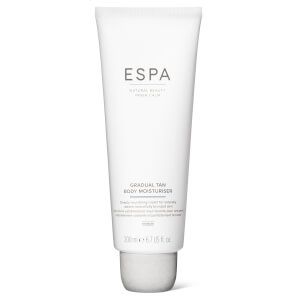
ESPA Gradual Tan Body Moisturiser

ESPA Gradual Tan Body Moisturiser

Efficacy75/100IrritancyHigh
Edit

Works for

1 of 1 advertised claim delivered

Moisturizing
Butyrospermum parkii butter, Glycerin + 9 more
Good evidence
What the product description says
“Gradual Tan Body Moisturiser”
Source: Beauty Expert

This product can help improve hydration of the skin with the two types of ingredients.

The first type is called “humectants”:
these ingredients help attract water. When humectants are on the surface of the skin, they “pull in” the moisture from the outside environment, or from within deeper layers of the skin. The following ingredients in this product do the job: glycerin.

This product also contains ingredients called “occlusives”. They help reduce the speed with which our skin loses moisture to the outside environment. These ingredients also help soften the upper layer of the skin, so it feels less tight and nicer to the touch. The following ingredients in this product do the job: butyrospermum parkii butter, caprylic/capric triglyceride.

Butyrospermum parkii butterKey active· Emollient, OcclusiveEffect: HighA great moisturising ingredient that softens the skin and reduces water loss from its upper layer. It also can be helpful in protecting skin from free radicals~1.5–1.8%
GlycerinKey active· HumectantEffect: HighOne of the best moisturizing ingredients. Naturally present in skin. It attracts water to the upper layer of the skin working as a humectant~1.7–2.1%
Caprylic/capric triglycerideKey active· Emollient, OcclusiveEffect: HighA good mix of fatty acids that forms a protective layer on the skin. Improves the shelf life of products. Derived from coconut and glycerin~4.3–5.2%
Glyceryl stearate seKey activeEffect: MediumUsed to stabilize the product formulations and works as an emollient~0.7–1%
Cetearyl alcoholKey active· EmollientEffect: MediumA non-drying alcohol. Works as an emollient. Helps water and oil mix together and creates a nice product texture~2–2.4%
Prunus amygdalus dulcis oilKey active· EmollientEffect: MediumAn emollient that softens the skin~2.4–2.9%
Isopropyl palmitate· EmollientEffect: LowHelps soften the upper layer of the skin and create a thicker product consistency~4.4–5.3%
Palmitic acid· EmollientEffect: LowAn emollient that is naturally present in skin and helps soften it~0.5–0.75%
C12-16 alcohols· EmollientEffect: LowHelps soften the upper layer of the skin and improve the product's texture~1.2–1.5%
LecithinEffect: Low, below effective doseUsed mostly for creating emulsions - helping oil and water mix together. Helps soften the upper layer of the skin~0.45–0.7%
TocopherolEffect: Low, below effective dosePure form of vitamin E. Can help moisturise and protect the skin from free radicals. Often used to help stabilise other ingredients or the formula itself~0.1–0.15%

Can it cause trouble?

Irritancy
24 strong irritants: Aniba rosodora wood oil, Linalool + 22 more — patch-test recommended
High risk
We flagged 33 ingredients with irritancy potential. Severity depends on your sensitivity threshold; the table lists the worst offenders first.
IngredientFunctionIrritationEst. amount
DihydroxyacetoneA self-tanning agentHigh~3.1–3.8%est.
Aniba rosodora wood oilA fragrant plant oil. Can be irritatingHigh~0.3–0.6%est.
LinaloolA fragrance. Can be irritatingHigh~0.25–0.5%est.
Cananga odorata flower oilAn essential oil. Can be irritatingHigh~0.25–0.45%est.
Citrus aurantium bergamia fruit oilA plant oil with a high content of volatile compounds that can irritate the skin and lead to allergic reactions. Can lead to photosensitivityHigh~0.25–0.45%est.
Lavandula angustifolia oilAn essential oil. Potential allergen and can be irritating. It has some anti-bacterial propertiesHigh~0.25–0.45%est.
LimoneneA common frangrance that can easily irritate skin, especially if exposed to air, light or heatHigh~0.2–0.4%est.
Citrus nobilis peel oilA plant oil with high content of volatile compounds that, especially when exposed to air, can cause allergic reactions and irritate the skinHigh~0.2–0.4%est.
Coriandrum sativum fruit oilA plant oil that is used as a fragrance. Can be irritatingHigh~0.2–0.4%est.
Eugenia caryophyllus bud oilUsed as a fragrance. Can be irritatingHigh~0.2–0.4%est.
Pelargonium graveolens oilUsed as a fragrance. Can be irritatingHigh~0.25–0.45%est.
Pogostemon cablin leaf oilUsed as a fragranceHigh~0.25–0.45%est.
EugenolA fragrance. Is a likely irritantHigh~0.2–0.4%est.
Acacia decurrens flower extractA plant extract that might have some anti-oxidant benefits but research on effectiveness in skin is lackingHigh~0.2–0.4%est.
Jasminum officinale flower extractFragrance. Can be irritatingHigh~0.2–0.4%est.
Salvia sclarea oil—High~0.25–0.4%est.
GeraniolA fragrance. Can be irritatingHigh~0.2–0.4%est.
CitronellolA fragrance. Can be irritatingHigh~0.2–0.4%est.
Benzyl benzoateFragrance with sweet balsamic smell. Help to preserve products and dissolve other ingredients. Could trigger allergic reactions and be irritatingHigh~0.2–0.35%est.
Citrus aurantifolia oil—High~0.25–0.45%est.
Rosa damascena flower extractUsed as a fragrance. Can be irritatingHigh~0.2–0.35%est.
Santalum album oilUsed as a fragrance. Can be irritatingHigh~0.15–0.3%est.
Zingiber officinale root oilAn essential oil that is likely to be irritating and can cause photosensitivityHigh~0.1–0.2%est.
Benzyl salicylateA fragrance. Is a likely irritantHigh~0.15–0.25%est.
FarnesolAdded to create a nice product smell. Can be irritatingHigh~0.1–0.2%est.
CitralA fragrance with a lemon scent. A likely irritantHigh~0.05–0.1%est.
Isopropyl palmitateHelps soften the upper layer of the skin and create a thicker product consistencyMedium~4.4–5.3%est.
Caprylic/capric triglycerideA good mix of fatty acids that forms a protective layer on the skin. Improves the shelf life of products. Derived from coconut and glycerinMedium~4.3–5.2%est.
C12-16 alcoholsHelps soften the upper layer of the skin and improve the product's textureMedium~1.2–1.5%est.
Benzoic acidA preservativeMedium~0.25–0.5%est.
Dehydroacetic acidA preservativeMedium~0.25–0.45%est.
Phytic acidAn alpha-hydroxy acid (AHA), but is mostly used to stabilize product formulations in cosmeticsMedium~0.25–0.45%est.
EthylhexylglycerinA preservativeMedium~0.25–0.45%est.
Comedogenic
4 ingredients rated 2 or more on the 0–5 pore-clogging scale
4 flagged
These ingredients have a comedogenic rating of 2 or more on a 0–5 scale; the table shows each one's rating. In leave-on products they can clog pores in acne-prone skin.
IngredientFunctionRatingEst. amount
Isopropyl palmitateHelps soften the upper layer of the skin and create a thicker product consistency3/5~4.4–5.3%est.
Butyrospermum parkii butterA great moisturising ingredient that softens the skin and reduces water loss from its upper layer. It also can be helpful in protecting skin from free radicals3/5~1.5–1.8%est.
Cetearyl alcoholA non-drying alcohol. Works as an emollient. Helps water and oil mix together and creates a nice product texture2/5~2–2.4%est.
Glyceryl stearate seUsed to stabilize the product formulations and works as an emollient2/5~0.7–1%est.
Edit

User reviews

Would you recommend?
No community reviews yet.

Be the first — your take helps the next person decide.

Write a review · ~30s

Ingredients

Filter by role to see what each ingredient is doing.

Water~45–55%
Formula
Irritation risk
Low

Plain old water

More about Water
Isopropyl palmitate~4.4–5.3%
Comedogenic 3/5Irritant · medium
Irritation risk
Medium
Comedogenicity
3/5
Works for
Moisturizing

Helps soften the upper layer of the skin and create a thicker product consistency

More about Isopropyl palmitate
Caprylic/capric triglyceride~4.3–5.2%
Key activeIrritant · medium
Irritation risk
Medium
Works for
Moisturizing

A good mix of fatty acids that forms a protective layer on the skin. Improves the shelf life of products. Derived from coconut and glycerin

More about Caprylic/capric triglyceride
Dihydroxyacetone~3.1–3.8%
Irritant · high
Irritation risk
High
Works for
Tanning

A self-tanning agent

More about Dihydroxyacetone
Prunus amygdalus dulcis oil~2.4–2.9%
Key active
Irritation risk
Low
Works for
MoisturizingAnti-oxidationAnti-aging

An emollient that softens the skin

More about Prunus amygdalus dulcis oil
Cetearyl alcohol~2–2.4%
Key activeComedogenic 2/5
Irritation risk
Low
Comedogenicity
2/5
Works for
CleansingMoisturizing

A non-drying alcohol. Works as an emollient. Helps water and oil mix together and creates a nice product texture

More about Cetearyl alcohol
Glycerin~1.7–2.1%
Key active
Irritation risk
Low
Works for
Moisturizing

One of the best moisturizing ingredients. Naturally present in skin. It attracts water to the upper layer of the skin working as a humectant

More about Glycerin
Butyrospermum parkii butter~1.5–1.8%
Key activeComedogenic 3/5
Irritation risk
Low
Comedogenicity
3/5
Works for
MoisturizingAnti-oxidationAnti-aging

A great moisturising ingredient that softens the skin and reduces water loss from its upper layer. It also can be helpful in protecting skin from free radicals

More about Butyrospermum parkii butter
C12-16 alcohols~1.2–1.5%
Irritant · medium
Irritation risk
Medium
Works for
Moisturizing

Helps soften the upper layer of the skin and improve the product's texture

More about C12-16 alcohols
Phenoxyethanol~0.5–1%
Formula
Irritation risk
Low

A preservative. It helps prevent bacterial growth in cosmetic products

More about Phenoxyethanol
Glyceryl stearate se~0.7–1%
Key activeComedogenic 2/5
Irritation risk
Low
Comedogenicity
2/5
Works for
CleansingMoisturizing

Used to stabilize the product formulations and works as an emollient

More about Glyceryl stearate se
Sucrose cocoate~0.55–0.85%
Formula
Irritation risk
Low
Works for
Cleansing
More about Sucrose cocoate
Xanthan gum~0.5–0.75%
Formula
Irritation risk
Low
Works for
Cleansing

Used to create a thicker product consistency

More about Xanthan gum
Palmitic acid~0.5–0.75%
Formula
Irritation risk
Low
Works for
CleansingMoisturizing

An emollient that is naturally present in skin and helps soften it

More about Palmitic acid
Lecithin~0.45–0.7%
Formula
Irritation risk
Low
Works for
CleansingMoisturizing

Used mostly for creating emulsions - helping oil and water mix together. Helps soften the upper layer of the skin

More about Lecithin
Melanin~0.4–0.65%
Formula
Irritation risk
Low
More about Melanin
Sclerotium gum~0.35–0.65%
Formula
Irritation risk
Low

Used to create gel-like formulas and stabilize emulsions

More about Sclerotium gum
Aniba rosodora wood oil~0.3–0.6%
Irritant · high
Irritation risk
High

A fragrant plant oil. Can be irritating

More about Aniba rosodora wood oil
Benzoic acid~0.25–0.5%
Irritant · medium
Irritation risk
Medium

A preservative

More about Benzoic acid
Linalool~0.25–0.5%
Irritant · high
Irritation risk
High

A fragrance. Can be irritating

More about Linalool
Cananga odorata flower oil~0.25–0.45%
Irritant · high
Irritation risk
High

An essential oil. Can be irritating

More about Cananga odorata flower oil
Citrus aurantium bergamia fruit oil~0.25–0.45%
Irritant · high
Irritation risk
High

A plant oil with a high content of volatile compounds that can irritate the skin and lead to allergic reactions. Can lead to photosensitivity

More about Citrus aurantium bergamia fruit oil
Lavandula angustifolia oil~0.25–0.45%
Irritant · high
Irritation risk
High

An essential oil. Potential allergen and can be irritating. It has some anti-bacterial properties

More about Lavandula angustifolia oil
Dehydroacetic acid~0.25–0.45%
Irritant · medium
Irritation risk
Medium

A preservative

More about Dehydroacetic acid
Limonene~0.2–0.4%
Irritant · high
Irritation risk
High

A common frangrance that can easily irritate skin, especially if exposed to air, light or heat

More about Limonene
Phytic acid~0.25–0.45%
Irritant · medium
Irritation risk
Medium

An alpha-hydroxy acid (AHA), but is mostly used to stabilize product formulations in cosmetics

More about Phytic acid
Citrus nobilis peel oil~0.2–0.4%
Irritant · high
Irritation risk
High

A plant oil with high content of volatile compounds that, especially when exposed to air, can cause allergic reactions and irritate the skin

More about Citrus nobilis peel oil
Coriandrum sativum fruit oil~0.2–0.4%
Irritant · high
Irritation risk
High

A plant oil that is used as a fragrance. Can be irritating

More about Coriandrum sativum fruit oil
Eugenia caryophyllus bud oil~0.2–0.4%
Irritant · high
Irritation risk
High

Used as a fragrance. Can be irritating

More about Eugenia caryophyllus bud oil
Pelargonium graveolens oil~0.25–0.45%
Irritant · high
Irritation risk
High

Used as a fragrance. Can be irritating

More about Pelargonium graveolens oil
Pogostemon cablin leaf oil~0.25–0.45%
Irritant · high
Irritation risk
High

Used as a fragrance

More about Pogostemon cablin leaf oil
Eugenol~0.2–0.4%
Irritant · high
Irritation risk
High

A fragrance. Is a likely irritant

More about Eugenol
Sodium hydroxide~0.25–0.45%
Formula
Irritation risk
Low

Used to adjust the product's pH

More about Sodium hydroxide
Ethylhexylglycerin~0.25–0.45%
Irritant · medium
Irritation risk
Medium

A preservative

More about Ethylhexylglycerin
Acacia decurrens flower extract~0.2–0.4%
Irritant · high
Irritation risk
High
Works for
Anti-oxidation

A plant extract that might have some anti-oxidant benefits but research on effectiveness in skin is lacking

More about Acacia decurrens flower extract
Jasminum officinale flower extract~0.2–0.4%
Irritant · high
Irritation risk
High

Fragrance. Can be irritating

More about Jasminum officinale flower extract
Salvia sclarea oil~0.25–0.4%
Irritant · high
Geraniol~0.2–0.4%
Irritant · high
Irritation risk
High

A fragrance. Can be irritating

More about Geraniol
Citronellol~0.2–0.4%
Irritant · high
Irritation risk
High

A fragrance. Can be irritating

More about Citronellol
Benzyl benzoate~0.2–0.35%
Irritant · high
Irritation risk
High

Fragrance with sweet balsamic smell. Help to preserve products and dissolve other ingredients. Could trigger allergic reactions and be irritating

More about Benzyl benzoate
Cistus ladaniferus resin~0.2–0.4%
Formula
Citrus aurantifolia oil~0.25–0.45%
Irritant · high
Ferula galbaniflua resin oil~0.15–0.3%
Formula
Illicium verum fruit/seed oil~0.2–0.4%
Formula
Opoponax oil~0.2–0.35%
Formula
Irritation risk
Low
More about Opoponax oil
Rosa damascena flower extract~0.2–0.35%
Irritant · high
Irritation risk
High

Used as a fragrance. Can be irritating

More about Rosa damascena flower extract
Santalum album oil~0.15–0.3%
Irritant · high
Irritation risk
High

Used as a fragrance. Can be irritating

More about Santalum album oil
Zingiber officinale root oil~0.1–0.2%
Irritant · high
Irritation risk
High

An essential oil that is likely to be irritating and can cause photosensitivity

More about Zingiber officinale root oil
Benzyl salicylate~0.15–0.25%
Irritant · high
Irritation risk
High

A fragrance. Is a likely irritant

More about Benzyl salicylate
Farnesol~0.1–0.2%
Irritant · high
Irritation risk
High

Added to create a nice product smell. Can be irritating

More about Farnesol
Tocopherol~0.1–0.15%
Formula
Irritation risk
Low
Works for
Anti-oxidationMoisturizingAnti-inflammatoryAnti-aging

Pure form of vitamin E. Can help moisturise and protect the skin from free radicals. Often used to help stabilise other ingredients or the formula itself

More about Tocopherol
Citral~0.05–0.1%
Irritant · high
Irritation risk
High

A fragrance with a lemon scent. A likely irritant

More about Citral
Ingredient list view

Water, Isopropyl palmitate, Caprylic/capric triglyceride, Dihydroxyacetone, Prunus amygdalus dulcis oil, Cetearyl alcohol, Glycerin, Butyrospermum parkii butter, C12-16 alcohols, Phenoxyethanol, Glyceryl stearate se, Sucrose cocoate, Xanthan gum, Palmitic acid, Lecithin, Melanin, Sclerotium gum, Aniba rosodora wood oil, Benzoic acid, Linalool, Cananga odorata flower oil, Citrus aurantium bergamia fruit oil, Lavandula angustifolia oil, Dehydroacetic acid, Limonene, Phytic acid, Citrus nobilis peel oil, Coriandrum sativum fruit oil, Eugenia caryophyllus bud oil, Pelargonium graveolens oil, Pogostemon cablin leaf oil, Eugenol, Sodium hydroxide, Ethylhexylglycerin, Acacia decurrens flower extract, Jasminum officinale flower extract, Salvia sclarea oil, Geraniol, Citronellol, Benzyl benzoate, Cistus ladaniferus resin, Citrus aurantifolia oil, Ferula galbaniflua resin oil, Illicium verum fruit/seed oil, Opoponax oil, Rosa damascena flower extract, Santalum album oil, Zingiber officinale root oil, Benzyl salicylate, Farnesol, Tocopherol, Citral

Compare prices

Retailers ranked by price — lowest first.

Espa
$79.00
Buy

Affiliate links · prices updated regularly

Cheaper alternatives? See how this stacks up against similar formulas.
We compare ingredient profiles across our catalog — pick the closest match for your budget.
Open dupe finder

Sources cited in this review

Every concentration estimate and effectiveness label is anchored to one of these 16 studies and safety reviews.

  1. 1
  2. 2
  3. 3
  4. 4
  5. 5
  6. 6
ESPA Gradual Tan Body Moisturiser
ESPAGradual Tan Body Moisturiser

Affiliate links · As an Amazon Associate, WIMJ earns from qualifying purchases.

As an Amazon Associate, WIMJ earns from qualifying purchases.