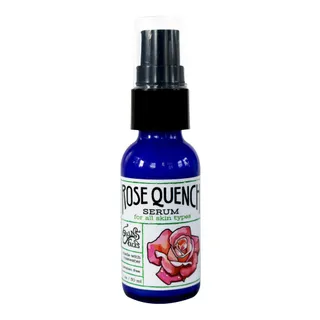
erinsfaces Rose Quench Serum

erinsfaces Rose Quench Serum

Efficacy75/100IrritancyHigh

Works for

Moisturizing
Cetyl alcohol, Glycerin + 12 more
Works
What the product description says
“Our Rose Quench Serum is super lightweight and packs a hydrating punch with essential nutrients that fight against the march of time.”
Source: Erin's faces

This product can help improve hydration of the skin with the two types of ingredients.

The first type is called “humectants”:
these ingredients help attract water. When humectants are on the surface of the skin, they “pull in” the moisture from the outside environment, or from within deeper layers of the skin. The following ingredients in this product do the job: glycerin, hyaluronic acid.

This product also contains ingredients called “occlusives”. They help reduce the speed with which our skin loses moisture to the outside environment. These ingredients also help soften the upper layer of the skin, so it feels less tight and nicer to the touch. The following ingredients in this product do the job: helianthus annuus seed oil, ricinus communis seed oil.

Cetyl alcoholKey active· EmollientEffect: MediumA non-drying alcohol that works to soften the skin and stabilize product formulations helping oil and water mix together~3.3–5%
GlycerinKey active· HumectantEffect: HighOne of the best moisturizing ingredients. Naturally present in skin. It attracts water to the upper layer of the skin working as a humectant~1.9–2.8%
Limnanthes alba seed oilKey active· EmollientEffect: HighThis oil's cmposition is closest to rapeseed oil. It is a very stable oil and serves as an emoillient~1.2–1.8%
Helianthus annuus seed oilKey active· Emollient, OcclusiveEffect: HighA great emollient due to its high linoleic acid content. One of the most effective plant oils in helping skin hydration and repairing skin barrier function~0.8–1.2%
Hyaluronic acidKey active· HumectantEffect: HighOne of the best moisturizing ingredients. Attracts water into the upper layer of the skin. Naturally present in skin. Typically has large molecule size unless advertised otherwise on the product label. Helps support skin's barrier function and may help to reduce inflammation~0.3–0.7%
UbiquinoneKey activeEffect: HighCoenzyme Q10. It helps neutralize free radicals in skin, improves skin hydration and might be helpful agains fine lines and wrinkles. It can be an allergen~0.2–0.7%
Ricinus communis seed oilKey active· Emollient, OcclusiveEffect: HighA plant oil that can help soften the skin. It might be helpful in calming down inflammation, but solid research is lacking. Is often used in lip products to create the needed product consistency~0.1–0.45%
Saccharum officinarum extractKey activeEffect: HighSugar extract that helps attract water to the upper layer of the skin~0.1–0.45%
Rosa damascena flower water· HumectantEffect: LowUsed to add a nice rose smell to the product. Might help attract water to the upper layer of the skin and have some anti-oxidant effect. Can be irritating~24–37%
Aloe barbadensis leaf juice· HumectantEffect: LowTraditionally used to treat sunburns, dermatitis and inflammation, but evidence for its effectiveness is lacking. The extract can contain humectants that help attract water into the skin~6.3–9.5%
TocopherolEffect: Low, below effective dosePure form of vitamin E. Can help moisturise and protect the skin from free radicals. Often used to help stabilise other ingredients or the formula itself~0.8–1.25%
LecithinEffect: Low, below effective doseUsed mostly for creating emulsions - helping oil and water mix together. Helps soften the upper layer of the skin~0.1–0.5%
PanthenolUnder-dosedHelps attract water to the upper layer of the skin and can help improve skin barrier function~0.15–0.5%
NiacinamideUnder-dosedIs proven to be effective in reducing blemishes, evening out skin tone and helping to improve lines and wrinkles. It helps the skin to repair sun damage, calm down inflammation and keep maintain good levels of moisture. The concentration of about 2% is effective for supporting the skin barrier and evening out the skin tone. Concentration of 4-6% is better for helping with acne and balancing the sebum production~0.15–0.5%
Anti-oxidation
Not advertised by the brand · Ubiquinone, Thioctic acid + 8 more
Works well

This product contains antioxidants (thioctic acid, ubiquinone) that can help neutralize free radicals in skin. By doing so, they can lessen the damage the skin gets from the UV light (sun).

UbiquinoneKey activeEffect: HighCoenzyme Q10. It helps neutralize free radicals in skin, improves skin hydration and might be helpful agains fine lines and wrinkles. It can be an allergen~0.2–0.7%
Thioctic acidKey activeEffect: High~0.15–0.6%
Rosa damascena flower waterEffect: LowUsed to add a nice rose smell to the product. Might help attract water to the upper layer of the skin and have some anti-oxidant effect. Can be irritating~24–37%
Limnanthes alba seed oilEffect: LowThis oil's cmposition is closest to rapeseed oil. It is a very stable oil and serves as an emoillient~1.2–1.8%
Daucus carota sativa seed oilEffect: LowA plant oil that might help neutralize free radicals and have an anti-bacterial effect~0.4–0.95%
UbidecarenoneEffect: LowA less bioavailable form of coQ10 (compared to ubiquinone)~0.3–0.75%
Vaccinium myrtillus fruit extractEffect: LowA plant extract that might help neutralize free radicals in skin, but research on its efficacy in skin is lacking~0.1–0.5%
Vaccinium macrocarpon fruit extractEffect: LowA berry extract. Might have some anti-oxidant properties~0.1–0.4%
Magnesium ascorbyl phosphateEffect: Low, below effective doseA derivative of vitamin C that is more stable, but less bioavailable than the pure form of vitamin C. It does not penetrate the skin well, but has been shown to convert to pure vitamin C once in skin. It can be helpful in stimulating collagen production and lightening the skin tone, but the required concentration is likely to be very high~0.45–1%
TocopherolUnder-dosedPure form of vitamin E. Can help moisturise and protect the skin from free radicals. Often used to help stabilise other ingredients or the formula itself~0.8–1.25%
Anti-aging
Not advertised by the brand · Aloe barbadensis leaf juice, Limnanthes alba seed oil + 7 more
May help

This product contains thioctic acid, ubiquinone. These ingredients help neutralize free radicals in skin. By doing so, they might be able to prevent early signs of aging (like fine lines and wrinkles), at least to some extent. These ingredients will not be able to "reverse" signs of aging.

Aloe barbadensis leaf juiceEffect: LowTraditionally used to treat sunburns, dermatitis and inflammation, but evidence for its effectiveness is lacking. The extract can contain humectants that help attract water into the skin~6.3–9.5%
Limnanthes alba seed oilEffect: LowThis oil's cmposition is closest to rapeseed oil. It is a very stable oil and serves as an emoillient~1.2–1.8%
Hyaluronic acidEffect: LowOne of the best moisturizing ingredients. Attracts water into the upper layer of the skin. Naturally present in skin. Typically has large molecule size unless advertised otherwise on the product label. Helps support skin's barrier function and may help to reduce inflammation~0.3–0.7%
UbiquinoneEffect: LowCoenzyme Q10. It helps neutralize free radicals in skin, improves skin hydration and might be helpful agains fine lines and wrinkles. It can be an allergen~0.2–0.7%
Thioctic acidEffect: Low~0.15–0.6%
TocopherolEffect: Low, below effective dosePure form of vitamin E. Can help moisturise and protect the skin from free radicals. Often used to help stabilise other ingredients or the formula itself~0.8–1.25%
Magnesium ascorbyl phosphateEffect: Low, below effective doseA derivative of vitamin C that is more stable, but less bioavailable than the pure form of vitamin C. It does not penetrate the skin well, but has been shown to convert to pure vitamin C once in skin. It can be helpful in stimulating collagen production and lightening the skin tone, but the required concentration is likely to be very high~0.45–1%
NiacinamideUnder-dosedIs proven to be effective in reducing blemishes, evening out skin tone and helping to improve lines and wrinkles. It helps the skin to repair sun damage, calm down inflammation and keep maintain good levels of moisture. The concentration of about 2% is effective for supporting the skin barrier and evening out the skin tone. Concentration of 4-6% is better for helping with acne and balancing the sebum production~0.15–0.5%
Retinyl palmitateUnder-dosedThree steps removed from the active form of vitamin A - retinoic acid. To have an effect in the skin, it first needs to be converted twice to become the retinoic acid. This means it is less potent than retinol, but could also be less irritating. Once converted to the retinoic acid in the skin, it helps against all signs of aging, improves skin cell turnover and helps fight blemishes and clogged pores. However, in many cosmetic formulations, it is used in a concentration that is too low to have the full effect~0.15–0.6%

Can it cause trouble?

Irritancy
13 flagged ingredients — patch-test recommended
High risk
We flagged 13 ingredients with irritancy potential. Severity depends on your sensitivity threshold; the table lists the worst offenders first.
IngredientFunctionIrritationEst. amount
Rosa damascena flower waterUsed to add a nice rose smell to the product. Might help attract water to the upper layer of the skin and have some anti-oxidant effect. Can be irritatingHigh~24–37%est.
Retinyl palmitateThree steps removed from the active form of vitamin A - retinoic acid. To have an effect in the skin, it first needs to be converted twice to become the retinoic acid. This means it is less potent than retinol, but could also be less irritating. Once converted to the retinoic acid in the skin, it helps against all signs of aging, improves skin cell turnover and helps fight blemishes and clogged pores. However, in many cosmetic formulations, it is used in a concentration that is too low to have the full effectHigh~0.15–0.6%est.
Citrus aurantium dulcis peel extractUsed as a fragranceHigh~0.1–0.4%est.
Citrus limon fruit extractUsed as a fragrance. Can be irritating and cause photosensitivityHigh~0.1–0.5%est.
Vaccinium macrocarpon fruit extractA berry extract. Might have some anti-oxidant propertiesHigh~0.1–0.4%est.
AlcoholCan be drying and contribute to skin irritation. Used in formulars to dissolve other ingredients, create a thinner product consistency or for its antibacterial propertiesHigh~0.1–0.35%est.
Aloe barbadensis leaf juiceTraditionally used to treat sunburns, dermatitis and inflammation, but evidence for its effectiveness is lacking. The extract can contain humectants that help attract water into the skinMedium~6.3–9.5%est.
Polysorbate 60Helps oil and water mix togetherMedium~2.3–3.5%est.
Magnesium ascorbyl phosphateA derivative of vitamin C that is more stable, but less bioavailable than the pure form of vitamin C. It does not penetrate the skin well, but has been shown to convert to pure vitamin C once in skin. It can be helpful in stimulating collagen production and lightening the skin tone, but the required concentration is likely to be very highMedium~0.45–1%est.
UbidecarenoneA less bioavailable form of coQ10 (compared to ubiquinone)Medium~0.3–0.75%est.
Vaccinium myrtillus fruit extractA plant extract that might help neutralize free radicals in skin, but research on its efficacy in skin is lackingMedium~0.1–0.5%est.
Acer saccharum extractA plant extract that contains small percentage of AHAs. Is unlikely to have any skin benefit due the small concentration of the active compoundsMedium~0.1–0.5%est.
Ricinus communis seed oilA plant oil that can help soften the skin. It might be helpful in calming down inflammation, but solid research is lacking. Is often used in lip products to create the needed product consistencyMedium~0.1–0.45%est.
Comedogenic
Clean of flagged comedogenic ingredients
None flagged

User reviews

Would you recommend?
No community reviews yet.

Be the first — your take helps the next person decide.

Ingredients

Filter by role to see what each ingredient is doing.

Rosa damascena flower water~24–37%
Irritant · high
Irritation risk
High
Works for
MoisturizingAnti-oxidation

Used to add a nice rose smell to the product. Might help attract water to the upper layer of the skin and have some anti-oxidant effect. Can be irritating

More about Rosa damascena flower water
Aloe barbadensis leaf juice~6.3–9.5%
Irritant · medium
Irritation risk
Medium
Works for
MoisturizingReduces irritationAnti-inflammatoryReduces rednessAntibacterialAnti-agingAnti-blemish

Traditionally used to treat sunburns, dermatitis and inflammation, but evidence for its effectiveness is lacking. The extract can contain humectants that help attract water into the skin

More about Aloe barbadensis leaf juice
Cetyl alcohol~3.3–5%
Key active
Irritation risk
Low
Works for
CleansingMoisturizing

A non-drying alcohol that works to soften the skin and stabilize product formulations helping oil and water mix together

More about Cetyl alcohol
Stearyl alcohol~3–4.5%
Formula
Irritation risk
Low
Works for
Cleansing

An emollient that helps soften the skin

More about Stearyl alcohol
Polysorbate 60~2.3–3.5%
Irritant · medium
Irritation risk
Medium
Works for
Cleansing

Helps oil and water mix together

More about Polysorbate 60
Glycerin~1.9–2.8%
Key active
Irritation risk
Low
Works for
Moisturizing

One of the best moisturizing ingredients. Naturally present in skin. It attracts water to the upper layer of the skin working as a humectant

More about Glycerin
Dimethylaminoethanol tartrate~1.5–2.2%
Formula
Limnanthes alba seed oil~1.2–1.8%
Key active
Irritation risk
Low
Works for
MoisturizingAnti-oxidationAnti-aging

This oil's cmposition is closest to rapeseed oil. It is a very stable oil and serves as an emoillient

More about Limnanthes alba seed oil
Tocopherol~0.8–1.25%
Under-dosed
Irritation risk
Low
Works for
Anti-oxidationMoisturizingAnti-inflammatoryAnti-aging

Pure form of vitamin E. Can help moisturise and protect the skin from free radicals. Often used to help stabilise other ingredients or the formula itself

More about Tocopherol
Helianthus annuus seed oil~0.8–1.2%
Key active
Irritation risk
Low
Works for
Moisturizing

A great emollient due to its high linoleic acid content. One of the most effective plant oils in helping skin hydration and repairing skin barrier function

More about Helianthus annuus seed oil
Magnesium ascorbyl phosphate~0.45–1%
Irritant · medium
Irritation risk
Medium
Works for
Evens skin toneAnti-agingAnti-oxidation

A derivative of vitamin C that is more stable, but less bioavailable than the pure form of vitamin C. It does not penetrate the skin well, but has been shown to convert to pure vitamin C once in skin. It can be helpful in stimulating collagen production and lightening the skin tone, but the required concentration is likely to be very high

More about Magnesium ascorbyl phosphate
Daucus carota sativa seed oil~0.4–0.95%
Formula
Irritation risk
Low
Works for
Anti-oxidationAntibacterial

A plant oil that might help neutralize free radicals and have an anti-bacterial effect

More about Daucus carota sativa seed oil
Hyaluronic acid~0.3–0.7%
Key active
Irritation risk
Low
Works for
MoisturizingAnti-inflammatoryAnti-aging

One of the best moisturizing ingredients. Attracts water into the upper layer of the skin. Naturally present in skin. Typically has large molecule size unless advertised otherwise on the product label. Helps support skin's barrier function and may help to reduce inflammation

More about Hyaluronic acid
Ubidecarenone~0.3–0.75%
Irritant · medium
Irritation risk
Medium
Works for
Anti-oxidation

A less bioavailable form of coQ10 (compared to ubiquinone)

More about Ubidecarenone
Ubiquinone~0.2–0.7%
Key active
Irritation risk
Low
Works for
Anti-oxidationMoisturizingAnti-aging

Coenzyme Q10. It helps neutralize free radicals in skin, improves skin hydration and might be helpful agains fine lines and wrinkles. It can be an allergen

More about Ubiquinone
Beta-carotene~0.15–0.7%
Formula
Irritation risk
Low

A colorant adding orange or bright yellow color

More about Beta-carotene
Retinyl palmitate~0.15–0.6%
Under-dosedIrritant · high
Irritation risk
High
Works for
Evens skin toneAnti-agingAnti-blemishExfoliation

Three steps removed from the active form of vitamin A - retinoic acid. To have an effect in the skin, it first needs to be converted twice to become the retinoic acid. This means it is less potent than retinol, but could also be less irritating. Once converted to the retinoic acid in the skin, it helps against all signs of aging, improves skin cell turnover and helps fight blemishes and clogged pores. However, in many cosmetic formulations, it is used in a concentration that is too low to have the full effect

More about Retinyl palmitate
Thioctic acid~0.15–0.6%
Key active
Irritation risk
Low
Works for
Anti-oxidationAnti-aging
More about Thioctic acid
Panthenol~0.15–0.5%
Under-dosed
Irritation risk
Low
Works for
MoisturizingReduces rednessReduces irritation

Helps attract water to the upper layer of the skin and can help improve skin barrier function

More about Panthenol
Niacinamide~0.15–0.5%
Under-dosed
Irritation risk
Low
Works for
Anti-agingEvens skin toneMoisturizingAnti-blemishReduces irritationAntibacterialReduces rednessAnti-inflammatory

Is proven to be effective in reducing blemishes, evening out skin tone and helping to improve lines and wrinkles. It helps the skin to repair sun damage, calm down inflammation and keep maintain good levels of moisture. The concentration of about 2% is effective for supporting the skin barrier and evening out the skin tone. Concentration of 4-6% is better for helping with acne and balancing the sebum production

More about Niacinamide
Saccharum officinarum extract~0.1–0.45%
Key active
Irritation risk
Low
Works for
Moisturizing

Sugar extract that helps attract water to the upper layer of the skin

More about Saccharum officinarum extract
Vaccinium myrtillus fruit extract~0.1–0.5%
Irritant · medium
Irritation risk
Medium
Works for
Anti-oxidation

A plant extract that might help neutralize free radicals in skin, but research on its efficacy in skin is lacking

More about Vaccinium myrtillus fruit extract
Acer saccharum extract~0.1–0.5%
Irritant · medium
Irritation risk
Medium

A plant extract that contains small percentage of AHAs. Is unlikely to have any skin benefit due the small concentration of the active compounds

More about Acer saccharum extract
Citrus sinensis
Not recognized
Citrus aurantium dulcis peel extract~0.1–0.4%
Irritant · high
Irritation risk
High

Used as a fragrance

More about Citrus aurantium dulcis peel extract
Citrus limon fruit extract~0.1–0.5%
Irritant · high
Irritation risk
High

Used as a fragrance. Can be irritating and cause photosensitivity

More about Citrus limon fruit extract
Vaccinium macrocarpon fruit extract~0.1–0.4%
Irritant · high
Irritation risk
High
Works for
Anti-oxidation

A berry extract. Might have some anti-oxidant properties

More about Vaccinium macrocarpon fruit extract
Alcohol~0.1–0.35%
Irritant · high
Irritation risk
High
Works for
Antibacterial

Can be drying and contribute to skin irritation. Used in formulars to dissolve other ingredients, create a thinner product consistency or for its antibacterial properties

More about Alcohol
Ricinus communis seed oil~0.1–0.45%
Key activeIrritant · medium
Irritation risk
Medium
Works for
MoisturizingAnti-inflammatory

A plant oil that can help soften the skin. It might be helpful in calming down inflammation, but solid research is lacking. Is often used in lip products to create the needed product consistency

More about Ricinus communis seed oil
Lecithin~0.1–0.5%
Formula
Irritation risk
Low
Works for
CleansingMoisturizing

Used mostly for creating emulsions - helping oil and water mix together. Helps soften the upper layer of the skin

More about Lecithin
Xanthan gum~0.05–0.2%
Formula
Irritation risk
Low
Works for
Cleansing

Used to create a thicker product consistency

More about Xanthan gum
Phenoxyethanol~0.05–0.2%
Formula
Irritation risk
Low

A preservative. It helps prevent bacterial growth in cosmetic products

More about Phenoxyethanol
Tetrasodium glutamate diacetate~0.01–0.05%
Formula
Irritation risk
Low

Helps stabilize the product formulation

More about Tetrasodium glutamate diacetate
Ingredient list view

Rosa damascena flower water, Aloe barbadensis leaf juice, Cetyl alcohol, Stearyl alcohol, Polysorbate 60, Glycerin, Dimethylaminoethanol tartrate, Limnanthes alba seed oil, Tocopherol, Helianthus annuus seed oil, Magnesium ascorbyl phosphate, Daucus carota sativa seed oil, Hyaluronic acid, Ubidecarenone, Ubiquinone, Beta-carotene, Retinyl palmitate, Thioctic acid, Panthenol, Niacinamide, Saccharum officinarum extract, Vaccinium myrtillus fruit extract, Acer saccharum extract, Unknown, Citrus aurantium dulcis peel extract, Citrus limon fruit extract, Vaccinium macrocarpon fruit extract, Alcohol, Ricinus communis seed oil, Lecithin, Xanthan gum, Phenoxyethanol, Tetrasodium glutamate diacetate

Compare prices

Retailers ranked by price — lowest first.

Erin's faces
$68.00
Buy

Affiliate links · As an Amazon Associate, WIMJ earns from qualifying purchases.

Worth comparing, line by line.

Match % combines shared ingredients, the first five ingredients, shared actives and hero ingredients, irritancy (lower counts in the alternative's favour), texture and body area. Only products in the same routine step are compared.

Side-by-side comparison of this product against its closest alternatives
erinsfacesRose Quench SerumYOUR PRODUCTHoliFrogGalilee Antioxidant Dewy Drop SerumAustralian BodycarePre-Anti-Age SerumskinmadeNiacinamide + Allantoin serum
Match—86%85%84%
Price$68.00$113.20+$45.20$20.06−$47.94$18.30−$49.70
Shared key ingredients—5 of 124 of 124 of 12
Key difference—Potassium Azeloyl DiglycinateBakuchiolBakuchiol
Irritancy High Medium Medium Medium
Drying alcohol Contains drying alcohol ———
View product Shop Shop Shop

More alternatives: Miss Spa Hydration Hookup Skin Quenching SerumDopeskin Botanical Antioxidant Serum

Cheaper alternatives? See how this stacks up against similar formulas.
We compare ingredient profiles across our catalog — pick the closest match for your budget.
Open dupe finder

Product summary

"erinsfaces - Rose Quench Serum" could be helpful for: Moisturizing and Anti-aging, but its actives are not the most effective or are not well-studied.

Ingredient callouts

  • this product includes a form of Retinoids (vitamin A) - retinyl palmitate 0.15% - 0.60%, but this type of vitamin A is not very effective. It could in theory help with fine lines and wrinkles, but the effect is most likely minimal.
  • Humectants (hyaluronic acid 0.30% - 0.70% and glycerin 1.90% - 2.80%). These ingredients help attract water to the upper layer of the skin and improve the skin hydration.

Price

The product retails for 68.00$ in the United States.

For a detailed price comparison: click here.

Sources cited in this review

Every concentration estimate and effectiveness label is anchored to one of these 23 studies and safety reviews.

  1. 1
  2. 2
  3. 3
    Vitamin E in dermatologyncbi.nlm.nih.gov
  4. 4
    Vitamin E and Skin Healthlpi.oregonstate.edu
  5. 5
  6. 6
erinsfaces Rose Quench Serum
erinsfacesRose Quench Serum

Affiliate links · As an Amazon Associate, WIMJ earns from qualifying purchases.

As an Amazon Associate, WIMJ earns from qualifying purchases.