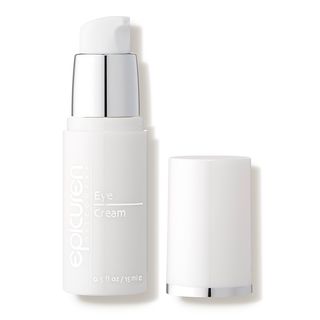
Epicuren Discovery Eye Cream
Works for
1 of 3 advertised claims delivered
MoisturizingSesamum indicum seed oil, Caprylic/capric triglyceride + 11 moreGood evidence
“Nourishes and hydrates the eye area Minimizes the appearance of dark circles and crow's feet Encourages elasticity Lipid molecules hold onto moisture longer and more efficiently MetadermabolicTM enzymes provide anti-aging rejuvenation to the eye area A professional spa line that creates natural and mostly vegan products.”
This product can help soften the skin and reduce its moisture loss with emollients and occlusives: caprylic/capric triglyceride, carthamus tinctorius seed oil.
Keep in mind that this product does not contain effective ingredients to attract water to the upper layer of the skin. This is why an additional product with humectants like glycerin or hyaluronic acid can be helpful (apply it before this product for the best results).
Evens skin toneRetinyl palmitate, NiacinWeak evidence
“improve skin elasticity, color tone and overall health of the skin Panthenol.”
Effective ingredients missing or their concentration is too low
Anti-agingAscorbyl palmitate, Niacin + 1 moreWeak evidence
“Epicuren Discovery’s Eye Cream helps restore the delicate eye area by minimizing the appearance of dark circles, crow's feet and dullness.”
Effective ingredients missing or their concentration is too low.
Can it cause trouble?
Irritancy2 strong irritants: Citrus grandis seed extract, Retinyl palmitateMedium risk
Comedogenic3 ingredients rated 2 or more on the 0–5 pore-clogging scale3 flagged
User reviews
Be the first — your take helps the next person decide.
Ingredients
Filter by role to see what each ingredient is doing.
Water~45–55%
Ethylhexyl palmitate~6.1–7.4%
- Irritation risk
- Low
- Comedogenicity
- 3/5
An emollient that helps soften the skin and create a nice product texture
More about Ethylhexyl palmitateCaprylic/capric triglyceride~4.4–5.4%
- Irritation risk
- Medium
A good mix of fatty acids that forms a protective layer on the skin. Improves the shelf life of products. Derived from coconut and glycerin
More about Caprylic/capric triglycerideCarthamus tinctorius seed oil~3.3–4%
- Irritation risk
- Low
An emollient that helps soften the skin and might help calm down inflammation
More about Carthamus tinctorius seed oilCetearyl alcohol~2.5–3%
- Irritation risk
- Low
- Comedogenicity
- 2/5
A non-drying alcohol. Works as an emollient. Helps water and oil mix together and creates a nice product texture
More about Cetearyl alcoholTocopheryl acetate~2–2.4%
- Irritation risk
- Medium
A more stable but less bio-available form of vitamin E compared to Tocopherol. Might help moisturize and protect the skin from free radicals, but mostly used in low concentrations to stabilize other ingredients.
More about Tocopheryl acetateCollagen amino acids~1.8–2.1%
- Irritation risk
- Low
Help attract water to the upper layer of the skin, soften it and support the skin barrier function
More about Collagen amino acidsElastin amino acids~1.5–1.8%
- Irritation risk
- Low
Aloe barbadensis leaf extract~1.3–1.6%
- Irritation risk
- Medium
Traditionally used to treat sunburns, dermatitis and inflammation, but evidence for its effectiveness is lacking. The extract can contain humectants that help attract water into the skin
More about Aloe barbadensis leaf extractSesamum indicum seed oil~1–1.3%
- Irritation risk
- Low
A good moisturizing plant oil. Due to the high linoleic acid content, it helps soften the upper layer of the skin, reduce water loss and support skin barrier function
More about Sesamum indicum seed oilCitrus grandis seed extract~0.65–1%
- Irritation risk
- High
Chamomilla recutita extract~0.6–0.9%
- Irritation risk
- High
Plant extract that can have healing and anti-inflammatory properties. It is a potential allergen and can be irritating
More about Chamomilla recutita extractArctostaphylos uva ursi leaf extract~0.55–0.8%
- Irritation risk
- Low
Biotin~0.5–0.75%
- Irritation risk
- Low
Might have some moisturising properties. Is not effective when applied topically beyond some moisturizing effect
More about BiotinNiacin~0.45–0.7%
- Irritation risk
- High
A form of vitamin B3. It is similar in action to niacinamide, but is more likely to cause red flashes in skin as the side effect
More about NiacinRiboflavin~0.45–0.65%
- Irritation risk
- Low
Hydroxyethyl acrylate/sodium acryloyldimethyl taurate copolymer~0.45–0.65%
- Irritation risk
- Medium
A gelling agent that thickens the product consistency and leaves the skin with a velvety finish
More about Hydroxyethyl acrylate/sodium acryloyldimethyl taurate copolymerAllantoin~0.3–0.55%
- Irritation risk
- Low
Helps calm down inflammation in skin and can help reduce itching. Helps to repair the skin barrier and keep skin hydrated
More about AllantoinAscorbyl palmitate~0.25–0.5%
- Irritation risk
- Medium
Being a lipid soluble form of vitamin C, it is more stable and can penetrate the skin better than L-Ascorbic acid. It is effective in protecting the skin from free radicals, as well as evening the skin tone, but is less effective in stimulating collagen production compared to L-Ascorbic acid.
More about Ascorbyl palmitateCeteareth-20~0.35–0.6%
- Irritation risk
- Medium
- Comedogenicity
- 2/5
Helps oil and water mix together. Has some emollient properties
More about Ceteareth-20Sorbitan stearate~0.25–0.45%
Retinyl palmitate~0.2–0.35%
- Irritation risk
- High
Three steps removed from the active form of vitamin A - retinoic acid. To have an effect in the skin, it first needs to be converted twice to become the retinoic acid. This means it is less potent than retinol, but could also be less irritating. Once converted to the retinoic acid in the skin, it helps against all signs of aging, improves skin cell turnover and helps fight blemishes and clogged pores. However, in many cosmetic formulations, it is used in a concentration that is too low to have the full effect
More about Retinyl palmitatePrunus armeniaca kernel oil~0.2–0.4%
- Irritation risk
- Medium
An emollient that helps soften the skin
More about Prunus armeniaca kernel oilPanthenol~0.15–0.3%
- Irritation risk
- Low
Helps attract water to the upper layer of the skin and can help improve skin barrier function
More about PanthenolLecithin~0.2–0.35%
- Irritation risk
- Low
Used mostly for creating emulsions - helping oil and water mix together. Helps soften the upper layer of the skin
More about LecithinPropanediol~0.15–0.25%
- Irritation risk
- Low
Acts as a solvent for other ingredients. Speeds up the absorption of other ingredients into the skin
More about PropanediolPhenoxyethanol~0.15–0.25%
- Irritation risk
- Low
A preservative. It helps prevent bacterial growth in cosmetic products
More about PhenoxyethanolEthylhexylglycerin~0.1–0.15%
Ingredient list view
Water, Ethylhexyl palmitate, Caprylic/capric triglyceride, Carthamus tinctorius seed oil, Cetearyl alcohol, Tocopheryl acetate, Unknown, Collagen amino acids, Unknown, Elastin amino acids, Aloe barbadensis leaf extract, Sesamum indicum seed oil, Citrus grandis seed extract, Chamomilla recutita extract, Arctostaphylos uva ursi leaf extract, Biotin, Niacin, Riboflavin, Hydroxyethyl acrylate/sodium acryloyldimethyl taurate copolymer, Allantoin, Ascorbyl palmitate, Ceteareth-20, Sorbitan stearate, Retinyl palmitate, Prunus armeniaca kernel oil, Panthenol, Lecithin, Propanediol, Phenoxyethanol, Ethylhexylglycerin
Compare prices
Retailers ranked by price — lowest first.

Worth comparing, line by line.
Match % combines shared ingredients, the first five ingredients, shared actives and hero ingredients, irritancy (lower counts in the alternative's favour), texture and body area. Only products in the same routine step are compared.
| Epicuren DiscoveryEye CreamYOUR PRODUCT | EpicurenEye Cream | Perricone MDHypoallergenic Firming Eye Cream | BaleaQ10 Anti-Age Eye Cream | |
|---|---|---|---|---|
| Match | — | 70% | 57% | 57% |
| Price | $60.50 | $60.50 | $52.50−$8.00 | $4.89−$55.61 |
| Shared key ingredients | — | 9 of 9 | 3 of 9 | 3 of 9 |
| Key difference | — | — | Acetyl Tetrapeptide-5 | Glycerin |
| Irritancy | Medium | Medium | Low | Low |
| Drying alcohol | — | — | — | — |
| View product | Shop | Shop | Shop |


Sources cited in this review
Every concentration estimate and effectiveness label is anchored to one of these 6 studies and safety reviews.
- 1
- 2Triglyceride composition of Sesamum indicum seed oilonlinelibrary.wiley.com
- 3
- 4
- 5Skin moisturizing effects of panthenol-based formulationspdfs.semanticscholar.org
- 6

Affiliate links · As an Amazon Associate, WIMJ earns from qualifying purchases.