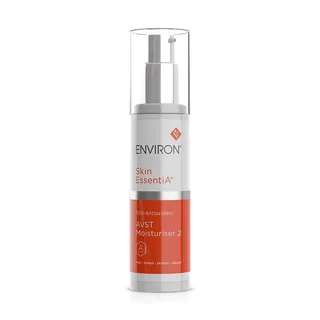
Works for
MoisturizingPanthenol, Caprylic/capric triglyceride + 12 moreWorks well
“This unique emulsion assists in rebalancing and moisturising the skin and can also help tackle pigmentation and broken capillaries.”
This product can help improve hydration of the skin with the two types of ingredients.
The first type is called “humectants”:
these ingredients help attract water.
When humectants are on the surface of the skin, they “pull in” the moisture from the outside environment, or from
within deeper layers of the skin. The following ingredients in this product do the job:
glycerin, sucrose.
This product also contains ingredients called “occlusives”. They help reduce the speed with which our skin loses moisture to the outside environment. These ingredients also help soften the upper layer of the skin, so it feels less tight and nicer to the touch. The following ingredients in this product do the job: caprylic/capric triglyceride, dimethicone.
The following ingredients in this product are especially good for supporting the skin barrier and helping with the hydration level: panthenol
Evens skin toneEpigallocatechin gallate, Ascorbyl tetraisopalmitate + 2 moreMay help
“Assists in improving the appearance of fine lines, uneven skin tone and the appearance of sun-damaged skin.”
The following ingredient (ingredients) in this product might be helpful, but there is no evidence to confirm that it actually works: epigallocatechin gallate.
Anti-agingEpigallocatechin gallate, Tocopherol + 4 moreMay help
“Assists in improving the appearance of fine lines, uneven skin tone and the appearance of sun-damaged skin.”
This product contains epigallocatechin gallate. This ingredient might be able to help reduce and prevent fine lines and wrinkles, improve skin elasticity and firmness, but there is not enough evidence that it actually works.
Anti-oxidationNot advertised by the brand · Epigallocatechin gallate, Tocopheryl acetate + 6 moreMay help
This product contains antioxidants (epigallocatechin gallate) that might be able to help neutralize free radicals in skin to lessen the damage it gets from the UV light (sun). There is not enough evidence to confirm their effectiveness in skin though.
Can it cause trouble?
Irritancy2 strong irritants: Retinyl palmitate, Rosmarinus officinalis leaf extract — patch-test recommendedHigh risk
Comedogenic3 ingredients rated 2 or more on the 0–5 pore-clogging scale3 flagged

User reviews
Be the first — your take helps the next person decide.
Ingredients
Filter by role to see what each ingredient is doing.
Water~45–55%
Hydrogenated polydecene~5.2–6.3%
- Irritation risk
- Low
Helps to soften the upper layer of the skin and create a nice product texture
More about Hydrogenated polydeceneSorbitol~4.1–5%
- Irritation risk
- Low
Helps attract water to the upper layer of the skin and improves the product texture
More about SorbitolTocopheryl acetate~3.2–3.9%
- Irritation risk
- Medium
A more stable but less bio-available form of vitamin E compared to Tocopherol. Might help moisturize and protect the skin from free radicals, but mostly used in low concentrations to stabilize other ingredients.
More about Tocopheryl acetateCaprylic/capric triglyceride~2.5–3.1%
- Irritation risk
- Medium
A good mix of fatty acids that forms a protective layer on the skin. Improves the shelf life of products. Derived from coconut and glycerin
More about Caprylic/capric triglycerideEthoxydiglycol~2–2.4%
Glyceryl stearate~1.7–2.1%
- Irritation risk
- Low
An emollient that softens the skin and forms a protective layer on its surface. Helps water and oil mix together
More about Glyceryl stearateCetearyl alcohol~1.5–1.8%
- Irritation risk
- Low
- Comedogenicity
- 2/5
A non-drying alcohol. Works as an emollient. Helps water and oil mix together and creates a nice product texture
More about Cetearyl alcoholPeg-100 stearate~1.2–1.5%
- Irritation risk
- Low
Helps oil and water mix togehter and creates a nice product texture
More about Peg-100 stearatePolysorbate 60~0.95–1.15%
Dimethicone~0.7–1.1%
- Irritation risk
- Low
A silicone that helps to reduce water loss from the surface of the skin. Can temporarily "fill in" lines and wrinkles, absorb oil, and create a nice product finish
More about DimethiconePanthenol~0.55–0.85%
- Irritation risk
- Low
Helps attract water to the upper layer of the skin and can help improve skin barrier function
More about PanthenolSorbitan stearate~0.5–0.75%
Retinyl palmitate~0.4–0.65%
- Irritation risk
- High
Three steps removed from the active form of vitamin A - retinoic acid. To have an effect in the skin, it first needs to be converted twice to become the retinoic acid. This means it is less potent than retinol, but could also be less irritating. Once converted to the retinoic acid in the skin, it helps against all signs of aging, improves skin cell turnover and helps fight blemishes and clogged pores. However, in many cosmetic formulations, it is used in a concentration that is too low to have the full effect
More about Retinyl palmitateAscorbyl tetraisopalmitate~0.45–0.65%
- Irritation risk
- Medium
A vitamin C derivative. Studies show that is might be effective in reducing hyperpigmentation, but there are no studies confirming that it is effectively converted into the bioavailable form of Vitamin C in skin. It is not clear how this derivative compares in effectiveness to the topical application of bioavailable form of vitamin C (L-ascorbic acid)
More about Ascorbyl tetraisopalmitateAscorbic acid~0.45–0.65%
- Irritation risk
- High
The most well-researched antioxidant that works in skin. Helps neutralize free radicals supporting collagen production, helping to even out the skin tone and preventing early signs of aging
More about Ascorbic acidTocopherol~0.4–0.65%
- Irritation risk
- Low
Pure form of vitamin E. Can help moisturise and protect the skin from free radicals. Often used to help stabilise other ingredients or the formula itself
More about TocopherolRosmarinus officinalis leaf extract~0.3–0.6%
- Irritation risk
- High
Can be helpful in reducing inflammation in skin, including inflamed acne. It can be irritating
More about Rosmarinus officinalis leaf extractEpigallocatechin gallate~0.3–0.55%
- Irritation risk
- Low
A polyphenol found in tea. This particular compound abbreviated EGCG is the most powerful antioxidant among those extracted from tea (usually green tea). Unfortunately, EGCG is unstable, requires a low pH (below 4) to prevent quick degradation, and does not penetrate the skin very well. This is why the full anti-oxidant effect of EGCG is typically not realized when it is added to topical skincare
More about Epigallocatechin gallateAspalathus linearis leaf extract~0.3–0.5%
- Irritation risk
- Low
Plant extract that might have help to neutralize free radicals in skin, but evidence of effectiveness is skin is lacking
More about Aspalathus linearis leaf extractCyclopia genistoides leaf extract~0.25–0.5%
- Irritation risk
- Low
Polygonum cuspidatum extract~0.25–0.5%
- Irritation risk
- Low
Helianthus annuus seed oil~0.25–0.5%
- Irritation risk
- Low
A great emollient due to its high linoleic acid content. One of the most effective plant oils in helping skin hydration and repairing skin barrier function
More about Helianthus annuus seed oilGlycerin~0.25–0.5%
- Irritation risk
- Low
One of the best moisturizing ingredients. Naturally present in skin. It attracts water to the upper layer of the skin working as a humectant
More about GlycerinPolyglyceryl-10 laurate~0.25–0.45%
- Irritation risk
- Medium
Helps water and oil mix together
More about Polyglyceryl-10 laurateSodium hydroxide~0.25–0.45%
Maltodextrin~0.25–0.45%
- Irritation risk
- Low
Used to stabilize the product formulation and can help absorb oil
More about MaltodextrinBeta-carotene~0.25–0.45%
Ascorbyl palmitate~0.25–0.45%
- Irritation risk
- Medium
Being a lipid soluble form of vitamin C, it is more stable and can penetrate the skin better than L-Ascorbic acid. It is effective in protecting the skin from free radicals, as well as evening the skin tone, but is less effective in stimulating collagen production compared to L-Ascorbic acid.
More about Ascorbyl palmitateXanthan gum~0.25–0.45%
- Irritation risk
- Low
Used to create a thicker product consistency
More about Xanthan gumDisodium edta~0.25–0.45%
Gelatin~0.25–0.5%
Sucrose~0.2–0.4%
- Irritation risk
- Low
Can help attract water to the upper layer of the skin. In crystal form, it can work as a gentle exfoliant, gentler than the salt scrub. Helps stabilize the emulsion
More about SucroseZea mays oil~0.2–0.4%
- Irritation risk
- Low
- Comedogenicity
- 3/5
A good moisturizing plant oil. Due to the high linoleic acid content, it helps soften the upper layer of the skin, reduce water loss and support skin barrier function
More about Zea mays oilZea mays starch~0.25–0.45%
- Irritation risk
- Medium
- Comedogenicity
- 3/5
Used to thicken the product's consistency
More about Zea mays starchMethylparaben~0.15–0.3%
Propylparaben~0.2–0.4%
Panthenol~0.25–0.4%
- Irritation risk
- Low
Helps attract water to the upper layer of the skin and can help improve skin barrier function
More about PanthenolRetinyl palmitate~0.2–0.35%
- Irritation risk
- High
Three steps removed from the active form of vitamin A - retinoic acid. To have an effect in the skin, it first needs to be converted twice to become the retinoic acid. This means it is less potent than retinol, but could also be less irritating. Once converted to the retinoic acid in the skin, it helps against all signs of aging, improves skin cell turnover and helps fight blemishes and clogged pores. However, in many cosmetic formulations, it is used in a concentration that is too low to have the full effect
More about Retinyl palmitateAscorbyl tetraisopalmitate~0.25–0.45%
- Irritation risk
- Medium
A vitamin C derivative. Studies show that is might be effective in reducing hyperpigmentation, but there are no studies confirming that it is effectively converted into the bioavailable form of Vitamin C in skin. It is not clear how this derivative compares in effectiveness to the topical application of bioavailable form of vitamin C (L-ascorbic acid)
More about Ascorbyl tetraisopalmitateAscorbic acid~0.2–0.35%
- Irritation risk
- High
The most well-researched antioxidant that works in skin. Helps neutralize free radicals supporting collagen production, helping to even out the skin tone and preventing early signs of aging
More about Ascorbic acidTocopherol~0.2–0.4%
- Irritation risk
- Low
Pure form of vitamin E. Can help moisturise and protect the skin from free radicals. Often used to help stabilise other ingredients or the formula itself
More about TocopherolRosmarinus officinalis leaf extract~0.15–0.3%
- Irritation risk
- High
Can be helpful in reducing inflammation in skin, including inflamed acne. It can be irritating
More about Rosmarinus officinalis leaf extractEpigallocatechin gallate~0.15–0.3%
- Irritation risk
- Low
A polyphenol found in tea. This particular compound abbreviated EGCG is the most powerful antioxidant among those extracted from tea (usually green tea). Unfortunately, EGCG is unstable, requires a low pH (below 4) to prevent quick degradation, and does not penetrate the skin very well. This is why the full anti-oxidant effect of EGCG is typically not realized when it is added to topical skincare
More about Epigallocatechin gallateAspalathus linearis leaf extract~0.15–0.3%
- Irritation risk
- Low
Plant extract that might have help to neutralize free radicals in skin, but evidence of effectiveness is skin is lacking
More about Aspalathus linearis leaf extractCyclopia genistoides leaf extract~0.15–0.3%
- Irritation risk
- Low
Polygonum cuspidatum extract~0.15–0.3%
- Irritation risk
- Low
Beta-carotene~0.1–0.15%
Ascorbyl palmitate~0.05–0.15%
- Irritation risk
- Medium
Being a lipid soluble form of vitamin C, it is more stable and can penetrate the skin better than L-Ascorbic acid. It is effective in protecting the skin from free radicals, as well as evening the skin tone, but is less effective in stimulating collagen production compared to L-Ascorbic acid.
More about Ascorbyl palmitateIngredient list view
Water, Hydrogenated polydecene, Sorbitol, Tocopheryl acetate, Caprylic/capric triglyceride, Ethoxydiglycol, Glyceryl stearate, Cetearyl alcohol, Peg-100 stearate, Polysorbate 60, Dimethicone, Panthenol, Sorbitan stearate, Retinyl palmitate, Ascorbyl tetraisopalmitate, Ascorbic acid, Tocopherol, Rosmarinus officinalis leaf extract, Epigallocatechin gallate, Aspalathus linearis leaf extract, Cyclopia genistoides leaf extract, Polygonum cuspidatum extract, Helianthus annuus seed oil, Glycerin, Polyglyceryl-10 laurate, Sodium hydroxide, Maltodextrin, Beta-carotene, Ascorbyl palmitate, Xanthan gum, Disodium edta, Gelatin, Sucrose, Zea mays oil, Zea mays starch, Methylparaben, Propylparaben, Panthenol, Retinyl palmitate, Ascorbyl tetraisopalmitate, Ascorbic acid, Tocopherol, Rosmarinus officinalis leaf extract, Epigallocatechin gallate, Aspalathus linearis leaf extract, Cyclopia genistoides leaf extract, Polygonum cuspidatum extract, Beta-carotene, Ascorbyl palmitate
Compare prices
Retailers ranked by price — lowest first.
Affiliate links · As an Amazon Associate, WIMJ earns from qualifying purchases.
Worth comparing, line by line.
Match % combines shared ingredients, the first five ingredients, shared actives and hero ingredients, irritancy (lower counts in the alternative's favour), texture and body area. Only products in the same routine step are compared.
| EnvironSkin EssentiA Vita-Antioxidant AVST 2YOUR PRODUCT | Laboratoire ACMDuolys.Hyal Intensive Anti-Ageing Serum | Bliv:UThe Real Vita C 20 Ampoule 12ml | VARI:HOPE8 Days Pure Vitamin C Ampoule EX | |
|---|---|---|---|---|
| Match | — | 81% | 81% | 80% |
| Price | — | $35.14 | $13.31 | $47.02 |
| Shared key ingredients | — | 6 of 12 | 6 of 12 | 6 of 12 |
| Key difference | — | Glycolic Acid | Niacinamide | Chitosan |
| Irritancy | High | Medium | Medium | High |
| Drying alcohol | — | — | — | — |
| View product | Shop | Shop | Shop |

More alternatives: Oce’ane Sérum Facial de Vitamina C e Ácido Ferulico - Vitamin C + Ferulic Acid SerumCeraVe Vitamin C Face Serum, Skin Brightening Serum with Hyaluronic Acid
Product summary
"Environ - Skin EssentiA Vita-Antioxidant AVST 2" is effective for: Moisturizing
This product could be helpful for: Evens skin tone and Anti-aging, but its actives are not the most effective or are not well-studied.
Ingredient callouts
- This product also contains Vitamin C (Ascorbic Acid). It can be an effective active for anti-aging and evening out the skin tone, but in this product it is used for stabilizing other ingredients in the formulation. In this concentration (0.45% - 0.65%) it cannot have a noticeable benefit for the skin.
- This product includes a form of Retinoids (vitamin A) - retinyl palmitate 0.40% - 0.65% and retinyl palmitate 0.20% - 0.35%, but this type of vitamin A is not very effective. It could in theory help with fine lines and wrinkles, but the effect is most likely minimal.
- An effective concentration of Panthenol (pro-vitamin B5) - about 0.55% - 0.85%. Panthenol helps strengthen the skin barrier, improve hydration and reduce inflammation in skin.
- Humectants (sucrose 0.20% - 0.40%, panthenol 0.55% - 0.85%, glycerin 0.25% - 0.50% and panthenol 0.25% - 0.40%). These ingredients help attract water to the upper layer of the skin and improve the skin hydration.
Price
The product retails for 55.00£ in the United Kingdom.
For a detailed price comparison: click here.
Sources cited in this review
Every concentration estimate and effectiveness label is anchored to one of these 25 studies and safety reviews.
- 1Safety Assessment of Polyene Group as Used in Cosmeticscir-safety.org
- 2
- 3Final Report on the Safety Assessment of Dimethicone Copolyoljournals.sagepub.com
- 4Skin moisturizing effects of panthenol-based formulationspdfs.semanticscholar.org
- 5
- 6

Affiliate links · As an Amazon Associate, WIMJ earns from qualifying purchases.