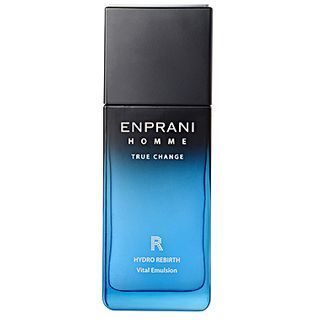
ENPRANI Homme Hydro Rebirth Vital Emulsion
Works for
1 of 2 advertised claims delivered
Moisturizing19 ingredients credited for this claimGood support
“Homme Hydro Rebirth Vital Emulsion”
This product can help improve hydration of the skin with the two types of ingredients.
The first type is called “humectants”:
these ingredients help attract water.
When humectants are on the surface of the skin, they “pull in” the moisture from the outside environment, or from
within deeper layers of the skin. The following ingredients in this product do the job:
betaine, cyclomethicone.
This product also contains ingredients called “occlusives”. They help reduce the speed with which our skin loses moisture to the outside environment. These ingredients also help soften the upper layer of the skin, so it feels less tight and nicer to the touch. The following ingredients in this product do the job: caprylic/capric triglyceride, dimethicone.
Anti-aging2 ingredients credited for this claimWeak support
“Youthcell promotes skin growth while improving elasticity for a younger-looking finish.”
Effective ingredients missing or their concentration is too low.
Can it cause trouble?
Irritancy7 strong irritants: Alcohol denat., Lilium candidum flower extract + 5 more — patch-test recommendedHigh risk
Comedogenic1 ingredient rated 2 or more on the 0–5 pore-clogging scale1 flagged
User reviews
Be the first — your take helps the next person decide.
Ingredients
Filter by role to see what each ingredient is doing.
Water~45–55%
Alcohol denat.~7.4–9.1%
- Irritation risk
- High
Produces temporary toning effect. Can help dissolve other ingredients or preserve products
More about Alcohol denat.Glycerin~4.1–5%
- Irritation risk
- Low
One of the best moisturizing ingredients. Naturally present in skin. It attracts water to the upper layer of the skin working as a humectant
More about GlycerinButylene glycol~3–3.6%
- Irritation risk
- Low
Used to create a nice product texture and help delivery of other ingredients. Might be somewhat helpful in attracting water to the upper layer of the skin
More about Butylene glycolCyclopentasiloxane~2.3–2.8%
- Irritation risk
- Low
A silicone that helps improve the product texture and spreadability. Can absorb oil creating a short-term mattifying effect on the skin
More about CyclopentasiloxaneBetaine~1.8–2.2%
- Irritation risk
- Low
Helps attract water to the upper layer of the skin and improves the product texture
More about BetaineCetyl ethylhexanoate~1.6–1.9%
- Irritation risk
- Medium
An emollient that helps soften the skin and creates a thicker product texture
More about Cetyl ethylhexanoateCaprylic/capric triglyceride~1.4–1.7%
- Irritation risk
- Medium
A good mix of fatty acids that forms a protective layer on the skin. Improves the shelf life of products. Derived from coconut and glycerin
More about Caprylic/capric triglycerideDipropylene glycol~1–1.2%
- Irritation risk
- Low
Helps to dissolve other ingredients in a formulation. Slows down the rate of product drying
More about Dipropylene glycolC14-22 alcohols~0.75–1.1%
- Irritation risk
- Low
A non-drying alcohol that helps stabilize product formulations
More about C14-22 alcoholsC12-20 alkyl glucoside~0.55–0.85%
- Irritation risk
- Medium
Helps water and oil mix together
More about C12-20 alkyl glucosideCetearyl alcohol~0.6–0.9%
- Irritation risk
- Low
- Comedogenicity
- 2/5
A non-drying alcohol. Works as an emollient. Helps water and oil mix together and creates a nice product texture
More about Cetearyl alcoholDimethicone~0.5–0.75%
- Irritation risk
- Low
A silicone that helps to reduce water loss from the surface of the skin. Can temporarily "fill in" lines and wrinkles, absorb oil, and create a nice product finish
More about DimethiconeCyclomethicone~0.45–0.65%
- Irritation risk
- Low
A type of silicone that leaves a nice silky finish on the skin and can help soften its upper layer
More about CyclomethiconePolyethylene~0.55–0.85%
Peg/ppg-20/15 dimethicone~0.35–0.65%
- Irritation risk
- Medium
Helps oil and water mix together
More about Peg/ppg-20/15 dimethiconePhenyl methicone~0.35–0.65%
- Irritation risk
- Low
Sodium acrylates copolymer~0.25–0.5%
- Irritation risk
- Medium
Used to create a thicker product consistency
More about Sodium acrylates copolymerBatyl alcohol~0.3–0.55%
- Irritation risk
- Low
Non-drying alcohol. Used to stabilize other ingredients and is an emollient
More about Batyl alcoholStearic acid~0.35–0.65%
- Irritation risk
- Low
Helps oil and water mix together and works as an emollient
More about Stearic acidLecithin~0.25–0.45%
- Irritation risk
- Low
Used mostly for creating emulsions - helping oil and water mix together. Helps soften the upper layer of the skin
More about LecithinTocopheryl acetate~0.25–0.45%
- Irritation risk
- Medium
A more stable but less bio-available form of vitamin E compared to Tocopherol. Might help moisturize and protect the skin from free radicals, but mostly used in low concentrations to stabilize other ingredients.
More about Tocopheryl acetateLilium candidum flower extract~0.2–0.35%
Nymphaea coerulea leaf cell extract~0.2–0.35%
- Irritation risk
- Low
Nymphaea alba leaf cell extract~0.2–0.35%
- Irritation risk
- Low
Portulaca oleracea extract~0.2–0.4%
- Irritation risk
- Medium
A plant extract that has some anti-oxidant activity, but solid research is lacking. Can help attract water to the upper layer of the skin
More about Portulaca oleracea extractBifida ferment lysate~0.2–0.4%
- Irritation risk
- Low
Consists of remains of dead yeast bacteria cells. Helps to hydrate the skin and reduce irritation. Might has some anti-oxidant effect
More about Bifida ferment lysateRhizophora mangle bark extract~0.25–0.45%
- Irritation risk
- Low
Buddleja davidii extract~0.25–0.4%
- Irritation risk
- Low
Thymus vulgaris extract~0.2–0.35%
- Irritation risk
- High
Boerhavia diffusa root extract~0.25–0.45%
- Irritation risk
- Medium
A plant extract that might help reduce inflammation and neutralize free radicals
More about Boerhavia diffusa root extractSpiraea ulmaria extract~0.2–0.4%
- Irritation risk
- Low
Rosa multiflora fruit extract~0.2–0.4%
Polyquaternium-51~0.25–0.5%
- Irritation risk
- Low
An emollient that helps create a nice silky finish on the skin
More about Polyquaternium-51Sodium hyaluronate~0.25–0.45%
- Irritation risk
- Low
One of the best moisturizing ingredients. Attracts water into the upper layer of the skin
More about Sodium hyaluronatePolysorbate 80~0.25–0.5%
Hydrolyzed millet~0.25–0.4%
- Irritation risk
- Low
Alcohol~0.25–0.45%
- Irritation risk
- High
Can be drying and contribute to skin irritation. Used in formulars to dissolve other ingredients, create a thinner product consistency or for its antibacterial properties
More about AlcoholHydrogenated lecithin~0.25–0.45%
- Irritation risk
- Low
Helps to retain moisture by creating a protective barrier on the skin. Rich in fatty acids. Improves product texture and helps with the penetration of other ingredients.
More about Hydrogenated lecithinPotassium phosphate~0.25–0.45%
Edta~0.2–0.4%
Rh-polypeptide-1~0.2–0.4%
- Irritation risk
- Low
Nelumbo nucifera extract~0.2–0.35%
- Irritation risk
- High
Might be somewhat helpful in protecting elastin in skin and evening skin tone, but good research is lacking. Contains fragrant components and can be irritating.
More about Nelumbo nucifera extractPrunus mume fruit extract~0.25–0.45%
- Irritation risk
- Low
A plant extract that might have an anti-oxidant effect and help even out skin tone, but solid evidence of effectiveness is lacking
More about Prunus mume fruit extractEthylhexylglycerin~0.25–0.45%
Allantoin~0.2–0.35%
- Irritation risk
- Low
Helps calm down inflammation in skin and can help reduce itching. Helps to repair the skin barrier and keep skin hydrated
More about AllantoinMenthyl lactate~0.2–0.4%
Menthone glycerin acetal~0.2–0.4%
- Irritation risk
- Low
Disodium edta~0.2–0.35%
Citric acid~0.15–0.3%
- Irritation risk
- Medium
Can work as an exfoliant but is typically used to adjust the product pH
More about Citric acidLactic acid~0.15–0.3%
- Irritation risk
- Medium
An exfoliating and moisturizing alpha-hydroxy acid (AHA). Typically causes less irritation than other AHAs, for example, glycolic acid. At high concentrations (about 15%), lactic acid can help reduce lines and wrinkles. Recent studies show that lactic acid can support the "good" bacteria living on skin's surface (healthy skin microbiome)
More about Lactic acidPhenoxyethanol~0.15–0.3%
- Irritation risk
- Low
A preservative. It helps prevent bacterial growth in cosmetic products
More about PhenoxyethanolCaprylhydroxamic acid~0.15–0.25%
Caprylyl glycol~0.15–0.25%
- Irritation risk
- Medium
Helps preserve products and creates a nice product texture
More about Caprylyl glycolParfum~0.1–0.15%
- Irritation risk
- High
An aromatic blend of unspecified and possibly irritating ingredients
More about ParfumIngredient list view
Water, Alcohol denat., Glycerin, Butylene glycol, Cyclopentasiloxane, Betaine, Cetyl ethylhexanoate, Caprylic/capric triglyceride, Dipropylene glycol, C14-22 alcohols, C12-20 alkyl glucoside, Cetearyl alcohol, Dimethicone, Cyclomethicone, Polyethylene, Peg/ppg-20/15 dimethicone, Phenyl methicone, Sodium acrylates copolymer, Batyl alcohol, Stearic acid, Lecithin, Tocopheryl acetate, Lilium candidum flower extract, Nymphaea coerulea leaf cell extract, Nymphaea alba leaf cell extract, Portulaca oleracea extract, Bifida ferment lysate, Rhizophora mangle bark extract, Buddleja davidii extract, Thymus vulgaris extract, Boerhavia diffusa root extract, Spiraea ulmaria extract, Rosa multiflora fruit extract, Polyquaternium-51, Sodium hyaluronate, Polysorbate 80, Hydrolyzed millet, Alcohol, Hydrogenated lecithin, Potassium phosphate, Edta, Rh-polypeptide-1, Nelumbo nucifera extract, Prunus mume fruit extract, Ethylhexylglycerin, Allantoin, Menthyl lactate, Menthone glycerin acetal, Disodium edta, Citric acid, Lactic acid, Phenoxyethanol, Caprylhydroxamic acid, Caprylyl glycol, Parfum
Compare prices
Retailers ranked by price — lowest first.

Affiliate links · prices updated regularly
Sources cited in this review
Every concentration estimate and effectiveness label is anchored to one of these 18 studies and safety reviews.
- 1
- 2
- 3Safety Assessment of Decyl Glucoside and Other Alkyl Glucosides as Used in Cosmeticsciteseerx.ist.psu.edu
- 4
- 5Final Report on the Safety Assessment of Dimethicone Copolyoljournals.sagepub.com
- 6

Affiliate links · As an Amazon Associate, WIMJ earns from qualifying purchases.