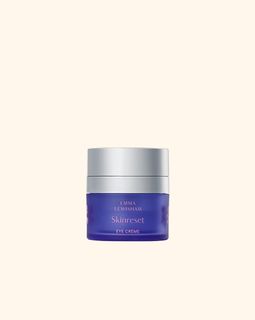
Emma Lewisham Skin Reset Eye Crème
Works for
2 of 3 advertised claims delivered
Moisturizing19 ingredients credited for this claimStrong support
“Tailored to the unique needs of the delicate eye area, this deeply nourishing, collagen-boosting crème helps improve the appearance of dark circles, puffiness, and brightness.”
This product can help improve hydration of the skin with the two types of ingredients.
The first type is called “humectants”:
these ingredients help attract water.
When humectants are on the surface of the skin, they “pull in” the moisture from the outside environment, or from
within deeper layers of the skin. The following ingredients in this product do the job:
glycerin, saccharide isomerate.
This product also contains ingredients called “occlusives”. They help reduce the speed with which our skin loses moisture to the outside environment. These ingredients also help soften the upper layer of the skin, so it feels less tight and nicer to the touch. The following ingredients in this product do the job: helianthus annuus seed oil, plukenetia volubilis seed oil.
The following ingredients in this product are especially good for supporting the skin barrier and helping with the hydration level: ceramide np
Anti-aging3 ingredients credited for this claimModerate support
“With daily use, fine lines and wrinkles are softened to reveal a firmer, smoother, more luminous under eye area.”
This product contains ubiquinone. This ingredient help neutralize free radicals in skin. By doing so, they might be able to prevent early signs of aging (like fine lines and wrinkles), at least to some extent. These ingredients will not be able to "reverse" signs of aging.
Evens skin tone1 ingredient credited for this claimWeak support
“Formulated to improve the appearance of dark circles, nurture a more even skin tone, and reduce puffiness, this brightening eye cream is powered by the brand’s liposomal CoQ10 delivery system.”
Effective ingredients missing or their concentration is too low
Anti-oxidationNot advertised by the brand · 7 ingredients credited for this claimStrong support
This product contains antioxidants (ubiquinone) that can help neutralize free radicals in skin. By doing so, they can lessen the damage the skin gets from the UV light (sun).
The following ingredients - squalene also can have an antioxidant effect, but there is less evidence to confirm their effectiveness in skin.
Can it cause trouble?
Irritancy2 strong irritants: Hibiscus sabdariffa flower extract, AlcoholMedium risk
Comedogenic3 ingredients rated 2 or more on the 0–5 pore-clogging scale3 flagged


User reviews
Be the first — your take helps the next person decide.
Ingredients
Filter by role to see what each ingredient is doing.
Aloe barbadensis leaf juice~26–31%
- Irritation risk
- Medium
Traditionally used to treat sunburns, dermatitis and inflammation, but evidence for its effectiveness is lacking. The extract can contain humectants that help attract water into the skin
More about Aloe barbadensis leaf juiceWater~13–16%
Coco-caprylate~5.9–7.2%
- Irritation risk
- Medium
An emollient that softens skin and creates a nice product texture
More about Coco-caprylateHelianthus annuus seed oil~4.3–5.3%
- Irritation risk
- Low
A great emollient due to its high linoleic acid content. One of the most effective plant oils in helping skin hydration and repairing skin barrier function
More about Helianthus annuus seed oilGlycerin~3–3.7%
- Irritation risk
- Low
One of the best moisturizing ingredients. Naturally present in skin. It attracts water to the upper layer of the skin working as a humectant
More about GlycerinCetearyl alcohol~2.1–2.6%
- Irritation risk
- Low
- Comedogenicity
- 2/5
A non-drying alcohol. Works as an emollient. Helps water and oil mix together and creates a nice product texture
More about Cetearyl alcoholJojoba esters~1.6–2%
- Irritation risk
- Medium
An emollient made of jojoba oil. Helps soften the skin and support its barrier function
More about Jojoba estersAstrocaryum murumuru seed butter~1.4–1.7%
- Irritation risk
- Medium
Helps soften the upper layer of the skin. Could be comedogenic due to the myrisic acid content
More about Astrocaryum murumuru seed butterGlyceryl stearate se~1.2–1.5%
- Irritation risk
- Low
- Comedogenicity
- 2/5
Used to stabilize the product formulations and works as an emollient
More about Glyceryl stearate seCetearyl olivate~1.1–1.3%
Cetearyl glucoside~0.8–1.2%
- Irritation risk
- Medium
Helps water and oil in the product mix well together and improves product texture
More about Cetearyl glucosideSorbitan olivate~0.7–1%
Saccharide isomerate~0.6–0.9%
- Irritation risk
- Low
Helps attract water to the upper layer of the skin
More about Saccharide isomerate1,2-hexanediol~0.55–0.85%
Caffeoyl tripeptide-1~0.55–0.85%
- Irritation risk
- Low
Plukenetia volubilis seed oil~0.6–0.9%
- Irritation risk
- Low
A plant oil that works as a good moisturizer by softening the upper layer of the skin. Might be helpful in reducing inflammation in skin and reducing blemishes due to the large content of linoleic acid
More about Plukenetia volubilis seed oilSodium hyaluronate~0.5–0.8%
- Irritation risk
- Low
One of the best moisturizing ingredients. Attracts water into the upper layer of the skin
More about Sodium hyaluronateTocopherol~0.5–0.75%
- Irritation risk
- Low
Pure form of vitamin E. Can help moisturise and protect the skin from free radicals. Often used to help stabilise other ingredients or the formula itself
More about TocopherolJojoba oil/macadamia seed oil esters~0.45–0.7%
- Irritation risk
- Low
Phytosterols~0.5–0.75%
- Irritation risk
- Medium
Lipids that work as an emollient and can be helpful in repairing skin barrier function
More about PhytosterolsPhytosteryl macadamiate~0.5–0.7%
- Irritation risk
- Low
Helps soften the upper layer of the skin
More about Phytosteryl macadamiateSqualene~0.45–0.7%
- Irritation risk
- Low
- Comedogenicity
- 2/5
An oil that is naturally part of skin sebum that helps to soften its upper layer, reduce water loss and neutralize free radicals. It might be comedogenic. Avoid applying large concentrations (or pure oil) before sun exposure as oxidized squalene can clog pores and lead to skin irritation. Today squalene is mostly derived from vegetable oils or synthetized by yeast
More about SqualeneHibiscus sabdariffa flower extract~0.35–0.65%
- Irritation risk
- High
A plant extract that can be irritating. It might contain a compound anthocyanin that could be helpful in neutralizing free radicals
More about Hibiscus sabdariffa flower extractCeramide np~0.45–0.7%
- Irritation risk
- Low
A type of lipid similar to ceramides naturally present in skin. Helps to soften the upper layer of the skin and supports the skin barrier function to keep it hydrated. Can help to prevent inflammation in skin
More about Ceramide npLeontopodium alpinum flower/leaf extract~0.35–0.65%
- Irritation risk
- Low
Ribose~0.35–0.6%
- Irritation risk
- Low
Glycosphingolipids~0.45–0.65%
- Irritation risk
- Low
A type of lipids naturally present in skin. They can be converted to ceramides in skin
More about GlycosphingolipidsHordeum vulgare extract~0.45–0.65%
- Irritation risk
- Medium
A plant extract that might have some anti-oxidant properties. Avoid if you are sensitive to gluten
More about Hordeum vulgare extractBuddleja davidii leaf extract~0.35–0.65%
- Irritation risk
- Low
Leucojum aestivum bulb extract~0.4–0.6%
- Irritation risk
- Low
Narcissus tazetta bulb extract~0.35–0.6%
- Irritation risk
- Medium
Might contain compounds called dormins that in theory could help lighten skin and reduce hyperpigmentation, but solid research is lacking
More about Narcissus tazetta bulb extractUbiquinone~0.35–0.65%
- Irritation risk
- Low
Coenzyme Q10. It helps neutralize free radicals in skin, improves skin hydration and might be helpful agains fine lines and wrinkles. It can be an allergen
More about UbiquinoneTocopheryl acetate~0.35–0.65%
- Irritation risk
- Medium
A more stable but less bio-available form of vitamin E compared to Tocopherol. Might help moisturize and protect the skin from free radicals, but mostly used in low concentrations to stabilize other ingredients.
More about Tocopheryl acetateSilica~0.5–0.75%
Lecithin~0.45–0.65%
- Irritation risk
- Low
Used mostly for creating emulsions - helping oil and water mix together. Helps soften the upper layer of the skin
More about LecithinMica~0.4–0.6%
- Irritation risk
- Low
Creates an illusion of smoother and more radiant skin tone. Adds shimmer to the skin by reflecting light
More about MicaTitanium dioxide~0.35–0.65%
- Irritation risk
- Low
Works as a UV filter when used in high concentrations. It is photostable and is effective mostly against the UVB light, with some protection in the UVA range. In small concentrations, used for its ability to improve the color of cosmetic products. Is usually well tolerated by the skin
More about Titanium dioxideIron oxides~0.3–0.55%
- Irritation risk
- Low
An umbrella term for the following three colorants: CI 77491, CI 77492, CI 77499. They might be able to offer some protection against visible light, but the degree of the protection is not clear
More about Iron oxidesIron oxides~0.3–0.55%
- Irritation risk
- Low
An umbrella term for the following three colorants: CI 77491, CI 77492, CI 77499. They might be able to offer some protection against visible light, but the degree of the protection is not clear
More about Iron oxidesPullulan~0.4–0.6%
- Irritation risk
- High
Creates a thin drying film on the skin resulting in a short-term tightening effect
More about PullulanXanthan gum~0.3–0.55%
- Irritation risk
- Low
Used to create a thicker product consistency
More about Xanthan gumSclerotium gum~0.3–0.55%
- Irritation risk
- Low
Used to create gel-like formulas and stabilize emulsions
More about Sclerotium gumAlcohol~0.2–0.4%
- Irritation risk
- High
Can be drying and contribute to skin irritation. Used in formulars to dissolve other ingredients, create a thinner product consistency or for its antibacterial properties
More about AlcoholBenzyl alcohol~0.15–0.25%
- Irritation risk
- High
A preservative. Can be used to mask unpleasant smell. Can be irritating
More about Benzyl alcoholDehydroacetic acid~0.2–0.35%
Citric acid~0.15–0.3%
- Irritation risk
- Medium
Can work as an exfoliant but is typically used to adjust the product pH
More about Citric acidPotassium sorbate~0.2–0.35%
Sodium benzoate~0.15–0.3%
Ingredient list view
Aloe barbadensis leaf juice, Water, Coco-caprylate, Helianthus annuus seed oil, Glycerin, Cetearyl alcohol, Jojoba esters, Astrocaryum murumuru seed butter, Glyceryl stearate se, Cetearyl olivate, Cetearyl glucoside, Sorbitan olivate, Saccharide isomerate, 1,2-hexanediol, Caffeoyl tripeptide-1, Plukenetia volubilis seed oil, Sodium hyaluronate, Tocopherol, Jojoba oil/macadamia seed oil esters, Phytosterols, Phytosteryl macadamiate, Squalene, Hibiscus sabdariffa flower extract, Ceramide np, Leontopodium alpinum flower/leaf extract, Ribose, Glycosphingolipids, Hordeum vulgare extract, Buddleja davidii leaf extract, Leucojum aestivum bulb extract, Narcissus tazetta bulb extract, Ubiquinone, Tocopheryl acetate, Silica, Lecithin, Mica, Titanium dioxide, Iron oxides, Iron oxides, Pullulan, Xanthan gum, Sclerotium gum, Alcohol, Benzyl alcohol, Dehydroacetic acid, Citric acid, Potassium sorbate, Sodium benzoate
Compare prices
Retailers ranked by price — lowest first.


Worth comparing, line by line.
Match % combines shared ingredients, the first five ingredients, shared actives and hero ingredients, irritancy (lower counts in the alternative's favour), texture and body area. Only products in the same routine step are compared.
| Emma LewishamSkin Reset Eye CrèmeYOUR PRODUCT | DRMTLGYAdvanced Eye Cream | Dr. Barbara SturmSuper Anti-Aging Eye Cream Contour des Yeux Anti-âge | Beyou CosmeticsCaffeine Eye Cream | |
|---|---|---|---|---|
| Match | — | 55% | 53% | 53% |
| Price | $90.00 | $55.00−$35.00 | $190.00+$100.00 | $18.99−$71.01 |
| Shared key ingredients | — | 4 of 16 | 5 of 16 | 3 of 16 |
| Key difference | — | Palmitoyl Tetrapeptide-7 | Panthenol | Niacinamide |
| Irritancy | Medium | Low | Medium | Low |
| Drying alcohol | Contains drying alcohol | — | Contains drying alcohol | — |
| View product | Shop | Shop | Shop |

Product summary
"Emma Lewisham - Skin Reset Eye Crème" is effective for: Moisturizing
This product could be helpful for: Anti-aging, but its actives are not the most effective or are not well-studied.
Ingredient callouts
- Ceramides (ceramide np 0.50% - 0.75%). Ceramides are a type of lipids that our skin produces itself. They are a building block of the skin's barrier. Ceramides used in skincare are synthetic or extracted from plants. They work well for softening the skin surface and "patch holes" in the skin's barrier.
- Humectants (hyaluronic acid 0.65% - 1.00%, sodium hyaluronate 0.80% - 1.15% and saccharide isomerate 1.20% - 1.50%). These ingredients help attract water to the upper layer of the skin and improve the skin hydration.
Price
The product retails from 90.00$ up to 135.00$ in the United States and from 85.00£ up to 545.00£ in the United Kingdom.
For a detailed price comparison: click here.
Sources cited in this review
Every concentration estimate and effectiveness label is anchored to one of these 24 studies and safety reviews.
- 1
- 2
- 3Effect of topically applied lipids on surfactant-irritated skinonlinelibrary.wiley.com
- 4
- 5
- 6

Affiliate links · As an Amazon Associate, WIMJ earns from qualifying purchases.