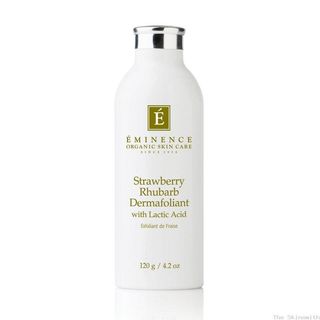
Eminence Organics Strawberry Rhubarb Dermafoliant
Works for
2 of 2 advertised claims delivered
Exfoliation4 ingredients credited for this claimStrong support
“This powder to paste exfoliant with rice powder and chickpea powder is a gentle manual exfoliant, leaving skin soft and smooth.”
This product can help exfoliate the skin. In other words, it helps break down the bonds between dead cells on the surface of the skin and speed up the skin turnover. Skin often appears softer and brighter after exfoliation, but overdoing it can result in disrupted skin barrier. The following ingredient is doing the exfoliating job in this product: salicylic acid.
Anti-blemish6 ingredients credited for this claimStrong support
“It also unclogs pores and removes dead skin build up and surface impurities.”
This product can help reduce breakouts and clogged pores because it contains the following ingredient: salicylic acid. This ingredient is used for treating acne and can have a noticeable effect.
Anti-oxidationNot advertised by the brand · 14 ingredients credited for this claimStrong support
This product contains antioxidants (thioctic acid, ubiquinone, vitis vinifera seed extract) that can help neutralize free radicals in skin. By doing so, they can lessen the damage the skin gets from the UV light (sun).
The following ingredients - ginkgo biloba leaf extract also can have an antioxidant effect, but there is less evidence to confirm their effectiveness in skin.
Anti-agingNot advertised by the brand · 7 ingredients credited for this claimModerate support
This product contains vitis vinifera seed extract. This ingredient might be able to help reduce and prevent fine lines and wrinkles, improve skin elasticity and firmness, but there is not enough evidence that it actually works.
MoisturizingNot advertised by the brand · 12 ingredients credited for this claimGood support
This product can help improve hydration of the skin with the two types of ingredients.
The first type is called “humectants”:
these ingredients help attract water.
When humectants are on the surface of the skin, they “pull in” the moisture from the outside environment, or from
within deeper layers of the skin. The following ingredients in this product do the job:
glycerin, cocos nucifera water.
This product also contains ingredients called “occlusives”. They help reduce the speed with which our skin loses moisture to the outside environment. These ingredients also help soften the upper layer of the skin, so it feels less tight and nicer to the touch. The following ingredients in this product do the job: squalane, vitis vinifera seed oil.
Can it cause trouble?
Irritancy5 strong irritants: Rosa damascena extract, Equisetum arvense extract + 3 more — patch-test recommendedHigh risk
ComedogenicClean of flagged comedogenic ingredientsNone flagged


User reviews
Be the first — your take helps the next person decide.
Ingredients
Filter by role to see what each ingredient is doing.
Agar~23–34%
- Irritation risk
- Medium
Polysaccharide derived from seaweed. Used to create a thicker product consistency and might help attract water to the upper layer of the skin
More about AgarRosa damascena extract~6.2–9.3%
- Irritation risk
- High
Oil of a very fragrant pink rose used as fragrance in cosmetics. Extensive research has shown it has mixed benefits. In the pro column, inhaling this flower’s scent seems to have relaxing properties and the plant’s petals contain skin-soothing and antioxidant compounds that can benefit skin. On the flipside, the numerous chemicals that create this rose’s distinctive fragrance pose a risk of causing skin aggravation.
More about Rosa damascena extractRheum rhabarbarum extract~4.4–6.6%
- Irritation risk
- Low
Althaea officinalis root extract~3–4.5%
- Irritation risk
- High
A plant extract that can help attract water to the upper layer of the skin and might help to reduce inflammation
More about Althaea officinalis root extractVitis vinifera seed extract~2.2–3.3%
- Irritation risk
- Low
A plant extract that contains resveratrol and other anti-oxidant compounds that can help neutralize free radicals, reduce inflammation in skin and even out its tone. Can be also used to stabilize the product formulation
More about Vitis vinifera seed extractOryza sativa~1.8–2.6%
- Irritation risk
- Low
Tin~1.4–2%
Sodium cocoyl isethionate~1.2–1.8%
- Irritation risk
- Medium
Helps water and oil mix together. Can be used as a cleansing agent
More about Sodium cocoyl isethionateSolanum tuberosum starch~1.1–1.7%
- Irritation risk
- Low
Avena sativa kernel flour~1.1–1.7%
- Irritation risk
- Low
A type of colloidal oatmeal. Can contain potent antioxidants and anti-inflammatory compounds. Is effective in supporting skin barrier
More about Avena sativa kernel flourSilica~1–1.5%
Salicylic acid~0.5–1.2%
- Irritation risk
- High
Used for skin exfoliation. It has an anti-inflammatory and anti-bacterial effect, helps to unclog pores, prevent blemishes and speed up healing of the existing ones. Sometimes referred to as a BHA (beta-hydroxy acid)
More about Salicylic acidMoroccan lava clay~0.95–1.4%
- Irritation risk
- Low
Helps absorb oil (for the time of application) and creates a thicker product consistency
More about Moroccan lava clayLactic acid~0.5–1.15%
- Irritation risk
- Medium
An exfoliating and moisturizing alpha-hydroxy acid (AHA). Typically causes less irritation than other AHAs, for example, glycolic acid. At high concentrations (about 15%), lactic acid can help reduce lines and wrinkles. Recent studies show that lactic acid can support the "good" bacteria living on skin's surface (healthy skin microbiome)
More about Lactic acidMedicago sativa leaf extract~0.5–1.1%
- Irritation risk
- Low
Equisetum arvense extract~0.55–1.3%
- Irritation risk
- High
A plant extract that might have anti-oxidant properties. Can be irritating
More about Equisetum arvense extractCamellia sinensis leaf extract~0.45–1.1%
- Irritation risk
- Low
Can contain potent anti-oxidant compounds (abbreviated ECG, GCG, EGC, and EGCG) that might help protect the skin from free radicals. Can help calm down inflammation and has some anti-bacterial properties. Unfortunately, these antioxidants are unstable and lose their effectiveness very quickly in products. The concentration of the antioxidant compounds in the extract also tends to be low to be effective in topical formulation
More about Camellia sinensis leaf extractAscorbic acid~0.4–1%
- Irritation risk
- High
The most well-researched antioxidant that works in skin. Helps neutralize free radicals supporting collagen production, helping to even out the skin tone and preventing early signs of aging
More about Ascorbic acidSalix alba bark extract~0.4–0.95%
- Irritation risk
- High
A plant extract that can help neutralize free radicals in skin. It contains a compound salicin that can theoretically be converted into salicylic acid that, in turn, helps reduce inflammation in skin, but the evidence of effectiveness in skin is lacking and the extract is usually not used in a concentration that would enable an exfoliating effect
More about Salix alba bark extractVitis vinifera seed oil~0.45–1%
- Irritation risk
- Medium
A great emollient that can also have anti-oxidant properties
More about Vitis vinifera seed oilPapain~0.35–0.85%
- Irritation risk
- High
An enzyme extracted from papaya fruit. Can have an exfoliating effect on the skin. Can be irritating
More about PapainCarica papaya fruit extract~0.35–0.85%
- Irritation risk
- High
Citrus grandis seed extract~0.3–0.75%
- Irritation risk
- High
Heilmoor clay~0.35–0.8%
Glycyrrhiza glabra root extract~0.35–0.85%
- Irritation risk
- Medium
A plant extract that can help lighten the skin and calm down inflammation. Might be helpful in neutralizing free radicals
More about Glycyrrhiza glabra root extractSqualane~0.4–0.95%
- Irritation risk
- Low
An oil naturally present in skin. Works as an emollient to soften the skin and form a protective layer on its surface without a greasy feeling.
More about SqualaneEuterpe oleracea fruit extract~0.35–0.8%
- Irritation risk
- Medium
A plant extract that can have some anti-oxidant effect in skin
More about Euterpe oleracea fruit extractCitrus limon peel oil~0.3–0.75%
Malpighia emarginata fruit extract~0.15–0.7%
- Irritation risk
- Low
Ficin~0.2–0.75%
- Irritation risk
- Low
Phyllanthus emblica extract~0.2–0.75%
- Irritation risk
- Low
Adansonia digitata seed oil~0.3–0.75%
- Irritation risk
- Medium
Helps soften the upper layer of the skin
More about Adansonia digitata seed oilMyrciaria dubia fruit extract~0.15–0.65%
- Irritation risk
- Medium
A plant extract that might help neutralize free radicals in skin, but research on its effectiveness is lacking
More about Myrciaria dubia fruit extractDaucus carota sativa root~0.15–0.55%
- Irritation risk
- Low
Cocos nucifera water~0.1–0.5%
- Irritation risk
- Low
Might help to attract water to the upper layer of the skin
More about Cocos nucifera waterLycium barbarum fruit extract~0.1–0.45%
- Irritation risk
- Medium
A plant extract that can help neutralize free radicals in skin and attract water to its upper layer
More about Lycium barbarum fruit extractTapioca starch~0.1–0.35%
Thioctic acid~0.1–0.35%
Ubiquinone~0.1–0.35%
- Irritation risk
- Low
Coenzyme Q10. It helps neutralize free radicals in skin, improves skin hydration and might be helpful agains fine lines and wrinkles. It can be an allergen
More about UbiquinoneGlycerin~0.1–0.35%
- Irritation risk
- Low
One of the best moisturizing ingredients. Naturally present in skin. It attracts water to the upper layer of the skin working as a humectant
More about GlycerinArctium lappa root extract~0.05–0.25%
- Irritation risk
- High
Plant extract. Has some anti-microbial and anti-oxidant properties. Can be irritating
More about Arctium lappa root extractGinkgo biloba leaf extract~0.05–0.25%
- Irritation risk
- High
A plant extract that might help neutralize free radicals and reduce inflammation in skin. It can be irritating
More about Ginkgo biloba leaf extractIngredient list view
Unknown, Agar, Rosa damascena extract, Rheum rhabarbarum extract, Althaea officinalis root extract, Vitis vinifera seed extract, Oryza sativa, Tin, Sodium cocoyl isethionate, Solanum tuberosum starch, Avena sativa kernel flour, Silica, Salicylic acid, Moroccan lava clay, Lactic acid, Medicago sativa leaf extract, Equisetum arvense extract, Camellia sinensis leaf extract, Ascorbic acid, Salix alba bark extract, Vitis vinifera seed oil, Papain, Carica papaya fruit extract, Citrus grandis seed extract, Heilmoor clay, Glycyrrhiza glabra root extract, Unknown, Squalane, Euterpe oleracea fruit extract, Citrus limon peel oil, Unknown, Malpighia emarginata fruit extract, Unknown, Ficin, Phyllanthus emblica extract, Adansonia digitata seed oil, Myrciaria dubia fruit extract, Daucus carota sativa root, Cocos nucifera water, Lycium barbarum fruit extract, Tapioca starch, Thioctic acid, Ubiquinone, Glycerin, Arctium lappa root extract, Ginkgo biloba leaf extract
Compare prices
Retailers ranked by price — lowest first.
Affiliate links · prices updated regularly · As an Amazon Associate, WIMJ earns from qualifying purchases.
Worth comparing, line by line.
Match % combines shared ingredients, the first five ingredients, shared actives and hero ingredients, irritancy (lower counts in the alternative's favour), texture and body area. Only products in the same routine step are compared.
| Eminence OrganicsStrawberry Rhubarb DermafoliantYOUR PRODUCT | BiodermaSebium Lotion Rebalancing water oil | Nubian HeritageAfrican Black Bar Soap | cocokindoil control routine | |
|---|---|---|---|---|
| Match | — | 55% | 54% | 52% |
| Price | $32.60 | $7.93−$24.67 | $4.99−$27.61 | $62.00+$29.40 |
| Shared key ingredients | — | 2 of 13 | 1 of 13 | 4 of 13 |
| Key difference | — | Mannitol | Butyrospermum Parkii Butter | Gluconolactone |
| Irritancy | High | Medium | Medium | High |
| Drying alcohol | — | — | — | — |
| View product | Shop | Shop | Shop |


Sources cited in this review
Every concentration estimate and effectiveness label is anchored to one of these 22 studies and safety reviews.
- 1
- 2
- 3
- 4Final Report on the Safety Assessment of Sodium Cocoyl Isethionatejournals.sagepub.com
- 5Salicylic acid as a peeling agent: a comprehensive reviewncbi.nlm.nih.gov
- 6Beta Hydroxy Acidsfda.gov

Affiliate links · As an Amazon Associate, WIMJ earns from qualifying purchases.