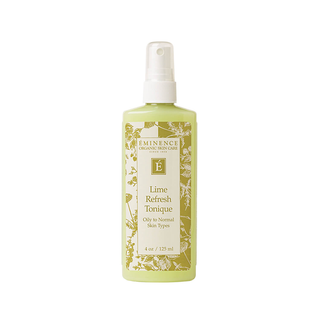
Eminence Organics Eminence Lime Refresh Tonique
Works for
2 of 3 advertised claims delivered
Moisturizing10 ingredients credited for this claimGood support
“Enriched with Lime Juice, Green Tea and Lavender, the antioxidant-rich formula works to restore hydration to dry skin, improve the appearance of pores and promote a more even skin tone.”
This product can help improve hydration of the skin with the two types of ingredients.
The first type is called “humectants”:
these ingredients help attract water.
When humectants are on the surface of the skin, they “pull in” the moisture from the outside environment, or from
within deeper layers of the skin. The following ingredients in this product do the job:
diglycerin, glycerin.
This product also contains ingredients called “occlusives”. They help reduce the speed with which our skin loses moisture to the outside environment. These ingredients also help soften the upper layer of the skin, so it feels less tight and nicer to the touch. The following ingredients in this product do the job: squalane, glycine soja oil.
Anti-aging5 ingredients credited for this claimModerate support
“The result is a radiant, youthful-looking complexion.”
This product contains lysine. This ingredient might be able to help reduce and prevent fine lines and wrinkles, improve skin elasticity and firmness, but there is not enough evidence that it actually works.
Evens skin tone1 ingredient credited for this claimWeak support
“Enriched with Lime Juice, Green Tea and Lavender, the antioxidant-rich formula works to restore hydration to dry skin, improve the appearance of pores and promote a more even skin tone.”
Effective ingredients missing or their concentration is too low
Anti-oxidationNot advertised by the brand · 5 ingredients credited for this claimStrong support
This product contains antioxidants (ubiquinone) that can help neutralize free radicals in skin. By doing so, they can lessen the damage the skin gets from the UV light (sun).
The following ingredients - camellia sinensis extract also can have an antioxidant effect, but there is less evidence to confirm their effectiveness in skin.
Can it cause trouble?
Irritancy3 strong irritants: Citrus aurantifolia juice, Lavandula angustifolia extract + 1 more — patch-test recommendedHigh risk
Comedogenic1 ingredient rated 2 or more on the 0–5 pore-clogging scale1 flagged
User reviews
Be the first — your take helps the next person decide.
Ingredients
Filter by role to see what each ingredient is doing.
Citrus aurantifolia juice~22–33%
Camellia sinensis extract~5.4–8%
- Irritation risk
- Low
Tea extract. Might be helpful in neutralizing free radicals in skin
More about Camellia sinensis extractGlycerin~4.3–6.5%
- Irritation risk
- Low
One of the best moisturizing ingredients. Naturally present in skin. It attracts water to the upper layer of the skin working as a humectant
More about GlycerinHydrolyzed wheat protein~3.4–5.1%
- Irritation risk
- Medium
Can help attract water to the upper layer of the skin. Avoid if sensitive to gluten
More about Hydrolyzed wheat proteinSorbitol~2.6–3.9%
- Irritation risk
- Low
Helps attract water to the upper layer of the skin and improves the product texture
More about SorbitolDiglycerin~1.9–2.9%
- Irritation risk
- Low
Helps attract water to the upper layer of the skin
More about DiglycerinLactic acid~1.5–2.3%
- Irritation risk
- Medium
An exfoliating and moisturizing alpha-hydroxy acid (AHA). Typically causes less irritation than other AHAs, for example, glycolic acid. At high concentrations (about 15%), lactic acid can help reduce lines and wrinkles. Recent studies show that lactic acid can support the "good" bacteria living on skin's surface (healthy skin microbiome)
More about Lactic acidLysine~1.2–1.8%
- Irritation risk
- Low
An amino-acid that helps to attract water to the upper layer of the skin. In combination with other amino-acids, might help to reduce fine lines and wrinkles
More about LysineLavandula angustifolia extract~1.1–1.6%
- Irritation risk
- High
Used for fragrance and contains volatile compounds that can irritate the skin
More about Lavandula angustifolia extractGlycine soja oil~0.95–1.45%
- Irritation risk
- Medium
- Comedogenicity
- 2/5
A good emollient that helps soften the skin and helps repair its barrier function. It can clog pores if used in high concentrations.
More about Glycine soja oilCitrus grandis~0.55–1.25%
- Irritation risk
- High
Vitis vinifera seed~0.45–1.1%
- Irritation risk
- Low
Xanthan gum~0.4–0.9%
- Irritation risk
- Low
Used to create a thicker product consistency
More about Xanthan gumSqualane~0.35–0.85%
- Irritation risk
- Low
An oil naturally present in skin. Works as an emollient to soften the skin and form a protective layer on its surface without a greasy feeling.
More about SqualaneUbiquinone~0.15–0.6%
- Irritation risk
- Low
Coenzyme Q10. It helps neutralize free radicals in skin, improves skin hydration and might be helpful agains fine lines and wrinkles. It can be an allergen
More about UbiquinoneTocopheryl acetate~0.1–0.45%
- Irritation risk
- Medium
A more stable but less bio-available form of vitamin E compared to Tocopherol. Might help moisturize and protect the skin from free radicals, but mostly used in low concentrations to stabilize other ingredients.
More about Tocopheryl acetateTocopherol~0.1–0.35%
- Irritation risk
- Low
Pure form of vitamin E. Can help moisturise and protect the skin from free radicals. Often used to help stabilise other ingredients or the formula itself
More about TocopherolAscorbyl palmitate~0.05–0.25%
- Irritation risk
- Medium
Being a lipid soluble form of vitamin C, it is more stable and can penetrate the skin better than L-Ascorbic acid. It is effective in protecting the skin from free radicals, as well as evening the skin tone, but is less effective in stimulating collagen production compared to L-Ascorbic acid.
More about Ascorbyl palmitateIngredient list view
Citrus aurantifolia juice, Camellia sinensis extract, Glycerin, Hydrolyzed wheat protein, Sorbitol, Diglycerin, Lactic acid, Unknown, Lysine, Lavandula angustifolia extract, Glycine soja oil, Citrus grandis, Vitis vinifera seed, Unknown, Xanthan gum, Unknown, Squalane, Ubiquinone, Tocopheryl acetate, Tocopherol, Ascorbyl palmitate
Compare prices
Retailers ranked by price — lowest first.
Affiliate links · prices updated regularly · As an Amazon Associate, WIMJ earns from qualifying purchases.
Sources cited in this review
Every concentration estimate and effectiveness label is anchored to one of these 7 studies and safety reviews.
- 1
- 2Wheat in skin caremdedge.com
- 3Epidermal and dermal effects of topical lactic acidncbi.nlm.nih.gov
- 4Dual Effects of Alpha-Hydroxy Acids on the Skinpdfs.semanticscholar.org
- 5Topical palmitoyl pentapeptide provides improvement in photoaged human facial skinonlinelibrary.wiley.com
- 6Vitamin E in dermatologyncbi.nlm.nih.gov

Affiliate links · As an Amazon Associate, WIMJ earns from qualifying purchases.