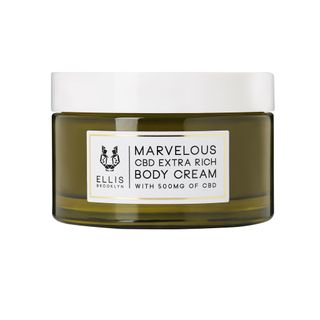
Ellis Brooklyn Marvelous CBD Extra Rich Body Cream
Works for
1 of 1 advertised claim delivered
MoisturizingHelianthus annuus seed oil, Persea gratissima oil + 17 moreGood evidence
“What Else You Need to Know: This marvelously aromatic, soothing, and moisturizing body cream features a powerful skin-soothing duo: full-spectrum CBD and French maritime pine bark extract.”
This product can help improve hydration of the skin with the two types of ingredients.
The first type is called “humectants”:
these ingredients help attract water.
When humectants are on the surface of the skin, they “pull in” the moisture from the outside environment, or from
within deeper layers of the skin. The following ingredients in this product do the job:
glycerin, sucrose.
This product also contains ingredients called “occlusives”. They help reduce the speed with which our skin loses moisture to the outside environment. These ingredients also help soften the upper layer of the skin, so it feels less tight and nicer to the touch. The following ingredients in this product do the job: butyrospermum parkii butter, helianthus annuus seed oil.
Can it cause trouble?
Irritancy3 strong irritants: Citrus grandis peel oil, Pelargonium graveolens flower oil + 1 more — patch-test recommendedHigh risk
Comedogenic4 ingredients rated 2 or more on the 0–5 pore-clogging scale4 flagged
User reviews
Be the first — your take helps the next person decide.
Ingredients
Filter by role to see what each ingredient is doing.
Water~45–55%
Cetyl alcohol~4.8–5.9%
- Irritation risk
- Low
A non-drying alcohol that works to soften the skin and stabilize product formulations helping oil and water mix together
More about Cetyl alcoholHelianthus annuus seed oil~4.3–5.2%
- Irritation risk
- Low
A great emollient due to its high linoleic acid content. One of the most effective plant oils in helping skin hydration and repairing skin barrier function
More about Helianthus annuus seed oilCetearyl alcohol~2.6–3.1%
- Irritation risk
- Low
- Comedogenicity
- 2/5
A non-drying alcohol. Works as an emollient. Helps water and oil mix together and creates a nice product texture
More about Cetearyl alcoholCetearyl olivate~2.3–2.8%
Sorbitan olivate~2–2.4%
Cannabis sativa seed oil~1.7–2.1%
- Irritation risk
- Medium
A plant oil that due to its high linoleic acid content can help strengthen skin's barrier function and soften its upper layer
More about Cannabis sativa seed oilGlycerin~1.5–1.9%
- Irritation risk
- Low
One of the best moisturizing ingredients. Naturally present in skin. It attracts water to the upper layer of the skin working as a humectant
More about GlycerinTheobroma cacao seed butter~1.2–1.5%
- Irritation risk
- Low
- Comedogenicity
- 3/5
Helps soften the upper layer of the skin and can be helpful in restoring the skin barrier function. Might have some anti-oxidant effect
More about Theobroma cacao seed butterButyrospermum parkii butter~1–1.3%
- Irritation risk
- Low
- Comedogenicity
- 3/5
A great moisturising ingredient that softens the skin and reduces water loss from its upper layer. It also can be helpful in protecting skin from free radicals
More about Butyrospermum parkii butterCetyl palmitate~0.75–1.15%
- Irritation risk
- Low
An emollient that helps soften the skin and is used to improve product texture and stability
More about Cetyl palmitateGlyceryl caprylate~0.65–0.95%
- Irritation risk
- Low
An emollient that can also help water and oil mix together, as well as prevent bacteria growth in products
More about Glyceryl caprylateArgania spinosa kernel oil~0.55–0.85%
- Irritation risk
- Medium
An emollient that helps soften the upper layer of the skin. Might have some weak anti-oxidant properties
More about Argania spinosa kernel oilPersea gratissima oil~0.55–0.8%
- Irritation risk
- Medium
An emollient that helps soften the skin and could be helpful in repairing its barrier function
More about Persea gratissima oilSorbitan palmitate~0.45–0.7%
- Irritation risk
- Medium
Helps water and oil mix together and stabilize the product formulation
More about Sorbitan palmitateSorbitan oleate decylglucoside crosspolymer~0.5–0.8%
- Irritation risk
- Medium
Helps oil and water mix together. Used as a cleansing agent
More about Sorbitan oleate decylglucoside crosspolymerAmyris balsamifera bark oil~0.4–0.6%
- Irritation risk
- Low
Citrus grandis peel oil~0.3–0.6%
- Irritation risk
- High
A plant oil with high content of volatile compounds that, especially when exposed to air, can cause allergic reactions and irritate the skin
More about Citrus grandis peel oilPelargonium graveolens flower oil~0.35–0.65%
- Irritation risk
- High
An essential oil. Can be irritating. Can become an allergen with oxidation
More about Pelargonium graveolens flower oilRosmarinus officinalis leaf oil~0.3–0.55%
- Irritation risk
- High
A plant oil with high content of volatile compounds that can irritate the skin. Can be used as a fragrance. Has anti-bacterial properties and might help neutralize free radicals on the surface of the skin
More about Rosmarinus officinalis leaf oilCitrus grandis peel oil~0.25–0.45%
- Irritation risk
- High
A plant oil with high content of volatile compounds that, especially when exposed to air, can cause allergic reactions and irritate the skin
More about Citrus grandis peel oilPelargonium graveolens flower oil~0.3–0.55%
- Irritation risk
- High
An essential oil. Can be irritating. Can become an allergen with oxidation
More about Pelargonium graveolens flower oilRosmarinus officinalis leaf oil~0.25–0.45%
- Irritation risk
- High
A plant oil with high content of volatile compounds that can irritate the skin. Can be used as a fragrance. Has anti-bacterial properties and might help neutralize free radicals on the surface of the skin
More about Rosmarinus officinalis leaf oilTocopherol~0.25–0.5%
- Irritation risk
- Low
Pure form of vitamin E. Can help moisturise and protect the skin from free radicals. Often used to help stabilise other ingredients or the formula itself
More about TocopherolCannabis sativa leaf extract~0.25–0.5%
- Irritation risk
- Low
Xanthan gum~0.25–0.5%
- Irritation risk
- Low
Used to create a thicker product consistency
More about Xanthan gumGlyceryl undecylenate~0.3–0.55%
- Irritation risk
- Medium
Helps oil and water mix together and helps preserve the product formulation
More about Glyceryl undecylenateAllantoin~0.25–0.4%
- Irritation risk
- Low
Helps calm down inflammation in skin and can help reduce itching. Helps to repair the skin barrier and keep skin hydrated
More about AllantoinAloe barbadensis leaf powder~0.25–0.45%
- Irritation risk
- Medium
A plant extract that might help attract water to the upper layer of the skin
More about Aloe barbadensis leaf powderSodium chloride~0.25–0.5%
- Irritation risk
- Low
Used to stabilize mixtures of oil and water, and create thicker, gel-like product textures
More about Sodium chloridePinus pinaster leaf/twig oil~0.25–0.45%
- Irritation risk
- Low
Camellia sinensis leaf powder~0.25–0.45%
- Irritation risk
- Low
Camellia sinensis leaf extract~0.25–0.45%
- Irritation risk
- Low
Can contain potent anti-oxidant compounds (abbreviated ECG, GCG, EGC, and EGCG) that might help protect the skin from free radicals. Can help calm down inflammation and has some anti-bacterial properties. Unfortunately, these antioxidants are unstable and lose their effectiveness very quickly in products. The concentration of the antioxidant compounds in the extract also tends to be low to be effective in topical formulation
More about Camellia sinensis leaf extractAcacia senegal gum~0.25–0.4%
- Irritation risk
- Medium
Helps mask the small of other ingredients and improve the product texture
More about Acacia senegal gumMaltodextrin~0.2–0.4%
- Irritation risk
- Low
Used to stabilize the product formulation and can help absorb oil
More about MaltodextrinCaprylic/capric triglyceride~0.25–0.5%
- Irritation risk
- Medium
A good mix of fatty acids that forms a protective layer on the skin. Improves the shelf life of products. Derived from coconut and glycerin
More about Caprylic/capric triglycerideSucrose~0.2–0.35%
- Irritation risk
- Low
Can help attract water to the upper layer of the skin. In crystal form, it can work as a gentle exfoliant, gentler than the salt scrub. Helps stabilize the emulsion
More about SucroseCrithmum maritimum extract~0.2–0.35%
- Irritation risk
- Low
- Comedogenicity
- 3/5
An algae extract that might have anti-oxidant properties
More about Crithmum maritimum extractHippophae rhamnoides extract~0.15–0.3%
- Irritation risk
- Low
Sodium ascorbate~0.2–0.35%
- Irritation risk
- Low
Ci 75130~0.15–0.3%
- Irritation risk
- Low
Silica~0.2–0.4%
Citric acid~0.1–0.15%
- Irritation risk
- Medium
Can work as an exfoliant but is typically used to adjust the product pH
More about Citric acidIngredient list view
Water, Cetyl alcohol, Helianthus annuus seed oil, Cetearyl alcohol, Cetearyl olivate, Sorbitan olivate, Cannabis sativa seed oil, Glycerin, Theobroma cacao seed butter, Butyrospermum parkii butter, Cetyl palmitate, Glyceryl caprylate, Argania spinosa kernel oil, Persea gratissima oil, Sorbitan palmitate, Sorbitan oleate decylglucoside crosspolymer, Amyris balsamifera bark oil, Citrus grandis peel oil, Pelargonium graveolens flower oil, Rosmarinus officinalis leaf oil, Citrus grandis peel oil, Pelargonium graveolens flower oil, Rosmarinus officinalis leaf oil, Tocopherol, Cannabis sativa leaf extract, Xanthan gum, Glyceryl undecylenate, Allantoin, Aloe barbadensis leaf powder, Sodium chloride, Pinus pinaster leaf/twig oil, Camellia sinensis leaf powder, Camellia sinensis leaf extract, Acacia senegal gum, Maltodextrin, Caprylic/capric triglyceride, Sucrose, Crithmum maritimum extract, Hippophae rhamnoides extract, Sodium ascorbate, Ci 75130, Silica, Citric acid
Compare prices
Retailers ranked by price — lowest first.

Affiliate links · prices updated regularly
Sources cited in this review
Every concentration estimate and effectiveness label is anchored to one of these 19 studies and safety reviews.
- 1
- 2
- 3Effect of topically applied lipids on surfactant-irritated skinonlinelibrary.wiley.com
- 4
- 5
- 6Hemp (Cannabis sativa L.) as a Resource for Green Cosmeticstandfonline.com

Affiliate links · As an Amazon Associate, WIMJ earns from qualifying purchases.