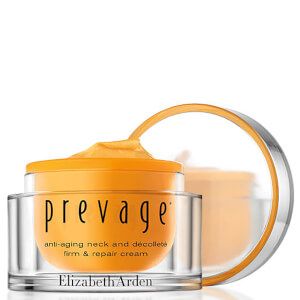
Elizabeth Arden Prevage Anti-Aging Neck and Décolleté Lift and Firm Cream
Works for
2 of 3 advertised claims delivered
Moisturizing27 ingredients credited for this claimGood support
“Prevage Anti-Aging Neck and Décolleté Lift and Firm Cream”
This product can help improve hydration of the skin with the two types of ingredients.
The first type is called “humectants”:
these ingredients help attract water.
When humectants are on the surface of the skin, they “pull in” the moisture from the outside environment, or from
within deeper layers of the skin. The following ingredients in this product do the job:
glycerin, hyaluronic acid.
This product also contains ingredients called “occlusives”. They help reduce the speed with which our skin loses moisture to the outside environment. These ingredients also help soften the upper layer of the skin, so it feels less tight and nicer to the touch. The following ingredients in this product do the job: butyrospermum parkii butter, chondrus crispus extract.
Anti-aging5 ingredients credited for this claimModerate support
“Prevage Anti-Aging Neck and Décolleté Lift and Firm Cream”
This product contains hydroxydecyl ubiquinoyl dipalmitoyl glycerate. This ingredient might be able to help reduce and prevent fine lines and wrinkles, improve skin elasticity and firmness, but there is not enough evidence that it actually works.
Evens skin tone1 ingredient credited for this claimWeak support
“Fights dryness and reduces the appearance of existing dark spots and sun damage.”
Effective ingredients missing or their concentration is too low
Anti-oxidationNot advertised by the brand · 7 ingredients credited for this claimModerate support
This product contains antioxidants (hydroxydecyl ubiquinoyl dipalmitoyl glycerate) that might be able to help neutralize free radicals in skin to lessen the damage it gets from the UV light (sun). There is not enough evidence to confirm their effectiveness in skin though.
Can it cause trouble?
Irritancy7 strong irritants: Citrus aurantium amara fruit extract, Citrus paradisi fruit extract + 5 more — patch-test recommendedHigh risk
Comedogenic6 ingredients rated 2 or more on the 0–5 pore-clogging scale6 flagged
User reviews
Be the first — your take helps the next person decide.
Ingredients
Filter by role to see what each ingredient is doing.
Ricinus communis seed oil~28–35%
- Irritation risk
- Medium
A plant oil that can help soften the skin. It might be helpful in calming down inflammation, but solid research is lacking. Is often used in lip products to create the needed product consistency
More about Ricinus communis seed oilDimethicone~5.9–7.3%
- Irritation risk
- Low
A silicone that helps to reduce water loss from the surface of the skin. Can temporarily "fill in" lines and wrinkles, absorb oil, and create a nice product finish
More about DimethiconeHyaluronic acid~4.8–5.9%
- Irritation risk
- Low
One of the best moisturizing ingredients. Attracts water into the upper layer of the skin. Naturally present in skin. Typically has large molecule size unless advertised otherwise on the product label. Helps support skin's barrier function and may help to reduce inflammation
More about Hyaluronic acidMica~4–4.9%
- Irritation risk
- Low
Creates an illusion of smoother and more radiant skin tone. Adds shimmer to the skin by reflecting light
More about MicaButyrospermum parkii butter~3.2–3.9%
- Irritation risk
- Low
- Comedogenicity
- 3/5
A great moisturising ingredient that softens the skin and reduces water loss from its upper layer. It also can be helpful in protecting skin from free radicals
More about Butyrospermum parkii butterTitanium dioxide~2.7–3.4%
- Irritation risk
- Low
Works as a UV filter when used in high concentrations. It is photostable and is effective mostly against the UVB light, with some protection in the UVA range. In small concentrations, used for its ability to improve the color of cosmetic products. Is usually well tolerated by the skin
More about Titanium dioxideUnspecified form of vitamin c~1.9–2.3%
- Irritation risk
- Low
Tocopherol~1.3–1.6%
- Irritation risk
- Low
Pure form of vitamin E. Can help moisturise and protect the skin from free radicals. Often used to help stabilise other ingredients or the formula itself
More about TocopherolWater~1.1–1.4%
Dimethicone~1–1.2%
- Irritation risk
- Low
A silicone that helps to reduce water loss from the surface of the skin. Can temporarily "fill in" lines and wrinkles, absorb oil, and create a nice product finish
More about DimethiconeGlycerin~0.65–1%
- Irritation risk
- Low
One of the best moisturizing ingredients. Naturally present in skin. It attracts water to the upper layer of the skin working as a humectant
More about GlycerinCaprylic/capric triglyceride~0.6–0.9%
- Irritation risk
- Medium
A good mix of fatty acids that forms a protective layer on the skin. Improves the shelf life of products. Derived from coconut and glycerin
More about Caprylic/capric triglycerideBiosaccharide gum-4~0.45–0.7%
Butyrospermum parkii butter~0.5–0.75%
- Irritation risk
- Low
- Comedogenicity
- 3/5
A great moisturising ingredient that softens the skin and reduces water loss from its upper layer. It also can be helpful in protecting skin from free radicals
More about Butyrospermum parkii butterPentylene glycol~0.45–0.7%
- Irritation risk
- Medium
Used to preserve products, dissolve other ingredients and create a nice product texture
More about Pentylene glycolCetearyl alcohol~0.45–0.7%
- Irritation risk
- Low
- Comedogenicity
- 2/5
A non-drying alcohol. Works as an emollient. Helps water and oil mix together and creates a nice product texture
More about Cetearyl alcoholButylene glycol~0.3–0.55%
- Irritation risk
- Low
Used to create a nice product texture and help delivery of other ingredients. Might be somewhat helpful in attracting water to the upper layer of the skin
More about Butylene glycolCaprylyl methicone~0.3–0.55%
- Irritation risk
- Low
A type of silicone that helps to soften the upper layer of the skin and create a nice product finish on the skin
More about Caprylyl methiconeOctyldodecanol~0.3–0.55%
- Irritation risk
- Low
An emollient that helps to soften the skin and create a pleasant product texture and stabilize the formulation
More about OctyldodecanolPropylene glycol~0.2–0.4%
- Irritation risk
- High
Helps oil and water mix together and can enhance the penetration of other ingredients into the skin. It can be irritating
More about Propylene glycolElaeis guineensis butter~0.3–0.5%
- Irritation risk
- Low
A type of palm oil. Helps soften the upper layer of the skin
More about Elaeis guineensis butterGlyceryl stearate~0.3–0.55%
- Irritation risk
- Low
An emollient that softens the skin and forms a protective layer on its surface. Helps water and oil mix together
More about Glyceryl stearatePeg-100 stearate~0.25–0.45%
- Irritation risk
- Low
Helps oil and water mix togehter and creates a nice product texture
More about Peg-100 stearatePolyimide-1~0.3–0.55%
Behenyl alcohol~0.25–0.5%
- Irritation risk
- Low
Non-drying alcohol that helps water and oil mix together. Also serves as an emollient
More about Behenyl alcoholPolyethylene~0.45–0.65%
Palmitoyl isoleucine~0.2–0.35%
- Irritation risk
- Low
Hydrogenated lecithin~0.2–0.35%
- Irritation risk
- Low
Helps to retain moisture by creating a protective barrier on the skin. Rich in fatty acids. Improves product texture and helps with the penetration of other ingredients.
More about Hydrogenated lecithinIsopropyl myristate~0.25–0.45%
- Irritation risk
- Low
- Comedogenicity
- 3/5
An emollient that helps soften the skin. Could be comedogenic
More about Isopropyl myristateAcrylates/dimethylaminoethyl methacrylate copolymer~0.3–0.55%
- Irritation risk
- Low
Helps create a nice product texture
More about Acrylates/dimethylaminoethyl methacrylate copolymerAlgin~0.2–0.35%
- Irritation risk
- Low
- Comedogenicity
- 3/5
Used to thicken product formulation. Can help attract water to the upper layer of the skin
More about AlginAlpha-glucan oligosaccharide~0.2–0.4%
- Irritation risk
- Low
Helps attract water to the upper layer of the skin
More about Alpha-glucan oligosaccharideAmmonium acryloyldimethyltaurate/vp copolymer~0.2–0.35%
- Irritation risk
- Low
Increases thickness of a product. Texture enhancer for oil-in-water emulsions
More about Ammonium acryloyldimethyltaurate/vp copolymerBis-vinyl dimethicone/dimethicone copolymer~0.3–0.55%
- Irritation risk
- Low
C11-15 pareth-7~0.2–0.35%
Caprylyl glycol~0.25–0.45%
- Irritation risk
- Medium
Helps preserve products and creates a nice product texture
More about Caprylyl glycolCardiospermum halicacabum flower/leaf/vine extract~0.2–0.35%
- Irritation risk
- High
A plant extract that might have some anti-inflammatory and anti-oxidant properties but evidence is missing
More about Cardiospermum halicacabum flower/leaf/vine extractCetearyl glucoside~0.2–0.4%
- Irritation risk
- Medium
Helps water and oil in the product mix well together and improves product texture
More about Cetearyl glucosideChondrus crispus extract~0.2–0.4%
- Irritation risk
- Low
- Comedogenicity
- 3/5
Red algae extract that helps attract water to the upper layer of the skin and create a nicer product consistency
More about Chondrus crispus extractCitrus aurantium amara fruit extract~0.2–0.35%
- Irritation risk
- High
Citrus paradisi fruit extract~0.2–0.35%
- Irritation risk
- High
Disodium edta~0.2–0.35%
Echium plantagineum seed oil~0.2–0.35%
- Irritation risk
- Medium
A plant oil that because of its high content of alpha-linolenic acid help support skin barrier function and moisturize the skin
More about Echium plantagineum seed oilErgothioneine~0.2–0.35%
- Irritation risk
- Low
Can help neutralize free radicals in skin. Preliminary studies show that it can be more effective than coenzyme Q10 but studies on effective concentration for topical applications are lacking
More about ErgothioneineHelianthus annuus seed oil~0.25–0.45%
- Irritation risk
- Low
A great emollient due to its high linoleic acid content. One of the most effective plant oils in helping skin hydration and repairing skin barrier function
More about Helianthus annuus seed oilHelianthus annuus seed oil unsaponifiables~0.25–0.5%
- Irritation risk
- Low
A great emollient due to its high linoleic acid content. One of the most effective plant oils in helping skin hydration and repairing skin barrier function
More about Helianthus annuus seed oil unsaponifiablesHydrogenated polyisobutene~0.25–0.5%
- Irritation risk
- Low
Used to improve the product consistency and soften the upper layer of the skin
More about Hydrogenated polyisobuteneHydroxydecyl ubiquinoyl dipalmitoyl glycerate~0.2–0.4%
- Irritation risk
- Low
Idebenone complex. Helps neutralize free radicals in skin
More about Hydroxydecyl ubiquinoyl dipalmitoyl glycerateLecithin~0.3–0.55%
- Irritation risk
- Low
Used mostly for creating emulsions - helping oil and water mix together. Helps soften the upper layer of the skin
More about LecithinLupinus albus seed extract~0.2–0.4%
- Irritation risk
- Medium
A plant extract that helps soften the upper layer of the skin
More about Lupinus albus seed extractMenthol~0.2–0.35%
- Irritation risk
- High
Menthyl lactate~0.2–0.4%
Mica~0.25–0.5%
- Irritation risk
- Low
Creates an illusion of smoother and more radiant skin tone. Adds shimmer to the skin by reflecting light
More about MicaParfum~0.2–0.35%
- Irritation risk
- High
An aromatic blend of unspecified and possibly irritating ingredients
More about ParfumPeg-40 hydrogenated castor oil~0.25–0.45%
- Irritation risk
- Medium
Helps oil and water mix together
More about Peg-40 hydrogenated castor oilPolyacrylate-21~0.35–0.65%
Propanediol~0.2–0.4%
- Irritation risk
- Low
Acts as a solvent for other ingredients. Speeds up the absorption of other ingredients into the skin
More about PropanediolPvp~0.35–0.6%
- Irritation risk
- Medium
Helps evenly disperse other ingredients in a formulation and create an even layer on the surface of the skin
More about PvpRetinyl linoleate~0.2–0.4%
- Irritation risk
- High
An ester of a retinoid and linoleic acid. Three steps removed from the bioactive form of retinoid, retinoic acid. Once converted to retinoic acid in skin, it can help reduce wrinkles, stimulate collagen production, even out skin tone and reduce blemishes. The concentrations used in cosmetic products are often not high enough to have a positive effect in skin.
More about Retinyl linoleateSodium hyaluronate~0.2–0.35%
- Irritation risk
- Low
One of the best moisturizing ingredients. Attracts water into the upper layer of the skin
More about Sodium hyaluronateSodium laureth-12 sulfate~0.5–0.75%
Tin oxide~0.3–0.55%
- Irritation risk
- Low
A colorant that can add a pearl-like appearance to the formulation
More about Tin oxideTocopherol~0.2–0.4%
- Irritation risk
- Low
Pure form of vitamin E. Can help moisturise and protect the skin from free radicals. Often used to help stabilise other ingredients or the formula itself
More about TocopherolTocopheryl acetate~0.2–0.4%
- Irritation risk
- Medium
A more stable but less bio-available form of vitamin E compared to Tocopherol. Might help moisturize and protect the skin from free radicals, but mostly used in low concentrations to stabilize other ingredients.
More about Tocopheryl acetateXanthan gum~0.2–0.4%
- Irritation risk
- Low
Used to create a thicker product consistency
More about Xanthan gumSodium ascorbate~0.2–0.4%
- Irritation risk
- Low
Alpha-isomethyl ionone~0.2–0.35%
- Irritation risk
- High
A fragrance. Potential allergen and can be irritating
More about Alpha-isomethyl iononeLinalool~0.2–0.35%
Chlorphenesin~0.16–0.32%
Phenoxyethanol~0.2–0.4%
- Irritation risk
- Low
A preservative. It helps prevent bacterial growth in cosmetic products
More about PhenoxyethanolPotassium sorbate~0.2–0.4%
Sodium dehydroacetate~0.2–0.35%
Sorbic acid~0.15–0.3%
Iron oxides~0.15–0.3%
- Irritation risk
- Low
An umbrella term for the following three colorants: CI 77491, CI 77492, CI 77499. They might be able to offer some protection against visible light, but the degree of the protection is not clear
More about Iron oxidesCi 77491~0.15–0.3%
- Irritation risk
- Low
A red colorant made of iron oxide. Typically is not irritating
More about Ci 77491Ci 14700~0.2–0.35%
Titanium dioxide~0.2–0.35%
- Irritation risk
- Low
Works as a UV filter when used in high concentrations. It is photostable and is effective mostly against the UVB light, with some protection in the UVA range. In small concentrations, used for its ability to improve the color of cosmetic products. Is usually well tolerated by the skin
More about Titanium dioxideCi 77891~0.1–0.2%
- Irritation risk
- Low
Ci 19140~0.1–0.2%
Ingredient list view
Ricinus communis seed oil, Dimethicone, Hyaluronic acid, Mica, Butyrospermum parkii butter, Titanium dioxide, Unspecified form of vitamin c, Tocopherol, Water, Dimethicone, Glycerin, Caprylic/capric triglyceride, Biosaccharide gum-4, Butyrospermum parkii butter, Pentylene glycol, Cetearyl alcohol, Butylene glycol, Caprylyl methicone, Octyldodecanol, Propylene glycol, Elaeis guineensis butter, Glyceryl stearate, Peg-100 stearate, Polyimide-1, Behenyl alcohol, Polyethylene, Palmitoyl isoleucine, Hydrogenated lecithin, Isopropyl myristate, Acrylates/dimethylaminoethyl methacrylate copolymer, Algin, Alpha-glucan oligosaccharide, Ammonium acryloyldimethyltaurate/vp copolymer, Bis-vinyl dimethicone/dimethicone copolymer, C11-15 pareth-7, Caprylyl glycol, Cardiospermum halicacabum flower/leaf/vine extract, Cetearyl glucoside, Chondrus crispus extract, Citrus aurantium amara fruit extract, Citrus paradisi fruit extract, Disodium edta, Echium plantagineum seed oil, Ergothioneine, Helianthus annuus seed oil, Helianthus annuus seed oil unsaponifiables, Hydrogenated polyisobutene, Hydroxydecyl ubiquinoyl dipalmitoyl glycerate, Lecithin, Lupinus albus seed extract, Menthol, Menthyl lactate, Mica, Parfum, Peg-40 hydrogenated castor oil, Polyacrylate-21, Propanediol, Pvp, Retinyl linoleate, Sodium hyaluronate, Sodium laureth-12 sulfate, Tin oxide, Tocopherol, Tocopheryl acetate, Xanthan gum, Sodium ascorbate, Alpha-isomethyl ionone, Linalool, Chlorphenesin, Phenoxyethanol, Potassium sorbate, Sodium dehydroacetate, Sorbic acid, Iron oxides, Ci 77491, Ci 14700, Titanium dioxide, Ci 77891, Ci 19140
Compare prices
Retailers ranked by price — lowest first.


Sources cited in this review
Every concentration estimate and effectiveness label is anchored to one of these 31 studies and safety reviews.
- 1
- 2
- 3
- 4
- 5Final Report on the Safety Assessment of Dimethicone Copolyoljournals.sagepub.com
- 6Efficacy of a New Topical Nano-hyaluronic Acid in Humansncbi.nlm.nih.gov

Affiliate links · As an Amazon Associate, WIMJ earns from qualifying purchases.