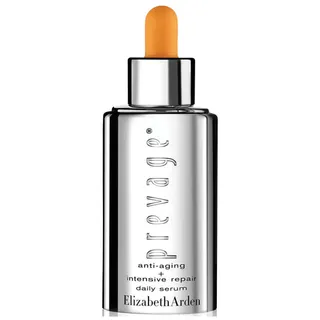
Elizabeth Arden Prevage Advanced Daily Serum
Works for
Anti-agingHydroxydecyl ubiquinoyl dipalmitoyl glycerate, Caprooyl tetrapeptide-3 + 5 moreMay help
“If you're looking for a product with impressive anti-ageing results, you needn't look any further than the Elizabeth Arden Prevage Advanced Daily Serum .”
This product contains caprooyl tetrapeptide-3, hydroxydecyl ubiquinoyl dipalmitoyl glycerate, oligopeptide-68, palmitoyl hexapeptide-19. These ingredients might be able to help reduce and prevent fine lines and wrinkles, improve skin elasticity and firmness, but there is not enough evidence that it actually works.
Evens skin toneRetinyl linoleate ~0.25–0.45%, below the ~1% it needsUnder-dosed
“It can also improve your skin's tone and brightness, whilst reducing the appearance of freckles, discolouration, and age spots.”
Effective ingredients missing or their concentration is too low
MoisturizingSide benefit · Caprooyl tetrapeptide-3, Oligopeptide-68 + 28 moreWorks well
This product can help improve hydration of the skin with the two types of ingredients.
The first type is called “humectants”:
these ingredients help attract water.
When humectants are on the surface of the skin, they “pull in” the moisture from the outside environment, or from
within deeper layers of the skin. The following ingredients in this product do the job:
dextran, glycerin.
This product also contains ingredients called “occlusives”. They help reduce the speed with which our skin loses moisture to the outside environment. These ingredients also help soften the upper layer of the skin, so it feels less tight and nicer to the touch. The following ingredients in this product do the job: chondrus crispus extract, dimethicone.
The following ingredients in this product are especially good for supporting the skin barrier and helping with the hydration level: caprooyl tetrapeptide-3, oligopeptide-68, palmitoyl hexapeptide-19, urea
Anti-oxidationSide benefit · Hydroxydecyl ubiquinoyl dipalmitoyl glycerate, Naringenin + 3 moreMay help
This product contains antioxidants (hydroxydecyl ubiquinoyl dipalmitoyl glycerate, naringenin) that might be able to help neutralize free radicals in skin to lessen the damage it gets from the UV light (sun). There is not enough evidence to confirm their effectiveness in skin though.
Can it cause trouble?
Irritancy4 strong irritants: Parfum, Alpha-isomethyl ionone + 2 more — patch-test recommendedHigh risk
Comedogenic2 ingredients rated 2 or more on the 0–5 pore-clogging scale2 flagged


User reviews
Be the first — your take helps the next person decide.
Ingredients
Filter by role to see what each ingredient is doing.
Water~45–55%
Cyclopentasiloxane~6–7.3%
- Irritation risk
- Low
A silicone that helps improve the product texture and spreadability. Can absorb oil creating a short-term mattifying effect on the skin
More about CyclopentasiloxaneButylene glycol~4.3–5.2%
- Irritation risk
- Low
Used to create a nice product texture and help delivery of other ingredients. Might be somewhat helpful in attracting water to the upper layer of the skin
More about Butylene glycolPentylene glycol~3.3–4%
- Irritation risk
- Medium
Used to preserve products, dissolve other ingredients and create a nice product texture
More about Pentylene glycolDimethicone~2.5–3.1%
- Irritation risk
- Low
A silicone that helps to reduce water loss from the surface of the skin. Can temporarily "fill in" lines and wrinkles, absorb oil, and create a nice product finish
More about DimethiconeMethyl trimethicone~2–2.5%
- Irritation risk
- Low
A type of silicone that helps create a silky product finish and dissolve other ingredients
More about Methyl trimethiconeIsododecane~1.7–2.1%
- Irritation risk
- Low
An emollient that helps soften the skin and can decrease moisture loss. Helps create a nice product texture
More about IsododecaneDipropylene glycol~1.4–1.7%
- Irritation risk
- Low
Helps to dissolve other ingredients in a formulation. Slows down the rate of product drying
More about Dipropylene glycolGlycerin~1.2–1.5%
- Irritation risk
- Low
One of the best moisturizing ingredients. Naturally present in skin. It attracts water to the upper layer of the skin working as a humectant
More about GlycerinPeg-75~0.95–1.15%
- Irritation risk
- Low
Helps create a nice product texture and soften the upper layer of the skin.
More about Peg-75Polysilicone-11~0.7–1.1%
- Irritation risk
- Low
A silicone that forms a light film on the skin surface helping to bind water and temporarily absorb oils creating a matt and powdery feel
More about Polysilicone-11Panthenyl triacetate~0.55–0.85%
- Irritation risk
- Low
A stable oil-soluble derivative of vitamin B5. It can help support skin barrier and reduce inflammation in skin
More about Panthenyl triacetateCaprylyl methicone~0.5–0.75%
- Irritation risk
- Low
A type of silicone that helps to soften the upper layer of the skin and create a nice product finish on the skin
More about Caprylyl methiconePropylene glycol~0.45–0.65%
- Irritation risk
- High
Helps oil and water mix together and can enhance the penetration of other ingredients into the skin. It can be irritating
More about Propylene glycolHydroxydecyl ubiquinoyl dipalmitoyl glycerate~0.4–0.6%
- Irritation risk
- Low
Idebenone complex. Helps neutralize free radicals in skin
More about Hydroxydecyl ubiquinoyl dipalmitoyl glycerateGlycereth-26~0.4–0.65%
Peg-10 dimethicone~0.45–0.7%
- Irritation risk
- Low
A silicone that works to soften the upper layer of the skin and reduce its water loss
More about Peg-10 dimethiconeErgothioneine~0.35–0.6%
- Irritation risk
- Low
Can help neutralize free radicals in skin. Preliminary studies show that it can be more effective than coenzyme Q10 but studies on effective concentration for topical applications are lacking
More about ErgothioneineChondrus crispus extract~0.35–0.6%
- Irritation risk
- Low
- Comedogenicity
- 3/5
Red algae extract that helps attract water to the upper layer of the skin and create a nicer product consistency
More about Chondrus crispus extractSodium hyaluronate~0.3–0.5%
- Irritation risk
- Low
One of the best moisturizing ingredients. Attracts water into the upper layer of the skin
More about Sodium hyaluronateRetinyl linoleate~0.25–0.45%
- Irritation risk
- High
An ester of a retinoid and linoleic acid. Three steps removed from the bioactive form of retinoid, retinoic acid. Once converted to retinoic acid in skin, it can help reduce wrinkles, stimulate collagen production, even out skin tone and reduce blemishes. The concentrations used in cosmetic products are often not high enough to have a positive effect in skin.
More about Retinyl linoleateTocopheryl acetate~0.25–0.5%
- Irritation risk
- Medium
A more stable but less bio-available form of vitamin E compared to Tocopherol. Might help moisturize and protect the skin from free radicals, but mostly used in low concentrations to stabilize other ingredients.
More about Tocopheryl acetateGlycine soja oil~0.25–0.45%
- Irritation risk
- Medium
- Comedogenicity
- 2/5
A good emollient that helps soften the skin and helps repair its barrier function. It can clog pores if used in high concentrations.
More about Glycine soja oilCaprylyl glycol~0.3–0.5%
- Irritation risk
- Medium
Helps preserve products and creates a nice product texture
More about Caprylyl glycolCoco-caprylate/caprate~0.3–0.5%
- Irritation risk
- Low
Helps to soften the upper layer of the skin without creating a greasy texture
More about Coco-caprylate/caprateIsohexadecane~0.4–0.6%
- Irritation risk
- Low
Improves the texture of the product and helps soften the skin. Helps oil and water mix together and can be used as a cleansing agent
More about IsohexadecanePpg-2 isoceteth-20 acetate~0.25–0.5%
- Irritation risk
- Medium
Helps water and oil mix together
More about Ppg-2 isoceteth-20 acetateUrea~0.25–0.45%
- Irritation risk
- Low
Naturally present in skin (urea makes up about 7% of natural moisturizing factors in skin). Attracts water to the upper layer of the skin. Also has a positive effect on the skin barrier beyond the humectant action. Can enhance penetration of other ingredients. Is an exfoliating ingredient when used in high concentrations
More about UreaAcetyl farnesylcysteine~0.25–0.45%
- Irritation risk
- Low
A synthetic amino-acid that might help calm down inflammation in skin and reduce its irritation, but conclusive studies are not available at the moment. It can help to attract water to the upper layer of the skin and support skin barrier
More about Acetyl farnesylcysteineHydrogenated lecithin~0.25–0.5%
- Irritation risk
- Low
Helps to retain moisture by creating a protective barrier on the skin. Rich in fatty acids. Improves product texture and helps with the penetration of other ingredients.
More about Hydrogenated lecithinLecithin~0.3–0.55%
- Irritation risk
- Low
Used mostly for creating emulsions - helping oil and water mix together. Helps soften the upper layer of the skin
More about LecithinLysophosphatidic acid~0.25–0.45%
- Irritation risk
- Low
A phospholipid. It is naturally present in skin and plays a signaling role there. It is involved in cell prolifiratio, skin inflammatory responses and wound healing. In cosmetics, it might help to support the skin barrier function
More about Lysophosphatidic acidNaringenin~0.25–0.45%
- Irritation risk
- Medium
A flavanoid that can be found in high concentrations in grapefruits, oranges, other citrus fruits, and tomato skin. Early studies suggest that it might be able to help reduce inflammation in skin and neutralize free radicals
More about NaringeninMethylsilanol hydroxyproline aspartate~0.25–0.45%
- Irritation risk
- Low
An amino-acid. There is not strong evidence of a particular beneficial effect for skin in topical applications, beyond attracting water to the upper layer of the skin
More about Methylsilanol hydroxyproline aspartatePalmitoyl hexapeptide-19~0.25–0.45%
- Irritation risk
- Low
A type of peptide. Peptides are excellent moisturizers and might be able support collagen production reducing fine lines and wrinkles
More about Palmitoyl hexapeptide-19Quercus suber bark extract~0.25–0.45%
- Irritation risk
- Low
Caprooyl tetrapeptide-3~0.3–0.55%
- Irritation risk
- Low
A type of peptide. Peptides are excellent moisturizers and might be able support collagen production reducing fine lines and wrinkles
More about Caprooyl tetrapeptide-3Oligopeptide-68~0.25–0.5%
- Irritation risk
- Low
A type of peptide. Peptides are excellent moisturizers and might be able support collagen production reducing fine lines and wrinkles
More about Oligopeptide-68Acrylamide/sodium acryloyldimethyltaurate copolymer~0.25–0.5%
- Irritation risk
- Low
Helps water and oil mix together and create gel-like textures
More about Acrylamide/sodium acryloyldimethyltaurate copolymerAmmonium acryloyldimethyltaurate/vp copolymer~0.25–0.5%
- Irritation risk
- Low
Increases thickness of a product. Texture enhancer for oil-in-water emulsions
More about Ammonium acryloyldimethyltaurate/vp copolymerDecyl glucoside~0.35–0.6%
- Irritation risk
- High
Helps oil and water mix together. Can be irritating
More about Decyl glucosideLysolecithin~0.25–0.5%
- Irritation risk
- Low
Lecithin derivative. It helps oil and water mix together and can enhance penetration of other ingredients. It helps soften the upper layer of the skin
More about LysolecithinPolysorbate 20~0.3–0.5%
Polysorbate 80~0.3–0.5%
Sodium oleate~0.7–1%
- Irritation risk
- Medium
Helps oil and water mix together and create a thicker product consistency
More about Sodium oleatePolyimide-1~0.3–0.55%
Dextran~0.25–0.45%
- Irritation risk
- Low
Helps attract water to the most upper layer of the skin. Derived from sugar
More about DextranHexylene glycol~0.25–0.45%
- Irritation risk
- Medium
Helps create a more spreadable product texture
More about Hexylene glycolDisodium edta~0.25–0.45%
Salicylic acid~0.25–0.45%
- Irritation risk
- High
Used for skin exfoliation. It has an anti-inflammatory and anti-bacterial effect, helps to unclog pores, prevent blemishes and speed up healing of the existing ones. Sometimes referred to as a BHA (beta-hydroxy acid)
More about Salicylic acidMica~0.3–0.5%
- Irritation risk
- Low
Creates an illusion of smoother and more radiant skin tone. Adds shimmer to the skin by reflecting light
More about MicaTin oxide~0.35–0.65%
- Irritation risk
- Low
A colorant that can add a pearl-like appearance to the formulation
More about Tin oxideAminopropyl dimethicone~0.25–0.45%
- Irritation risk
- Low
A type of silicone. Helps soften the upper layer of the skin and create a nice product texture
More about Aminopropyl dimethiconeParfum~0.25–0.45%
- Irritation risk
- High
An aromatic blend of unspecified and possibly irritating ingredients
More about ParfumAlpha-isomethyl ionone~0.2–0.4%
- Irritation risk
- High
A fragrance. Potential allergen and can be irritating
More about Alpha-isomethyl iononeLinalool~0.2–0.4%
Benzophenone-4~0.45–0.65%
- Irritation risk
- High
Sulisobenzone. A UV filter. Is typically used to improve the product stability under exposure to UV light. It is effective against both UVA and UVB rays. It can be used is larger concentrations as a sun protection ingredient for the skin, but can be irritating
More about Benzophenone-4Ethylparaben~0.2–0.4%
Methylparaben~0.15–0.3%
Phenoxyethanol~0.2–0.4%
- Irritation risk
- Low
A preservative. It helps prevent bacterial growth in cosmetic products
More about PhenoxyethanolPotassium sorbate~0.2–0.35%
Propylparaben~0.1–0.25%
Sodium dehydroacetate~0.15–0.25%
Sodium methylparaben~0.15–0.3%
Ci 14700~0.15–0.3%
Titanium dioxide~0.1–0.2%
- Irritation risk
- Low
Works as a UV filter when used in high concentrations. It is photostable and is effective mostly against the UVB light, with some protection in the UVA range. In small concentrations, used for its ability to improve the color of cosmetic products. Is usually well tolerated by the skin
More about Titanium dioxideCi 19140~0.1–0.2%
Ingredient list view
Water, Cyclopentasiloxane, Butylene glycol, Pentylene glycol, Dimethicone, Methyl trimethicone, Isododecane, Dipropylene glycol, Glycerin, Peg-75, Polysilicone-11, Panthenyl triacetate, Caprylyl methicone, Propylene glycol, Hydroxydecyl ubiquinoyl dipalmitoyl glycerate, Glycereth-26, Peg-10 dimethicone, Ergothioneine, Chondrus crispus extract, Sodium hyaluronate, Retinyl linoleate, Tocopheryl acetate, Glycine soja oil, Caprylyl glycol, Coco-caprylate/caprate, Isohexadecane, Ppg-2 isoceteth-20 acetate, Urea, Acetyl farnesylcysteine, Hydrogenated lecithin, Lecithin, Lysophosphatidic acid, Naringenin, Methylsilanol hydroxyproline aspartate, Palmitoyl hexapeptide-19, Quercus suber bark extract, Caprooyl tetrapeptide-3, Oligopeptide-68, Acrylamide/sodium acryloyldimethyltaurate copolymer, Ammonium acryloyldimethyltaurate/vp copolymer, Decyl glucoside, Lysolecithin, Polysorbate 20, Polysorbate 80, Sodium oleate, Polyimide-1, Dextran, Hexylene glycol, Disodium edta, Salicylic acid, Mica, Tin oxide, Aminopropyl dimethicone, Parfum, Alpha-isomethyl ionone, Linalool, Benzophenone-4, Ethylparaben, Methylparaben, Phenoxyethanol, Potassium sorbate, Propylparaben, Sodium dehydroacetate, Sodium methylparaben, Ci 14700, Titanium dioxide, Ci 19140
Compare prices
Retailers ranked by price — lowest first.
Affiliate links · As an Amazon Associate, WIMJ earns from qualifying purchases.
Worth comparing, line by line.
Match % combines shared ingredients, the first five ingredients, shared actives and hero ingredients, irritancy (lower counts in the alternative's favour), texture and body area. Only products in the same routine step are compared.
| Elizabeth ArdenPrevage Advanced Daily SerumYOUR PRODUCT | CliniqueSmart Custom-Repair Serum | skintific2% SALICYLIC ACID ANTI ACNE SERUM | OriginsOriginal Skin Renewal Serum with Willowherb | |
|---|---|---|---|---|
| Match | — | 72% | 70% | 69% |
| Price | — | — | — | $48.85 |
| Shared key ingredients | — | 8 of 22 | 4 of 22 | 6 of 22 |
| Key difference | — | Ascorbyl Glucoside | Oligopeptide-1 | Acetyl Hexapeptide-8 |
| Irritancy | High | Medium | Medium | High |
| Drying alcohol | — | — | — | — |
| View product | Shop | Shop | Shop |


More alternatives: Lab Series Skincare for Men Max LS Power V Lifting Serumpureclinica Triple Strength Vitamin C, E & Ferulic Acid Serum
Sources cited in this review
Every concentration estimate and effectiveness label is anchored to one of these 31 studies and safety reviews.
- 1
- 2Final Report on the Safety Assessment of Dimethicone Copolyoljournals.sagepub.com
- 3
- 4
- 5
- 6Surfactants and experimental irritant contact dermatitisncbi.nlm.nih.gov

Affiliate links · As an Amazon Associate, WIMJ earns from qualifying purchases.