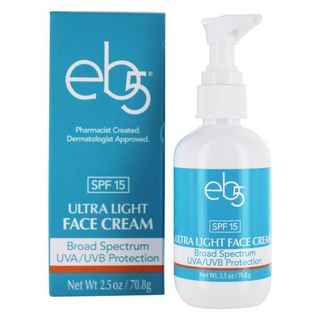
eb5 Ultra Light Face Cream Broad Spectrum UVA/UVB Protection 15 SPF
Works for
1 of 3 advertised claims delivered
Sun protectionSPF 15 · 3 UV filters · Broad spectrumWeak protectionSPF under 30
This product offers broad spectrum sun protection, but it is weak. We recommend to use a broad spectrum sunscreen with at least SPF 30.
Moisturizing7 ingredients credited for this claimStrong support
“Ultra Light Face Cream Broad Spectrum UVA/UVB Protection 15 SPF”
This product can help improve hydration of the skin with the two types of ingredients.
The first type is called “humectants”:
these ingredients help attract water.
When humectants are on the surface of the skin, they “pull in” the moisture from the outside environment, or from
within deeper layers of the skin. The following ingredients in this product do the job:
allantoin.
This product also contains ingredients called “occlusives”. They help reduce the speed with which our skin loses moisture to the outside environment. These ingredients also help soften the upper layer of the skin, so it feels less tight and nicer to the touch. The following ingredients in this product do the job: dimethicone, helianthus annuus seed oil.
The following ingredients in this product are especially good for supporting the skin barrier and helping with the hydration level: panthenol
Anti-aging2 ingredients credited for this claimLimited support
“Moisturize, prevent fine lines and wrinkles and protect skin all at once.”
This product does not contain ingredients that are able to reduce fine lines and wrinkles or help with skin elasticity, but it can improve the look of the skin temporarily through moisturization. Well-moisturized skin might also be able to repair the sun damage better.
The biggest anti-aging effect in this product comes from sun protection. Sun damage is the main factor causing early signs of skin aging. We, however, do not recommend using this product as a sunscreen because the protection it offers is not strong enough).
Can it cause trouble?
Irritancy1 strong irritant: Retinyl palmitateMedium risk
ComedogenicClean of flagged comedogenic ingredientsNone flagged


User reviews
Be the first — your take helps the next person decide.
Ingredients
Filter by role to see what each ingredient is doing.
Ethylhexyl methoxycinnamate5%
- Irritation risk
- High
Octinoxate. When used in higher concentrations, works as a sunscreen protecting the skin from UVB rays. When used in lower concentration, helps to preserve the product formulation. Is shown to be harmful to coral reefs - consider avoiding bathing in coral reef areas when wearing a product with this ingredient. It can be irritating
More about Ethylhexyl methoxycinnamateEthylhexyl salicylate3%
- Irritation risk
- Low
Octisalate. A UV filter. It offers some protection against the sun rays that cause sunburn (UVB), but does not protect against the most aging sun rays (UVA). It loses its effectiveness quickly when exposed to sunlight. It is an organic, or so called "chemical" sunscreen
More about Ethylhexyl salicylateZinc oxide3%
- Irritation risk
- Low
A broad spectrum sunblock (protects from both UVA and UVB rays). Is suitable for most sensitive skins. In small concentrations, can be used as a colorant
More about Zinc oxideAllantoin~23–34%
- Irritation risk
- Low
Helps calm down inflammation in skin and can help reduce itching. Helps to repair the skin barrier and keep skin hydrated
More about AllantoinWater~10–15%
Avena sativa kernel protein~4.9–7.4%
- Irritation risk
- Low
Carbomer~3.7–5.5%
- Irritation risk
- Low
Helps create a thicker or gel-like product texture. It is not a surfactant but can be used in gentle cleansing formulations
More about CarbomerCetyl alcohol~2.9–4.3%
- Irritation risk
- Low
A non-drying alcohol that works to soften the skin and stabilize product formulations helping oil and water mix together
More about Cetyl alcoholDimethicone~2.4–3.6%
- Irritation risk
- Low
A silicone that helps to reduce water loss from the surface of the skin. Can temporarily "fill in" lines and wrinkles, absorb oil, and create a nice product finish
More about DimethiconePanthenol~1.5–2.2%
- Irritation risk
- Low
Helps attract water to the upper layer of the skin and can help improve skin barrier function
More about PanthenolEthylhexylglycerin~1.2–1.8%
Helianthus annuus seed oil~1.2–1.9%
- Irritation risk
- Low
A great emollient due to its high linoleic acid content. One of the most effective plant oils in helping skin hydration and repairing skin barrier function
More about Helianthus annuus seed oilPhenoxyethanol~0.5–1%
- Irritation risk
- Low
A preservative. It helps prevent bacterial growth in cosmetic products
More about PhenoxyethanolPolysorbate 20~0.5–1.15%
Potassium sorbate~0.3–0.6%
Propylene glycol~0.4–0.9%
- Irritation risk
- High
Helps oil and water mix together and can enhance the penetration of other ingredients into the skin. It can be irritating
More about Propylene glycolRetinyl palmitate~0.3–0.7%
- Irritation risk
- High
Three steps removed from the active form of vitamin A - retinoic acid. To have an effect in the skin, it first needs to be converted twice to become the retinoic acid. This means it is less potent than retinol, but could also be less irritating. Once converted to the retinoic acid in the skin, it helps against all signs of aging, improves skin cell turnover and helps fight blemishes and clogged pores. However, in many cosmetic formulations, it is used in a concentration that is too low to have the full effect
More about Retinyl palmitateSilica~0.35–0.75%
Sodium hydroxide~0.1–0.35%
Stearic acid~0.15–0.65%
- Irritation risk
- Low
Helps oil and water mix together and works as an emollient
More about Stearic acidTocopheryl acetate~0.05–0.25%
- Irritation risk
- Medium
A more stable but less bio-available form of vitamin E compared to Tocopherol. Might help moisturize and protect the skin from free radicals, but mostly used in low concentrations to stabilize other ingredients.
More about Tocopheryl acetateTocopherol~0.05–0.2%
- Irritation risk
- Low
Pure form of vitamin E. Can help moisturise and protect the skin from free radicals. Often used to help stabilise other ingredients or the formula itself
More about TocopherolIngredient list view
Ethylhexyl methoxycinnamate, Ethylhexyl salicylate, Zinc oxide, Allantoin, Water, Avena sativa kernel protein, Carbomer, Cetyl alcohol, Dimethicone, Panthenol, Ethylhexylglycerin, Helianthus annuus seed oil, Phenoxyethanol, Polysorbate 20, Potassium sorbate, Propylene glycol, Retinyl palmitate, Silica, Sodium hydroxide, Stearic acid, Tocopheryl acetate, Tocopherol
Compare prices
Retailers ranked by price — lowest first.
Worth comparing, line by line.
Match % combines shared ingredients, the first five ingredients, shared actives and hero ingredients, irritancy (lower counts in the alternative's favour), texture and body area. Only products in the same routine step are compared.
| eb5Ultra Light Face Cream Broad Spectrum UVA/UVB Protection 15 SPFYOUR PRODUCT | SkinMedicaTotal Defense and Repair SPF 50 | Image skincarePREVENTION+ SPF32+ Daily Matte Moisturizer | DCLSkincare Super Sheer SPF50 Broad Spectrum Protection Sunscreen | |
|---|---|---|---|---|
| Match | — | 62% | 59% | 59% |
| Price | $24.95 | $61.20+$36.25 | $50.00+$25.05 | $60.81+$35.86 |
| Shared key ingredients | — | 4 of 7 | 4 of 7 | 4 of 7 |
| Key difference | — | Niacinamide | Tetrahexyldecyl Ascorbate | Tetrahexyldecyl Ascorbate |
| Irritancy | Medium | Low | Low | Low |
| SPF | SPF 15 | SPF 50 | SPF 32 | SPF 50 |
| Drying alcohol | — | — | — | — |
| View product | Shop | Shop | Shop |


Product summary
"eb5 - Ultra Light Face Cream Broad Spectrum UVA/UVB Protection 15 SPF" "is a broad spectrum sunscreen meaning that it protects both from UVB rays (" burning "- they cause sunburn) and UVA rays (" aging "- they don't cause sunburn but lead to premature aging and pigmentation issues). However, this moisturizer does not offer enough sun protection. We recommend to use a sunscreen with at least SPF 30 daily.
Because it includes good moisturizing ingredients, it can also work as a hydrating day cream.
Sunscreen filters
This is a" mixed "sunscreen in the sense that it uses both mineral and organic (so-called" chemical ") sun filters. Here are the organic filters this product uses: octinoxate and octisalate. As for the mineral filters, this sunscreen uses zinc oxide.
Irritation risk
There are some common irritants in this product, including ingredients that do not have benefits for the skin. We assess the overall irritancy of this moisturizer to be medium. For a detailed overview of all potential irritants: click here
You can see the detailed formula review with the breakdown of all actives in the product and the full ingredient list with estimated concentrations in the tables below.
Sources cited in this review
Every concentration estimate and effectiveness label is anchored to one of these 19 studies and safety reviews.
- 1A review of inorganic UV filters zinc oxide and titanium dioxideonlinelibrary.wiley.com
- 2
- 3
- 4
- 5
- 6

Affiliate links · As an Amazon Associate, WIMJ earns from qualifying purchases.