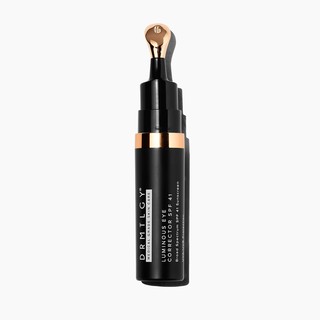
DRMTLGY Luminous Eye Corrector SPF 41
Works for
4 of 4 advertised claims delivered
Sun protectionSPF 41 · 3 UV filtersBroad spectrum
This product offers a good level of protection against both UVB and UVA rays.
This sunscreen uses organic (so-called "chemical") sunscreen filters. Organic, or "chemical" filters usually provide reliable sun protection and rarely leave a white cast. Sunscreens with organic filters can sting eyes.
This product can be considered "reef safe" because it does not contain the UV filters (oxybenzone and octinoxate) that can be harmful to coral reefs when present in the water in high concentrations.
Evens skin toneNo ingredient credited for this claimStrong evidence
“brightening, color-correcting”
This product offers broad spectrum sun protection. It means that it can prevent hyperpigmentation and help keep the skin tone even (sun damage is the main factor causing age spots, darkening of post-acne marks and other discolorations).
Anti-agingPalmitoyl tetrapeptide-7, Palmitoyl tripeptide-5 + 1 moreStrong evidence
“This multi-tasking SPF eye corrector instantly camouflages dark circles and visibly improves the appearance of fine lines and puffiness, all while protecting the delicate eye area against photoaging.”
This product can help prevent early signs of skin aging because it offers a good level of broad spectrum sun protection. Sun damage is the main cause of premature skin aging, and protecting your skin from the sun is the best anti-aging strategy.
These ingredients in the product might also be helpful for reducing and preventing fine lines, wrinkles, and skin elasticity, even though there is no conclusive evidence for their effectiveness: palmitoyl tetrapeptide-7, palmitoyl tripeptide-1, palmitoyl tripeptide-5.
MoisturizingPalmitoyl tripeptide-5, Phytosphingosine + 20 moreStrong evidence
“The cooling applicator tip pairs with hydrating anti-aging ingredients, like peptides and snow mushroom, to help reduce puffiness and brighten eyes without settling into fine lines.”
This product can help improve hydration of the skin with the two types of ingredients.
The first type is called “humectants”:
these ingredients help attract water.
When humectants are on the surface of the skin, they “pull in” the moisture from the outside environment, or from
within deeper layers of the skin. The following ingredients in this product do the job:
glycerin, sodium lactate.
This product also contains ingredients called “occlusives”. They help reduce the speed with which our skin loses moisture to the outside environment. These ingredients also help soften the upper layer of the skin, so it feels less tight and nicer to the touch. The following ingredients in this product do the job: caprylic/capric triglyceride, dimethicone.
The following ingredients in this product are especially good for supporting the skin barrier and helping with the hydration level: ceramide ap, ceramide eop, ceramide np, palmitoyl tetrapeptide-7, palmitoyl tripeptide-1, palmitoyl tripeptide-5, phytosphingosine
Anti-oxidationNot advertised by the brand · Polygonum aviculare extract, Tremella fuciformis sporocarp extract + 3 moreStrong evidence
This product contains antioxidants (polygonum aviculare extract) that can help neutralize free radicals in skin. By doing so, they can lessen the damage the skin gets from the UV light (sun).
Can it cause trouble?
Irritancy16 flagged ingredientsMedium risk
ComedogenicClean of flagged comedogenic ingredientsNone flagged
User reviews
Be the first — your take helps the next person decide.
Ingredients
Filter by role to see what each ingredient is doing.
Zinc oxide12%
- Irritation risk
- Low
A broad spectrum sunblock (protects from both UVA and UVB rays). Is suitable for most sensitive skins. In small concentrations, can be used as a colorant
More about Zinc oxideTitanium dioxide10%
- Irritation risk
- Low
Works as a UV filter when used in high concentrations. It is photostable and is effective mostly against the UVB light, with some protection in the UVA range. In small concentrations, used for its ability to improve the color of cosmetic products. Is usually well tolerated by the skin
More about Titanium dioxideWater~45–55%
Dimethicone~4.7–5.8%
- Irritation risk
- Low
A silicone that helps to reduce water loss from the surface of the skin. Can temporarily "fill in" lines and wrinkles, absorb oil, and create a nice product finish
More about DimethiconeButyloctyl salicylate~5–6.1%
- Irritation risk
- Medium
A synthetic ester of salicylic acid that is used to help disperse pigments and boost effectiveness of sunscreen ingredients. It is able to absorb UV light (working as an organic, or chemical filter), but is not approved as a sunscreen ingredient on its own
More about Butyloctyl salicylatePropanediol~3.6–4.4%
- Irritation risk
- Low
Acts as a solvent for other ingredients. Speeds up the absorption of other ingredients into the skin
More about PropanediolCaprylic/capric triglyceride~3.1–3.8%
- Irritation risk
- Medium
A good mix of fatty acids that forms a protective layer on the skin. Improves the shelf life of products. Derived from coconut and glycerin
More about Caprylic/capric triglycerideIsododecane~2.4–2.9%
- Irritation risk
- Low
An emollient that helps soften the skin and can decrease moisture loss. Helps create a nice product texture
More about IsododecanePolymethylsilsesquioxane/trimethylsiloxysilicate~2.2–2.6%
- Irritation risk
- Low
Dimethicone crosspolymer~1.8–2.2%
- Irritation risk
- Low
Used to create a thicker product texture. Helps soften the upper layer of the skin and might be able to prevent moisture loss from its surface
More about Dimethicone crosspolymerPolyglyceryl-4 isostearate~1.5–1.8%
- Irritation risk
- Medium
Helps water and oil mix together
More about Polyglyceryl-4 isostearateCetyl peg/ppg-10/1 dimethicone~1.3–1.5%
- Irritation risk
- Low
A type of silicone that helps water and oil mix together. Can help to soften upper layer of the skin
More about Cetyl peg/ppg-10/1 dimethiconeHexyl laurate~1.1–1.3%
- Irritation risk
- Medium
Helps soften the upper layer of the skin and create a nice product consistency
More about Hexyl lauratePolyhydroxystearic acid~1–1.2%
- Irritation risk
- Medium
Used to create a thicker product consistency and stabilize the formulation
More about Polyhydroxystearic acidSodium chloride~0.95–1.15%
- Irritation risk
- Low
Used to stabilize mixtures of oil and water, and create thicker, gel-like product textures
More about Sodium chloride1,2-hexanediol~0.75–1.15%
Coco-caprylate/caprate~0.9–1.1%
- Irritation risk
- Low
Helps to soften the upper layer of the skin without creating a greasy texture
More about Coco-caprylate/caprateDimethicone/vinyl dimethicone crosspolymer~0.75–1.15%
- Irritation risk
- Low
Used to stabilize product formulations and create a nice product texture
More about Dimethicone/vinyl dimethicone crosspolymerPolyphenylsilsesquioxane~0.7–1.1%
- Irritation risk
- Low
Glycerin~0.75–1.1%
- Irritation risk
- Low
One of the best moisturizing ingredients. Naturally present in skin. It attracts water to the upper layer of the skin working as a humectant
More about GlycerinCaprylhydroxamic acid~0.65–1%
Citrullus lanatus fruit extract~0.6–0.95%
- Irritation risk
- Medium
A plant extract that can contain an antioxidant compound
More about Citrullus lanatus fruit extractPolyglyceryl-6 polyricinoleate~0.65–0.95%
- Irritation risk
- Medium
Helps oil and water mix together
More about Polyglyceryl-6 polyricinoleateLens esculenta fruit extract~0.6–0.9%
- Irritation risk
- Medium
A plant extract containing sugars that might help attract water to the upper layer of the skin. Is claimed by the manufacturer to help reduce pore size but evidence is lacking
More about Lens esculenta fruit extractTremella fuciformis sporocarp extract~0.55–0.85%
- Irritation risk
- Low
Mushroom extract that helps attract water to the upper layer of the skin
More about Tremella fuciformis sporocarp extractDilinoleic acid/butanediol copolymer~0.6–0.9%
- Irritation risk
- Low
Disodium stearoyl glutamate~0.6–0.95%
- Irritation risk
- Medium
Helps oil and water mix together and workd as a cleanser
More about Disodium stearoyl glutamatePyrus malus fruit extract~0.55–0.85%
- Irritation risk
- Medium
Can have some moisturizing properties due to its sugar content
More about Pyrus malus fruit extractSilica~0.65–1%
Trisodium ethylenediamine disuccinate~0.55–0.85%
- Irritation risk
- Medium
Used to improve stability of the formulation
More about Trisodium ethylenediamine disuccinateCastor oil/ipdi copolymer~0.6–0.9%
Sodium lactate~0.55–0.85%
- Irritation risk
- Medium
Helps attract water to the upper layer of the skin. Is often used to adjust the pH level of the product
More about Sodium lactateSodium pca~0.55–0.85%
- Irritation risk
- Low
Naturally present in skin and helps to attract water to its upper layer
More about Sodium pcaButylene glycol~0.55–0.8%
- Irritation risk
- Low
Used to create a nice product texture and help delivery of other ingredients. Might be somewhat helpful in attracting water to the upper layer of the skin
More about Butylene glycolSodium lauroyl lactylate~0.5–0.7%
- Irritation risk
- Medium
Helps water and oil mix together
More about Sodium lauroyl lactylatePolygonum aviculare extract~0.55–0.8%
- Irritation risk
- Medium
A plant extract that contains a flavanol Juglanin. It can help neutralize free radicals in skin and reduce inflammation
More about Polygonum aviculare extractCarbomer~0.5–0.75%
- Irritation risk
- Low
Helps create a thicker or gel-like product texture. It is not a surfactant but can be used in gentle cleansing formulations
More about CarbomerCeramide np~0.5–0.75%
- Irritation risk
- Low
A type of lipid similar to ceramides naturally present in skin. Helps to soften the upper layer of the skin and supports the skin barrier function to keep it hydrated. Can help to prevent inflammation in skin
More about Ceramide npPalmitoyl tripeptide-5~0.45–0.7%
- Irritation risk
- Low
A type of peptide. Peptides are excellent moisturizers and might be able support collagen production reducing fine lines and wrinkles
More about Palmitoyl tripeptide-5Ceramide ap~0.45–0.65%
- Irritation risk
- Low
A type of lipid similar to ceramides naturally present in skin. Helps to soften the upper layer of the skin and supports the skin barrier function to keep it hydrated. Can help to prevent inflammation in skin
More about Ceramide apPhytosphingosine~0.45–0.7%
- Irritation risk
- Low
A type of lipid that is naturally present in skin. It might help in repairing skin barrier function and has anti-bacterial effect
More about PhytosphingosineCholesterol~0.45–0.65%
- Irritation risk
- Low
An emollient that is naturally found in skin
More about CholesterolPolysorbate 20~0.35–0.65%
Xanthan gum~0.3–0.55%
- Irritation risk
- Low
Used to create a thicker product consistency
More about Xanthan gumPalmitoyl tripeptide-1~0.3–0.5%
- Irritation risk
- Low
A type of peptide. Peptides are excellent moisturizers and might be able support collagen production reducing fine lines and wrinkles
More about Palmitoyl tripeptide-1Palmitoyl tetrapeptide-7~0.25–0.5%
- Irritation risk
- Low
A type of peptide. Peptides are excellent moisturizers and might be able support collagen production reducing fine lines and wrinkles
More about Palmitoyl tetrapeptide-7Ceramide eop~0.25–0.45%
- Irritation risk
- Low
A type of lipid similar to ceramides naturally present in skin. Helps to soften the upper layer of the skin and supports the skin barrier function to keep it hydrated. Can help to prevent inflammation in skin
More about Ceramide eopIngredient list view
Zinc oxide, Titanium dioxide, Water, Dimethicone, Butyloctyl salicylate, Propanediol, Caprylic/capric triglyceride, Isododecane, Polymethylsilsesquioxane/trimethylsiloxysilicate, Dimethicone crosspolymer, Polyglyceryl-4 isostearate, Cetyl peg/ppg-10/1 dimethicone, Hexyl laurate, Polyhydroxystearic acid, Sodium chloride, 1,2-hexanediol, Coco-caprylate/caprate, Dimethicone/vinyl dimethicone crosspolymer, Polyphenylsilsesquioxane, Glycerin, Caprylhydroxamic acid, Citrullus lanatus fruit extract, Polyglyceryl-6 polyricinoleate, Lens esculenta fruit extract, Tremella fuciformis sporocarp extract, Dilinoleic acid/butanediol copolymer, Disodium stearoyl glutamate, Pyrus malus fruit extract, Silica, Trisodium ethylenediamine disuccinate, Castor oil/ipdi copolymer, Sodium lactate, Sodium pca, Butylene glycol, Sodium lauroyl lactylate, Polygonum aviculare extract, Carbomer, Ceramide np, Palmitoyl tripeptide-5, Ceramide ap, Phytosphingosine, Cholesterol, Polysorbate 20, Xanthan gum, Palmitoyl tripeptide-1, Palmitoyl tetrapeptide-7, Ceramide eop, Unknown, Unknown, Unknown
Compare prices
Retailers ranked by price — lowest first.

Worth comparing, line by line.
Match % combines shared ingredients, the first five ingredients, shared actives and hero ingredients, irritancy (lower counts in the alternative's favour), texture and body area. Only products in the same routine step are compared.
| DRMTLGYLuminous Eye Corrector SPF 41YOUR PRODUCT | .25 fl ozLuminous Eye Corrector SPF 41 - Medium | |
|---|---|---|
| Match | — | 75% |
| Price | $46.33 | — |
| Shared key ingredients | — | 18 of 18 |
| Key difference | — | — |
| Irritancy | Medium | Medium |
| SPF | SPF 41 | SPF 41 |
| Drying alcohol | — | — |
| View product | Shop |
Sources cited in this review
Every concentration estimate and effectiveness label is anchored to one of these 17 studies and safety reviews.
- 1A review of inorganic UV filters zinc oxide and titanium dioxideonlinelibrary.wiley.com
- 2
- 3
- 4
- 5
- 6

Affiliate links · As an Amazon Associate, WIMJ earns from qualifying purchases.