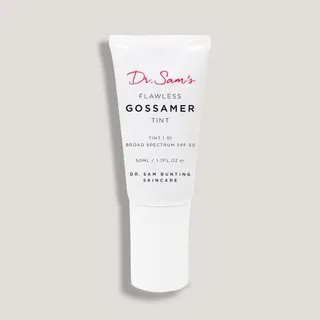
Dr Sam's Flawless Gossamer Tint SPF 50
Works for
Sun protectionSPF 50 · 2 UV filtersBroad spectrum
This product offers a good level of protection against both UVB and UVA rays.
It is a mineral sunscreen. In other words, it contains non-organic UV filters. It will probably not sting your eyes but might leave a white cast.
This product can be considered "reef safe" because it does not contain the UV filters (oxybenzone and octinoxate) that can be harmful to coral reefs when present in the water in high concentrations.
Evens skin toneSide benefit · No ingredient credited for this claimWorks well
This product offers broad spectrum sun protection. It means that it can prevent hyperpigmentation and help keep the skin tone even (sun damage is the main factor causing age spots, darkening of post-acne marks and other discolorations).
Anti-agingSide benefit · Butyrospermum parkii butterWorks well
This product can help prevent early signs of skin aging because it offers a good level of broad spectrum sun protection. Sun damage is the main cause of premature skin aging, and protecting your skin from the sun is the best anti-aging strategy.
MoisturizingSide benefit the brand mentions · Octyldodecyl neopentanoate, Squalane + 10 moreWorks
“Next-level hydration for all-day dewiness Skin perfecting finish Broad-spectrum SPF 50”
This product can help improve hydration of the skin with the two types of ingredients.
The first type is called “humectants”:
these ingredients help attract water.
When humectants are on the surface of the skin, they “pull in” the moisture from the outside environment, or from
within deeper layers of the skin. The following ingredients in this product do the job:
glycerin, sodium hyaluronate.
This product also contains ingredients called “occlusives”. They help reduce the speed with which our skin loses moisture to the outside environment. These ingredients also help soften the upper layer of the skin, so it feels less tight and nicer to the touch. The following ingredients in this product do the job: butyrospermum parkii butter, caprylic/capric triglyceride.
Can it cause trouble?
Irritancy1 strong irritant: Sodium hydroxymethylglycinate — patch-test recommendedHigh risk
Comedogenic8 ingredients rated 2 or more on the 0–5 pore-clogging scale8 flagged
User reviews
Be the first — your take helps the next person decide.
Ingredients
Filter by role to see what each ingredient is doing.
Tin~26–39%
Water~11–17%
Caprylic/capric triglyceride~5.4–8%
- Irritation risk
- Medium
A good mix of fatty acids that forms a protective layer on the skin. Improves the shelf life of products. Derived from coconut and glycerin
More about Caprylic/capric triglycerideZinc oxide~3.7–5.6%
- Irritation risk
- Low
A broad spectrum sunblock (protects from both UVA and UVB rays). Is suitable for most sensitive skins. In small concentrations, can be used as a colorant
More about Zinc oxideOctyldodecyl neopentanoate~2.4–3.6%
- Irritation risk
- Low
An emollient that helps soften the skin. Often used to stabilize other ingredients, for example, sunscreen
More about Octyldodecyl neopentanoateTitanium dioxide~2.2–3.4%
- Irritation risk
- Low
Works as a UV filter when used in high concentrations. It is photostable and is effective mostly against the UVB light, with some protection in the UVA range. In small concentrations, used for its ability to improve the color of cosmetic products. Is usually well tolerated by the skin
More about Titanium dioxideButyrospermum parkii butter~2–2.9%
- Irritation risk
- Low
- Comedogenicity
- 3/5
A great moisturising ingredient that softens the skin and reduces water loss from its upper layer. It also can be helpful in protecting skin from free radicals
More about Butyrospermum parkii butterHydroxyethyl acrylate/sodium acryloyldimethyl taurate copolymer~1.6–2.4%
- Irritation risk
- Medium
A gelling agent that thickens the product consistency and leaves the skin with a velvety finish
More about Hydroxyethyl acrylate/sodium acryloyldimethyl taurate copolymerPolyhydroxystearic acid~1.5–2.2%
- Irritation risk
- Medium
Used to create a thicker product consistency and stabilize the formulation
More about Polyhydroxystearic acidSqualane~1.1–1.7%
- Irritation risk
- Low
An oil naturally present in skin. Works as an emollient to soften the skin and form a protective layer on its surface without a greasy feeling.
More about SqualaneCetearyl alcohol~1–1.5%
- Irritation risk
- Low
- Comedogenicity
- 2/5
A non-drying alcohol. Works as an emollient. Helps water and oil mix together and creates a nice product texture
More about Cetearyl alcoholPhenoxyethanol~0.5–1%
- Irritation risk
- Low
A preservative. It helps prevent bacterial growth in cosmetic products
More about PhenoxyethanolSodium stearoyl glutamate~0.55–1.3%
- Irritation risk
- Medium
Helps oil and water mix together
More about Sodium stearoyl glutamateSodium hyaluronate~0.5–1.1%
- Irritation risk
- Low
One of the best moisturizing ingredients. Attracts water into the upper layer of the skin
More about Sodium hyaluronatePolysorbate 60~0.5–1.1%
Alumina~0.85–1.25%
- Irritation risk
- Low
The same compound that is used safely in dental implants and bone cements. In cosmetics, it is used to improve the consistency of products
More about AluminaAluminum stearate~0.45–1.05%
- Irritation risk
- Medium
Used to help evenly disperse other ingredients (for example, pigment) in a formulation
More about Aluminum stearateHydrogenated polydecene~0.45–1.05%
- Irritation risk
- Low
Helps to soften the upper layer of the skin and create a nice product texture
More about Hydrogenated polydeceneCarbomer~0.45–1%
- Irritation risk
- Low
Helps create a thicker or gel-like product texture. It is not a surfactant but can be used in gentle cleansing formulations
More about CarbomerSodium hydroxymethylglycinate~0.25–0.5%
Hexanediol~0.4–0.9%
Disodium edta~0.4–0.9%
Isostearic acid~0.45–1%
- Irritation risk
- Low
Used to create a nice product texture
More about Isostearic acidEthylhexylglycerin~0.35–0.85%
Sorbitan isostearate~0.4–0.9%
- Irritation risk
- Low
Helps oil and water mix together
More about Sorbitan isostearateBiosaccharide gum-4~0.35–0.85%
Disteardimonium hectorite~0.35–0.85%
- Irritation risk
- Low
A type of clay that is used to thicken the product consistency
More about Disteardimonium hectoritePropylene carbonate~0.4–0.9%
- Irritation risk
- Low
Is used to dissolve other ingredients and create nice product texture
More about Propylene carbonateCitric acid~0.35–0.85%
- Irritation risk
- Medium
Can work as an exfoliant but is typically used to adjust the product pH
More about Citric acidCi 77492~0.35–0.85%
Iron oxides~0.35–0.8%
- Irritation risk
- Low
An umbrella term for the following three colorants: CI 77491, CI 77492, CI 77499. They might be able to offer some protection against visible light, but the degree of the protection is not clear
More about Iron oxidesCi 77891~0.35–0.8%
- Irritation risk
- Low
Titanium dioxide~0.45–1%
- Irritation risk
- Low
Works as a UV filter when used in high concentrations. It is photostable and is effective mostly against the UVB light, with some protection in the UVA range. In small concentrations, used for its ability to improve the color of cosmetic products. Is usually well tolerated by the skin
More about Titanium dioxideCi 77491~0.35–0.85%
- Irritation risk
- Low
A red colorant made of iron oxide. Typically is not irritating
More about Ci 77491Iron oxides~0.35–0.8%
- Irritation risk
- Low
An umbrella term for the following three colorants: CI 77491, CI 77492, CI 77499. They might be able to offer some protection against visible light, but the degree of the protection is not clear
More about Iron oxidesCi 77499~0.35–0.85%
Iron oxides~0.35–0.8%
- Irritation risk
- Low
An umbrella term for the following three colorants: CI 77491, CI 77492, CI 77499. They might be able to offer some protection against visible light, but the degree of the protection is not clear
More about Iron oxidesTin~0.35–0.85%
Water~0.35–0.85%
Caprylic/capric triglyceride~0.45–1%
- Irritation risk
- Medium
A good mix of fatty acids that forms a protective layer on the skin. Improves the shelf life of products. Derived from coconut and glycerin
More about Caprylic/capric triglycerideZinc oxide~0.45–1.1%
- Irritation risk
- Low
A broad spectrum sunblock (protects from both UVA and UVB rays). Is suitable for most sensitive skins. In small concentrations, can be used as a colorant
More about Zinc oxideOctyldodecyl neopentanoate~0.45–1%
- Irritation risk
- Low
An emollient that helps soften the skin. Often used to stabilize other ingredients, for example, sunscreen
More about Octyldodecyl neopentanoateTitanium dioxide~0.45–1%
- Irritation risk
- Low
Works as a UV filter when used in high concentrations. It is photostable and is effective mostly against the UVB light, with some protection in the UVA range. In small concentrations, used for its ability to improve the color of cosmetic products. Is usually well tolerated by the skin
More about Titanium dioxideOctyldodecyl oleate~0.45–1%
- Irritation risk
- Low
Butyrospermum parkii butter~0.4–0.95%
- Irritation risk
- Low
- Comedogenicity
- 3/5
A great moisturising ingredient that softens the skin and reduces water loss from its upper layer. It also can be helpful in protecting skin from free radicals
More about Butyrospermum parkii butterHydroxyethyl acrylate/sodium acryloyldimethyl taurate copolymer~0.35–0.85%
- Irritation risk
- Medium
A gelling agent that thickens the product consistency and leaves the skin with a velvety finish
More about Hydroxyethyl acrylate/sodium acryloyldimethyl taurate copolymerSqualane~0.45–1%
- Irritation risk
- Low
An oil naturally present in skin. Works as an emollient to soften the skin and form a protective layer on its surface without a greasy feeling.
More about SqualanePolyhydroxystearic acid~0.4–0.9%
- Irritation risk
- Medium
Used to create a thicker product consistency and stabilize the formulation
More about Polyhydroxystearic acidCetearyl alcohol~0.45–1.05%
- Irritation risk
- Low
- Comedogenicity
- 2/5
A non-drying alcohol. Works as an emollient. Helps water and oil mix together and creates a nice product texture
More about Cetearyl alcoholPhenoxyethanol~0.35–0.85%
- Irritation risk
- Low
A preservative. It helps prevent bacterial growth in cosmetic products
More about PhenoxyethanolSodium hyaluronate~0.35–0.85%
- Irritation risk
- Low
One of the best moisturizing ingredients. Attracts water into the upper layer of the skin
More about Sodium hyaluronatePolysorbate 60~0.4–0.9%
Alumina~0.5–1.1%
- Irritation risk
- Low
The same compound that is used safely in dental implants and bone cements. In cosmetics, it is used to improve the consistency of products
More about AluminaAluminum stearate~0.35–0.85%
- Irritation risk
- Medium
Used to help evenly disperse other ingredients (for example, pigment) in a formulation
More about Aluminum stearateCarbomer~0.4–0.9%
- Irritation risk
- Low
Helps create a thicker or gel-like product texture. It is not a surfactant but can be used in gentle cleansing formulations
More about CarbomerSodium hydroxymethylglycinate~0.25–0.5%
Sodium stearoyl glutamate~0.4–0.95%
- Irritation risk
- Medium
Helps oil and water mix together
More about Sodium stearoyl glutamate1,2-hexanediol~0.35–0.8%
Disodium edta~0.35–0.85%
Isostearic acid~0.45–1%
- Irritation risk
- Low
Used to create a nice product texture
More about Isostearic acidEthylhexylglycerin~0.35–0.85%
Sorbitan isostearate~0.4–0.9%
- Irritation risk
- Low
Helps oil and water mix together
More about Sorbitan isostearateBiosaccharide gum-4~0.35–0.85%
Citric acid~0.35–0.85%
- Irritation risk
- Medium
Can work as an exfoliant but is typically used to adjust the product pH
More about Citric acidCi 77891~0.35–0.8%
- Irritation risk
- Low
Titanium dioxide~0.45–1%
- Irritation risk
- Low
Works as a UV filter when used in high concentrations. It is photostable and is effective mostly against the UVB light, with some protection in the UVA range. In small concentrations, used for its ability to improve the color of cosmetic products. Is usually well tolerated by the skin
More about Titanium dioxideCi 77492~0.35–0.85%
Iron oxides~0.35–0.8%
- Irritation risk
- Low
An umbrella term for the following three colorants: CI 77491, CI 77492, CI 77499. They might be able to offer some protection against visible light, but the degree of the protection is not clear
More about Iron oxidesCi 77491~0.35–0.85%
- Irritation risk
- Low
A red colorant made of iron oxide. Typically is not irritating
More about Ci 77491Iron oxides~0.35–0.8%
- Irritation risk
- Low
An umbrella term for the following three colorants: CI 77491, CI 77492, CI 77499. They might be able to offer some protection against visible light, but the degree of the protection is not clear
More about Iron oxidesCi 77499~0.35–0.85%
Iron oxides~0.35–0.8%
- Irritation risk
- Low
An umbrella term for the following three colorants: CI 77491, CI 77492, CI 77499. They might be able to offer some protection against visible light, but the degree of the protection is not clear
More about Iron oxidesTin~0.35–0.85%
Water~0.35–0.85%
Caprylic/capric triglyceride~0.45–1%
- Irritation risk
- Medium
A good mix of fatty acids that forms a protective layer on the skin. Improves the shelf life of products. Derived from coconut and glycerin
More about Caprylic/capric triglycerideZinc oxide~0.45–1.1%
- Irritation risk
- Low
A broad spectrum sunblock (protects from both UVA and UVB rays). Is suitable for most sensitive skins. In small concentrations, can be used as a colorant
More about Zinc oxideOctyldodecyl neopentanoate~0.45–1%
- Irritation risk
- Low
An emollient that helps soften the skin. Often used to stabilize other ingredients, for example, sunscreen
More about Octyldodecyl neopentanoateTitanium dioxide~0.45–1%
- Irritation risk
- Low
Works as a UV filter when used in high concentrations. It is photostable and is effective mostly against the UVB light, with some protection in the UVA range. In small concentrations, used for its ability to improve the color of cosmetic products. Is usually well tolerated by the skin
More about Titanium dioxideButyrospermum parkii butter~0.4–0.95%
- Irritation risk
- Low
- Comedogenicity
- 3/5
A great moisturising ingredient that softens the skin and reduces water loss from its upper layer. It also can be helpful in protecting skin from free radicals
More about Butyrospermum parkii butterHydroxyethyl acrylate/sodium acryloyldimethyl taurate copolymer~0.35–0.85%
- Irritation risk
- Medium
A gelling agent that thickens the product consistency and leaves the skin with a velvety finish
More about Hydroxyethyl acrylate/sodium acryloyldimethyl taurate copolymerPolyhydroxystearic acid~0.4–0.9%
- Irritation risk
- Medium
Used to create a thicker product consistency and stabilize the formulation
More about Polyhydroxystearic acidSqualane~0.45–1%
- Irritation risk
- Low
An oil naturally present in skin. Works as an emollient to soften the skin and form a protective layer on its surface without a greasy feeling.
More about SqualaneCoco-caprylate/caprate~0.4–0.95%
- Irritation risk
- Low
Helps to soften the upper layer of the skin without creating a greasy texture
More about Coco-caprylate/caprateCetearyl alcohol~0.45–1.05%
- Irritation risk
- Low
- Comedogenicity
- 2/5
A non-drying alcohol. Works as an emollient. Helps water and oil mix together and creates a nice product texture
More about Cetearyl alcoholSaccharomyces ferment~0.35–0.8%
- Irritation risk
- Low
A product of yeast fermentation. Helps attract water to the upper layer of the skin
More about Saccharomyces fermentPhenoxyethanol~0.35–0.85%
- Irritation risk
- Low
A preservative. It helps prevent bacterial growth in cosmetic products
More about PhenoxyethanolAluminum stearate~0.35–0.85%
- Irritation risk
- Medium
Used to help evenly disperse other ingredients (for example, pigment) in a formulation
More about Aluminum stearateGlycerin~0.4–0.95%
- Irritation risk
- Low
One of the best moisturizing ingredients. Naturally present in skin. It attracts water to the upper layer of the skin working as a humectant
More about GlycerinSodium hyaluronate~0.35–0.85%
- Irritation risk
- Low
One of the best moisturizing ingredients. Attracts water into the upper layer of the skin
More about Sodium hyaluronatePolyglyceryl-6 polyricinoleate~0.4–0.9%
- Irritation risk
- Medium
Helps oil and water mix together
More about Polyglyceryl-6 polyricinoleatePolysorbate 60~0.4–0.9%
Alumina~0.5–1.1%
- Irritation risk
- Low
The same compound that is used safely in dental implants and bone cements. In cosmetics, it is used to improve the consistency of products
More about AluminaCarbomer~0.4–0.9%
- Irritation risk
- Low
Helps create a thicker or gel-like product texture. It is not a surfactant but can be used in gentle cleansing formulations
More about CarbomerSodium stearoyl glutamate~0.4–0.95%
- Irritation risk
- Medium
Helps oil and water mix together
More about Sodium stearoyl glutamateDilinoleic acid/butanediol copolymer~0.4–0.9%
- Irritation risk
- Low
Disodium stearoyl glutamate~0.4–0.95%
- Irritation risk
- Medium
Helps oil and water mix together and workd as a cleanser
More about Disodium stearoyl glutamate1,2-hexanediol~0.35–0.8%
Isostearic acid~0.45–1%
- Irritation risk
- Low
Used to create a nice product texture
More about Isostearic acidLauroyl lysine~0.35–0.85%
- Irritation risk
- Low
Helps soften the upper layer of the skin and creates a nice product texture
More about Lauroyl lysineEthylhexylglycerin~0.35–0.85%
Sorbitan isostearate~0.4–0.9%
- Irritation risk
- Low
Helps oil and water mix together
More about Sorbitan isostearateBiosaccharide gum-4~0.35–0.85%
Castor oil/ipdi copolymer~0.4–0.9%
Disodium edta~0.35–0.85%
Ci 77891~0.35–0.8%
- Irritation risk
- Low
Titanium dioxide~0.45–1%
- Irritation risk
- Low
Works as a UV filter when used in high concentrations. It is photostable and is effective mostly against the UVB light, with some protection in the UVA range. In small concentrations, used for its ability to improve the color of cosmetic products. Is usually well tolerated by the skin
More about Titanium dioxideCi 77492~0.35–0.85%
Iron oxides~0.35–0.8%
- Irritation risk
- Low
An umbrella term for the following three colorants: CI 77491, CI 77492, CI 77499. They might be able to offer some protection against visible light, but the degree of the protection is not clear
More about Iron oxidesCi 77491~0.35–0.85%
- Irritation risk
- Low
A red colorant made of iron oxide. Typically is not irritating
More about Ci 77491Iron oxides~0.35–0.8%
- Irritation risk
- Low
An umbrella term for the following three colorants: CI 77491, CI 77492, CI 77499. They might be able to offer some protection against visible light, but the degree of the protection is not clear
More about Iron oxidesCi 77499~0.35–0.85%
Iron oxides~0.35–0.8%
- Irritation risk
- Low
An umbrella term for the following three colorants: CI 77491, CI 77492, CI 77499. They might be able to offer some protection against visible light, but the degree of the protection is not clear
More about Iron oxidesTin~0.35–0.85%
Water~0.35–0.85%
Caprylic/capric triglyceride~0.45–1%
- Irritation risk
- Medium
A good mix of fatty acids that forms a protective layer on the skin. Improves the shelf life of products. Derived from coconut and glycerin
More about Caprylic/capric triglycerideZinc oxide~0.45–1.1%
- Irritation risk
- Low
A broad spectrum sunblock (protects from both UVA and UVB rays). Is suitable for most sensitive skins. In small concentrations, can be used as a colorant
More about Zinc oxideOctyldodecyl neopentanoate~0.45–1%
- Irritation risk
- Low
An emollient that helps soften the skin. Often used to stabilize other ingredients, for example, sunscreen
More about Octyldodecyl neopentanoateTitanium dioxide~0.45–1%
- Irritation risk
- Low
Works as a UV filter when used in high concentrations. It is photostable and is effective mostly against the UVB light, with some protection in the UVA range. In small concentrations, used for its ability to improve the color of cosmetic products. Is usually well tolerated by the skin
More about Titanium dioxideCoco-caprylate/caprate~0.4–0.95%
- Irritation risk
- Low
Helps to soften the upper layer of the skin without creating a greasy texture
More about Coco-caprylate/caprateButyrospermum parkii butter~0.4–0.95%
- Irritation risk
- Low
- Comedogenicity
- 3/5
A great moisturising ingredient that softens the skin and reduces water loss from its upper layer. It also can be helpful in protecting skin from free radicals
More about Butyrospermum parkii butterHydroxyethyl acrylate/sodium acryloyldimethyl taurate copolymer~0.35–0.85%
- Irritation risk
- Medium
A gelling agent that thickens the product consistency and leaves the skin with a velvety finish
More about Hydroxyethyl acrylate/sodium acryloyldimethyl taurate copolymerPolyhydroxystearic acid~0.4–0.9%
- Irritation risk
- Medium
Used to create a thicker product consistency and stabilize the formulation
More about Polyhydroxystearic acidSqualane~0.45–1%
- Irritation risk
- Low
An oil naturally present in skin. Works as an emollient to soften the skin and form a protective layer on its surface without a greasy feeling.
More about SqualaneCetearyl alcohol~0.45–1.05%
- Irritation risk
- Low
- Comedogenicity
- 2/5
A non-drying alcohol. Works as an emollient. Helps water and oil mix together and creates a nice product texture
More about Cetearyl alcoholSaccharomyces ferment~0.35–0.8%
- Irritation risk
- Low
A product of yeast fermentation. Helps attract water to the upper layer of the skin
More about Saccharomyces fermentPhenoxyethanol~0.35–0.85%
- Irritation risk
- Low
A preservative. It helps prevent bacterial growth in cosmetic products
More about PhenoxyethanolPolyglyceryl-6 polyricinoleate~0.4–0.9%
- Irritation risk
- Medium
Helps oil and water mix together
More about Polyglyceryl-6 polyricinoleateAluminum stearate~0.35–0.85%
- Irritation risk
- Medium
Used to help evenly disperse other ingredients (for example, pigment) in a formulation
More about Aluminum stearateGlycerin~0.4–0.95%
- Irritation risk
- Low
One of the best moisturizing ingredients. Naturally present in skin. It attracts water to the upper layer of the skin working as a humectant
More about GlycerinSodium hyaluronate~0.35–0.85%
- Irritation risk
- Low
One of the best moisturizing ingredients. Attracts water into the upper layer of the skin
More about Sodium hyaluronatePolysorbate 60~0.4–0.9%
Dilinoleic acid/butanediol copolymer~0.4–0.9%
- Irritation risk
- Low
Disodium stearoyl glutamate~0.4–0.95%
- Irritation risk
- Medium
Helps oil and water mix together and workd as a cleanser
More about Disodium stearoyl glutamateAlumina~0.45–1.05%
- Irritation risk
- Low
The same compound that is used safely in dental implants and bone cements. In cosmetics, it is used to improve the consistency of products
More about AluminaCarbomer~0.35–0.85%
- Irritation risk
- Low
Helps create a thicker or gel-like product texture. It is not a surfactant but can be used in gentle cleansing formulations
More about CarbomerSodium stearoyl glutamate~0.35–0.85%
- Irritation risk
- Medium
Helps oil and water mix together
More about Sodium stearoyl glutamate1,2-hexanediol~0.2–0.8%
Isostearic acid~0.4–0.9%
- Irritation risk
- Low
Used to create a nice product texture
More about Isostearic acidLauroyl lysine~0.3–0.75%
- Irritation risk
- Low
Helps soften the upper layer of the skin and creates a nice product texture
More about Lauroyl lysineEthylhexylglycerin~0.3–0.75%
Sorbitan isostearate~0.35–0.75%
- Irritation risk
- Low
Helps oil and water mix together
More about Sorbitan isostearateCastor oil/ipdi copolymer~0.3–0.75%
Biosaccharide gum-4~0.2–0.8%
Disodium edta~0.2–0.75%
Ci 77492~0.2–0.7%
Iron oxides~0.15–0.6%
- Irritation risk
- Low
An umbrella term for the following three colorants: CI 77491, CI 77492, CI 77499. They might be able to offer some protection against visible light, but the degree of the protection is not clear
More about Iron oxidesCi 77491~0.15–0.5%
- Irritation risk
- Low
A red colorant made of iron oxide. Typically is not irritating
More about Ci 77491Iron oxides~0.1–0.45%
- Irritation risk
- Low
An umbrella term for the following three colorants: CI 77491, CI 77492, CI 77499. They might be able to offer some protection against visible light, but the degree of the protection is not clear
More about Iron oxidesCi 77499~0.1–0.45%
Iron oxides~0.1–0.4%
- Irritation risk
- Low
An umbrella term for the following three colorants: CI 77491, CI 77492, CI 77499. They might be able to offer some protection against visible light, but the degree of the protection is not clear
More about Iron oxidesCi 77891~0.1–0.3%
- Irritation risk
- Low
Titanium dioxide~0.1–0.45%
- Irritation risk
- Low
Works as a UV filter when used in high concentrations. It is photostable and is effective mostly against the UVB light, with some protection in the UVA range. In small concentrations, used for its ability to improve the color of cosmetic products. Is usually well tolerated by the skin
More about Titanium dioxideIngredient list view
Tin, Water, Caprylic/capric triglyceride, Zinc oxide, Octyldodecyl neopentanoate, Titanium dioxide, Butyrospermum parkii butter, Hydroxyethyl acrylate/sodium acryloyldimethyl taurate copolymer, Polyhydroxystearic acid, Squalane, Cetearyl alcohol, Phenoxyethanol, Sodium stearoyl glutamate, Sodium hyaluronate, Polysorbate 60, Alumina, Aluminum stearate, Hydrogenated polydecene, Carbomer, Sodium hydroxymethylglycinate, Hexanediol, Disodium edta, Isostearic acid, Ethylhexylglycerin, Sorbitan isostearate, Biosaccharide gum-4, Disteardimonium hectorite, Propylene carbonate, Citric acid, Ci 77492, Iron oxides, Ci 77891, Titanium dioxide, Ci 77491, Iron oxides, Ci 77499, Iron oxides, Tin, Water, Caprylic/capric triglyceride, Zinc oxide, Octyldodecyl neopentanoate, Titanium dioxide, Octyldodecyl oleate, Butyrospermum parkii butter, Hydroxyethyl acrylate/sodium acryloyldimethyl taurate copolymer, Squalane, Polyhydroxystearic acid, Cetearyl alcohol, Phenoxyethanol, Sodium hyaluronate, Polysorbate 60, Alumina, Aluminum stearate, Carbomer, Sodium hydroxymethylglycinate, Sodium stearoyl glutamate, 1,2-hexanediol, Disodium edta, Isostearic acid, Ethylhexylglycerin, Sorbitan isostearate, Biosaccharide gum-4, Citric acid, Ci 77891, Titanium dioxide, Ci 77492, Iron oxides, Ci 77491, Iron oxides, Ci 77499, Iron oxides, Tin, Water, Caprylic/capric triglyceride, Zinc oxide, Octyldodecyl neopentanoate, Titanium dioxide, Butyrospermum parkii butter, Hydroxyethyl acrylate/sodium acryloyldimethyl taurate copolymer, Polyhydroxystearic acid, Squalane, Coco-caprylate/caprate, Cetearyl alcohol, Saccharomyces ferment, Phenoxyethanol, Aluminum stearate, Glycerin, Sodium hyaluronate, Polyglyceryl-6 polyricinoleate, Polysorbate 60, Alumina, Carbomer, Sodium stearoyl glutamate, Dilinoleic acid/butanediol copolymer, Disodium stearoyl glutamate, 1,2-hexanediol, Isostearic acid, Lauroyl lysine, Ethylhexylglycerin, Sorbitan isostearate, Biosaccharide gum-4, Castor oil/ipdi copolymer, Disodium edta, Ci 77891, Titanium dioxide, Ci 77492, Iron oxides, Ci 77491, Iron oxides, Ci 77499, Iron oxides, Tin, Water, Caprylic/capric triglyceride, Zinc oxide, Octyldodecyl neopentanoate, Titanium dioxide, Coco-caprylate/caprate, Butyrospermum parkii butter, Hydroxyethyl acrylate/sodium acryloyldimethyl taurate copolymer, Polyhydroxystearic acid, Squalane, Cetearyl alcohol, Saccharomyces ferment, Phenoxyethanol, Polyglyceryl-6 polyricinoleate, Aluminum stearate, Glycerin, Sodium hyaluronate, Polysorbate 60, Dilinoleic acid/butanediol copolymer, Disodium stearoyl glutamate, Alumina, Carbomer, Sodium stearoyl glutamate, 1,2-hexanediol, Isostearic acid, Lauroyl lysine, Ethylhexylglycerin, Sorbitan isostearate, Castor oil/ipdi copolymer, Biosaccharide gum-4, Disodium edta, Ci 77492, Iron oxides, Ci 77491, Iron oxides, Ci 77499, Iron oxides, Ci 77891, Titanium dioxide
Compare prices
Retailers ranked by price — lowest first.

Worth comparing, line by line.
Match % combines shared ingredients, the first five ingredients, shared actives and hero ingredients, irritancy (lower counts in the alternative's favour), texture and body area. Only products in the same routine step are compared.
| Dr Sam'sFlawless Gossamer Tint SPF 50YOUR PRODUCT | MALIN + GOETZspf 30 mineral sunscreen | EltaMDUV Replenish Broad-Spectrum SPF 44 | PatykaCrème Solaire Teintée SPF50 | |
|---|---|---|---|---|
| Match | — | 28% | 28% | 28% |
| Price | — | $40.00 | — | $25.00 |
| Shared key ingredients | — | 6 of 9 | 6 of 9 | 5 of 9 |
| Key difference | — | Niacinamide | Cetyl Dimethicone | Haematococcus Pluvialis Extract |
| Irritancy | High | Low | Low | Medium |
| SPF | SPF 50 | SPF 30 | SPF 44 | SPF 50 |
| Drying alcohol | — | — | — | — |
| View product | Shop | Shop | Shop |



More alternatives: Clinique Moisture Surge CC Cream SPF 30 MediumVolition Adaptint Super Seamless Mineral Shield SPF30
Product summary
The ingredient list suggests that "Dr Sam's - Flawless Gossamer Tint SPF 50" can provide reliable sun protection. We love that it can protect from both UVA and UVB rays (not all sunscreens with SPF ratings give UVA protection. UVA rays do not cause sunburn, but still damage our skin and lead to early aging).
It also works as a moisturizer, so you do not have to use an additional hydrating product. Like all broad-spectrum sunscreens, this product has an anti-aging benefit.
Sunscreen filters
This product is a mineral sunscreen. It uses titanium dioxide and zinc oxide for sun protection. Both titanium dioxide and zinc oxide almost never irritate even the most sensitive skin and eyes, but can leave a white cast.
Irritation risk
There are some common irritants in this product, including ingredients that do not have benefits for the skin. We assess the overall irritancy of this product to be high. For a detailed overview of all potential irritants: click here
You can see the detailed formula review with the breakdown of all actives in the product and the full ingredient list with estimated concentrations in the tables below.
Price
The product retails for 33.00£ in the United Kingdom.
For a detailed price comparison: click here.
Sources cited in this review
Every concentration estimate and effectiveness label is anchored to one of these 13 studies and safety reviews.
- 1A review of inorganic UV filters zinc oxide and titanium dioxideonlinelibrary.wiley.com
- 2
- 3
- 4
- 5
- 6

Affiliate links · As an Amazon Associate, WIMJ earns from qualifying purchases.