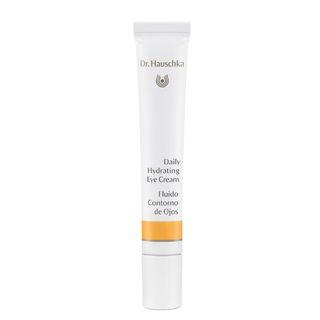
Dr. Hauschka Daily Hydrating Eye Cream
Works for
1 of 2 advertised claims delivered
Moisturizing18 ingredients credited for this claimGood support
“Daily Hydrating Eye Cream”
This product can help improve hydration of the skin with the two types of ingredients.
The first type is called “humectants”:
these ingredients help attract water.
When humectants are on the surface of the skin, they “pull in” the moisture from the outside environment, or from
within deeper layers of the skin. The following ingredients in this product do the job:
glycerin, rosa damascena flower water.
This product also contains ingredients called “occlusives”. They help reduce the speed with which our skin loses moisture to the outside environment. These ingredients also help soften the upper layer of the skin, so it feels less tight and nicer to the touch. The following ingredients in this product do the job: beeswax, cera alba.
Anti-aging2 ingredients credited for this claimWeak support
“Pineapple, marsh mallow and calendula have a revitalizing, calming effect, smoothing the appearance of fine lines and wrinkles.”
Effective ingredients missing or their concentration is too low.
Can it cause trouble?
Irritancy6 strong irritants: Rosa damascena flower water, Alcohol + 4 more — patch-test recommendedHigh risk
Comedogenic2 ingredients rated 2 or more on the 0–5 pore-clogging scale2 flagged
User reviews
Be the first — your take helps the next person decide.
Ingredients
Filter by role to see what each ingredient is doing.
Water~40–60%
Persea gratissima oil~3.8–5.7%
- Irritation risk
- Medium
An emollient that helps soften the skin and could be helpful in repairing its barrier function
More about Persea gratissima oilRosa damascena flower water~3.2–4.8%
- Irritation risk
- High
Used to add a nice rose smell to the product. Might help attract water to the upper layer of the skin and have some anti-oxidant effect. Can be irritating
More about Rosa damascena flower waterGlycerin~2.5–3.8%
- Irritation risk
- Low
One of the best moisturizing ingredients. Naturally present in skin. It attracts water to the upper layer of the skin working as a humectant
More about GlycerinAlcohol~2–3%
- Irritation risk
- High
Can be drying and contribute to skin irritation. Used in formulars to dissolve other ingredients, create a thinner product consistency or for its antibacterial properties
More about AlcoholAnanas sativus fruit extract~1.6–2.4%
- Irritation risk
- Medium
A fruit extract that might help to attract water to the upper layer of the skin, but there is no evidence for any other benefits to the skin
More about Ananas sativus fruit extractBeeswax~1.4–2.2%
- Irritation risk
- Low
Forms a protective barrier that holds water and keeps dry skin hydrated. Keeps an emulsion from separating into its oil and liquid components, and increases the thickness of a product. Can be an allergen
More about BeeswaxCera alba~1.5–2.3%
- Irritation risk
- Medium
Forms a protective barrier that holds water and keeps dry skin hydrated. Keeps an emulsion from separating into its oil and liquid components, and increases the thickness of a product. Can be an allergen
More about Cera albaAlthaea officinalis leaf extract~0.95–1.45%
- Irritation risk
- Low
Calendula officinalis flower extract~0.55–1.25%
- Irritation risk
- High
A plant extract that has some anti-oxidant and anti-bacterial properties. Can be irritating
More about Calendula officinalis flower extractArachis hypogaea oil~0.45–1%
- Irritation risk
- Low
Hectorite~0.35–0.85%
- Irritation risk
- Low
Prunus amygdalus dulcis oil~0.2–0.75%
- Irritation risk
- Low
An emollient that softens the skin
More about Prunus amygdalus dulcis oilRosa damascena extract~0.15–0.55%
- Irritation risk
- High
Oil of a very fragrant pink rose used as fragrance in cosmetics. Extensive research has shown it has mixed benefits. In the pro column, inhaling this flower’s scent seems to have relaxing properties and the plant’s petals contain skin-soothing and antioxidant compounds that can benefit skin. On the flipside, the numerous chemicals that create this rose’s distinctive fragrance pose a risk of causing skin aggravation.
More about Rosa damascena extractPrunus armeniaca kernel oil~0.15–0.65%
- Irritation risk
- Medium
An emollient that helps soften the skin
More about Prunus armeniaca kernel oilLysolecithin~0.15–0.6%
- Irritation risk
- Low
Lecithin derivative. It helps oil and water mix together and can enhance penetration of other ingredients. It helps soften the upper layer of the skin
More about LysolecithinLecithin~0.2–0.7%
- Irritation risk
- Low
Used mostly for creating emulsions - helping oil and water mix together. Helps soften the upper layer of the skin
More about LecithinSimmondsia chinensis seed oil~0.2–0.7%
- Irritation risk
- Medium
Softens the upper layer of skin and helps restore the healthy skin barrier. Has shown to help calm down inflammation in skin. It is a stable oil, meaning that it retains its properties even when exposed to air.
More about Simmondsia chinensis seed oilMangifera indica seed butter~0.15–0.55%
- Irritation risk
- Low
Helps to soften the upper layer of the skin and might have some anti-oxidant effect
More about Mangifera indica seed butterMacadamia ternifolia seed oil~0.15–0.55%
- Irritation risk
- Medium
Plant oil from nuts that helps soften the upper layer of the skin. Contains a high concentration of oleic acid that can weaken skin's barrier function and increase water-loss while enhancing penetration of other ingredients
More about Macadamia ternifolia seed oilButyrospermum parkii butter~0.15–0.55%
- Irritation risk
- Low
- Comedogenicity
- 3/5
A great moisturising ingredient that softens the skin and reduces water loss from its upper layer. It also can be helpful in protecting skin from free radicals
More about Butyrospermum parkii butterHippophae rhamnoides oil~0.1–0.45%
- Irritation risk
- High
A good emollient. Contains various ingredients including vitamins and fatty acids that could work in the skin to neutralize free radicals and minimize moisture loss - if enough of these compounds is able to penetrate the skin in an active form.
More about Hippophae rhamnoides oilChondrus crispus extract~0.1–0.4%
- Irritation risk
- Low
- Comedogenicity
- 3/5
Red algae extract that helps attract water to the upper layer of the skin and create a nicer product consistency
More about Chondrus crispus extractGlyceryl stearate~0.1–0.45%
- Irritation risk
- Low
An emollient that softens the skin and forms a protective layer on its surface. Helps water and oil mix together
More about Glyceryl stearateStearic acid~0.15–0.55%
- Irritation risk
- Low
Helps oil and water mix together and works as an emollient
More about Stearic acidXanthan gum~0.05–0.25%
- Irritation risk
- Low
Used to create a thicker product consistency
More about Xanthan gumSodium stearoyl lactylate~0.05–0.25%
- Irritation risk
- Medium
Helps oil and water mix together
More about Sodium stearoyl lactylateParfum~0.05–0.1%
- Irritation risk
- High
An aromatic blend of unspecified and possibly irritating ingredients
More about ParfumGeraniol~0.01–0.05%
Ingredient list view
Water, Persea gratissima oil, Rosa damascena flower water, Glycerin, Alcohol, Ananas sativus fruit extract, Beeswax, Cera alba, Althaea officinalis leaf extract, Calendula officinalis flower extract, Arachis hypogaea oil, Hectorite, Prunus amygdalus dulcis oil, Rosa damascena extract, Prunus armeniaca kernel oil, Lysolecithin, Unknown, Lecithin, Simmondsia chinensis seed oil, Mangifera indica seed butter, Macadamia ternifolia seed oil, Butyrospermum parkii butter, Hippophae rhamnoides oil, Chondrus crispus extract, Glyceryl stearate, Stearic acid, Xanthan gum, Sodium stearoyl lactylate, Parfum, Geraniol
Compare prices
Retailers ranked by price — lowest first.


.png)
Sources cited in this review
Every concentration estimate and effectiveness label is anchored to one of these 12 studies and safety reviews.
- 1
- 2
- 3
- 4
- 5
- 6

Affiliate links · As an Amazon Associate, WIMJ earns from qualifying purchases.