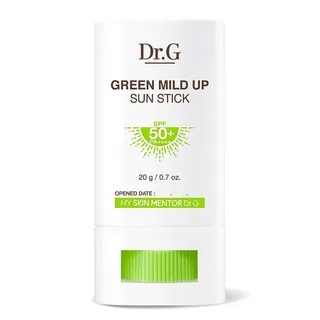
Dr.G Green Mild Up Sun Stick

Dr.G Green Mild Up Sun Stick

Efficacy75/100IrritancyMedium

Works for

Moisturizing
Coco-caprylate/caprate, C12-15 alkyl benzoate + 16 more
Works
What the product description says
“Pro-vitamin D and pycnogenol help to protect and strengthen skin.”
Source: Lila Beauty

This product can help improve hydration of the skin with the two types of ingredients.

The first type is called “humectants”:
these ingredients help attract water. When humectants are on the surface of the skin, they “pull in” the moisture from the outside environment, or from within deeper layers of the skin. The following ingredients in this product do the job: lactobacillus ferment, butylene glycol.

This product also contains ingredients called “occlusives”. They help reduce the speed with which our skin loses moisture to the outside environment. These ingredients also help soften the upper layer of the skin, so it feels less tight and nicer to the touch. The following ingredients in this product do the job: caprylic/capric triglyceride, vinyl dimethicone.

Coco-caprylate/caprateKey active· EmollientEffect: MediumHelps to soften the upper layer of the skin without creating a greasy texture~3.9–4.7%
C12-15 alkyl benzoateKey active· EmollientEffect: MediumEnhances the product texture and makes it more spreadable. Helps reduce water loss from the outer layer of skin. Extands the shelf life by preventing bacteria growth~3–3.7%
Butylene glycol dicaprylate/dicaprateKey active· EmollientEffect: MediumHelps soften the upper layer of the skin~1.5–1.9%
Caprylic/capric triglycerideKey active· Emollient, OcclusiveEffect: HighA good mix of fatty acids that forms a protective layer on the skin. Improves the shelf life of products. Derived from coconut and glycerin~0.75–1.15%
Vinyl dimethiconeKey active· EmollientEffect: HighA type of silicone that helps to create a nice product texture and soften the upper layer of the skin~0.7–1.05%
Centella asiatica extractKey activeEffect: HighA plant extract that has been shown to be able to reduce inflammation in skin, support restoration of skin barrier function, as well as support collagen production. Contains active compounds called centelloids: asiaticoside, madecasosside, asiatic acid and madecassic acid. Might be helpful in preventing stretch marks. It can be itself be irritating though.~0.6–0.95%
Kappaphycus alvarezii extractKey activeEffect: HighA red algae extract that can help attract water to the upper layer of the skin and might have some antioxidant properties~0.45–0.7%
7-dehydrocholesterolKey activeEffect: HighPro-vitamin D. It is claimed to have anti-inflammatory effect in skin, but there is no research available confirming that this compound converts to vitamin D in skin or has any other benefits apart from softening the upper layer of the skin. This compound is different from the Vitamin D3 analogues used in medicine to treat psoriasis~0.3–0.6%
EctoinKey activeEffect: HighSoftens the upper layer of the skin and can support skin barrier function~0.25–0.5%
Lactobacillus fermentKey active· HumectantEffect: HighA fermentation product created by bacteria Lactobacillus. The fermented product has anti-bacterial properties and might be helpful in calming down inflammation, but studies are lacking. Helps attract water to the upper layer of the skin. Can be used as a preservative~0.2–0.35%
Octyldodecanol· EmollientEffect: LowAn emollient that helps to soften the skin and create a pleasant product texture and stabilize the formulation~25–31%
Cetyl ethylhexanoate· EmollientEffect: LowAn emollient that helps soften the skin and creates a thicker product texture~6.6–8.1%
Isopropyl palmitate· EmollientEffect: LowHelps soften the upper layer of the skin and create a thicker product consistency~2.4–2.9%
Dibutyl ethylhexanoyl glutamideEffect: LowHelps improve the product texture and soften the upper layer of the skin~0.7–1.05%
Glyceryl caprylate· EmollientEffect: LowAn emollient that can also help water and oil mix together, as well as prevent bacteria growth in products~0.5–0.75%
Camellia sinensis leaf extractEffect: LowCan contain potent anti-oxidant compounds (abbreviated ECG, GCG, EGC, and EGCG) that might help protect the skin from free radicals. Can help calm down inflammation and has some anti-bacterial properties. Unfortunately, these antioxidants are unstable and lose their effectiveness very quickly in products. The concentration of the antioxidant compounds in the extract also tends to be low to be effective in topical formulation~0.5–0.75%
Butylene glycol· HumectantEffect: LowUsed to create a nice product texture and help delivery of other ingredients. Might be somewhat helpful in attracting water to the upper layer of the skin~0.2–0.35%
TocopherolEffect: Low, below effective dosePure form of vitamin E. Can help moisturise and protect the skin from free radicals. Often used to help stabilise other ingredients or the formula itself~0.4–0.65%
Anti-oxidation
Side benefit · Centella asiatica extract, Pinus pinaster bark extract + 8 more
May help

This product contains antioxidants (camellia sinensis leaf extract, centella asiatica extract, ginkgo biloba leaf extract, pinus pinaster bark extract) that can help neutralize free radicals in skin to lessen the damage it gets from the UV light (sun). There is some human evidence for this effect in skin, though it is smaller or less consistent than the evidence for the best antioxidants.

Centella asiatica extractKey activeEffect: MediumA plant extract that has been shown to be able to reduce inflammation in skin, support restoration of skin barrier function, as well as support collagen production. Contains active compounds called centelloids: asiaticoside, madecasosside, asiatic acid and madecassic acid. Might be helpful in preventing stretch marks. It can be itself be irritating though.~0.6–0.95%
Pinus pinaster bark extractKey activeEffect: MediumA plant extract that might help neutralize free radicals and reduce hyperpigmentation, but evidence of effectiveness of topical application is lacking. It can be an INCI name for the trademarked ingredient Pycnogenol (but could also be a different type of this plant's bark extract)~0.55–0.8%
Camellia sinensis leaf extractKey activeEffect: MediumCan contain potent anti-oxidant compounds (abbreviated ECG, GCG, EGC, and EGCG) that might help protect the skin from free radicals. Can help calm down inflammation and has some anti-bacterial properties. Unfortunately, these antioxidants are unstable and lose their effectiveness very quickly in products. The concentration of the antioxidant compounds in the extract also tends to be low to be effective in topical formulation~0.5–0.75%
Ginkgo biloba leaf extractKey activeEffect: MediumA plant extract that might help neutralize free radicals and reduce inflammation in skin. It can be irritating~0.45–0.65%
Buddleja officinalis flower extractEffect: LowA plant flower extract that might help calm down inflammation in skin and neutralize free radicals, but evidence of effectiveness in skin is lacking~0.6–0.9%
Medicago sativa extractEffect: LowA plant extract that might help neutralize free radicals in skin~0.45–0.65%
Kappaphycus alvarezii extractEffect: LowA red algae extract that can help attract water to the upper layer of the skin and might have some antioxidant properties~0.45–0.7%
Camellia japonica leaf extractEffect: LowA plant extract that might help neutralize free radicals in skin~0.45–0.65%
Lactobacillus fermentEffect: LowA fermentation product created by bacteria Lactobacillus. The fermented product has anti-bacterial properties and might be helpful in calming down inflammation, but studies are lacking. Helps attract water to the upper layer of the skin. Can be used as a preservative~0.2–0.35%
TocopherolUnder-dosedPure form of vitamin E. Can help moisturise and protect the skin from free radicals. Often used to help stabilise other ingredients or the formula itself~0.4–0.65%
Anti-aging
Side benefit · Centella asiatica extract, Camellia sinensis leaf extract + 1 more
May help

This product contains centella asiatica extract. There is some human evidence that this ingredient helps reduce and prevent fine lines and wrinkles and improve skin elasticity and firmness, though it is smaller or less consistent than the evidence for the best anti-aging ingredients.

Centella asiatica extractKey activeEffect: MediumA plant extract that has been shown to be able to reduce inflammation in skin, support restoration of skin barrier function, as well as support collagen production. Contains active compounds called centelloids: asiaticoside, madecasosside, asiatic acid and madecassic acid. Might be helpful in preventing stretch marks. It can be itself be irritating though.~0.6–0.95%
Camellia sinensis leaf extractEffect: LowCan contain potent anti-oxidant compounds (abbreviated ECG, GCG, EGC, and EGCG) that might help protect the skin from free radicals. Can help calm down inflammation and has some anti-bacterial properties. Unfortunately, these antioxidants are unstable and lose their effectiveness very quickly in products. The concentration of the antioxidant compounds in the extract also tends to be low to be effective in topical formulation~0.5–0.75%
TocopherolEffect: Low, below effective dosePure form of vitamin E. Can help moisturise and protect the skin from free radicals. Often used to help stabilise other ingredients or the formula itself~0.4–0.65%

Can it cause trouble?

Irritancy
2 strong irritants: Mentha viridis extract, Parfum
Medium risk
We flagged 21 ingredients with irritancy potential. Severity depends on your sensitivity threshold; the table lists the worst offenders first.
IngredientFunctionIrritationEst. amount
Mentha viridis extractUsed as a fragrance and can be irritatingHigh~0.55–0.85%est.
Buddleja officinalis flower extractA plant flower extract that might help calm down inflammation in skin and neutralize free radicals, but evidence of effectiveness in skin is lackingHigh~0.6–0.9%est.
Ginkgo biloba leaf extractA plant extract that might help neutralize free radicals and reduce inflammation in skin. It can be irritatingHigh~0.45–0.65%est.
ParfumAn aromatic blend of unspecified and possibly irritating ingredientsHigh~0.1–0.2%est.
Cetyl ethylhexanoateAn emollient that helps soften the skin and creates a thicker product textureMedium~6.6–8.1%est.
Benzotriazolyl dodecyl p-cresolUsed to stabilize the product formulation protecting it from sun lightMedium~4.8–5.8%est.
Isopropyl palmitateHelps soften the upper layer of the skin and create a thicker product consistencyMedium~2.4–2.9%est.
Acrylates copolymerUsed to stabilize product formulation, help create an even product layer over skin (for example, in sunscreen) and create a thicker product consistencyMedium~2.1–2.6%est.
Dibutyl lauroyl glutamideHelps improve the product texture and soften the upper layer of the skinMedium~1.1–1.4%est.
Dibutyl ethylhexanoyl glutamideHelps improve the product texture and soften the upper layer of the skinMedium~0.7–1.05%est.
Caprylic/capric triglycerideA good mix of fatty acids that forms a protective layer on the skin. Improves the shelf life of products. Derived from coconut and glycerinMedium~0.75–1.15%est.
Butyloctyl salicylateA synthetic ester of salicylic acid that is used to help disperse pigments and boost effectiveness of sunscreen ingredients. It is able to absorb UV light (working as an organic, or chemical filter), but is not approved as a sunscreen ingredient on its ownMedium~0.6–0.95%est.
Dextrin palmitateHelps water and oil mix togetherMedium~0.6–0.9%est.
Centella asiatica extractA plant extract that has been shown to be able to reduce inflammation in skin, support restoration of skin barrier function, as well as support collagen production. Contains active compounds called centelloids: asiaticoside, madecasosside, asiatic acid and madecassic acid. Might be helpful in preventing stretch marks. It can be itself be irritating though.Medium~0.6–0.95%est.
Pinus pinaster bark extractA plant extract that might help neutralize free radicals and reduce hyperpigmentation, but evidence of effectiveness of topical application is lacking. It can be an INCI name for the trademarked ingredient Pycnogenol (but could also be a different type of this plant's bark extract)Medium~0.55–0.8%est.
Camellia japonica leaf extractA plant extract that might help neutralize free radicals in skinMedium~0.45–0.65%est.
Medicago sativa extractA plant extract that might help neutralize free radicals in skinMedium~0.45–0.65%est.
Polyhydroxystearic acidUsed to create a thicker product consistency and stabilize the formulationMedium~0.5–0.7%est.
Polyglyceryl-6 polyricinoleateHelps oil and water mix togetherMedium~0.45–0.7%est.
7-dehydrocholesterolPro-vitamin D. It is claimed to have anti-inflammatory effect in skin, but there is no research available confirming that this compound converts to vitamin D in skin or has any other benefits apart from softening the upper layer of the skin. This compound is different from the Vitamin D3 analogues used in medicine to treat psoriasisMedium~0.3–0.6%est.
1,2-hexanediolA preservativeMedium~0.15–0.3%est.
Comedogenic
1 ingredient rated 2 or more on the 0–5 pore-clogging scale
1 flagged
These ingredients have a comedogenic rating of 2 or more on a 0–5 scale; the table shows each one's rating. In leave-on products they can clog pores in acne-prone skin.
IngredientFunctionRatingEst. amount
Isopropyl palmitateHelps soften the upper layer of the skin and create a thicker product consistency3/5~2.4–2.9%est.
Did this help you decide?

User reviews

Would you recommend?
No community reviews yet.

Be the first — your take helps the next person decide.

Ingredients

Filter by role to see what each ingredient is doing.

Octyldodecanol~25–31%
Formula
Irritation risk
Low
Works for
Moisturizing

An emollient that helps to soften the skin and create a pleasant product texture and stabilize the formulation

More about Octyldodecanol
Zinc oxide~12–14%
Formula
Irritation risk
Low
Works for
Sun protection

A broad spectrum sunblock (protects from both UVA and UVB rays). Is suitable for most sensitive skins. In small concentrations, can be used as a colorant

More about Zinc oxide
Cetyl ethylhexanoate~6.6–8.1%
Irritant · medium
Irritation risk
Medium
Works for
Moisturizing

An emollient that helps soften the skin and creates a thicker product texture

More about Cetyl ethylhexanoate
Benzotriazolyl dodecyl p-cresol~4.8–5.8%
Irritant · medium
Irritation risk
Medium

Used to stabilize the product formulation protecting it from sun light

More about Benzotriazolyl dodecyl p-cresol
Coco-caprylate/caprate~3.9–4.7%
Key active
Irritation risk
Low
Works for
Moisturizing

Helps to soften the upper layer of the skin without creating a greasy texture

More about Coco-caprylate/caprate
C12-15 alkyl benzoate~3–3.7%
Key active
Irritation risk
Low
Works for
Moisturizing

Enhances the product texture and makes it more spreadable. Helps reduce water loss from the outer layer of skin. Extands the shelf life by preventing bacteria growth

More about C12-15 alkyl benzoate
Isopropyl palmitate~2.4–2.9%
Comedogenic 3/5Irritant · medium
Irritation risk
Medium
Comedogenicity
3/5
Works for
Moisturizing

Helps soften the upper layer of the skin and create a thicker product consistency

More about Isopropyl palmitate
Acrylates copolymer~2.1–2.6%
Irritant · medium
Irritation risk
Medium

Used to stabilize product formulation, help create an even product layer over skin (for example, in sunscreen) and create a thicker product consistency

More about Acrylates copolymer
Butylene glycol dicaprylate/dicaprate~1.5–1.9%
Key active
Irritation risk
Low
Works for
Moisturizing

Helps soften the upper layer of the skin

More about Butylene glycol dicaprylate/dicaprate
Silica silylate~1.3–1.6%
Formula
Irritation risk
Low

Helps create a thicker product consistency

More about Silica silylate
Dibutyl lauroyl glutamide~1.1–1.4%
Irritant · medium
Irritation risk
Medium

Helps improve the product texture and soften the upper layer of the skin

More about Dibutyl lauroyl glutamide
Dibutyl ethylhexanoyl glutamide~0.7–1.05%
Irritant · medium
Irritation risk
Medium
Works for
Moisturizing

Helps improve the product texture and soften the upper layer of the skin

More about Dibutyl ethylhexanoyl glutamide
Caprylic/capric triglyceride~0.75–1.15%
Key activeIrritant · medium
Irritation risk
Medium
Works for
Moisturizing

A good mix of fatty acids that forms a protective layer on the skin. Improves the shelf life of products. Derived from coconut and glycerin

More about Caprylic/capric triglyceride
Butyloctyl salicylate~0.6–0.95%
Irritant · medium
Irritation risk
Medium

A synthetic ester of salicylic acid that is used to help disperse pigments and boost effectiveness of sunscreen ingredients. It is able to absorb UV light (working as an organic, or chemical filter), but is not approved as a sunscreen ingredient on its own

More about Butyloctyl salicylate
Dextrin palmitate~0.6–0.9%
Irritant · medium
Irritation risk
Medium
Works for
Cleansing

Helps water and oil mix together

More about Dextrin palmitate
Vinyl dimethicone~0.7–1.05%
Key active
Irritation risk
Low
Works for
Moisturizing

A type of silicone that helps to create a nice product texture and soften the upper layer of the skin

More about Vinyl dimethicone
Vinyl dimethicone/methicone silsesquioxane crosspolymer~0.6–0.9%
Formula
Irritation risk
Low

A type of silicone that create a smooth product finish and can create an optical soft-focus effect on the skin. Helps to thicken the product consistency

More about Vinyl dimethicone/methicone silsesquioxane crosspolymer
Centella asiatica extract~0.6–0.95%
Key activeIrritant · medium
Irritation risk
Medium
Works for
Reduces irritationReduces rednessMoisturizingAnti-inflammatoryAnti-agingAnti-oxidationAnti-blemish

A plant extract that has been shown to be able to reduce inflammation in skin, support restoration of skin barrier function, as well as support collagen production. Contains active compounds called centelloids: asiaticoside, madecasosside, asiatic acid and madecassic acid. Might be helpful in preventing stretch marks. It can be itself be irritating though.

More about Centella asiatica extract
Mentha viridis extract~0.55–0.85%
Irritant · high
Irritation risk
High

Used as a fragrance and can be irritating

More about Mentha viridis extract
Pinus pinaster bark extract~0.55–0.8%
Key activeIrritant · medium
Irritation risk
Medium
Works for
Anti-oxidationEvens skin tone

A plant extract that might help neutralize free radicals and reduce hyperpigmentation, but evidence of effectiveness of topical application is lacking. It can be an INCI name for the trademarked ingredient Pycnogenol (but could also be a different type of this plant's bark extract)

More about Pinus pinaster bark extract
Caesalpinia spinosa fruit extract~0.5–0.7%
Formula
Kappaphycus alvarezii extract~0.45–0.7%
Key active
Irritation risk
Low
Works for
MoisturizingAnti-oxidation

A red algae extract that can help attract water to the upper layer of the skin and might have some antioxidant properties

More about Kappaphycus alvarezii extract
Buddleja officinalis flower extract~0.6–0.9%
Irritant · high
Irritation risk
High
Works for
Anti-inflammatoryAnti-oxidationAntibacterial

A plant flower extract that might help calm down inflammation in skin and neutralize free radicals, but evidence of effectiveness in skin is lacking

More about Buddleja officinalis flower extract
Camellia sinensis leaf extract~0.5–0.75%
Key active
Irritation risk
Low
Works for
AntibacterialAnti-oxidationAnti-agingAnti-blemishMoisturizingEvens skin tone

Can contain potent anti-oxidant compounds (abbreviated ECG, GCG, EGC, and EGCG) that might help protect the skin from free radicals. Can help calm down inflammation and has some anti-bacterial properties. Unfortunately, these antioxidants are unstable and lose their effectiveness very quickly in products. The concentration of the antioxidant compounds in the extract also tends to be low to be effective in topical formulation

More about Camellia sinensis leaf extract
Ginkgo biloba leaf extract~0.45–0.65%
Key activeIrritant · high
Irritation risk
High
Works for
Anti-oxidationAnti-blemishAntibacterialAnti-inflammatory

A plant extract that might help neutralize free radicals and reduce inflammation in skin. It can be irritating

More about Ginkgo biloba leaf extract
Camellia japonica leaf extract~0.45–0.65%
Irritant · medium
Irritation risk
Medium
Works for
Anti-oxidation

A plant extract that might help neutralize free radicals in skin

More about Camellia japonica leaf extract
Eruca sativa leaf extract~0.45–0.65%
Formula
Triticum vulgare sprout extract~0.45–0.7%
Formula
Brassica oleracea italica sprout extract~0.5–0.75%
Formula
Medicago sativa extract~0.45–0.65%
Irritant · medium
Irritation risk
Medium
Works for
Anti-oxidation

A plant extract that might help neutralize free radicals in skin

More about Medicago sativa extract
Glyceryl caprylate~0.5–0.75%
Formula
Irritation risk
Low
Works for
CleansingMoisturizing

An emollient that can also help water and oil mix together, as well as prevent bacteria growth in products

More about Glyceryl caprylate
Triethoxycaprylylsilane~0.45–0.65%
Formula
Irritation risk
Low

A type of silicone that helps oil and water mix well together. Helps to disperse other ingredients, e.g. pigments, evenly in a formulation

More about Triethoxycaprylylsilane
Polyhydroxystearic acid~0.5–0.7%
Irritant · medium
Irritation risk
Medium
Works for
Cleansing

Used to create a thicker product consistency and stabilize the formulation

More about Polyhydroxystearic acid
Polyglyceryl-6 polyricinoleate~0.45–0.7%
Irritant · medium
Irritation risk
Medium
Works for
Cleansing

Helps oil and water mix together

More about Polyglyceryl-6 polyricinoleate
Tocopherol~0.4–0.65%
Under-dosed
Irritation risk
Low
Works for
Anti-oxidationMoisturizingAnti-inflammatoryAnti-aging

Pure form of vitamin E. Can help moisturise and protect the skin from free radicals. Often used to help stabilise other ingredients or the formula itself

More about Tocopherol
Water~0.35–0.65%
Formula
Irritation risk
Low

Plain old water

More about Water
7-dehydrocholesterol~0.3–0.6%
Key activeIrritant · medium
Irritation risk
Medium
Works for
Moisturizing

Pro-vitamin D. It is claimed to have anti-inflammatory effect in skin, but there is no research available confirming that this compound converts to vitamin D in skin or has any other benefits apart from softening the upper layer of the skin. This compound is different from the Vitamin D3 analogues used in medicine to treat psoriasis

More about 7-dehydrocholesterol
Ectoin~0.25–0.5%
Key active
Irritation risk
Low
Works for
Moisturizing

Softens the upper layer of the skin and can support skin barrier function

More about Ectoin
Propanediol~0.25–0.5%
Formula
Irritation risk
Low

Acts as a solvent for other ingredients. Speeds up the absorption of other ingredients into the skin

More about Propanediol
Butylene glycol~0.2–0.35%
Formula
Irritation risk
Low
Works for
Moisturizing

Used to create a nice product texture and help delivery of other ingredients. Might be somewhat helpful in attracting water to the upper layer of the skin

More about Butylene glycol
Lactobacillus ferment~0.2–0.35%
Key active
Irritation risk
Low
Works for
MoisturizingAnti-inflammatoryAnti-oxidationReduces irritation

A fermentation product created by bacteria Lactobacillus. The fermented product has anti-bacterial properties and might be helpful in calming down inflammation, but studies are lacking. Helps attract water to the upper layer of the skin. Can be used as a preservative

More about Lactobacillus ferment
1,2-hexanediol~0.15–0.3%
Irritant · medium
Irritation risk
Medium

A preservative

More about 1,2-hexanediol
Parfum~0.1–0.2%
Irritant · high
Irritation risk
High

An aromatic blend of unspecified and possibly irritating ingredients

More about Parfum
Ingredient list view

Octyldodecanol, Zinc oxide, Cetyl ethylhexanoate, Benzotriazolyl dodecyl p-cresol, Coco-caprylate/caprate, C12-15 alkyl benzoate, Isopropyl palmitate, Acrylates copolymer, Butylene glycol dicaprylate/dicaprate, Silica silylate, Dibutyl lauroyl glutamide, Dibutyl ethylhexanoyl glutamide, Caprylic/capric triglyceride, Butyloctyl salicylate, Dextrin palmitate, Vinyl dimethicone, Vinyl dimethicone/methicone silsesquioxane crosspolymer, Centella asiatica extract, Mentha viridis extract, Pinus pinaster bark extract, Caesalpinia spinosa fruit extract, Kappaphycus alvarezii extract, Buddleja officinalis flower extract, Camellia sinensis leaf extract, Ginkgo biloba leaf extract, Camellia japonica leaf extract, Eruca sativa leaf extract, Triticum vulgare sprout extract, Brassica oleracea italica sprout extract, Medicago sativa extract, Glyceryl caprylate, Triethoxycaprylylsilane, Polyhydroxystearic acid, Polyglyceryl-6 polyricinoleate, Tocopherol, Water, 7-dehydrocholesterol, Ectoin, Propanediol, Butylene glycol, Lactobacillus ferment, 1,2-hexanediol, Parfum

Compare prices

Retailers ranked by price — lowest first.

🇦🇺 Lila Beauty (AU)20 g
≈ $19.67
Buy

Affiliate links · As an Amazon Associate, WIMJ earns from qualifying purchases.

Worth comparing, line by line.

Match % combines shared ingredients, the first five ingredients, shared actives and hero ingredients, irritancy (lower counts in the alternative's favour), texture and body area. Only products in the same routine step are compared.

Side-by-side comparison of this product against its closest alternatives
Dr.GGreen Mild Up Sun StickYOUR PRODUCTBaleaBeauty Expert Day Cream 3% Peptid-Solution 1% EctoinCOSRXPure Fit Cica PowderManyoPanthe-Calming Sun Cream
Match—28%27%27%
Price——$9.44—
Shared key ingredients—2 of 123 of 124 of 12
Key difference—Acetyl Dipeptide-1 Cetyl EsterMadecassosideNiacinamide
Irritancy Medium Low Low Low
Drying alcohol————
View product Shop Shop Shop

More alternatives: ROVECTIN Skin Essentials Aqua Soothing UV ProtectorHealez Invisible Restorative Sun Shield

Cheaper alternatives? See how this stacks up against similar formulas.
We compare ingredient profiles across our catalog — pick the closest match for your budget.
Open dupe finder

Product summary

"Dr. G - Buy Dr. G Green Mild Up Sun Stick Australia - Korean Skin Care and Cosmetics" could be helpful for: Moisturizing and Anti-aging, but its actives are not the most effective or are not well-studied.

Ingredient callouts

  • Humectants (lactobacillus ferment 0.20% - 0.35%). These ingredients help attract water to the upper layer of the skin and improve the skin hydration.

Price

The product retails for 29.50A$ in Australia.

For a detailed price comparison: click here.

Sources cited in this review

Every concentration estimate and effectiveness label is anchored to one of these 35 studies and safety reviews.

  1. 1
  2. 2
  3. 3
  4. 4
  5. 5
  6. 6
Dr.G Green Mild Up Sun Stick
Dr.GGreen Mild Up Sun Stick

Affiliate links · As an Amazon Associate, WIMJ earns from qualifying purchases.

As an Amazon Associate, WIMJ earns from qualifying purchases.