Works for
CleansingSodium laureth sulfate, Sodium lauryl sulfate + 6 moreCan be harsh
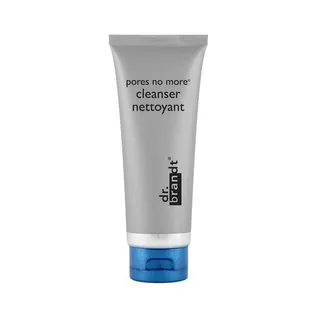
“Pores No More Cleanser”
This product works by removing dirt and oil from the surface of the skin.
It contains the following cleansing agents that tend to be harsh on the skin: sodium laureth sulfate, sodium lauryl sulfate.
The following cleansing agents are typically mild, but still can cause an irritation or allergy for some people cocamidopropyl betaine.
Keep in mind that cleansing can disrupt the skin barrier, and most people do not need to cleanse their skin more than once per day.
ExfoliationSalix alba bark extract, Salicylic acidNot delivered
“Dissolve impurities, oil and debris while refining and unclogging pores, and leave skin feeling ultra clean with Dr. Brandt Pores No More Cleanser; a non-drying cleanser formulated with salicylic acid, tea tree oil, and willow bark.”
This product does not contain effective exfoliating ingredients. It might be able to deliver physical exfoliation, that is scrub off some of the dead cells on the surface of the skin. We do not recommend physical exfoliation, because it is not uniform (some bits of skin can get exfoliated too much while others not at all). It can also traumatize the skin and aggrevate acne and other skin conditions.
Can it cause trouble?
Irritancy3 strong irritants: Lavandula angustifolia oil, Rosmarinus officinalis leaf oil + 1 more — patch-test recommendedHigh risk
Comedogenic2 ingredients rated 2 or more on the 0–5 pore-clogging scale2 flagged


User reviews
Be the first — your take helps the next person decide.
Ingredients
Filter by role to see what each ingredient is doing.
Water~45–55%
Sodium laureth sulfate~10–13%
- Irritation risk
- High
- Comedogenicity
- 2/5
Works as a foaming cleansing agent
More about Sodium laureth sulfateSodium lauryl sulfate~5.5–6.7%
- Irritation risk
- High
- Comedogenicity
- 3/5
A cleansing agent (SLS). It can be irritating
More about Sodium lauryl sulfateDisodium oleamido mea-sulfosuccinate~3.9–4.7%
Cocamide mea~2.2–2.7%
Cocamidopropyl betaine~2.5–3.1%
- Irritation risk
- High
Helps water and oil mix together. Used as a cleansing ingredient. Could be an allergen
More about Cocamidopropyl betaineGlycol distearate~1.6–2%
- Irritation risk
- Medium
Helps water and oil mix together
More about Glycol distearatePhenoxyethanol~0.5–1%
- Irritation risk
- Low
A preservative. It helps prevent bacterial growth in cosmetic products
More about PhenoxyethanolMethylparaben~0.15–0.3%
Butylparaben~0.2–0.4%
Ethylparaben~0.2–0.4%
Propylparaben~0.2–0.4%
Isobutylparaben~0.55–0.8%
Sodium chloride~0.5–0.75%
- Irritation risk
- Low
Used to stabilize mixtures of oil and water, and create thicker, gel-like product textures
More about Sodium chlorideHydroxypropyl guar~0.45–0.65%
- Irritation risk
- Medium
Used to create a thicker product consistency and stabilize emulsions
More about Hydroxypropyl guarLavandula angustifolia oil~0.3–0.55%
- Irritation risk
- High
An essential oil. Potential allergen and can be irritating. It has some anti-bacterial properties
More about Lavandula angustifolia oilCitric acid~0.25–0.45%
- Irritation risk
- Medium
Can work as an exfoliant but is typically used to adjust the product pH
More about Citric acidRosmarinus officinalis leaf oil~0.2–0.4%
- Irritation risk
- High
A plant oil with high content of volatile compounds that can irritate the skin. Can be used as a fragrance. Has anti-bacterial properties and might help neutralize free radicals on the surface of the skin
More about Rosmarinus officinalis leaf oilMelaleuca alternifolia leaf oil~0.15–0.3%
- Irritation risk
- High
An essential oil that can be irritating. Has some anti-bacterial properties
More about Melaleuca alternifolia leaf oilSalix alba bark extract~0.15–0.3%
- Irritation risk
- High
A plant extract that can help neutralize free radicals in skin. It contains a compound salicin that can theoretically be converted into salicylic acid that, in turn, helps reduce inflammation in skin, but the evidence of effectiveness in skin is lacking and the extract is usually not used in a concentration that would enable an exfoliating effect
More about Salix alba bark extractPropylene glycol~0.15–0.25%
- Irritation risk
- High
Helps oil and water mix together and can enhance the penetration of other ingredients into the skin. It can be irritating
More about Propylene glycolSalicylic acid~0.1–0.2%
- Irritation risk
- High
Used for skin exfoliation. It has an anti-inflammatory and anti-bacterial effect, helps to unclog pores, prevent blemishes and speed up healing of the existing ones. Sometimes referred to as a BHA (beta-hydroxy acid)
More about Salicylic acidDisodium edta~0.05–0.1%
Laureth-10~0.05–0.1%
Ingredient list view
Water, Sodium laureth sulfate, Sodium lauryl sulfate, Disodium oleamido mea-sulfosuccinate, Cocamide mea, Cocamidopropyl betaine, Glycol distearate, Phenoxyethanol, Methylparaben, Butylparaben, Ethylparaben, Propylparaben, Isobutylparaben, Sodium chloride, Hydroxypropyl guar, Lavandula angustifolia oil, Citric acid, Rosmarinus officinalis leaf oil, Melaleuca alternifolia leaf oil, Salix alba bark extract, Propylene glycol, Salicylic acid, Disodium edta, Laureth-10
Compare prices
Retailers ranked by price — lowest first.
Affiliate links · As an Amazon Associate, WIMJ earns from qualifying purchases.
Worth comparing, line by line.
Match % combines shared ingredients, the first five ingredients, shared actives and hero ingredients, irritancy (lower counts in the alternative's favour), texture and body area. Only products in the same routine step are compared.
| Dr. BrandtPores No More CleanserYOUR PRODUCT | CelltoneSpot Control Cleanser Gel Wash | CLn Skin CareCLn Acne Cleanser | ClearasilUltra Rapid Action Daily Gel Wash | |
|---|---|---|---|---|
| Match | — | 86% | 85% | 84% |
| Price | $38.00 | — | — | — |
| Shared key ingredients | — | 6 of 9 | 4 of 9 | 3 of 9 |
| Key difference | — | Niacinamide | — | Glycerin |
| Irritancy | High | High | Low | Medium |
| Drying alcohol | — | — | — | — |
| View product | Shop | Shop | Shop |


More alternatives: Murad Mini AHA/BHA Exfoliating CleanserDHC Salicylic Acne Wash
Sources cited in this review
Every concentration estimate and effectiveness label is anchored to one of these 16 studies and safety reviews.
- 1Surfactants and experimental irritant contact dermatitisncbi.nlm.nih.gov
- 2
- 3
- 4
- 5Occupational contact dermatitis due to essential oilsonlinelibrary.wiley.com
- 6

Affiliate links · As an Amazon Associate, WIMJ earns from qualifying purchases.