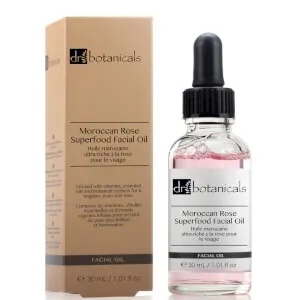
Dr. Botanicals Moroccan Rose Superfood Facial Oil

Dr. Botanicals Moroccan Rose Superfood Facial Oil

Efficacy100/100IrritancyHigh

Works for

Anti-aging
Bakuchiol, Dipeptide diaminobutyroyl benzylamide diacetate + 4 more
Works well
What the product description says
“Created using only the finest natural extracts, the main ingredient of Moroccan Rose Oil boasts high levels of Vitamin C to stimulate collagen production and Vitamin A to protect against free radicals and even skin tone.”
Source: Mankind

This product can help reduce and prevent fine lines and wrinkles, improve skin elasticity and firmness because it contains bakuchiol.

These ingredients in the product can also be helpful, even though there is less evidence for their effectiveness: dipeptide diaminobutyroyl benzylamide diacetate, palmitoyl tetrapeptide-7, palmitoyl tripeptide-1.

Keep in mind that it typically takes at least 6 weeks to notice any results because the changes that are needed to improve fine lines and elasticity happen in the deeper layers of the skin. No topical anti-aging product can “erase” wrinkles or fully reverse signs of aging.

BakuchiolKey activeEffect: HighA plant extract that is, though different in chemical structure, acts similar to retinoids. First studies show that it can help reduce fine lines and wrinkles, improve skin tone, reduce clogged pores and blemishes, and reduce inflammation. There is no conclusive evidence that bakuchiol is as effective as retinol however. The study that directly compared retinol with bakuchiol used bakuchiol applied twice daily compared to once per day for the retinol. According to this study, bakuchiol is less irritating than retinol. Bakuchiol is extracted from seeds of Babchi plant. Other parts of the plant contain coumarins that could cause allergic and irritant reactions. These compounds should be removed in the extraction process when bakuchiol is produced, but it is a good idea to be cautious and stay away from products that include the Babchi plant extracts other than purified bakuchiol to avoid irritation~0.85–1.3%
Dipeptide diaminobutyroyl benzylamide diacetateKey activeEffect: MediumA type of peptide. Peptides are excellent moisturizers and might be able support collagen production reducing fine lines and wrinkles~0.1–0.4%
Palmitoyl tripeptide-1Key activeEffect: MediumA type of peptide. Peptides are excellent moisturizers and might be able support collagen production reducing fine lines and wrinkles~0.1–0.35%
Palmitoyl tetrapeptide-7Key activeEffect: MediumA type of peptide. Peptides are excellent moisturizers and might be able support collagen production reducing fine lines and wrinkles~0.05–0.25%
Ascorbyl glucosideUnder-dosedA vitamin C derivative that is more stable but less potent than pure form of vitamin C. Has a potential to boost collagen production, nutralise free radicals and reduce hyperpigmentation, but the required concentration is likely to be much higher than for the pure form of vitamin C, limiting the ingredient's effectiveness in products~0.15–0.7%
Lactic acidUnder-dosedAn exfoliating and moisturizing alpha-hydroxy acid (AHA). Typically causes less irritation than other AHAs, for example, glycolic acid. At high concentrations (about 15%), lactic acid can help reduce lines and wrinkles. Recent studies show that lactic acid can support the "good" bacteria living on skin's surface (healthy skin microbiome)~0.05–0.3%
Moisturizing
Palmitoyl tripeptide-1, Dipeptide diaminobutyroyl benzylamide diacetate + 11 more
Works well
What the product description says
“Nourishing Almond Oil helps brighten and moisturise, revealing a radiant and rejuvenated complexion.”
Source: Mankind

This product can help improve hydration of the skin with the two types of ingredients.

The first type is called “humectants”:
these ingredients help attract water. When humectants are on the surface of the skin, they “pull in” the moisture from the outside environment, or from within deeper layers of the skin. The following ingredients in this product do the job: glycerin, isomalt.

This product also contains ingredients called “occlusives”. They help reduce the speed with which our skin loses moisture to the outside environment. These ingredients also help soften the upper layer of the skin, so it feels less tight and nicer to the touch. The following ingredients in this product do the job: palmitoyl tetrapeptide-7, palmitoyl tripeptide-1.

The following ingredients in this product are especially good for supporting the skin barrier and helping with the hydration level: dipeptide diaminobutyroyl benzylamide diacetate, palmitoyl tetrapeptide-7, palmitoyl tripeptide-1

Palmitoyl tripeptide-1Hero· EmollientEffect: HighA type of peptide. Peptides are excellent moisturizers and might be able support collagen production reducing fine lines and wrinkles~0.1–0.35%
Dipeptide diaminobutyroyl benzylamide diacetateHeroEffect: HighA type of peptide. Peptides are excellent moisturizers and might be able support collagen production reducing fine lines and wrinkles~0.1–0.4%
Palmitoyl tetrapeptide-7Hero· EmollientEffect: HighA type of peptide. Peptides are excellent moisturizers and might be able support collagen production reducing fine lines and wrinkles~0.05–0.25%
GlycerinKey active· HumectantEffect: HighOne of the best moisturizing ingredients. Naturally present in skin. It attracts water to the upper layer of the skin working as a humectant~0.35–0.8%
IsomaltKey active· HumectantEffect: HighHelps attract water to the upper layer of the skin~0.15–0.5%
Hippophae rhamnoides fruit oilKey activeEffect: MediumA plant oil that might somewhat help to neutralize free radicals. It could be irritating~0.15–0.6%
Sodium lactateKey active· HumectantEffect: HighHelps attract water to the upper layer of the skin. Is often used to adjust the pH level of the product~0.1–0.45%
GlucoseKey active· HumectantEffect: MediumHelps attract water to the upper layer of the skin. Could be helpful in restoring the skin barrier function~0.1–0.45%
Butylene glycol· HumectantEffect: LowUsed to create a nice product texture and help delivery of other ingredients. Might be somewhat helpful in attracting water to the upper layer of the skin~5–7.5%
Aloe barbadensis leaf juice powderEffect: LowTraditionally used to treat sunburns, dermatitis and inflammation, but evidence for its effectiveness is lacking. The extract can contain humectants that help attract water into the skin~0.15–0.65%
Rosa damascena flower oilEffect: LowUsed as a fragrance. Can be irritating~0.1–0.45%
LecithinEffect: Low, below effective doseUsed mostly for creating emulsions - helping oil and water mix together. Helps soften the upper layer of the skin~0.15–0.55%
Lactic acidUnder-dosedAn exfoliating and moisturizing alpha-hydroxy acid (AHA). Typically causes less irritation than other AHAs, for example, glycolic acid. At high concentrations (about 15%), lactic acid can help reduce lines and wrinkles. Recent studies show that lactic acid can support the "good" bacteria living on skin's surface (healthy skin microbiome)~0.05–0.3%
Evens skin tone
Bakuchiol, Ascorbyl glucoside + 1 more
Works well
What the product description says
“Created using only the finest natural extracts, the main ingredient of Moroccan Rose Oil boasts high levels of Vitamin C to stimulate collagen production and Vitamin A to protect against free radicals and even skin tone.”
Source: Mankind

This product can help reduce hypepigmentation and even out the skin tone because it contains the following effective ingredients: bakuchiol

Keep in mind that you would need to apply any topical skincare targetted at hypigmentation consistently for a couple of months to get a result. No topical skincare product can help get rid of hyperpigmentation (including post-acne marks and age spots) instantly.

BakuchiolKey activeEffect: HighA plant extract that is, though different in chemical structure, acts similar to retinoids. First studies show that it can help reduce fine lines and wrinkles, improve skin tone, reduce clogged pores and blemishes, and reduce inflammation. There is no conclusive evidence that bakuchiol is as effective as retinol however. The study that directly compared retinol with bakuchiol used bakuchiol applied twice daily compared to once per day for the retinol. According to this study, bakuchiol is less irritating than retinol. Bakuchiol is extracted from seeds of Babchi plant. Other parts of the plant contain coumarins that could cause allergic and irritant reactions. These compounds should be removed in the extraction process when bakuchiol is produced, but it is a good idea to be cautious and stay away from products that include the Babchi plant extracts other than purified bakuchiol to avoid irritation~0.85–1.3%
Ascorbyl glucosideUnder-dosedA vitamin C derivative that is more stable but less potent than pure form of vitamin C. Has a potential to boost collagen production, nutralise free radicals and reduce hyperpigmentation, but the required concentration is likely to be much higher than for the pure form of vitamin C, limiting the ingredient's effectiveness in products~0.15–0.7%
Lactic acidUnder-dosedAn exfoliating and moisturizing alpha-hydroxy acid (AHA). Typically causes less irritation than other AHAs, for example, glycolic acid. At high concentrations (about 15%), lactic acid can help reduce lines and wrinkles. Recent studies show that lactic acid can support the "good" bacteria living on skin's surface (healthy skin microbiome)~0.05–0.3%
Anti-oxidation
Side benefit · Bakuchiol, Tocopheryl acetate + 3 more
Works well

This product contains antioxidants (bakuchiol) that can help neutralize free radicals in skin. By doing so, they can lessen the damage the skin gets from the UV light (sun).

BakuchiolKey activeEffect: HighA plant extract that is, though different in chemical structure, acts similar to retinoids. First studies show that it can help reduce fine lines and wrinkles, improve skin tone, reduce clogged pores and blemishes, and reduce inflammation. There is no conclusive evidence that bakuchiol is as effective as retinol however. The study that directly compared retinol with bakuchiol used bakuchiol applied twice daily compared to once per day for the retinol. According to this study, bakuchiol is less irritating than retinol. Bakuchiol is extracted from seeds of Babchi plant. Other parts of the plant contain coumarins that could cause allergic and irritant reactions. These compounds should be removed in the extraction process when bakuchiol is produced, but it is a good idea to be cautious and stay away from products that include the Babchi plant extracts other than purified bakuchiol to avoid irritation~0.85–1.3%
Tocopheryl acetateEffect: LowA more stable but less bio-available form of vitamin E compared to Tocopherol. Might help moisturize and protect the skin from free radicals, but mostly used in low concentrations to stabilize other ingredients.~1–1.6%
Hippophae rhamnoides fruit oilEffect: LowA plant oil that might somewhat help to neutralize free radicals. It could be irritating~0.15–0.6%
Pelargonium graveolens flower oilEffect: LowAn essential oil. Can be irritating. Can become an allergen with oxidation~0.1–0.5%
Ascorbyl glucosideUnder-dosedA vitamin C derivative that is more stable but less potent than pure form of vitamin C. Has a potential to boost collagen production, nutralise free radicals and reduce hyperpigmentation, but the required concentration is likely to be much higher than for the pure form of vitamin C, limiting the ingredient's effectiveness in products~0.15–0.7%
Anti-blemish
Side benefit · Bakuchiol
May help

This product might be able to help reduce blemishes and clogged pores because it contains bakuchiol.

BakuchiolKey activeEffect: HighA plant extract that is, though different in chemical structure, acts similar to retinoids. First studies show that it can help reduce fine lines and wrinkles, improve skin tone, reduce clogged pores and blemishes, and reduce inflammation. There is no conclusive evidence that bakuchiol is as effective as retinol however. The study that directly compared retinol with bakuchiol used bakuchiol applied twice daily compared to once per day for the retinol. According to this study, bakuchiol is less irritating than retinol. Bakuchiol is extracted from seeds of Babchi plant. Other parts of the plant contain coumarins that could cause allergic and irritant reactions. These compounds should be removed in the extraction process when bakuchiol is produced, but it is a good idea to be cautious and stay away from products that include the Babchi plant extracts other than purified bakuchiol to avoid irritation~0.85–1.3%

Can it cause trouble?

Irritancy
10 strong irritants: Parfum, Benzyl salicylate + 8 more — patch-test recommended
High risk
We flagged 25 ingredients with irritancy potential. Severity depends on your sensitivity threshold; the table lists the worst offenders first.
IngredientFunctionIrritationEst. amount
Benzyl alcoholA preservative. Can be used to mask unpleasant smell. Can be irritatingHigh~0.5–1%est.
ParfumAn aromatic blend of unspecified and possibly irritating ingredientsHigh~0.2–0.7%est.
Hippophae rhamnoides fruit oilA plant oil that might somewhat help to neutralize free radicals. It could be irritatingHigh~0.15–0.6%est.
Benzyl salicylateA fragrance. Is a likely irritantHigh~0.1–0.45%est.
Hexyl cinnamalA fragrance with jasmine smell. A likely irritantHigh~0.1–0.4%est.
CitronellolA fragrance. Can be irritatingHigh~0.1–0.4%est.
LimoneneA common frangrance that can easily irritate skin, especially if exposed to air, light or heatHigh~0.1–0.4%est.
Pelargonium graveolens flower oilAn essential oil. Can be irritating. Can become an allergen with oxidationHigh~0.1–0.5%est.
GeraniolA fragrance. Can be irritatingHigh~0.1–0.4%est.
LinaloolA fragrance. Can be irritatingHigh~0.1–0.4%est.
Citrus aurantium amara flower oilUsed as a fragrance. Can be irritatingHigh~0.1–0.45%est.
Rosa damascena flower oilUsed as a fragrance. Can be irritatingHigh~0.1–0.45%est.
Olive oil peg-7 estersHelps oil and water mix together and works as a cleansing agentMedium~2.4–3.6%est.
Peg-40 hydrogenated castor oilHelps oil and water mix togetherMedium~1.9–2.9%est.
Tocopheryl acetateA more stable but less bio-available form of vitamin E compared to Tocopherol. Might help moisturize and protect the skin from free radicals, but mostly used in low concentrations to stabilize other ingredients.Medium~1–1.6%est.
BakuchiolA plant extract that is, though different in chemical structure, acts similar to retinoids. First studies show that it can help reduce fine lines and wrinkles, improve skin tone, reduce clogged pores and blemishes, and reduce inflammation. There is no conclusive evidence that bakuchiol is as effective as retinol however. The study that directly compared retinol with bakuchiol used bakuchiol applied twice daily compared to once per day for the retinol. According to this study, bakuchiol is less irritating than retinol. Bakuchiol is extracted from seeds of Babchi plant. Other parts of the plant contain coumarins that could cause allergic and irritant reactions. These compounds should be removed in the extraction process when bakuchiol is produced, but it is a good idea to be cautious and stay away from products that include the Babchi plant extracts other than purified bakuchiol to avoid irritationMedium~0.85–1.3%est.
Polylactic acidUsed as an abrasive ingredient for physical (mechanical) exfoliationMedium~0.85–1.25%est.
Disodium edtaStabilizes the product formulationMedium~0.4–0.9%est.
Dehydroacetic acidA preservativeMedium~0.3–0.6%est.
EthylhexylglycerinA preservativeMedium~0.15–0.7%est.
Aloe barbadensis leaf juice powderTraditionally used to treat sunburns, dermatitis and inflammation, but evidence for its effectiveness is lacking. The extract can contain humectants that help attract water into the skinMedium~0.15–0.65%est.
Ascorbyl glucosideA vitamin C derivative that is more stable but less potent than pure form of vitamin C. Has a potential to boost collagen production, nutralise free radicals and reduce hyperpigmentation, but the required concentration is likely to be much higher than for the pure form of vitamin C, limiting the ingredient's effectiveness in productsMedium~0.15–0.7%est.
Sodium lactateHelps attract water to the upper layer of the skin. Is often used to adjust the pH level of the productMedium~0.1–0.45%est.
Lactic acidAn exfoliating and moisturizing alpha-hydroxy acid (AHA). Typically causes less irritation than other AHAs, for example, glycolic acid. At high concentrations (about 15%), lactic acid can help reduce lines and wrinkles. Recent studies show that lactic acid can support the "good" bacteria living on skin's surface (healthy skin microbiome)Medium~0.05–0.3%est.
Ci 17200A red colorantMedium~0.05–0.15%est.
Comedogenic
Clean of flagged comedogenic ingredients
None flagged
Did this help you decide?

User reviews

Would you recommend?
No community reviews yet.

Be the first — your take helps the next person decide.

Ingredients

Filter by role to see what each ingredient is doing.

Water~40–60%
Formula
Irritation risk
Low

Plain old water

More about Water
Butylene glycol~5–7.5%
Formula
Irritation risk
Low
Works for
Moisturizing

Used to create a nice product texture and help delivery of other ingredients. Might be somewhat helpful in attracting water to the upper layer of the skin

More about Butylene glycol
Almond oil peg-8 esters~3.3–5%
Formula
Irritation risk
Low
Works for
Cleansing
More about Almond oil peg-8 esters
Olive oil peg-7 esters~2.4–3.6%
Irritant · medium
Irritation risk
Medium
Works for
Cleansing

Helps oil and water mix together and works as a cleansing agent

More about Olive oil peg-7 esters
Peg-40 hydrogenated castor oil~1.9–2.9%
Irritant · medium
Irritation risk
Medium
Works for
Cleansing

Helps oil and water mix together

More about Peg-40 hydrogenated castor oil
Benzyl alcohol~0.5–1%
Irritant · high
Irritation risk
High

A preservative. Can be used to mask unpleasant smell. Can be irritating

More about Benzyl alcohol
Phenoxyethanol~0.5–1%
Formula
Irritation risk
Low

A preservative. It helps prevent bacterial growth in cosmetic products

More about Phenoxyethanol
Tocopheryl acetate~1–1.6%
Irritant · medium
Irritation risk
Medium
Works for
Anti-oxidation

A more stable but less bio-available form of vitamin E compared to Tocopherol. Might help moisturize and protect the skin from free radicals, but mostly used in low concentrations to stabilize other ingredients.

More about Tocopheryl acetate
Bakuchiol~0.85–1.3%
Key activeIrritant · medium
Irritation risk
Medium
Works for
Anti-agingAnti-inflammatoryAnti-blemishEvens skin toneAnti-oxidation

A plant extract that is, though different in chemical structure, acts similar to retinoids. First studies show that it can help reduce fine lines and wrinkles, improve skin tone, reduce clogged pores and blemishes, and reduce inflammation. There is no conclusive evidence that bakuchiol is as effective as retinol however. The study that directly compared retinol with bakuchiol used bakuchiol applied twice daily compared to once per day for the retinol. According to this study, bakuchiol is less irritating than retinol. Bakuchiol is extracted from seeds of Babchi plant. Other parts of the plant contain coumarins that could cause allergic and irritant reactions. These compounds should be removed in the extraction process when bakuchiol is produced, but it is a good idea to be cautious and stay away from products that include the Babchi plant extracts other than purified bakuchiol to avoid irritation

More about Bakuchiol
Polylactic acid~0.85–1.25%
Irritant · medium
Irritation risk
Medium
Works for
Exfoliation

Used as an abrasive ingredient for physical (mechanical) exfoliation

More about Polylactic acid
Disodium edta~0.4–0.9%
Irritant · medium
Irritation risk
Medium

Stabilizes the product formulation

More about Disodium edta
Dehydroacetic acid~0.3–0.6%
Irritant · medium
Irritation risk
Medium

A preservative

More about Dehydroacetic acid
Glycerin~0.35–0.8%
Key active
Irritation risk
Low
Works for
Moisturizing

One of the best moisturizing ingredients. Naturally present in skin. It attracts water to the upper layer of the skin working as a humectant

More about Glycerin
Parfum~0.2–0.7%
Irritant · high
Irritation risk
High

An aromatic blend of unspecified and possibly irritating ingredients

More about Parfum
Ethylhexylglycerin~0.15–0.7%
Irritant · medium
Irritation risk
Medium

A preservative

More about Ethylhexylglycerin
Aloe barbadensis leaf juice powder~0.15–0.65%
Irritant · medium
Irritation risk
Medium
Works for
Moisturizing

Traditionally used to treat sunburns, dermatitis and inflammation, but evidence for its effectiveness is lacking. The extract can contain humectants that help attract water into the skin

More about Aloe barbadensis leaf juice powder
Ascorbyl glucoside~0.15–0.7%
Under-dosedIrritant · medium
Irritation risk
Medium
Works for
Evens skin toneAnti-agingAnti-oxidation

A vitamin C derivative that is more stable but less potent than pure form of vitamin C. Has a potential to boost collagen production, nutralise free radicals and reduce hyperpigmentation, but the required concentration is likely to be much higher than for the pure form of vitamin C, limiting the ingredient's effectiveness in products

More about Ascorbyl glucoside
Charcoal powder~0.3–0.75%
Formula
Irritation risk
Low

Benefits for the skin are not clear

More about Charcoal powder
Hippophae rhamnoides fruit oil~0.15–0.6%
Key activeIrritant · high
Irritation risk
High
Works for
MoisturizingAnti-oxidationAnti-inflammatory

A plant oil that might somewhat help to neutralize free radicals. It could be irritating

More about Hippophae rhamnoides fruit oil
Pumice~0.2–0.75%
Formula
Irritation risk
Low

Milled volcanic rock. Used as an abrasive for physical exfoliation

More about Pumice
Isomalt~0.15–0.5%
Key active
Irritation risk
Low
Works for
Moisturizing

Helps attract water to the upper layer of the skin

More about Isomalt
Benzyl salicylate~0.1–0.45%
Irritant · high
Irritation risk
High

A fragrance. Is a likely irritant

More about Benzyl salicylate
Glucose~0.1–0.45%
Key active
Irritation risk
Low
Works for
Moisturizing

Helps attract water to the upper layer of the skin. Could be helpful in restoring the skin barrier function

More about Glucose
Hexyl cinnamal~0.1–0.4%
Irritant · high
Irritation risk
High

A fragrance with jasmine smell. A likely irritant

More about Hexyl cinnamal
Citronellol~0.1–0.4%
Irritant · high
Irritation risk
High

A fragrance. Can be irritating

More about Citronellol
Subtilisin~0.1–0.45%
Formula
Irritation risk
Low
More about Subtilisin
Hydrolyzed pearl~0.1–0.45%
Formula
Limonene~0.1–0.4%
Irritant · high
Irritation risk
High

A common frangrance that can easily irritate skin, especially if exposed to air, light or heat

More about Limonene
Pelargonium graveolens flower oil~0.1–0.5%
Irritant · high
Irritation risk
High
Works for
Anti-oxidation

An essential oil. Can be irritating. Can become an allergen with oxidation

More about Pelargonium graveolens flower oil
Butyrospermum parkii seedcake extract~0.1–0.45%
Formula
Geraniol~0.1–0.4%
Irritant · high
Irritation risk
High

A fragrance. Can be irritating

More about Geraniol
Linalool~0.1–0.4%
Irritant · high
Irritation risk
High

A fragrance. Can be irritating

More about Linalool
Citrus aurantium amara flower oil~0.1–0.45%
Irritant · high
Irritation risk
High

Used as a fragrance. Can be irritating

More about Citrus aurantium amara flower oil
Rosa damascena flower oil~0.1–0.45%
Irritant · high
Irritation risk
High
Works for
Moisturizing

Used as a fragrance. Can be irritating

More about Rosa damascena flower oil
Carbomer~0.1–0.45%
Formula
Irritation risk
Low
Works for
Cleansing

Helps create a thicker or gel-like product texture. It is not a surfactant but can be used in gentle cleansing formulations

More about Carbomer
Sodium lactate~0.1–0.45%
Key activeIrritant · medium
Irritation risk
Medium
Works for
Moisturizing

Helps attract water to the upper layer of the skin. Is often used to adjust the pH level of the product

More about Sodium lactate
Lecithin~0.15–0.55%
Formula
Irritation risk
Low
Works for
CleansingMoisturizing

Used mostly for creating emulsions - helping oil and water mix together. Helps soften the upper layer of the skin

More about Lecithin
Rhododendron ferrugineum leaf cell culture extract~0.1–0.4%
Formula
Dipeptide diaminobutyroyl benzylamide diacetate~0.1–0.4%
Hero · Moisturizing
Irritation risk
Low
Works for
MoisturizingAnti-aging

A type of peptide. Peptides are excellent moisturizers and might be able support collagen production reducing fine lines and wrinkles

More about Dipeptide diaminobutyroyl benzylamide diacetate
Polysorbate 20~0.1–0.4%
Formula
Irritation risk
Low
Works for
Cleansing

Helps oil and water mix together

More about Polysorbate 20
Sodium benzoate~0.05–0.2%
Formula
Irritation risk
Low

A preservative

More about Sodium benzoate
Lactic acid~0.05–0.3%
Under-dosedIrritant · medium
Irritation risk
Medium
Works for
ExfoliationEvens skin toneMoisturizingAnti-aging

An exfoliating and moisturizing alpha-hydroxy acid (AHA). Typically causes less irritation than other AHAs, for example, glycolic acid. At high concentrations (about 15%), lactic acid can help reduce lines and wrinkles. Recent studies show that lactic acid can support the "good" bacteria living on skin's surface (healthy skin microbiome)

More about Lactic acid
Palmitoyl tripeptide-1~0.1–0.35%
Hero · Moisturizing
Irritation risk
Low
Works for
MoisturizingAnti-aging

A type of peptide. Peptides are excellent moisturizers and might be able support collagen production reducing fine lines and wrinkles

More about Palmitoyl tripeptide-1
Palmitoyl tetrapeptide-7~0.05–0.25%
Hero · Moisturizing
Irritation risk
Low
Works for
MoisturizingAnti-aging

A type of peptide. Peptides are excellent moisturizers and might be able support collagen production reducing fine lines and wrinkles

More about Palmitoyl tetrapeptide-7
Ci 17200~0.05–0.15%
Irritant · medium
Irritation risk
Medium

A red colorant

More about Ci 17200
Ingredient list view

Water, Butylene glycol, Almond oil peg-8 esters, Olive oil peg-7 esters, Peg-40 hydrogenated castor oil, Benzyl alcohol, Phenoxyethanol, Tocopheryl acetate, Bakuchiol, Polylactic acid, Disodium edta, Dehydroacetic acid, Glycerin, Parfum, Ethylhexylglycerin, Aloe barbadensis leaf juice powder, Ascorbyl glucoside, Charcoal powder, Hippophae rhamnoides fruit oil, Pumice, Isomalt, Benzyl salicylate, Glucose, Hexyl cinnamal, Citronellol, Subtilisin, Hydrolyzed pearl, Limonene, Pelargonium graveolens flower oil, Butyrospermum parkii seedcake extract, Geraniol, Linalool, Citrus aurantium amara flower oil, Rosa damascena flower oil, Carbomer, Sodium lactate, Lecithin, Rhododendron ferrugineum leaf cell culture extract, Dipeptide diaminobutyroyl benzylamide diacetate, Polysorbate 20, Sodium benzoate, Lactic acid, Palmitoyl tripeptide-1, Palmitoyl tetrapeptide-7, Ci 17200

Compare prices

Retailers ranked by price — lowest first.

Amazon US
Price unavailable Out of stock
Check

Affiliate links · As an Amazon Associate, WIMJ earns from qualifying purchases.

Worth comparing, line by line.

Match % combines shared ingredients, the first five ingredients, shared actives and hero ingredients, irritancy (lower counts in the alternative's favour), texture and body area. Only products in the same routine step are compared.

Side-by-side comparison of this product against its closest alternatives
Dr. BotanicalsMoroccan Rose Superfood Facial OilYOUR PRODUCTskinChemistsRose Quartz Age Defence Youth Facial OilSKIN&LABretinol repair serumElizabeth GrantWonder Effect Retinol Ceramide Renewal Day Cream
Match—98%81%79%
Price——$12.99$29.00
Shared key ingredients—8 of 85 of 85 of 8
Key difference——Sh-Polypeptide-22Retinol
Irritancy High High Medium Medium
Drying alcohol————
View product Shop Shop Shop

More alternatives: Transparent Lab Retinal Age Reverse CreamMATTER OF FACT Maximalist Age-Defying Moisturizer

Cheaper alternatives? See how this stacks up against similar formulas.
We compare ingredient profiles across our catalog — pick the closest match for your budget.
Open dupe finder

Product summary

"Dr. Botanicals - Moroccan Rose Superfood Facial Oil" is effective for: Anti-inflammatory, Anti-aging, Moisturizing and Evens skin tone

This moisturizer could be helpful for: Anti-blemish, but its actives are not the most effective or are not well-studied.

Ingredient callouts

  • this moisturizer contains Bakuchiol (0.85% - 1.30%). It is a plant extract that is has a similar effect to that of Retinoids but with less irritation. Bakuchiol can help reduce fine lines and wrinkles, improve skin tone, reduce clogged pores and blemishes, and reduce inflammation.
  • We like that this moisturizer contains peptides (palmitoyl tetrapeptide-7 0.05% - 0.25%, dipeptide diaminobutyroyl benzylamide diacetate 0.10% - 0.40% and palmitoyl tripeptide-1 0.10% - 0.35%). There are many different kind of Peptides and they are naturally present in our skin. They all are a combination of aminoacids. Some of them work as natural antibiotics, promote wound-healing and production of collagen. The science is still not settled on how effective Peptides are in skincare, but it is very likely that they have a benefit. Peptides might help restore the skin barrier and fight the signs of aging. At the very least, Peptides work as humectants: they attract water to the upper layer of the skin and improve its hydration.

Price

The product retails for 24.40CA$ in Canada and for 39.00£ in the United Kingdom.

For a detailed price comparison: click here.

Sources cited in this review

Every concentration estimate and effectiveness label is anchored to one of these 14 studies and safety reviews.

  1. 1
  2. 2
  3. 3
  4. 4
  5. 5
  6. 6
Dr. Botanicals Moroccan Rose Superfood Facial Oil
Dr. BotanicalsMoroccan Rose Superfood Facial Oil

Affiliate links · As an Amazon Associate, WIMJ earns from qualifying purchases.

As an Amazon Associate, WIMJ earns from qualifying purchases.