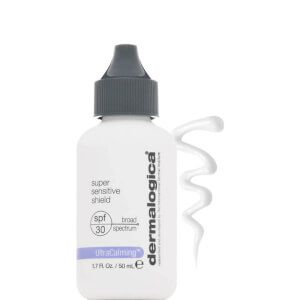
Dermalogica UltraCalming Super Sensitive Shield SPF 30
Works for
1 of 1 advertised claim delivered
Sun protectionSPF 30 · 2 UV filtersBroad spectrum
This product offers a good level of protection against both UVB and UVA rays.
It is a mineral sunscreen. In other words, it contains non-organic UV filters. It will probably not sting your eyes but might leave a white cast.
This product can be considered "reef safe" because it does not contain the UV filters (oxybenzone and octinoxate) that can be harmful to coral reefs when present in the water in high concentrations.
Anti-agingNot advertised by the brand · 3 ingredients credited for this claimStrong support
This product can help prevent early signs of skin aging because it offers a good level of broad spectrum sun protection. Sun damage is the main cause of premature skin aging, and protecting your skin from the sun is the best anti-aging strategy.
Evens skin toneNot advertised by the brand · 3 ingredients credited for this claimStrong support
This product offers broad spectrum sun protection. It means that it can prevent hyperpigmentation and help keep the skin tone even (sun damage is the main factor causing age spots, darkening of post-acne marks and other discolorations).
Anti-oxidationNot advertised by the brand · 10 ingredients credited for this claimModerate support
This product contains antioxidants (camellia sinensis leaf extract) that might be able to help neutralize free radicals in skin to lessen the damage it gets from the UV light (sun). There is not enough evidence to confirm their effectiveness in skin though.
MoisturizingNot advertised by the brand · 21 ingredients credited for this claimGood support
This product can help improve hydration of the skin with the two types of ingredients.
The first type is called “humectants”:
these ingredients help attract water.
When humectants are on the surface of the skin, they “pull in” the moisture from the outside environment, or from
within deeper layers of the skin. The following ingredients in this product do the job:
cyclomethicone, glycerin.
This product also contains ingredients called “occlusives”. They help reduce the speed with which our skin loses moisture to the outside environment. These ingredients also help soften the upper layer of the skin, so it feels less tight and nicer to the touch. The following ingredients in this product do the job: dimethicone, cyclomethicone.
Can it cause trouble?
Irritancy2 strong irritants: Eucalyptus globulus leaf oil, Lavandula hybrida oilMedium risk
ComedogenicClean of flagged comedogenic ingredientsNone flagged
User reviews
Ingredients
Filter by role to see what each ingredient is doing.
Titanium dioxide7%
- Irritation risk
- Low
Works as a UV filter when used in high concentrations. It is photostable and is effective mostly against the UVB light, with some protection in the UVA range. In small concentrations, used for its ability to improve the color of cosmetic products. Is usually well tolerated by the skin
More about Titanium dioxideZinc oxide9%
- Irritation risk
- Low
A broad spectrum sunblock (protects from both UVA and UVB rays). Is suitable for most sensitive skins. In small concentrations, can be used as a colorant
More about Zinc oxideWater~45–55%
Cyclopentasiloxane~6.3–7.7%
- Irritation risk
- Low
A silicone that helps improve the product texture and spreadability. Can absorb oil creating a short-term mattifying effect on the skin
More about CyclopentasiloxaneDicaprylyl ether~6.6–8%
- Irritation risk
- Low
Helps soften the upper layer of the skin while creating a non-greasy feel on the skin. Helps to dissolve other ingredients
More about Dicaprylyl etherButylene glycol~4.2–5.2%
- Irritation risk
- Low
Used to create a nice product texture and help delivery of other ingredients. Might be somewhat helpful in attracting water to the upper layer of the skin
More about Butylene glycolPolyglyceryl-3 polydimethylsiloxyethyl dimethicone~3.5–4.3%
- Irritation risk
- Low
Lauryl peg-9 polydimethylsiloxyethyl dimethicone~3.1–3.8%
- Irritation risk
- Low
A type of silicone that helps to soften upper layer of the skin and create a nice product texture
More about Lauryl peg-9 polydimethylsiloxyethyl dimethiconeStearic acid~2.7–3.3%
- Irritation risk
- Low
Helps oil and water mix together and works as an emollient
More about Stearic acidAluminum hydroxide~2.3–2.8%
- Irritation risk
- Low
Is used to add opaque (non-transparent) appearance to formulations. Can be used to coat other ingredients for even dispersion. This is a different ingredient compared to the ones used in antipersperants (aluminium chloride and aluminium chlorohydrate)
More about Aluminum hydroxideDimethicone~1.9–2.3%
- Irritation risk
- Low
A silicone that helps to reduce water loss from the surface of the skin. Can temporarily "fill in" lines and wrinkles, absorb oil, and create a nice product finish
More about DimethiconeLeuconostoc/radish root ferment filtrate~1.3–1.6%
- Irritation risk
- Medium
A preservative that comes from radishes fermented by a bacteria. New research suggests that the preservation properties in the ingredient come from an ammonium salt that is not present naturally in radish root but used in its cultivation. Is problematic because the exact amount of the preservative agents is difficult to determine
More about Leuconostoc/radish root ferment filtrateCamellia sinensis leaf extract~1.1–1.4%
- Irritation risk
- Low
Can contain potent anti-oxidant compounds (abbreviated ECG, GCG, EGC, and EGCG) that might help protect the skin from free radicals. Can help calm down inflammation and has some anti-bacterial properties. Unfortunately, these antioxidants are unstable and lose their effectiveness very quickly in products. The concentration of the antioxidant compounds in the extract also tends to be low to be effective in topical formulation
More about Camellia sinensis leaf extractAvena sativa kernel extract~1.1–1.3%
- Irritation risk
- Low
An effective moisturizing and skin barrier repair ingredient. Helps calm down inflammation and has some anti-oxidant properties
More about Avena sativa kernel extractBoerhavia diffusa root extract~0.95–1.2%
- Irritation risk
- Medium
A plant extract that might help reduce inflammation and neutralize free radicals
More about Boerhavia diffusa root extractOxothiazolidine~0.95–1.15%
- Irritation risk
- Low
Citrullus lanatus fruit extract~0.8–1.2%
- Irritation risk
- Medium
A plant extract that can contain an antioxidant compound
More about Citrullus lanatus fruit extractPyrus malus fruit extract~0.9–1.1%
- Irritation risk
- Medium
Can have some moisturizing properties due to its sugar content
More about Pyrus malus fruit extractSodium hyaluronate~0.75–1.15%
- Irritation risk
- Low
One of the best moisturizing ingredients. Attracts water into the upper layer of the skin
More about Sodium hyaluronateSodium pca~0.75–1.1%
- Irritation risk
- Low
Naturally present in skin and helps to attract water to its upper layer
More about Sodium pcaSodium lactate~0.7–1.05%
- Irritation risk
- Medium
Helps attract water to the upper layer of the skin. Is often used to adjust the pH level of the product
More about Sodium lactateLens esculenta fruit extract~0.65–0.95%
- Irritation risk
- Medium
A plant extract containing sugars that might help attract water to the upper layer of the skin. Is claimed by the manufacturer to help reduce pore size but evidence is lacking
More about Lens esculenta fruit extractAscorbyl tetraisopalmitate~0.7–1.05%
- Irritation risk
- Medium
A vitamin C derivative. Studies show that is might be effective in reducing hyperpigmentation, but there are no studies confirming that it is effectively converted into the bioavailable form of Vitamin C in skin. It is not clear how this derivative compares in effectiveness to the topical application of bioavailable form of vitamin C (L-ascorbic acid)
More about Ascorbyl tetraisopalmitateLavandula spica flower oil~0.65–0.95%
- Irritation risk
- Low
Eucalyptus globulus leaf oil~0.55–0.85%
- Irritation risk
- High
An essential oil that can be very irritating. Has some anti-bacterial properties
More about Eucalyptus globulus leaf oilLavandula hybrida oil~0.65–1%
- Irritation risk
- High
Plant extract that can be irritating and is a known allergen
More about Lavandula hybrida oilSodium dna~0.6–0.95%
- Irritation risk
- Low
Tocopherol~0.65–0.95%
- Irritation risk
- Low
Pure form of vitamin E. Can help moisturise and protect the skin from free radicals. Often used to help stabilise other ingredients or the formula itself
More about TocopherolCaprylic/capric triglyceride~0.7–1.05%
- Irritation risk
- Medium
A good mix of fatty acids that forms a protective layer on the skin. Improves the shelf life of products. Derived from coconut and glycerin
More about Caprylic/capric triglycerideCarbomer~0.6–0.9%
- Irritation risk
- Low
Helps create a thicker or gel-like product texture. It is not a surfactant but can be used in gentle cleansing formulations
More about CarbomerPentylene glycol~0.7–1.1%
- Irritation risk
- Medium
Used to preserve products, dissolve other ingredients and create a nice product texture
More about Pentylene glycolHydroxyphenyl propamidobenzoic acid~0.6–0.9%
- Irritation risk
- Low
Might help to reduce inflammation in skin, but solid research is lacking
More about Hydroxyphenyl propamidobenzoic acidBisabolol~0.6–0.9%
- Irritation risk
- Low
An active component of chamomile plant that historically has been used to calm down irritated skin. A recent study shows that bisabolol indeed can have some anti-inflammatory effect on skin, even though conclusive data is lacking. Bisabolol has a sweet floral scent and can be added to products for its aromatic properties
More about BisabololZingiber officinale extract~0.6–0.85%
- Irritation risk
- Low
Dimethicone/vinyl dimethicone crosspolymer~0.5–0.75%
- Irritation risk
- Low
Used to stabilize product formulations and create a nice product texture
More about Dimethicone/vinyl dimethicone crosspolymerSilica~0.65–0.95%
Dipotassium glycyrrhizate~0.5–0.75%
- Irritation risk
- Low
A salt derived from licorice. Works as an emollient to soften the upper layer of the skin and can help calm down inflammation. Might be helpful for skin lightening
More about Dipotassium glycyrrhizateTriethoxysilylethyl polydimethylsiloxyethyl hexyl dimethicone~0.5–0.75%
- Irritation risk
- Low
Dimethicone/peg-10/15 crosspolymer~0.5–0.7%
Peg/ppg-18/18 dimethicone~0.5–0.75%
- Irritation risk
- Low
A silicone that mixes with water creating nice light-weight product texture
More about Peg/ppg-18/18 dimethiconeGlycerin~0.45–0.7%
- Irritation risk
- Low
One of the best moisturizing ingredients. Naturally present in skin. It attracts water to the upper layer of the skin working as a humectant
More about GlycerinCyclomethicone~0.5–0.7%
- Irritation risk
- Low
A type of silicone that leaves a nice silky finish on the skin and can help soften its upper layer
More about CyclomethiconeTocopheryl acetate~0.4–0.6%
- Irritation risk
- Medium
A more stable but less bio-available form of vitamin E compared to Tocopherol. Might help moisturize and protect the skin from free radicals, but mostly used in low concentrations to stabilize other ingredients.
More about Tocopheryl acetateDisodium edta~0.3–0.55%
Sodium benzoate~0.2–0.4%
Sodium chloride~0.25–0.45%
- Irritation risk
- Low
Used to stabilize mixtures of oil and water, and create thicker, gel-like product textures
More about Sodium chlorideSodium citrate~0.25–0.4%
- Irritation risk
- Medium
Helps to control the skin's pH level. Maintains the skin's natural film of amino-lactic acids and oils. Helps to preserve products
More about Sodium citrateGlycerin~0.15–0.3%
- Irritation risk
- Low
One of the best moisturizing ingredients. Naturally present in skin. It attracts water to the upper layer of the skin working as a humectant
More about GlycerinPhenoxyethanol~0.15–0.3%
- Irritation risk
- Low
A preservative. It helps prevent bacterial growth in cosmetic products
More about PhenoxyethanolIngredient list view
Titanium dioxide, Zinc oxide, Water, Cyclopentasiloxane, Dicaprylyl ether, Butylene glycol, Polyglyceryl-3 polydimethylsiloxyethyl dimethicone, Lauryl peg-9 polydimethylsiloxyethyl dimethicone, Stearic acid, Aluminum hydroxide, Dimethicone, Leuconostoc/radish root ferment filtrate, Camellia sinensis leaf extract, Avena sativa kernel extract, Boerhavia diffusa root extract, Oxothiazolidine, Citrullus lanatus fruit extract, Pyrus malus fruit extract, Sodium hyaluronate, Sodium pca, Sodium lactate, Lens esculenta fruit extract, Ascorbyl tetraisopalmitate, Lavandula spica flower oil, Eucalyptus globulus leaf oil, Lavandula hybrida oil, Sodium dna, Tocopherol, Caprylic/capric triglyceride, Carbomer, Pentylene glycol, Hydroxyphenyl propamidobenzoic acid, Bisabolol, Zingiber officinale extract, Dimethicone/vinyl dimethicone crosspolymer, Silica, Dipotassium glycyrrhizate, Triethoxysilylethyl polydimethylsiloxyethyl hexyl dimethicone, Dimethicone/peg-10/15 crosspolymer, Peg/ppg-18/18 dimethicone, Glycerin, Cyclomethicone, Tocopheryl acetate, Disodium edta, Sodium benzoate, Sodium chloride, Sodium citrate, Unknown, Glycerin, Phenoxyethanol
Compare prices
Retailers ranked by price — lowest first.
Product summary
We believe that "Dermalogica - UltraCalming Super Sensitive Shield SPF 30" can provide reliable sun protection based on the ingredients listed. We love that it can protect from both UVA and UVB rays (not all sunscreens with SPF ratings give UVA protection. UVA rays do not cause sunburn, but still damage our skin and lead to early aging).
Because it includes good moisturizing ingredients, it can also work as a hydrating day cream. Like all broad-spectrum sunscreens, this product has an anti-aging benefit.
Sunscreen filters
This product is a mineral sunscreen. It uses titanium dioxide and zinc oxide for sun protection. Both titanium dioxide and zinc oxide almost never irritate even the most sensitive skin and eyes, but can leave a white cast.
Irritation risk
It contains some common irritants, including those without a benefit for the skin. We assess the overall irritancy of this product to be medium. For a detailed overview of all potential irritants: click here
You can see the detailed formula review with the breakdown of all actives in the product and the full ingredient list with estimated concentrations in the tables below.
What our users say
Based on 1 review 100% recommend this product- As for the white cast, it did not leave a noticeable white residue for the reviewer.
- When it comes to using this sunscreen under makeup, the user found that it pills under a foundation.
About the brand
According to Cruelty-Free Kitty "Dermalogica" is cruelty free, but its parent company is not.
Price
The product retails for 54.00$ in the United States.
For a detailed price comparison: click here.
Sources cited in this review
Every concentration estimate and effectiveness label is anchored to one of these 23 studies and safety reviews.
- 1A review of inorganic UV filters zinc oxide and titanium dioxideonlinelibrary.wiley.com
- 2
- 3
- 4
- 5
- 6

Affiliate links · As an Amazon Associate, WIMJ earns from qualifying purchases.