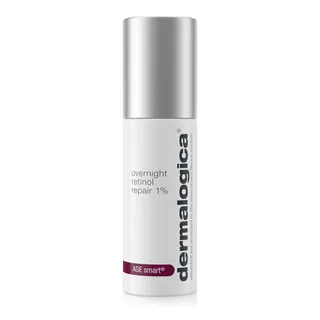
Works for
Anti-agingRetinol, Palmitoyl tripeptide-5 + 3 moreWorks well
“La crème de soin concentrée et personnalisable de nuit au rétinol accélère le renouvellement cutané et réduit l'apparence du vieillissement cutané.”
This product can help reduce and prevent fine lines and wrinkles, improve skin elasticity and firmness because it contains retinol.
These ingredients in the product can also be helpful, even though there is less evidence for their effectiveness: palmitoyl tripeptide-5, tetradecyl aminobutyroylvalylaminobutyric urea trifluoroacetate.
Keep in mind that it typically takes at least 6 weeks to notice any results because the changes that are needed to improve fine lines and elasticity happen in the deeper layers of the skin. No topical anti-aging product can “erase” wrinkles or fully reverse signs of aging.
Evens skin toneRetinol, Dipotassium glycyrrhizateWorks well
“De puissants peptides et de la vitamine C antioxydante aident à réduire le teint inégal et la décoloration.”
This product can help reduce hypepigmentation and even out the skin tone because it contains the following effective ingredients: retinol.
The following ingredient (ingredients) in this product might be helpful, but there is no evidence to confirm that it actually can help even out the skin tone: dipotassium glycyrrhizate.
Keep in mind that you would need to apply any topical skincare targetted at hypigmentation consistently for a couple of months to get a result. No topical skincare product can help get rid of hyperpigmentation (including post-acne marks and age spots) instantly.
ExfoliationSide benefit the brand mentions · RetinolWorks well
“Prep skin with Pre Cleanse and Skin Resurfacing Cleanser.”
This product can help exfoliate the skin. In other words, it helps break down the bonds between dead cells on the surface of the skin and speed up the skin turnover. Skin often appears softer and brighter after exfoliation, but overdoing it can result in disrupted skin barrier. The following ingredient is doing the exfoliating job in this product: retinol.
Anti-oxidationSide benefit · Retinol, Pelargonium graveolens flower oil + 1 moreWorks well
This product contains antioxidants (retinol) that can help neutralize free radicals in skin. By doing so, they can lessen the damage the skin gets from the UV light (sun).
Anti-blemishSide benefit · Retinol, Aloe barbadensis leaf juice + 1 moreWorks well
This product can help reduce breakouts and clogged pores because it contains the following ingredient: retinol. This ingredient is used for treating acne and can have a noticeable effect.
Can it cause trouble?
Irritancy6 strong irritants: Retinol, Pelargonium graveolens flower oil + 4 more — patch-test recommendedHigh risk
ComedogenicClean of flagged comedogenic ingredientsNone flagged


User reviews
Be the first — your take helps the next person decide.
Ingredients
Filter by role to see what each ingredient is doing.
Water~45–55%
Squalane~5.4–6.6%
- Irritation risk
- Low
An oil naturally present in skin. Works as an emollient to soften the skin and form a protective layer on its surface without a greasy feeling.
More about SqualaneGlycerin~4.2–5.2%
- Irritation risk
- Low
One of the best moisturizing ingredients. Naturally present in skin. It attracts water to the upper layer of the skin working as a humectant
More about GlycerinC14-22 alcohols~3.2–3.9%
- Irritation risk
- Low
A non-drying alcohol that helps stabilize product formulations
More about C14-22 alcoholsCaprylic/capric triglyceride~2.5–3%
- Irritation risk
- Medium
A good mix of fatty acids that forms a protective layer on the skin. Improves the shelf life of products. Derived from coconut and glycerin
More about Caprylic/capric triglycerideXylitylglucoside~2–2.4%
- Irritation risk
- Low
Helps attract water to the upper layer of the skin and repair the skin barrier function
More about XylitylglucosideRetinol~1.7–2%
- Irritation risk
- High
Two steps removed from the active form of vitamin A - retinoic acid. Once converted to the retinoic acid in the skin, retinol is proven to be effective against all signs of aging. It improves skin cell turnover, helps fight blemishes and clogged pores, can regulate excess oil production and even skin tone. It can, however, be quite irritating
More about RetinolDipotassium glycyrrhizate~1.5–1.8%
- Irritation risk
- Low
A salt derived from licorice. Works as an emollient to soften the upper layer of the skin and can help calm down inflammation. Might be helpful for skin lightening
More about Dipotassium glycyrrhizateSodium ascorbyl phosphate~1.2–1.4%
- Irritation risk
- Medium
A stable derivative of vitamin C. It is oil-soluble which means it is more likely to penetrate the skin compared to the pure form of vitamin C (which is water-soluble), but it is less bio-available and is way less effective in stimulating collagen and reducing wrinkles compared to the pure form of vitamin C (L-ascorbic acid) and its other derivatives (for example, magnesium ascorbyl phosphate). At the same time, this vitamin C derivative has been shown in studies to be effective in reducing acne, blemishes and clogged pores. It is less irritating then the pure form of vitamin C
More about Sodium ascorbyl phosphateCeramide 3~1.1–1.3%
- Irritation risk
- Low
A type of lipid similar to ceramides naturally present in skin. Helps to soften the upper layer of the skin and supports the skin barrier function to keep it hydrated. Can help to prevent inflammation in skin
More about Ceramide 3Xylitol~0.7–1.05%
- Irritation risk
- Low
Helps attract water to the upper layer of the skin and repair the skin barrier function
More about XylitolPalmitoyl tripeptide-5~0.6–0.9%
- Irritation risk
- Low
A type of peptide. Peptides are excellent moisturizers and might be able support collagen production reducing fine lines and wrinkles
More about Palmitoyl tripeptide-5Copper lysinate/prolinate~0.55–0.85%
- Irritation risk
- Low
Glucose~0.55–0.8%
- Irritation risk
- Low
Helps attract water to the upper layer of the skin. Could be helpful in restoring the skin barrier function
More about GlucoseCetyl palmitate~0.55–0.8%
- Irritation risk
- Low
An emollient that helps soften the skin and is used to improve product texture and stability
More about Cetyl palmitatePelargonium graveolens flower oil~0.5–0.75%
- Irritation risk
- High
An essential oil. Can be irritating. Can become an allergen with oxidation
More about Pelargonium graveolens flower oilMethylglucoside phosphate~0.45–0.7%
- Irritation risk
- Low
Tetradecyl aminobutyroylvalylaminobutyric urea trifluoroacetate~0.45–0.65%
- Irritation risk
- Low
A peptide. It helps attract water to the upper layer of the skin, support skin's barrier function and might have some slight anti-aging effect through stimulating skin's own production of hyaluronic acid
More about Tetradecyl aminobutyroylvalylaminobutyric urea trifluoroacetateLavandula hybrida oil~0.4–0.65%
- Irritation risk
- High
Plant extract that can be irritating and is a known allergen
More about Lavandula hybrida oilAnhydroxylitol~0.35–0.6%
- Irritation risk
- Low
Helps attract water to the upper layer of the skin and repair the skin barrir function
More about AnhydroxylitolMagnesium chloride~0.3–0.6%
C12-20 alkyl glucoside~0.3–0.6%
- Irritation risk
- Medium
Helps water and oil mix together
More about C12-20 alkyl glucosidePolysorbate 20~0.3–0.55%
Acrylates/c10-30 alkyl acrylate crosspolymer~0.3–0.55%
- Irritation risk
- Medium
Maintains the texture of skincare products. Allows the product to spread evenly. Helps oil and water mix together
More about Acrylates/c10-30 alkyl acrylate crosspolymerSodium hydroxide~0.3–0.5%
Aminomethyl propanol~0.3–0.5%
Ethylhexylglycerin~0.3–0.6%
Linalool~0.3–0.55%
Citronellol~0.3–0.55%
Geraniol~0.3–0.55%
Phenoxyethanol~0.3–0.6%
- Irritation risk
- Low
A preservative. It helps prevent bacterial growth in cosmetic products
More about PhenoxyethanolWater~0.3–0.6%
Aloe barbadensis leaf juice~0.3–0.55%
- Irritation risk
- Medium
Traditionally used to treat sunburns, dermatitis and inflammation, but evidence for its effectiveness is lacking. The extract can contain humectants that help attract water into the skin
More about Aloe barbadensis leaf juiceEthylhexyl hydroxystearate~0.35–0.65%
- Irritation risk
- Low
Helps soften the upper layer of the skin and reduce water loss from it
More about Ethylhexyl hydroxystearateButylene glycol~0.3–0.55%
- Irritation risk
- Low
Used to create a nice product texture and help delivery of other ingredients. Might be somewhat helpful in attracting water to the upper layer of the skin
More about Butylene glycolCetearyl ethylhexanoate~0.35–0.65%
- Irritation risk
- Low
An emollient that helps soften the skin
More about Cetearyl ethylhexanoateCetyl caprylate~0.35–0.6%
- Irritation risk
- Low
Peg-8~0.3–0.6%
- Irritation risk
- Medium
Used to create a nice product consistency
More about Peg-8Stearic acid~0.45–0.7%
- Irritation risk
- Low
Helps oil and water mix together and works as an emollient
More about Stearic acidDimethicone~0.4–0.65%
- Irritation risk
- Low
A silicone that helps to reduce water loss from the surface of the skin. Can temporarily "fill in" lines and wrinkles, absorb oil, and create a nice product finish
More about DimethiconeCetyl dimethicone~0.35–0.65%
- Irritation risk
- Low
A type of silicone. Helps soften the upper layer of the skin and creates a nice, light product texture
More about Cetyl dimethiconeGlyceryl stearate~0.4–0.6%
- Irritation risk
- Low
An emollient that softens the skin and forms a protective layer on its surface. Helps water and oil mix together
More about Glyceryl stearateLactamide mea~0.3–0.55%
- Irritation risk
- Low
Peg-100 stearate~0.45–0.65%
- Irritation risk
- Low
Helps oil and water mix togehter and creates a nice product texture
More about Peg-100 stearateCetyl alcohol~0.4–0.6%
- Irritation risk
- Low
A non-drying alcohol that works to soften the skin and stabilize product formulations helping oil and water mix together
More about Cetyl alcoholPotassium cetyl phosphate~0.35–0.6%
- Irritation risk
- Medium
Helps oil and water mix together
More about Potassium cetyl phosphateSodium pca~0.3–0.55%
- Irritation risk
- Low
Naturally present in skin and helps to attract water to its upper layer
More about Sodium pcaCarbomer~0.3–0.6%
- Irritation risk
- Low
Helps create a thicker or gel-like product texture. It is not a surfactant but can be used in gentle cleansing formulations
More about CarbomerDisodium edta~0.3–0.55%
Ethylhexylglycerin~0.3–0.6%
Aminomethyl propanol~0.3–0.6%
Ethanolamine~0.3–0.6%
- Irritation risk
- Low
Phenoxyethanol~0.3–0.6%
- Irritation risk
- Low
A preservative. It helps prevent bacterial growth in cosmetic products
More about PhenoxyethanolWater~0.3–0.6%
Aloe barbadensis leaf juice~0.3–0.55%
- Irritation risk
- Medium
Traditionally used to treat sunburns, dermatitis and inflammation, but evidence for its effectiveness is lacking. The extract can contain humectants that help attract water into the skin
More about Aloe barbadensis leaf juiceEthylhexyl hydroxystearate~0.35–0.65%
- Irritation risk
- Low
Helps soften the upper layer of the skin and reduce water loss from it
More about Ethylhexyl hydroxystearateButylene glycol~0.3–0.55%
- Irritation risk
- Low
Used to create a nice product texture and help delivery of other ingredients. Might be somewhat helpful in attracting water to the upper layer of the skin
More about Butylene glycolCetearyl ethylhexanoate~0.35–0.65%
- Irritation risk
- Low
An emollient that helps soften the skin
More about Cetearyl ethylhexanoateCetyl caprylate~0.35–0.6%
- Irritation risk
- Low
Peg-8~0.3–0.6%
- Irritation risk
- Medium
Used to create a nice product consistency
More about Peg-8Stearic acid~0.45–0.7%
- Irritation risk
- Low
Helps oil and water mix together and works as an emollient
More about Stearic acidDimethicone~0.4–0.6%
- Irritation risk
- Low
A silicone that helps to reduce water loss from the surface of the skin. Can temporarily "fill in" lines and wrinkles, absorb oil, and create a nice product finish
More about DimethiconeCetyl dimethicone~0.3–0.6%
- Irritation risk
- Low
A type of silicone. Helps soften the upper layer of the skin and creates a nice, light product texture
More about Cetyl dimethiconeGlyceryl stearate~0.35–0.6%
- Irritation risk
- Low
An emollient that softens the skin and forms a protective layer on its surface. Helps water and oil mix together
More about Glyceryl stearateLactamide mea~0.25–0.5%
- Irritation risk
- Low
Peg-100 stearate~0.35–0.65%
- Irritation risk
- Low
Helps oil and water mix togehter and creates a nice product texture
More about Peg-100 stearateCetyl alcohol~0.3–0.55%
- Irritation risk
- Low
A non-drying alcohol that works to soften the skin and stabilize product formulations helping oil and water mix together
More about Cetyl alcoholPotassium cetyl phosphate~0.25–0.5%
- Irritation risk
- Medium
Helps oil and water mix together
More about Potassium cetyl phosphateSodium pca~0.2–0.4%
- Irritation risk
- Low
Naturally present in skin and helps to attract water to its upper layer
More about Sodium pcaCarbomer~0.15–0.3%
- Irritation risk
- Low
Helps create a thicker or gel-like product texture. It is not a surfactant but can be used in gentle cleansing formulations
More about CarbomerDisodium edta~0.15–0.3%
Ethylhexylglycerin~0.15–0.3%
Aminomethyl propanol~0.15–0.3%
Ethanolamine~0.1–0.2%
- Irritation risk
- Low
Phenoxyethanol~0.15–0.3%
- Irritation risk
- Low
A preservative. It helps prevent bacterial growth in cosmetic products
More about PhenoxyethanolIngredient list view
Water, Squalane, Glycerin, C14-22 alcohols, Caprylic/capric triglyceride, Xylitylglucoside, Retinol, Dipotassium glycyrrhizate, Sodium ascorbyl phosphate, Ceramide 3, Xylitol, Palmitoyl tripeptide-5, Copper lysinate/prolinate, Glucose, Cetyl palmitate, Pelargonium graveolens flower oil, Methylglucoside phosphate, Tetradecyl aminobutyroylvalylaminobutyric urea trifluoroacetate, Lavandula hybrida oil, Anhydroxylitol, Magnesium chloride, C12-20 alkyl glucoside, Polysorbate 20, Acrylates/c10-30 alkyl acrylate crosspolymer, Sodium hydroxide, Aminomethyl propanol, Ethylhexylglycerin, Linalool, Citronellol, Geraniol, Phenoxyethanol, Water, Aloe barbadensis leaf juice, Ethylhexyl hydroxystearate, Butylene glycol, Cetearyl ethylhexanoate, Cetyl caprylate, Peg-8, Stearic acid, Dimethicone, Cetyl dimethicone, Glyceryl stearate, Lactamide mea, Peg-100 stearate, Cetyl alcohol, Potassium cetyl phosphate, Sodium pca, Carbomer, Disodium edta, Ethylhexylglycerin, Aminomethyl propanol, Ethanolamine, Phenoxyethanol, Water, Aloe barbadensis leaf juice, Ethylhexyl hydroxystearate, Butylene glycol, Cetearyl ethylhexanoate, Cetyl caprylate, Peg-8, Stearic acid, Dimethicone, Cetyl dimethicone, Glyceryl stearate, Lactamide mea, Peg-100 stearate, Cetyl alcohol, Potassium cetyl phosphate, Sodium pca, Carbomer, Disodium edta, Ethylhexylglycerin, Aminomethyl propanol, Ethanolamine, Phenoxyethanol
Compare prices
Retailers ranked by price — lowest first.
Affiliate links · As an Amazon Associate, WIMJ earns from qualifying purchases.
Worth comparing, line by line.
Match % combines shared ingredients, the first five ingredients, shared actives and hero ingredients, irritancy (lower counts in the alternative's favour), texture and body area. Only products in the same routine step are compared.
| Dermalogicaovernight retinol repair 1%YOUR PRODUCT | BlissYouth Got This Serum | Image skincareIMAGE MD restoring retinol crème | Paula's choiceClinical Ceramide-Enriched Firming Moisturiser | |
|---|---|---|---|---|
| Match | — | 79% | 74% | 74% |
| Price | — | $32.00 | — | $50.40 |
| Shared key ingredients | — | 8 of 15 | 7 of 15 | 6 of 15 |
| Key difference | — | Acetyl Hexapeptide-8 | Lactic Acid | Ascorbyl Glucoside |
| Irritancy | High | Medium | High | Medium |
| Drying alcohol | — | — | Contains drying alcohol | — |
| View product | Shop | Shop | Shop |


More alternatives: Clinique Smart Night Clinical MD Multi-Dimensional Repair Treatment RetinolAesthetics Rx A Serum Retinol Restorative
Product summary
"Dermalogica - overnight retinol repair 1%" is effective for: Anti-aging, Evens skin tone, Anti-blemish and Exfoliation
Ingredient callouts
- this product contains an effective form of Retinoids (vitamin A): retinol 1.40% - 1.70% and retinol 28.00% - 34.00%. Retinoids are potent multitasking actives. They work to improve and prevent early signs of aging, reduce hyperpigmentation (age spots and post-acne marks), and prevent inflamed blemishes and clogged pores. The downside of Retinoids is that they can be irritating. If you are not already using a Retinoid in your routine, it is best to start slowly and apply the Retinoid product only a few times per week. If your skin tolerates it well, you can gradually increase the frequency to daily.
- Ceramides (ceramide 3 0.75% - 1.10%). Ceramides are a type of lipids that our skin produces itself. They are a building block of the skin's barrier. Ceramides used in skincare are synthetic or extracted from plants. They work well for softening the skin surface and "patch holes" in the skin's barrier.
- Peptides (palmitoyl tripeptide-5 0.50% - 0.80%). There are many different kind of Peptides and they are naturally present in our skin. They all are a combination of aminoacids. Some of them work as natural antibiotics, promote wound-healing and production of collagen. The science is still not settled on how effective Peptides are in skincare, but it is very likely that they have a benefit. They might help restore the skin barrier and fight the signs of aging. At the very least, Peptides work as humectants: they attract water to the upper layer of the skin and improve its hydration.
- Dipotassium Glycyrrhizate in this product (1.20% - 1.40%) can also further help improve the skin barrier. It might be able to calm down inflammation and reduce sensitivity. Dipotassium Glycyrrhizate is an active compound from the licorice root.
About the brand
According to Cruelty-Free Kitty "Dermalogica" is cruelty free, but its parent company is not.
Price
The product retails from 70.76£ up to 837.00£ in the United Kingdom, from 126.00CA$ up to 159.99CA$ in Canada, for 92.00$ in the United States and for 118.80A$ in Australia.
For a detailed price comparison: click here.
Sources cited in this review
Every concentration estimate and effectiveness label is anchored to one of these 22 studies and safety reviews.
- 1
- 2
- 3Improvement of naturally aged skin with vitamin A (retinol)ncbi.nlm.nih.gov
- 4
- 5
- 6

Affiliate links · As an Amazon Associate, WIMJ earns from qualifying purchases.