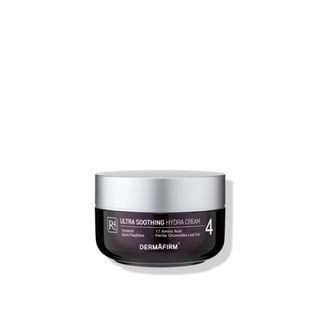
DERMAFIRM Ultra Soothing Hydra Cream R4
Works for
1 of 1 advertised claim delivered
MoisturizingPalmitoyl oligopeptide, Copper tripeptide-1 + 34 moreStrong evidence
“Ultra Soothing Hydra Cream R4”
This product can help improve hydration of the skin with the two types of ingredients.
The first type is called “humectants”:
these ingredients help attract water.
When humectants are on the surface of the skin, they “pull in” the moisture from the outside environment, or from
within deeper layers of the skin. The following ingredients in this product do the job:
alanine, arginine.
This product also contains ingredients called “occlusives”. They help reduce the speed with which our skin loses moisture to the outside environment. These ingredients also help soften the upper layer of the skin, so it feels less tight and nicer to the touch. The following ingredients in this product do the job: arginine, dimethiconol.
The following ingredients in this product are especially good for supporting the skin barrier and helping with the hydration level: acetyl hexapeptide-8, ceramide np, copper tripeptide-1, palmitoyl oligopeptide
Anti-oxidationNot advertised by the brand · Cysteine, Oenothera biennis oil + 4 moreModerate evidence
This product contains antioxidants (cysteine) that might be able to help neutralize free radicals in skin to lessen the damage it gets from the UV light (sun). There is not enough evidence to confirm their effectiveness in skin though.
Anti-agingNot advertised by the brand · Lysine, Serine + 7 moreModerate evidence
This product contains acetyl hexapeptide-8, aspartic acid, copper tripeptide-1, lysine, palmitoyl oligopeptide, serine, threonine. These ingredients might be able to help reduce and prevent fine lines and wrinkles, improve skin elasticity and firmness, but there is not enough evidence that it actually works.
Can it cause trouble?
Irritancy2 strong irritants: Perilla ocymoides leaf extract, Hamamelis virginiana extractMedium risk
Comedogenic1 ingredient rated 2 or more on the 0–5 pore-clogging scale1 flagged

User reviews
Be the first — your take helps the next person decide.
Ingredients
Filter by role to see what each ingredient is doing.
Water~45–55%
Cyclohexasiloxane~6.3–7.8%
- Irritation risk
- Low
A silicone that serves as an emollient. Helps create a nice non-greasy feels
More about CyclohexasiloxaneGlycerin~3.9–4.8%
- Irritation risk
- Low
One of the best moisturizing ingredients. Naturally present in skin. It attracts water to the upper layer of the skin working as a humectant
More about GlycerinCetearyl alcohol~2.5–3.1%
- Irritation risk
- Low
- Comedogenicity
- 2/5
A non-drying alcohol. Works as an emollient. Helps water and oil mix together and creates a nice product texture
More about Cetearyl alcoholButylene glycol~2.3–2.8%
- Irritation risk
- Low
Used to create a nice product texture and help delivery of other ingredients. Might be somewhat helpful in attracting water to the upper layer of the skin
More about Butylene glycol1,2-hexanediol~0.7–1.05%
Isododecane~1.7–2%
- Irritation risk
- Low
An emollient that helps soften the skin and can decrease moisture loss. Helps create a nice product texture
More about IsododecaneBetaine~1.4–1.7%
- Irritation risk
- Low
Helps attract water to the upper layer of the skin and improves the product texture
More about BetaineCetearyl glucoside~1.1–1.4%
- Irritation risk
- Medium
Helps water and oil in the product mix well together and improves product texture
More about Cetearyl glucosideSodium polyacryloyldimethyl taurate~0.8–1.2%
- Irritation risk
- Medium
Helps oil and water mix together
More about Sodium polyacryloyldimethyl taurateDimethiconol~0.7–1%
- Irritation risk
- Low
A silicone that makes products more spreadable and keeps skin smooth. Helps to add gloss to skin and may visually fill in fine lines/wrinkles for short time
More about DimethiconolHydrogenated polydecene~0.5–0.75%
- Irritation risk
- Low
Helps to soften the upper layer of the skin and create a nice product texture
More about Hydrogenated polydeceneDimethicone/vinyl dimethicone crosspolymer~0.45–0.7%
- Irritation risk
- Low
Used to stabilize product formulations and create a nice product texture
More about Dimethicone/vinyl dimethicone crosspolymerTocopherol~0.4–0.6%
- Irritation risk
- Low
Pure form of vitamin E. Can help moisturise and protect the skin from free radicals. Often used to help stabilise other ingredients or the formula itself
More about TocopherolHydrogenated phosphatidylcholine~0.3–0.6%
- Irritation risk
- Medium
Helps oil and water mix together
More about Hydrogenated phosphatidylcholineCarbomer~0.3–0.6%
- Irritation risk
- Low
Helps create a thicker or gel-like product texture. It is not a surfactant but can be used in gentle cleansing formulations
More about CarbomerTromethamine~0.3–0.55%
Ethylhexylglycerin~0.3–0.5%
Dipotassium glycyrrhizate~0.25–0.45%
- Irritation risk
- Low
A salt derived from licorice. Works as an emollient to soften the upper layer of the skin and can help calm down inflammation. Might be helpful for skin lightening
More about Dipotassium glycyrrhizateTrideceth-10~0.3–0.55%
Olea europaea fruit oil~0.2–0.4%
- Irritation risk
- Medium
An emollient that helps soften the skin but is not effective for restoring its barrier function. Might be helpful to calm down inflammation
More about Olea europaea fruit oilGlyceryl acrylate/acrylic acid copolymer~0.2–0.35%
- Irritation risk
- Medium
Helps attract water to the upper layer of the skin and provide a longer-lasting hydration. Can create a thicker product consistency
More about Glyceryl acrylate/acrylic acid copolymerSodium hyaluronate~0.15–0.3%
- Irritation risk
- Low
One of the best moisturizing ingredients. Attracts water into the upper layer of the skin
More about Sodium hyaluronateGlucose~0.2–0.35%
- Irritation risk
- Low
Helps attract water to the upper layer of the skin. Could be helpful in restoring the skin barrier function
More about GlucosePerilla ocymoides leaf extract~0.2–0.35%
- Irritation risk
- High
A plant extract that might help neutralize free radicals in skin but solid research is lacking. Contains a number of volatile compounds and could be irritating
More about Perilla ocymoides leaf extractSodium guaiazulene sulfonate~0.2–0.35%
Centella asiatica extract~0.2–0.4%
- Irritation risk
- Medium
A plant extract that has been shown to be able to reduce inflammation in skin, support restoration of skin barrier function, as well as support collagen production. Contains active compounds called centelloids: asiaticoside, madecasosside, asiatic acid and madecassic acid. Might be helpful in preventing stretch marks. It can be itself be irritating though.
More about Centella asiatica extractGlycine~0.15–0.3%
- Irritation risk
- Low
Helps to attract water to the upper layer of the skin and can help restore the skin barrier function
More about GlycineSerine~0.15–0.3%
- Irritation risk
- Low
An amino-acid that helps to attract water to the upper layer of the skin. In combination with other amino-acids, might help to reduce fine lines and wrinkles
More about SerineArginine~0.15–0.3%
- Irritation risk
- Low
An amino acid that is naturally present in skin and helps keep it hydrated. When used together with AHAs, it can reduce their irritating effect on the skin
More about ArginineHamamelis virginiana extract~0.15–0.3%
- Irritation risk
- High
A plant extract that can help calm down inflammation in skin. Can, however, itself be irritating
More about Hamamelis virginiana extractPortulaca oleracea extract~0.2–0.35%
- Irritation risk
- Medium
A plant extract that has some anti-oxidant activity, but solid research is lacking. Can help attract water to the upper layer of the skin
More about Portulaca oleracea extractAspartic acid~0.15–0.3%
- Irritation risk
- Low
An amino-acid that helps increase skin hydration and might help to slightly improve skin firmness, potentially reducing lines and wrinkles
More about Aspartic acidGlutamic acid~0.2–0.35%
- Irritation risk
- Low
An amino-acid that helps attract water to the upper layer of the skin
More about Glutamic acidLeucine~0.15–0.3%
- Irritation risk
- Low
Lysine~0.15–0.3%
- Irritation risk
- Low
An amino-acid that helps to attract water to the upper layer of the skin. In combination with other amino-acids, might help to reduce fine lines and wrinkles
More about LysineAlanine~0.15–0.3%
- Irritation risk
- Low
An amino-acid that helps to attract water to the upper layer of the skin and might help to lighten the skin, but solid evidence is lacking
More about AlanineProline~0.2–0.35%
Phenylalanine~0.2–0.35%
- Irritation risk
- Low
Threonine~0.2–0.35%
- Irritation risk
- Low
An amino-acid that helps to attract water to the upper layer of the skin. In combination with other amino-acids, might help to reduce fine lines and wrinkles
More about ThreonineValine~0.15–0.3%
- Irritation risk
- Low
Isoleucine~0.15–0.3%
- Irritation risk
- Low
An amino acid that can help attract water to the upper layer of the skin and support skin's barrier function
More about IsoleucineTyrosine~0.2–0.35%
Histidine~0.15–0.3%
Disodium edta~0.15–0.3%
Oenothera biennis oil~0.2–0.4%
- Irritation risk
- Medium
Helps soften the upper layer of the skin and can support skin barrier function
More about Oenothera biennis oilCopper tripeptide-1~0.2–0.35%
- Irritation risk
- Low
A naturally occurring peptide. One of the most studied peptides in dermatology. It is sometimes abbreviated GHK-Cu. Belongs to the class of carrier peptides. It stimulates both synthesis and breakdown of collagen in skin. It is released in skin wounds and inflammation to support healing. It accelerates wound-healing of the skin and can stimulate hair growth. There are preliminary studies that confirm that copper tripeptide can help support collagen production reducing fine lines and wrinkles and decrease inflammation in skin.
More about Copper tripeptide-1Ppg-26-buteth-26~0.2–0.4%
Peg-40 hydrogenated castor oil~0.2–0.4%
- Irritation risk
- Medium
Helps oil and water mix together
More about Peg-40 hydrogenated castor oilAcetyl hexapeptide-8~0.2–0.35%
- Irritation risk
- Low
A type of peptide. Peptides are excellent moisturizers and might be able support collagen production reducing fine lines and wrinkles
More about Acetyl hexapeptide-8Ceramide np~0.2–0.4%
- Irritation risk
- Low
A type of lipid similar to ceramides naturally present in skin. Helps to soften the upper layer of the skin and supports the skin barrier function to keep it hydrated. Can help to prevent inflammation in skin
More about Ceramide npPalmitoyl oligopeptide~0.25–0.45%
- Irritation risk
- Low
A type of peptide. Peptides are excellent moisturizers and might be able support collagen production reducing fine lines and wrinkles
More about Palmitoyl oligopeptideOleic acid~0.2–0.4%
- Irritation risk
- Medium
Helps soften the upper layer of the skin. At the same time, it can weaken the skin's barrier enhancing penetration of other ingredients and increasing the risk of skin dryness
More about Oleic acidCysteine~0.15–0.25%
- Irritation risk
- Low
Might help neutralize free radicals in skin and might be helpful against hyperpigmentation
More about CysteineMethionine~0.1–0.2%
- Irritation risk
- Low
Hydrolyzed collagen~0.15–0.3%
- Irritation risk
- Low
A typically plant-derived compound that is supposed mimic human collagen. Cannot penetrate the skin barrier so is not particularly useful in skincare products beyond attracting water to the upper layer of the skin
More about Hydrolyzed collagenIngredient list view
Water, Cyclohexasiloxane, Glycerin, Cetearyl alcohol, Butylene glycol, 1,2-hexanediol, Isododecane, Betaine, Cetearyl glucoside, Sodium polyacryloyldimethyl taurate, Dimethiconol, Hydrogenated polydecene, Dimethicone/vinyl dimethicone crosspolymer, Tocopherol, Hydrogenated phosphatidylcholine, Carbomer, Tromethamine, Ethylhexylglycerin, Dipotassium glycyrrhizate, Trideceth-10, Olea europaea fruit oil, Glyceryl acrylate/acrylic acid copolymer, Sodium hyaluronate, Glucose, Perilla ocymoides leaf extract, Sodium guaiazulene sulfonate, Centella asiatica extract, Glycine, Serine, Arginine, Hamamelis virginiana extract, Portulaca oleracea extract, Aspartic acid, Glutamic acid, Leucine, Lysine, Alanine, Proline, Phenylalanine, Threonine, Valine, Isoleucine, Tyrosine, Histidine, Disodium edta, Oenothera biennis oil, Copper tripeptide-1, Ppg-26-buteth-26, Peg-40 hydrogenated castor oil, Acetyl hexapeptide-8, Ceramide np, Palmitoyl oligopeptide, Oleic acid, Cysteine, Methionine, Hydrolyzed collagen
Compare prices
Retailers ranked by price — lowest first.

Worth comparing, line by line.
Match % combines shared ingredients, the first five ingredients, shared actives and hero ingredients, irritancy (lower counts in the alternative's favour), texture and body area. Only products in the same routine step are compared.
| DERMAFIRMUltra Soothing Hydra Cream R4YOUR PRODUCT | EvercellDeep Wrinkle Solution Cream Syringe Type | The SaemRepair Rx Cream | KLAVUURejuve Pearlsation Multi Pearl Peptide Cream | |
|---|---|---|---|---|
| Match | — | 52% | 50% | 50% |
| Price | $29.50 | $14.10−$15.40 | $32.40+$2.90 | $29.10 |
| Shared key ingredients | — | 16 of 27 | 11 of 27 | 16 of 27 |
| Key difference | — | Biotinoyl Tripeptide-1 | Sh-Decapeptide-7 | Niacinamide |
| Irritancy | Medium | Medium | Medium | Medium |
| Drying alcohol | — | — | — | — |
| View product | Shop | Shop | Shop |


Product summary
Based on the ingredient list, "DERMAFIRM - Ultra Soothing Hydra Cream R4" can work well for skin moisturization. As we expect from a proper moisturizer, the formula includes a combo of effective humectants and emollients. These are the two different types of ingredients that are essential for improving the skin hydration and supporting a healthy skin barrier. Acetyl hexapeptide-8, alanine, arginine, aspartic acid and betaine in this product (humectants) attract water molecules to the upper layer of the skin (the water comes from the outside air or from the deeper layers of the skin if the air is dry). Emollients in this formulation (ceramide np, hydrolyzed collagen, oenothera biennis oil, arginine and dimethiconol) help to reduce the moisture loss from the skin. They also soften the skin surface and relieve the feeling of dryness and tightness.
Ingredient callouts
- Another benefit is that this moisturizer contain ceramides (ceramide np 0.20% - 0.40%). Ceramides are an important part of our natural skin barrier. The Ceramides used in skincare are synthetic or come from plants. They help soften the skin and can help "fill the gaps" in the skin barrier, keeping the skin hydrated and resilient for longer.
- We like that this moisturizer contains peptides (palmitoyl oligopeptide 0.25% - 0.45%, acetyl hexapeptide-8 0.20% - 0.35% and copper tripeptide-1 0.20% - 0.35%). There are many different kind of Peptides and they are naturally present in our skin. They all are a combination of aminoacids. Some of them work as natural antibiotics, promote wound-healing and production of collagen. The science is still not settled on how effective Peptides are in skincare, but it is very likely that they have a benefit. Peptides might help restore the skin barrier and fight the signs of aging. At the very least, Peptides work as humectants: they attract water to the upper layer of the skin and improve its hydration.
Irritation risk
This moisturizer contains actives that can be irritating. We assess the overall irritancy of this moisturizer to be medium. For a detailed overview of all potential irritants: click here
You can see the detailed formula review with the breakdown of all actives in the product and the full ingredient list with estimated concentrations in the tables below.
Price
The product retails from 29.50$ up to 40.30$ in the United States.
For a detailed price comparison: click here.
Sources cited in this review
Every concentration estimate and effectiveness label is anchored to one of these 44 studies and safety reviews.
- 1
- 2
- 3Safety Assessment of Polyene Group as Used in Cosmeticscir-safety.org
- 4Vitamin E in dermatologyncbi.nlm.nih.gov
- 5Vitamin E and Skin Healthlpi.oregonstate.edu
- 6Safety Assessment of Tromethamine as Used in Cosmeticscir-safety.org

Affiliate links · As an Amazon Associate, WIMJ earns from qualifying purchases.