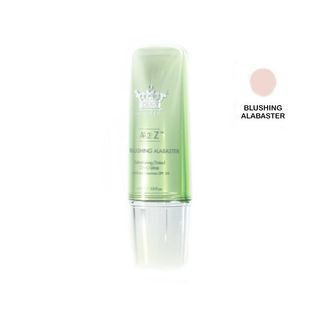
Danne Montague-King DMK Limited A 2 Z Revitalizing Tinted Day Creme - Blushing Alabaster
Works for
3 of 3 advertised claims delivered
Sun protectionSPF 30 · 2 UV filtersBroad spectrum
This product offers a good level of protection against both UVB and UVA rays.
This sunscreen uses organic (so-called "chemical") sunscreen filters. Organic, or "chemical" filters usually provide reliable sun protection and rarely leave a white cast. Sunscreens with organic filters can sting eyes.
This product can be considered "reef safe" because it does not contain the UV filters (oxybenzone and octinoxate) that can be harmful to coral reefs when present in the water in high concentrations.
Evens skin tone3 ingredients credited for this claimStrong evidence
“This revitalizing day crème is packed with nutrients, from Aqua to Zinc that work to improve skin firmness and elasticity, boost hydration, blur fine lines and brighten dark spots.”
This product offers broad spectrum sun protection. It means that it can prevent hyperpigmentation and help keep the skin tone even (sun damage is the main factor causing age spots, darkening of post-acne marks and other discolorations).
Anti-aging4 ingredients credited for this claimStrong evidence
“This revitalizing day crème is packed with nutrients, from Aqua to Zinc that work to improve skin firmness and elasticity, boost hydration, blur fine lines and brighten dark spots.”
This product can help prevent early signs of skin aging because it offers a good level of broad spectrum sun protection. Sun damage is the main cause of premature skin aging, and protecting your skin from the sun is the best anti-aging strategy.
These ingredients in the product might also be helpful for reducing and preventing fine lines, wrinkles, and skin elasticity, even though there is no conclusive evidence for their effectiveness: serine.
MoisturizingNot advertised by the brand · 21 ingredients credited for this claimGood evidence
This product can help improve hydration of the skin with the two types of ingredients.
The first type is called “humectants”:
these ingredients help attract water.
When humectants are on the surface of the skin, they “pull in” the moisture from the outside environment, or from
within deeper layers of the skin. The following ingredients in this product do the job:
alanine, glycerin.
This product also contains ingredients called “occlusives”. They help reduce the speed with which our skin loses moisture to the outside environment. These ingredients also help soften the upper layer of the skin, so it feels less tight and nicer to the touch. The following ingredients in this product do the job: caprylic/capric triglyceride, dimethicone.
Anti-oxidationNot advertised by the brand · 5 ingredients credited for this claimModerate evidence
This product contains antioxidants (naringenin) that might be able to help neutralize free radicals in skin to lessen the damage it gets from the UV light (sun). There is not enough evidence to confirm their effectiveness in skin though.
Can it cause trouble?
Irritancy13 flagged ingredientsMedium risk
Comedogenic2 ingredients rated 2 or more on the 0–5 pore-clogging scale2 flagged
User reviews
Be the first — your take helps the next person decide.
Ingredients
Filter by role to see what each ingredient is doing.
Water~45–55%
Cyclopentasiloxane~6.3–7.6%
- Irritation risk
- Low
A silicone that helps improve the product texture and spreadability. Can absorb oil creating a short-term mattifying effect on the skin
More about CyclopentasiloxaneZinc oxide~4.8–5.9%
- Irritation risk
- Low
A broad spectrum sunblock (protects from both UVA and UVB rays). Is suitable for most sensitive skins. In small concentrations, can be used as a colorant
More about Zinc oxideCaprylyl methicone~3.4–4.1%
- Irritation risk
- Low
A type of silicone that helps to soften the upper layer of the skin and create a nice product finish on the skin
More about Caprylyl methiconeCaprylic/capric triglyceride~2.9–3.5%
- Irritation risk
- Medium
A good mix of fatty acids that forms a protective layer on the skin. Improves the shelf life of products. Derived from coconut and glycerin
More about Caprylic/capric triglycerideButyloctyl salicylate~2.3–2.8%
- Irritation risk
- Medium
A synthetic ester of salicylic acid that is used to help disperse pigments and boost effectiveness of sunscreen ingredients. It is able to absorb UV light (working as an organic, or chemical filter), but is not approved as a sunscreen ingredient on its own
More about Butyloctyl salicylateGlycerin~2–2.4%
- Irritation risk
- Low
One of the best moisturizing ingredients. Naturally present in skin. It attracts water to the upper layer of the skin working as a humectant
More about GlycerinPeg-12 dimethicone crosspolymer~1.6–1.9%
Vp/hexadecene copolymer~1.4–1.7%
- Irritation risk
- Low
Creates a nice product texture and can support water-resistance of sunscreens
More about Vp/hexadecene copolymerPolyglyceryl-2 stearate~1.1–1.3%
- Irritation risk
- Medium
Helps water and oil mix together
More about Polyglyceryl-2 stearatePeg-12 dimethicone/ppg-20 crosspolymer~0.9–1.1%
- Irritation risk
- Low
Helps water and oil mix together
More about Peg-12 dimethicone/ppg-20 crosspolymerGlyceryl isostearate~0.8–1.15%
Hydrogenated jojoba oil~0.8–1.15%
- Irritation risk
- Low
Helps soften the upper layer of the skin
More about Hydrogenated jojoba oilGlyceryl stearate~0.7–1.05%
- Irritation risk
- Low
An emollient that softens the skin and forms a protective layer on its surface. Helps water and oil mix together
More about Glyceryl stearateStearyl alcohol~0.65–1%
- Irritation risk
- Low
An emollient that helps soften the skin
More about Stearyl alcoholDimethicone~0.65–1%
- Irritation risk
- Low
A silicone that helps to reduce water loss from the surface of the skin. Can temporarily "fill in" lines and wrinkles, absorb oil, and create a nice product finish
More about DimethiconePeg/ppg-18/18 dimethicone~0.6–0.9%
- Irritation risk
- Low
A silicone that mixes with water creating nice light-weight product texture
More about Peg/ppg-18/18 dimethiconePolyhydroxystearic acid~0.55–0.85%
- Irritation risk
- Medium
Used to create a thicker product consistency and stabilize the formulation
More about Polyhydroxystearic acidButyrospermum parkii butter~0.55–0.8%
- Irritation risk
- Low
- Comedogenicity
- 3/5
A great moisturising ingredient that softens the skin and reduces water loss from its upper layer. It also can be helpful in protecting skin from free radicals
More about Butyrospermum parkii butterOctyldodecanol~0.45–0.7%
- Irritation risk
- Low
An emollient that helps to soften the skin and create a pleasant product texture and stabilize the formulation
More about OctyldodecanolPanthenyl triacetate~0.45–0.65%
- Irritation risk
- Low
A stable oil-soluble derivative of vitamin B5. It can help support skin barrier and reduce inflammation in skin
More about Panthenyl triacetatePolyacrylate-13~0.45–0.7%
- Irritation risk
- Low
Used to create a thicker product consistency and stabilize the product formulation
More about Polyacrylate-13Sodium chloride~0.45–0.65%
- Irritation risk
- Low
Used to stabilize mixtures of oil and water, and create thicker, gel-like product textures
More about Sodium chlorideEnteromorpha compressa extract~0.4–0.6%
- Irritation risk
- Low
- Comedogenicity
- 3/5
Citric acid~0.35–0.65%
- Irritation risk
- Medium
Can work as an exfoliant but is typically used to adjust the product pH
More about Citric acidPolyisobutene~0.45–0.65%
Aminoethylphosphinic acid~0.35–0.65%
Ethylhexylglycerin~0.4–0.6%
Tocopheryl acetate~0.4–0.6%
- Irritation risk
- Medium
A more stable but less bio-available form of vitamin E compared to Tocopherol. Might help moisturize and protect the skin from free radicals, but mostly used in low concentrations to stabilize other ingredients.
More about Tocopheryl acetateTetrahexyldecyl ascorbate~0.4–0.6%
- Irritation risk
- Medium
Being a lipid soluble form of vitamin C, it is more stable than ascorbic acid, but still degrades quickly and needs to be stabilized in a formulation with another ingredient. It is claimed to penetrate skin better than pure vitamin C and have the the similar benefits, but solid studies of its effectiveness are lacking. Is likely to require a higher concentration in a product than pure vitamin C to be effective. It might be able to help reduce pore clogging.
More about Tetrahexyldecyl ascorbateDipotassium glycyrrhizate~0.35–0.65%
- Irritation risk
- Low
A salt derived from licorice. Works as an emollient to soften the upper layer of the skin and can help calm down inflammation. Might be helpful for skin lightening
More about Dipotassium glycyrrhizateCyclotetrasiloxane~0.45–0.65%
- Irritation risk
- Low
Naringenin~0.35–0.65%
- Irritation risk
- Medium
A flavanoid that can be found in high concentrations in grapefruits, oranges, other citrus fruits, and tomato skin. Early studies suggest that it might be able to help reduce inflammation in skin and neutralize free radicals
More about NaringeninSea whip extract~0.35–0.65%
- Irritation risk
- Low
Might help neutrlize free radicals, calm down inflammation, and attract water to the upper layer of the skin
More about Sea whip extractPseudoalteromonas ferment extract~0.35–0.6%
- Irritation risk
- Low
Butylene glycol~0.35–0.6%
- Irritation risk
- Low
Used to create a nice product texture and help delivery of other ingredients. Might be somewhat helpful in attracting water to the upper layer of the skin
More about Butylene glycolPolysorbate 20~0.4–0.6%
Silica dimethyl silylate~0.4–0.65%
Caesalpinia spinosa gum~0.4–0.6%
Sorbitan isostearate~0.25–0.5%
- Irritation risk
- Low
Helps oil and water mix together
More about Sorbitan isostearateXanthan gum~0.25–0.45%
- Irritation risk
- Low
Used to create a thicker product consistency
More about Xanthan gumCaprylyl glycol~0.25–0.5%
- Irritation risk
- Medium
Helps preserve products and creates a nice product texture
More about Caprylyl glycolAloe barbadensis leaf extract~0.3–0.55%
- Irritation risk
- Medium
Traditionally used to treat sunburns, dermatitis and inflammation, but evidence for its effectiveness is lacking. The extract can contain humectants that help attract water into the skin
More about Aloe barbadensis leaf extractAlanine~0.25–0.4%
- Irritation risk
- Low
An amino-acid that helps to attract water to the upper layer of the skin and might help to lighten the skin, but solid evidence is lacking
More about AlanineProline~0.25–0.45%
Serine~0.2–0.35%
- Irritation risk
- Low
An amino-acid that helps to attract water to the upper layer of the skin. In combination with other amino-acids, might help to reduce fine lines and wrinkles
More about SerineSodium phosphate~0.2–0.35%
Sodium hydroxide~0.15–0.3%
Dimethicone/vinyl dimethicone crosspolymer~0.15–0.3%
- Irritation risk
- Low
Used to stabilize product formulations and create a nice product texture
More about Dimethicone/vinyl dimethicone crosspolymerCi 77891~0.15–0.25%
- Irritation risk
- Low
Ci 77492~0.15–0.25%
Ci 77491~0.15–0.25%
- Irritation risk
- Low
A red colorant made of iron oxide. Typically is not irritating
More about Ci 77491Ci 77007~0.1–0.25%
Phenoxyethanol~0.1–0.25%
- Irritation risk
- Low
A preservative. It helps prevent bacterial growth in cosmetic products
More about PhenoxyethanolPotassium sorbate~0.1–0.2%
Ingredient list view
Water, Cyclopentasiloxane, Zinc oxide, Caprylyl methicone, Caprylic/capric triglyceride, Butyloctyl salicylate, Glycerin, Peg-12 dimethicone crosspolymer, Vp/hexadecene copolymer, Polyglyceryl-2 stearate, Peg-12 dimethicone/ppg-20 crosspolymer, Glyceryl isostearate, Hydrogenated jojoba oil, Glyceryl stearate, Stearyl alcohol, Dimethicone, Peg/ppg-18/18 dimethicone, Polyhydroxystearic acid, Butyrospermum parkii butter, Octyldodecanol, Panthenyl triacetate, Polyacrylate-13, Sodium chloride, Enteromorpha compressa extract, Citric acid, Polyisobutene, Aminoethylphosphinic acid, Ethylhexylglycerin, Tocopheryl acetate, Tetrahexyldecyl ascorbate, Dipotassium glycyrrhizate, Cyclotetrasiloxane, Naringenin, Sea whip extract, Pseudoalteromonas ferment extract, Butylene glycol, Polysorbate 20, Silica dimethyl silylate, Caesalpinia spinosa gum, Sorbitan isostearate, Xanthan gum, Caprylyl glycol, Aloe barbadensis leaf extract, Alanine, Proline, Serine, Sodium phosphate, Sodium hydroxide, Dimethicone/vinyl dimethicone crosspolymer, Ci 77891, Ci 77492, Ci 77491, Ci 77007, Phenoxyethanol, Potassium sorbate
Compare prices
Retailers ranked by price — lowest first.
Product summary
Based on the ingredients included, we believe that "Danne Montague-King - DMK Limited A 2 Z Revitalizing Tinted Day Creme - Blushing Alabaster" can offer reliable sun protection. We love that it can protect from both UVA and UVB rays (not all sunscreens with SPF ratings give UVA protection. UVA rays do not cause sunburn, but still damage our skin and lead to early aging).
Because it includes good moisturizing ingredients, it can also work as a hydrating day cream. Like all broad-spectrum sunscreens, this product helps prevent early signs of aging.
Sunscreen filters
This is a "mixed" sunscreen in the sense that it uses both mineral and organic (so-called "chemical") sun filters. The organic filters in the product are: butyloctyl salicylate. As for the mineral filters, this sunscreen uses zinc oxide.
Irritation risk
This product does not contain known common irritants and is suitable for sensitive skin. We assess the overall irritancy of this moisturizer to be medium. For a detailed overview of all potential irritants: click here
You can see the detailed formula review with the breakdown of all actives in the product and the full ingredient list with estimated concentrations in the tables below.
Sources cited in this review
Every concentration estimate and effectiveness label is anchored to one of these 22 studies and safety reviews.
- 1A review of inorganic UV filters zinc oxide and titanium dioxideonlinelibrary.wiley.com
- 2
- 3
- 4
- 5
- 6

Affiliate links · As an Amazon Associate, WIMJ earns from qualifying purchases.